
A complete issue · 14 pages · 1888
Life — August 30, 1888
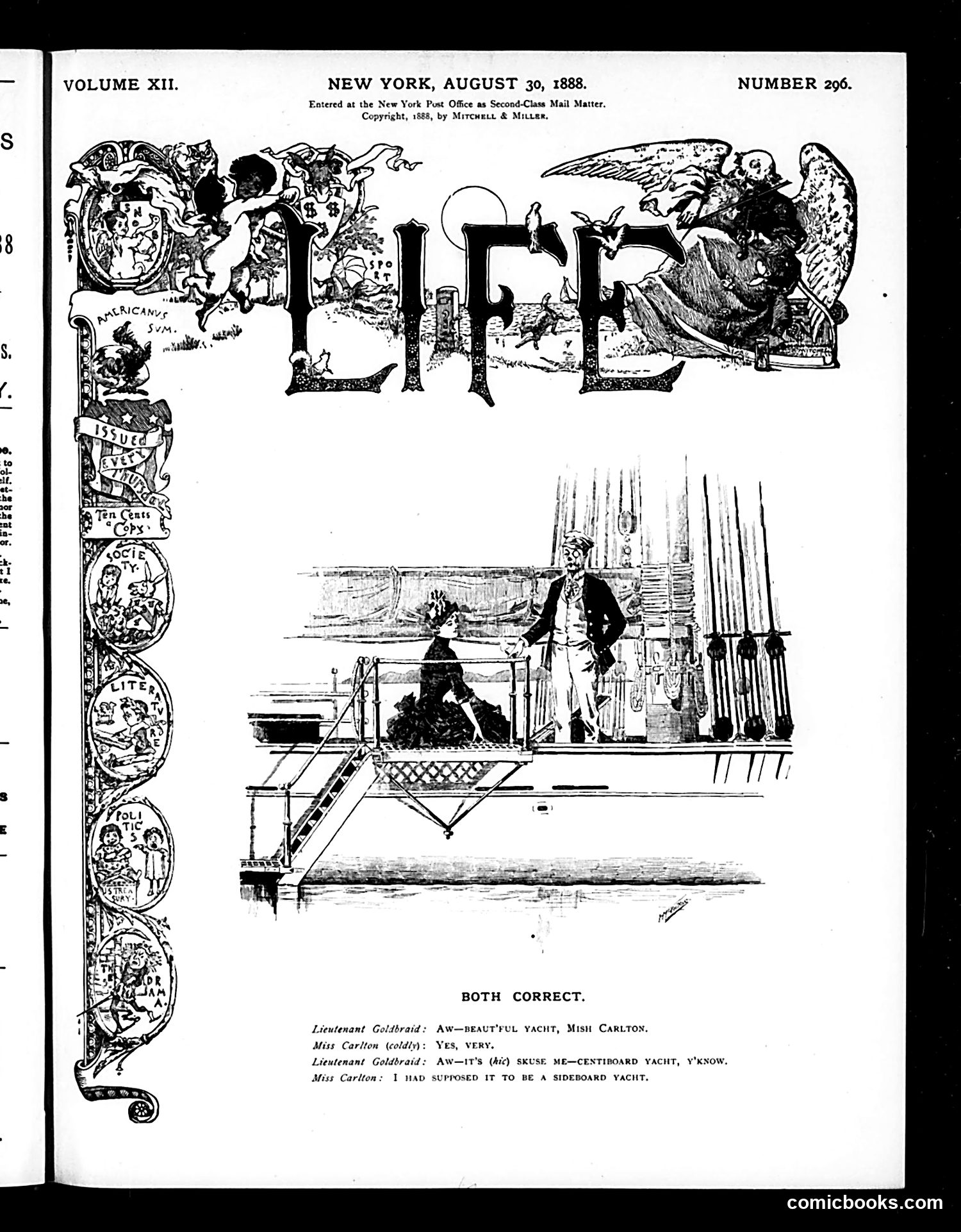
This cartoon satirizes a conversation about yachts between Lieutenant Goldbraid and Miss Carlton. The humor relies on a misunderstanding: Goldbraid compliments "Miss Carlton," describing her as a "beautiful yacht," while Miss Carlton believes he's calling her a "sideboard yacht" (a smaller, inferior vessel type). The joke plays on the ambiguity of "your" — Goldbraid means her actual yacht, Miss Carlton, while she thinks he's comparing *her* to a yacht. Both interpret the exchange as complimentary, hence "both correct," though for entirely different reasons. It's a Victorian-era pun about courtship miscommunication dressed in nautical terminology.
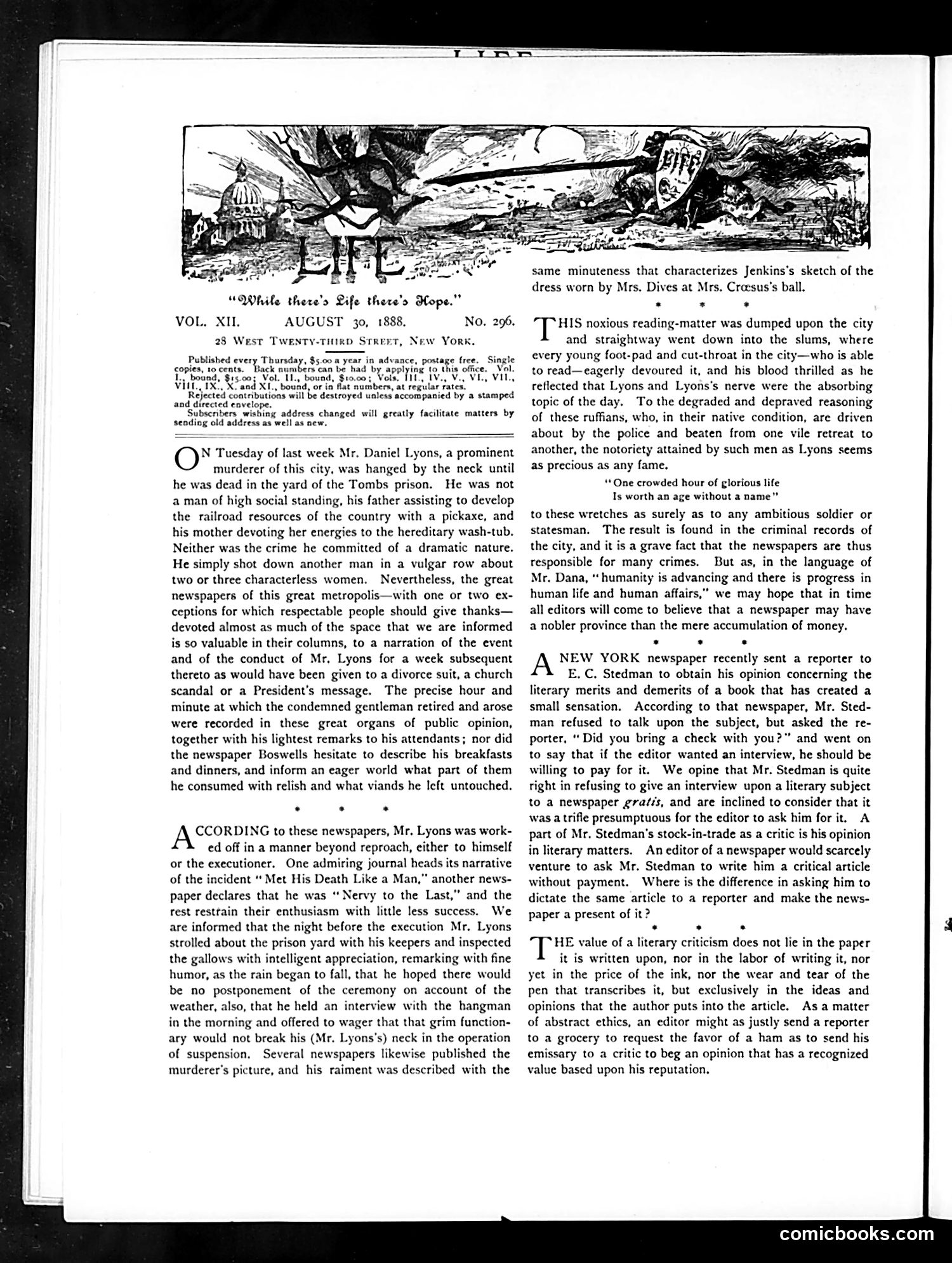
The masthead cartoon depicts a landscape with classical and allegorical elements, including what appears to be a capitol building and various symbolic figures—likely representing American institutions and progress. The main article discusses Mr. Daniel Lyons, a "prominent murderer" executed by hanging at the Tombs prison in New York City. Life satirizes how newspapers devoted extensive coverage to this execution, treating it as major news while the condemned man had little social standing. The satire criticizes sensationalist journalism—the disproportionate attention given to criminal cases in the press compared to weightier matters. The subsequent editorial disputes emphasize press ethics, questioning whether newspapers should pay subjects for interviews or favorable coverage. It's a critique of emerging yellow journalism practices.
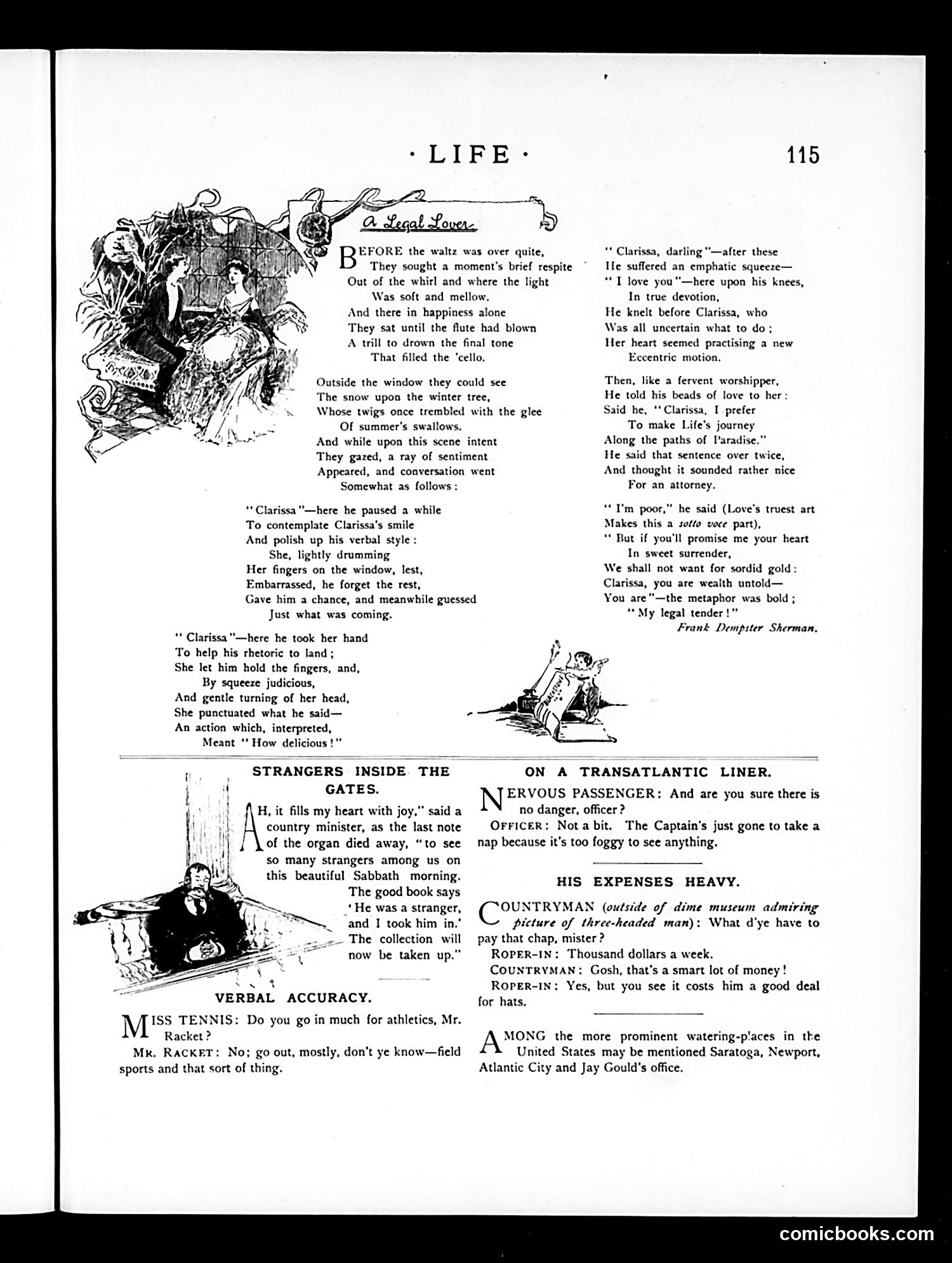
This page contains several humor pieces rather than political cartoons: **"A Legal Lover"** is a romantic poem about a marriage proposal, where the suitor uses legal/financial language ("My legal tender!") as courtship rhetoric. **"Strangers Inside the Gates"** depicts a minister noting the presence of visitors at a church service, referencing the biblical phrase about welcoming strangers. **"Verbal Accuracy"** is a brief dialogue joke about athletic participation—the humor relies on a misunderstanding of "field sports." **"On a Transatlantic Liner"** and **"His Expenses Heavy"** are shipboard humor pieces about passenger anxieties and the costs of maintaining appearance while traveling. These are gentle, domestic satires typical of Life's early 20th-century humor content—focused on manners, relationships, and everyday social situations rather than political commentary.
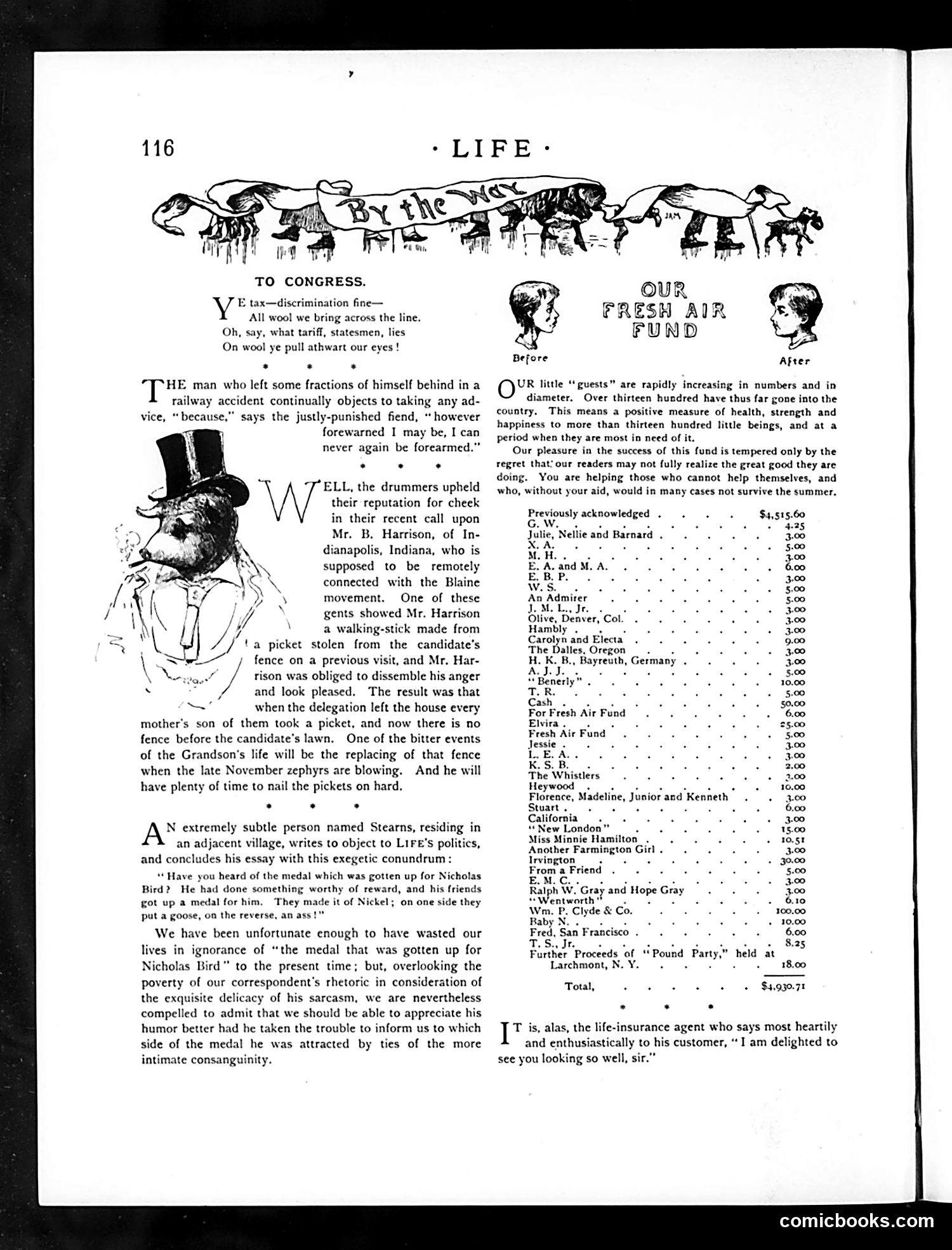
This page contains three separate satirical pieces: 1. **"To Congress"** — A poem mocking wool tariffs, with a caricatured figure (likely a politician or industrialist) wearing a top hat. The satire criticizes protectionist trade policies. 2. **Railway accident anecdote** — Mocks a man who refuses practical advice after a train accident, fearing he'd "never be forewarned." The humor lies in his illogical reasoning. 3. **Letter from "Stearns"** — Critiques Life's political stance by referencing a Nicholas Nickleby medal anecdote from Dickens. Stearns accuses Life of wasting readers' intelligence with overly subtle satire about the medal's origins (nickel vs. goose symbolism). The page primarily showcases **satirical commentary on politics and social hypocrisy**, alongside an unrelated "Fresh Air Fund" donation list. The tone is sharply critical of politicians and inconsistent editorial positions.
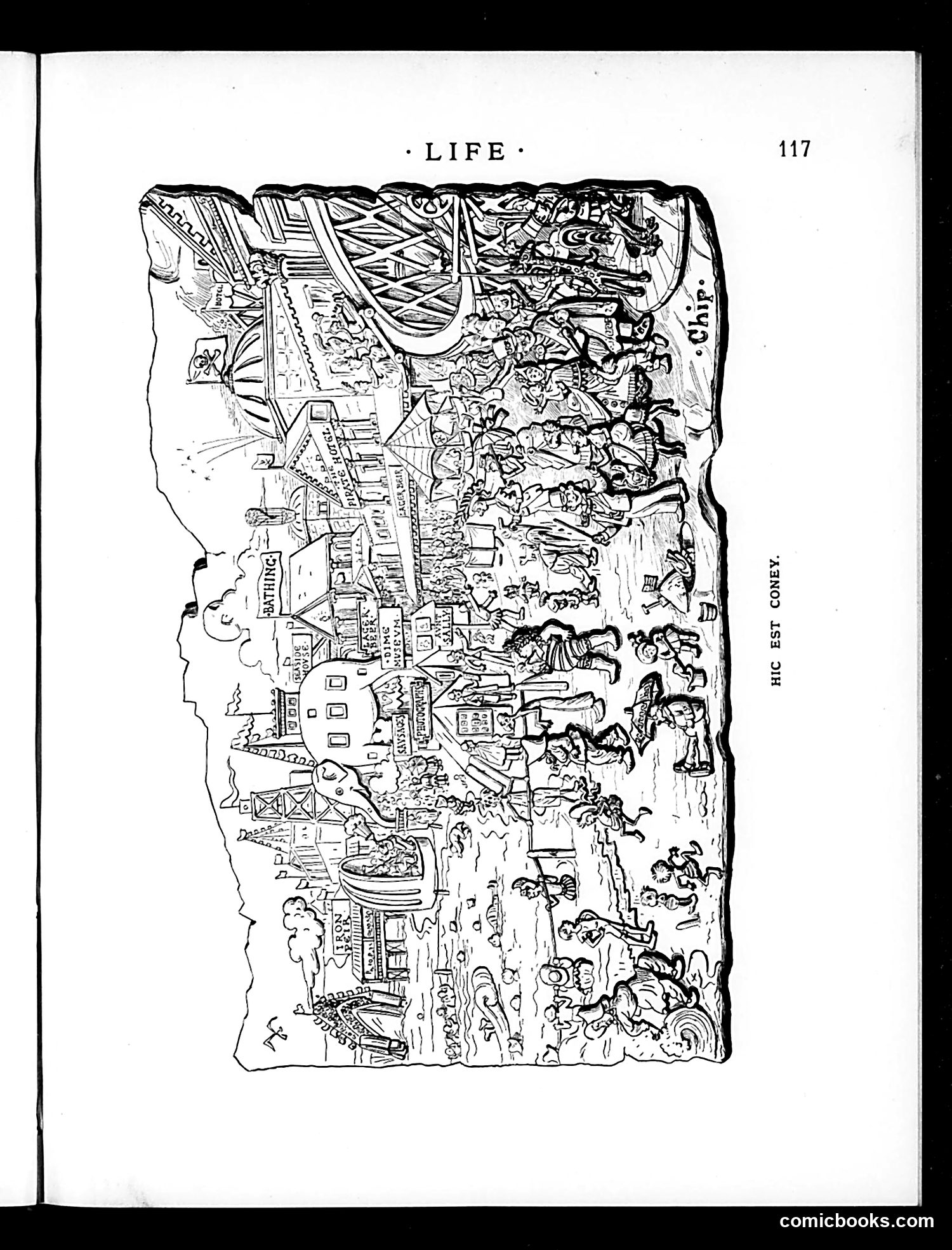
This page from *Life* magazine (page 117) contains a detailed satirical illustration titled "HIS EST CODEX" (His Easiest Code). The cartoon depicts a crowded, chaotic scene rendered in black ink with multiple figures engaged in various activities throughout what appears to be an interior space—possibly a legislative chamber, courthouse, or government building. The dense composition suggests commentary on institutional confusion, bureaucratic complexity, or political disorder. The title's wordplay on "codex" (legal code) hints at satire about law, governance, or rule-making. However, without clearer identification of specific figures or visible date markers, the precise political references and target remain unclear from the image alone. The satirical intent appears focused on exposing complexity or hypocrisy within formal institutions.
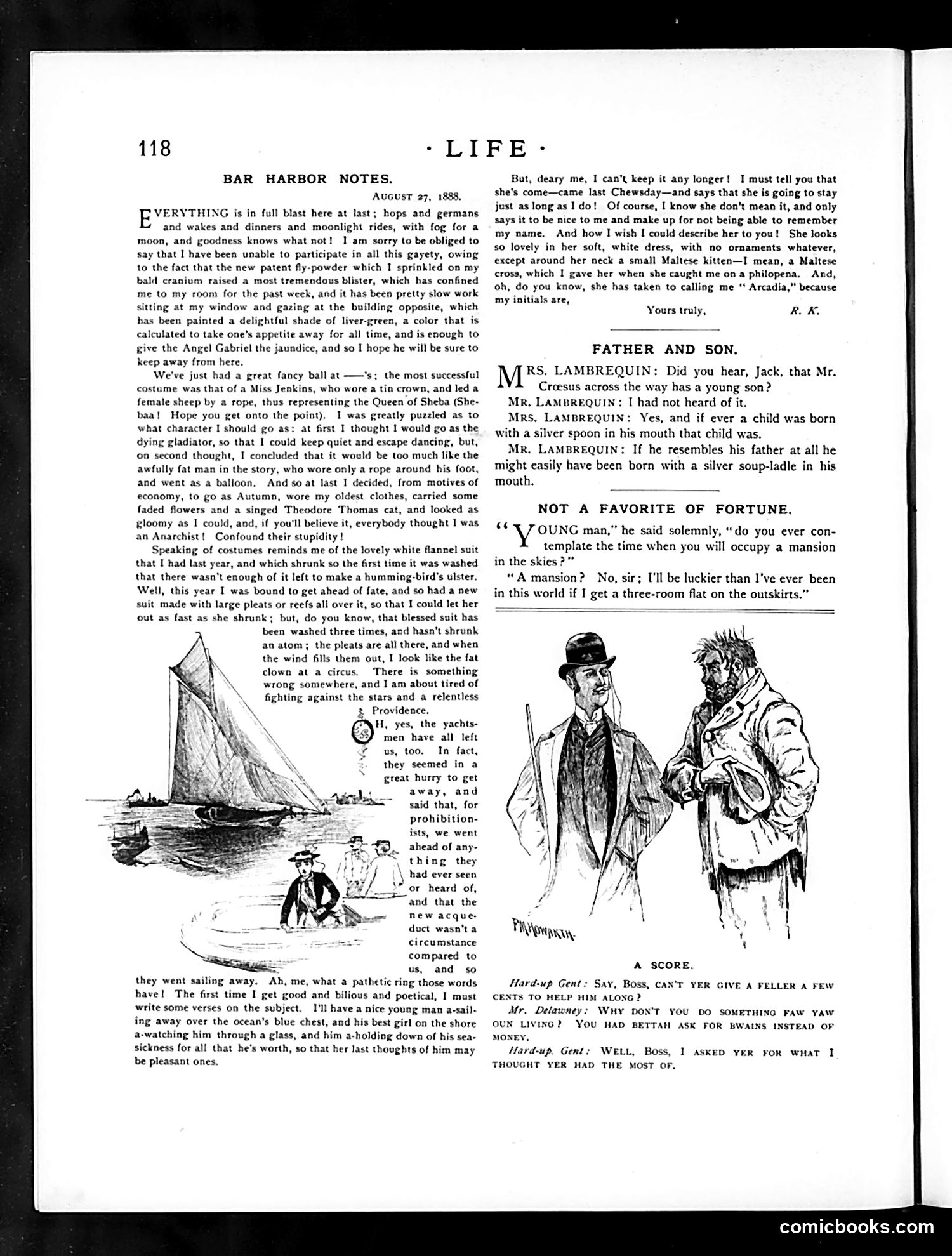
This page contains three separate satirical pieces: 1. **"Bar Harbor Notes"** (August 27, 1888): A humorous letter describing social life at Bar Harbor, a wealthy resort. The writer humorously catalogs fashionable activities and complains about the exclusivity and artificiality of high society. 2. **"Father and Son"**: A brief comic dialogue about inheritance, where Mr. Lambrequin notes a child born with a "silver spoon" and resemblance to his father—likely satirizing assumptions about wealth and legitimacy among the upper classes. 3. **"Not a Favorite of Fortune"** and **"A Score"**: Short humor pieces poking fun at working-class aspirations and financial hardship, typical of Life's satirical treatment of class distinctions in Gilded Age America. The sailing vessel illustration accompanies the Bar Harbor piece, emphasizing the leisure pursuits of the wealthy.
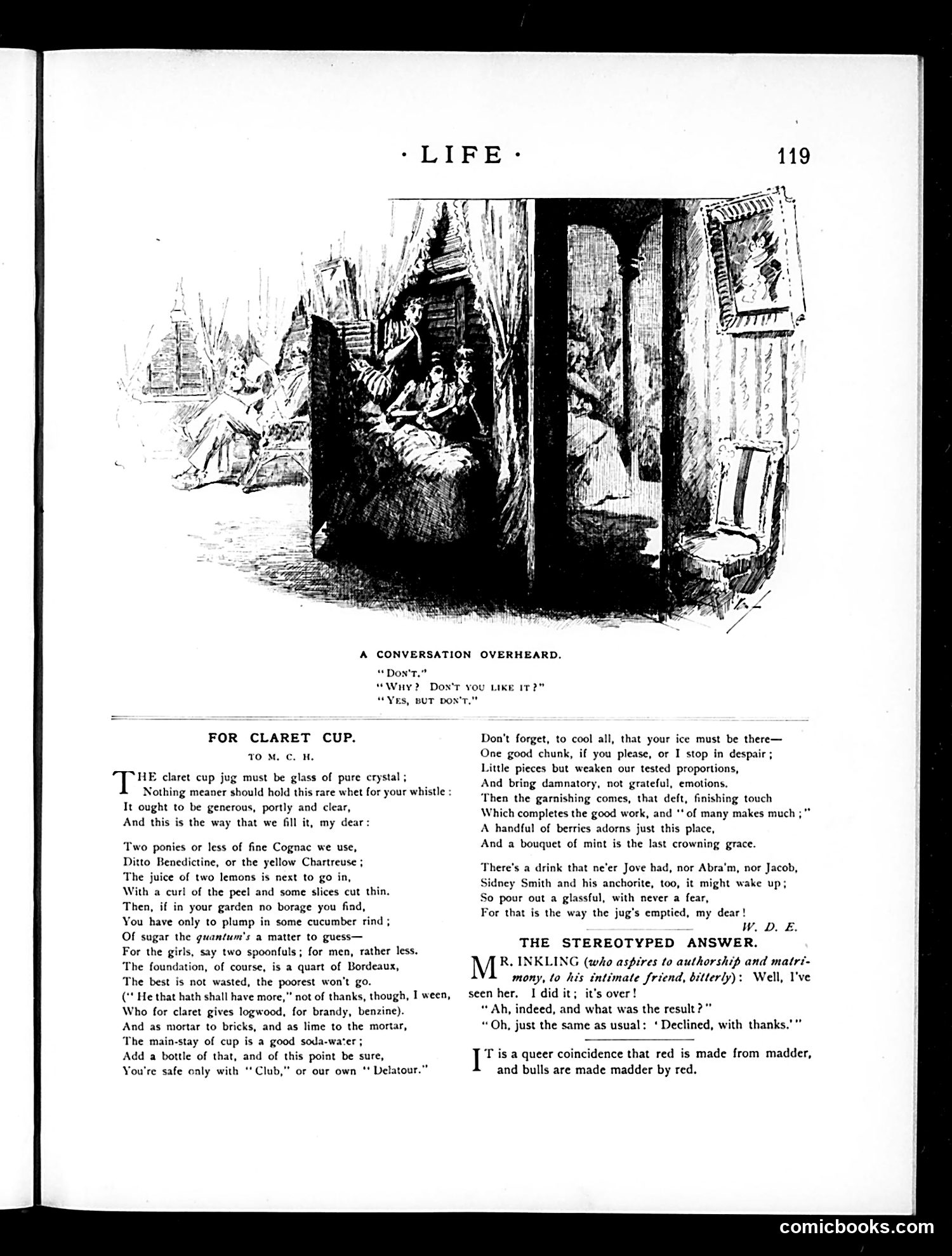
**The Cartoon ("A Conversation Overheard"):** This simple sketch depicts two figures in conversation, with one saying "Don't," another asking "Why? Don't you like it?", and the response "Yes, but don't." The humor is subtle—likely poking fun at indecisive or contradictory social behavior, a common target of Life's satirical cartoons. **The Written Content:** The page contains two distinct pieces: a recipe/instructions for making a "Claret Cup" (a wine-based beverage), and a brief satirical piece titled "The Stereotyped Answer" where M. Inkling comments on predictable social responses. The claret cup instructions are humorous and detailed, while the final line about red making bulls and madder animals is a pun-based joke.
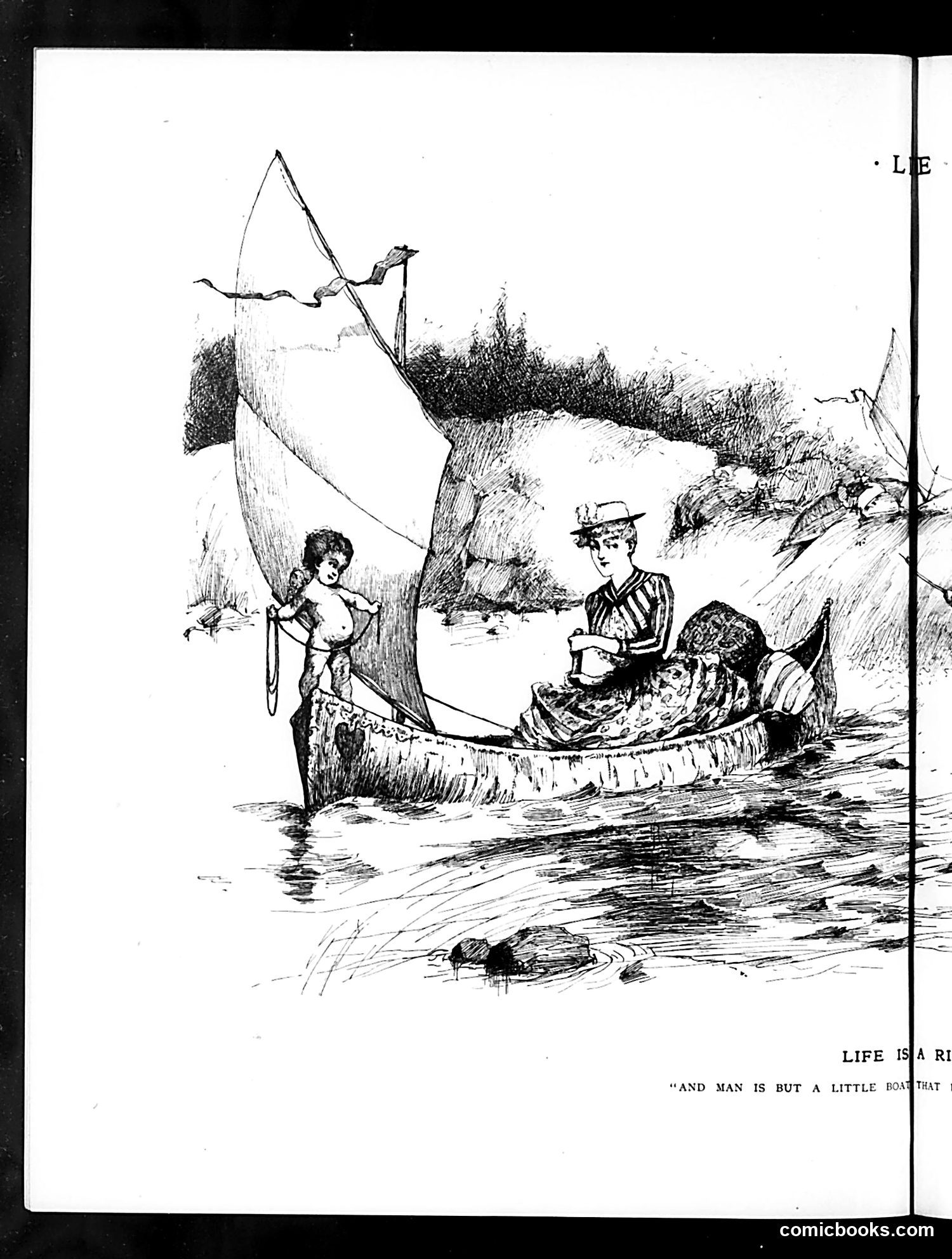
This page from *Life* magazine presents a satirical illustration accompanying the philosophical statement "Life is a River" and the quote "And man is but a little boat that..." The sketch depicts two elegantly dressed women in a small boat on water, with a campsite and tent visible in the background. One woman holds what appears to be a fishing line or rope. The satire contrasts the romantic, leisurely vision of life as a peaceful river journey with the reality of human vulnerability. The quote's incomplete phrase suggests that humanity, despite aspirations and pretensions (represented by the women's refined appearance and leisure activities), is ultimately small and fragile—merely a "little boat" subject to the river's currents and forces beyond individual control. This reflects turn-of-the-century philosophical commentary on human insignificance against nature's power.
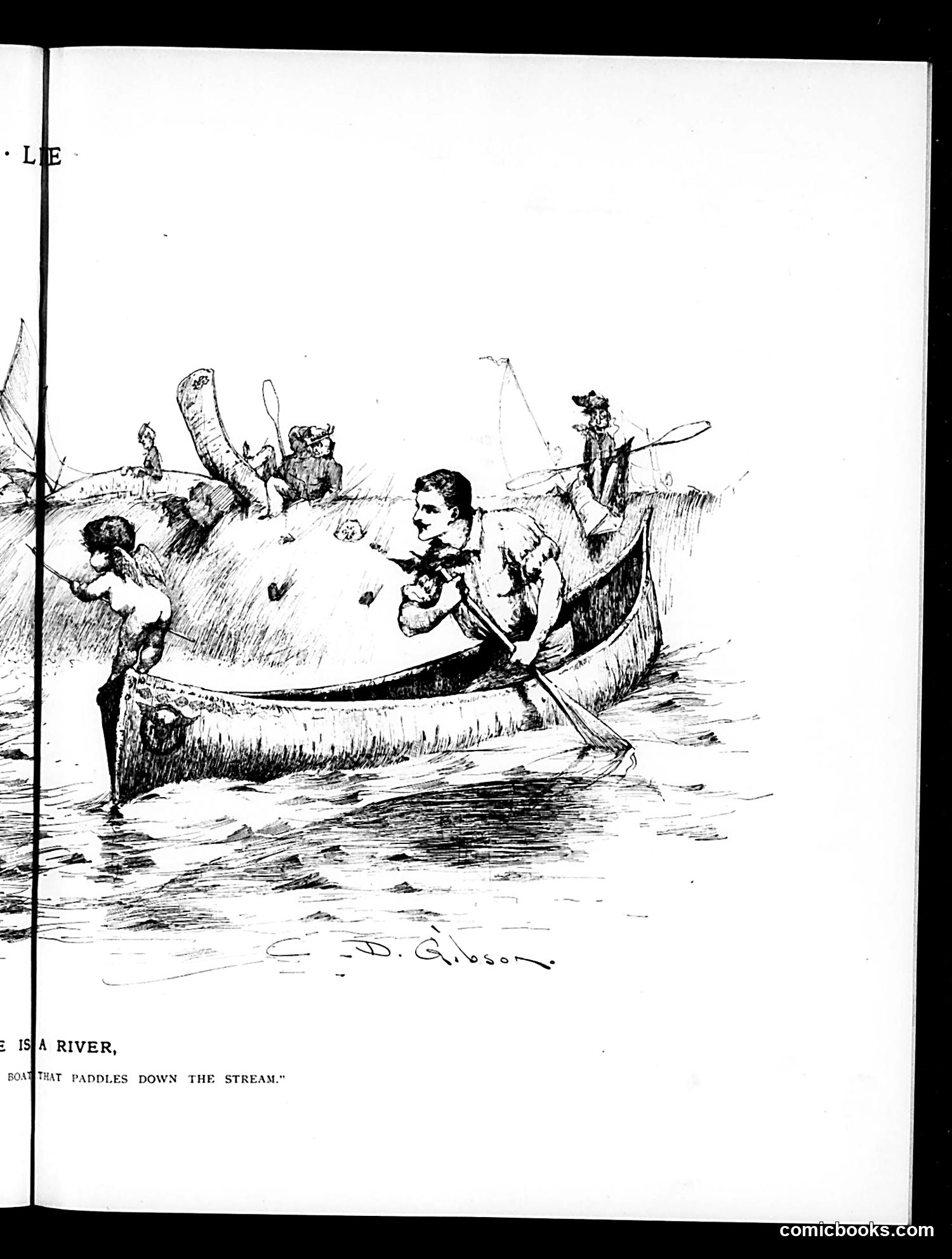
This is an illustration by C. D. Gibson (signed lower right) depicting a scene titled "A RIVER BOAT THAT PADDLES DOWN THE STREAM." The cartoon shows a well-dressed man in a boat being paddled by what appear to be cherubs or putti (classical figures). The figures in the background on the shore suggest leisure and recreation. This appears to be social satire about idle luxury or effortless living—the gentleman reclines while others (depicted as mythological beings) do the work of propelling him forward. The joke likely mocks wealthy individuals who benefit from others' labor without exertion. The classical artistic style (cherubs) contrasts humorously with the mundane reality of river transportation, suggesting either romantic delusion or satiric commentary on class privilege in Gilded Age America.
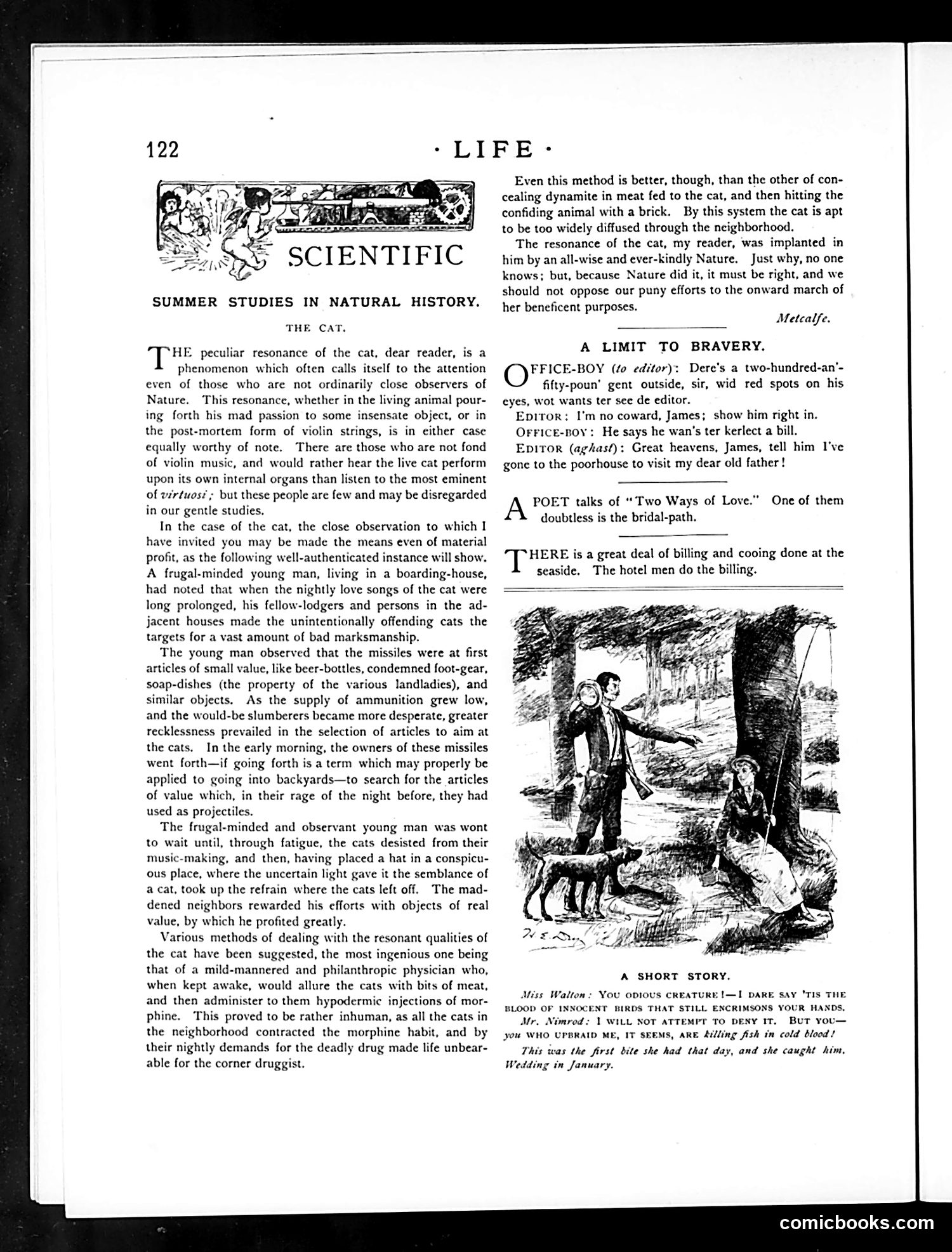
This page contains a satirical article titled "Summer Studies in Natural History: The Cat" that humorously describes a young man's campaign of harassment against neighborhood cats using household projectiles (soap-dishes, boot-heels, etc.). The article mocks both the man's obsessive behavior and pseudo-scientific justifications for it. Below is an unrelated sketch showing two men and a dog, accompanying a brief humorous exchange about "A Limit to Bravery"—apparently a joke about one man's cowardice. The final item is a short story excerpt titled "A Poet Talks of 'Two Ways of Love,'" referencing the "bridal path." The page primarily contains satirical prose rather than political commentary—it targets social absurdities through exaggeration rather than addressing specific contemporary events.
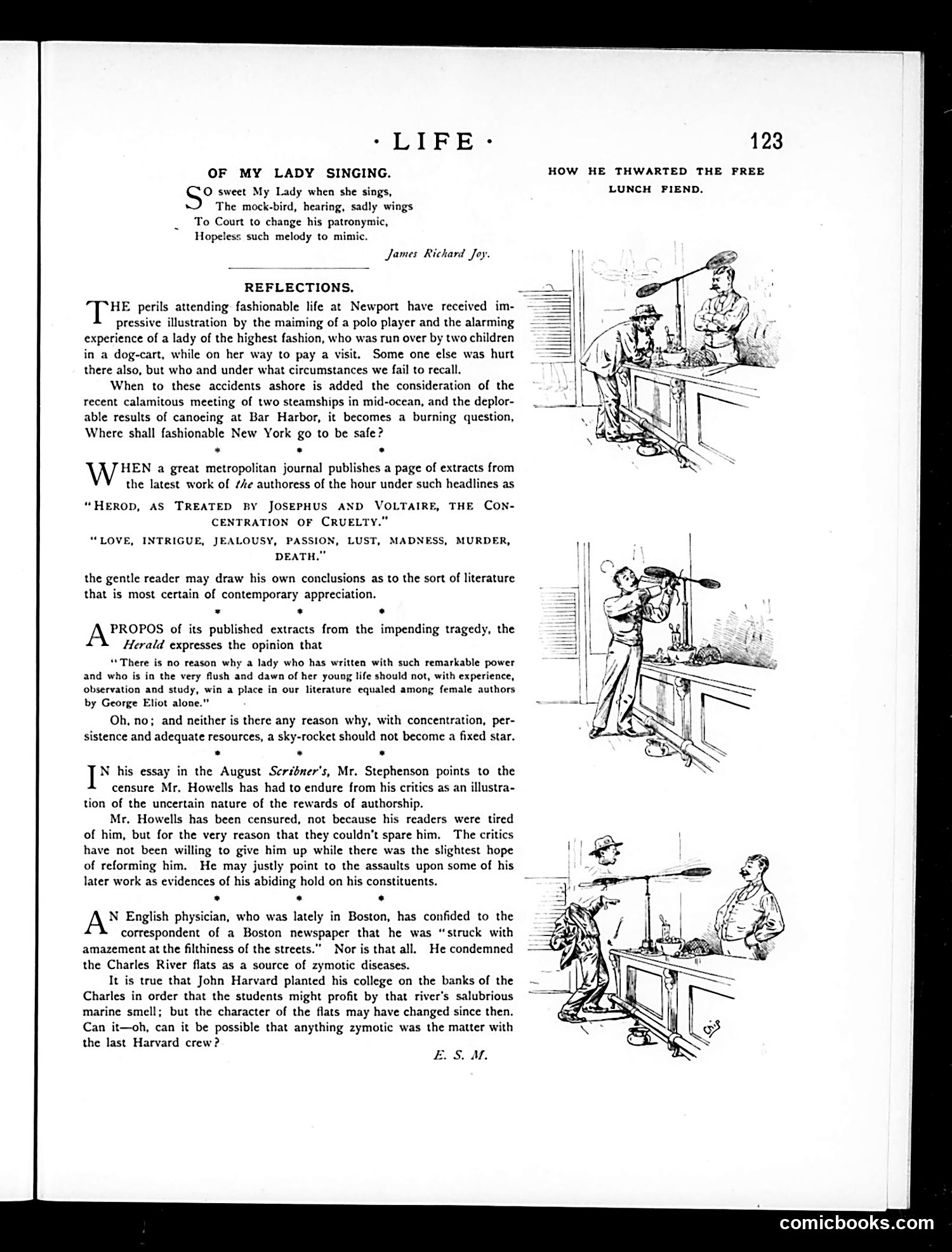
This page combines satirical commentary with humorous illustrations titled "How He Thwarted the Free Lunch Fiend." **The Illustrations:** Three cartoon panels show a man defending his lunch from an aggressive figure (the "fiend"), using a telescope or rod as a weapon. The joke appears to be about protecting food from someone trying to steal or mooch a free meal—a common working-class concern of the era. **The Text:** Multiple satirical pieces mock contemporary issues: 1. **Newport Society Dangers:** Ridicules fashionable New York's accidents (polo injuries, carriage mishaps, boating disasters), sarcastically asking where the wealthy can safely visit. 2. **Sensationalist Literature:** Critiques lurid novels with dramatic headlines about "Herod" featuring themes of "lust, madness, murder, death"—mocking popular female authors and cheap sensationalism. 3. **Literary Criticism:** Defends William Dean Howells against critics; compares unrealistic authorial ambitions to expecting a sky-rocket to become a fixed star. 4. **Boston Hygiene:** Jokes about an English physician's shock at Boston street filthiness and the Charles River's foul smell near Harvard.
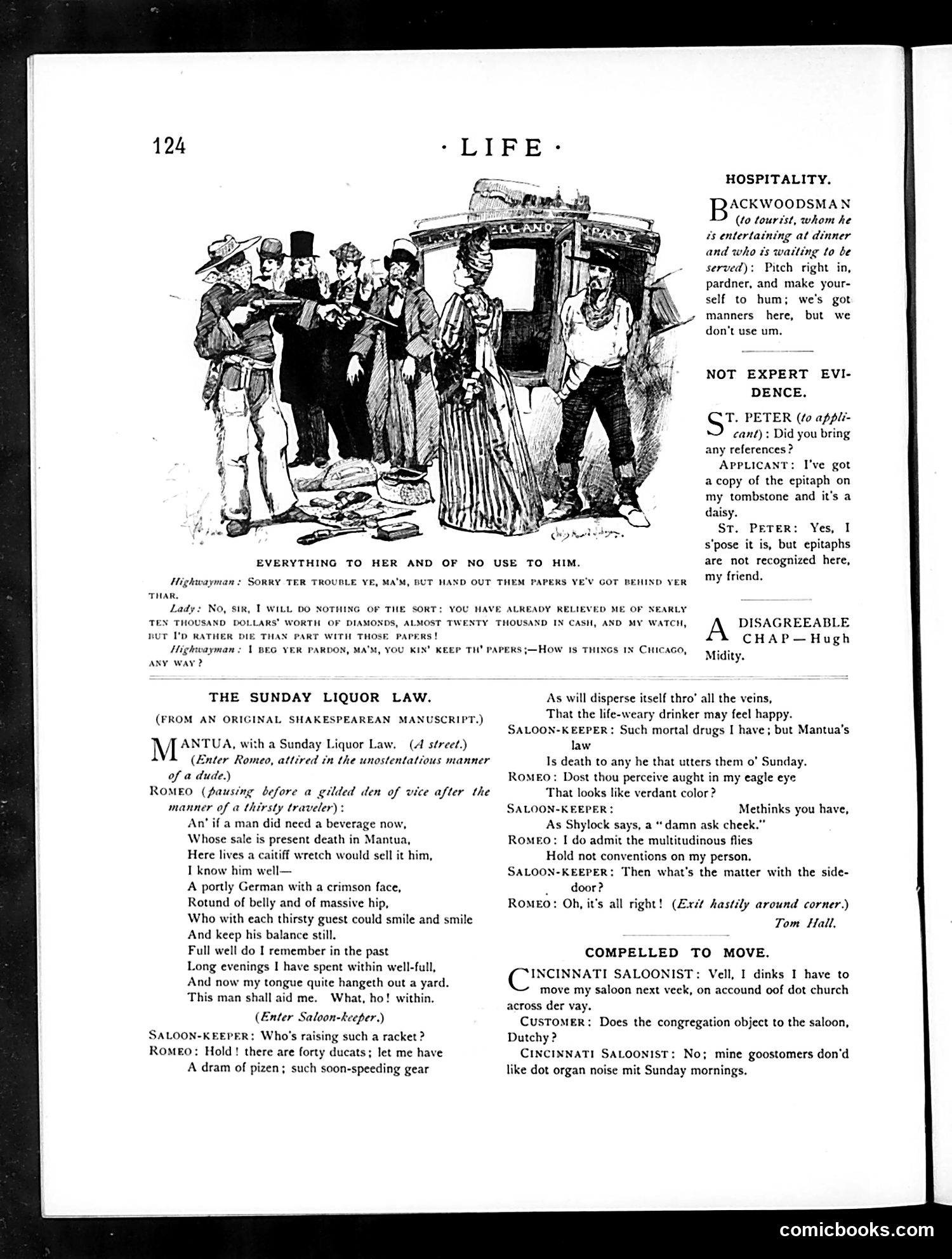
This *Life* magazine page (page 124) contains three separate satirical pieces mocking late-19th-century American social conventions: **Top cartoon**: A highwayman robs a woman of valuables but she refuses to surrender "papers"—likely divorce or legal documents—suggesting these held more personal value than diamonds or cash. **"Not Expert Evidence"**: St. Peter (gatekeeper to heaven) rejects a job applicant's tombstone epitaph as a reference, a pun on the uselessness of the dead as character witnesses. **"The Sunday Liquor Law"**: A parody of Shakespeare's *Romeo and Juliet* where Romeo seeks alcohol on Sunday (when sales were illegal in many states). The saloon-keeper refuses, citing death penalty for Sunday sales, but hints at the "side-door"—mocking how prohibition laws were easily circumvented through back entrances. **"Compelled to Move"**: A German-accented Cincinnati saloon owner complains he must relocate because customers dislike the church organ noise on Sunday mornings—satirizing the tension between religious institutions and drinking establishments during Prohibition-era reform campaigns.
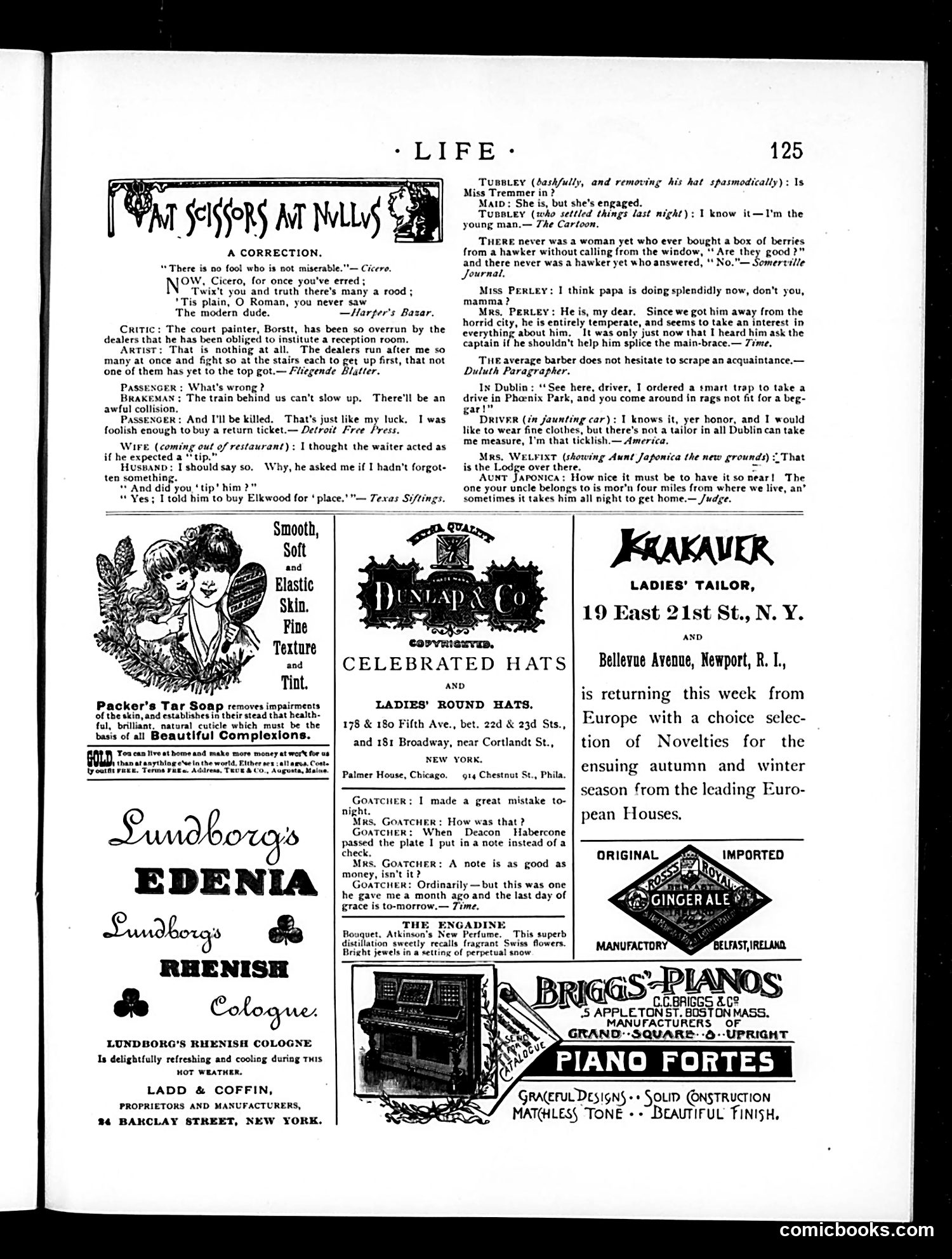
This page from *Life* magazine consists primarily of **short humorous anecdotes and jokes** rather than political cartoons. The pieces mock everyday social situations and human foibles typical of the late 19th century. Key jokes include: - A correction to Cicero about fools, referencing "the modern dude" - A court painter overwhelmed by dealers - Train passengers discussing tips and horse racing - A young man claiming to be Miss Tremmer's fiancé after a prior engagement - Various quips about hawkers, barbers, city life, and temperance The page is heavily populated with **period advertisements** for ladies' clothing, hats, soap, pianos, and cologne—typical commercial content for a magazine of this era. The humor relies on class commentary, courtship customs, urban life observations, and puns rather than partisan politics. The satire targets human pretension and social awkwardness rather than specific political figures.
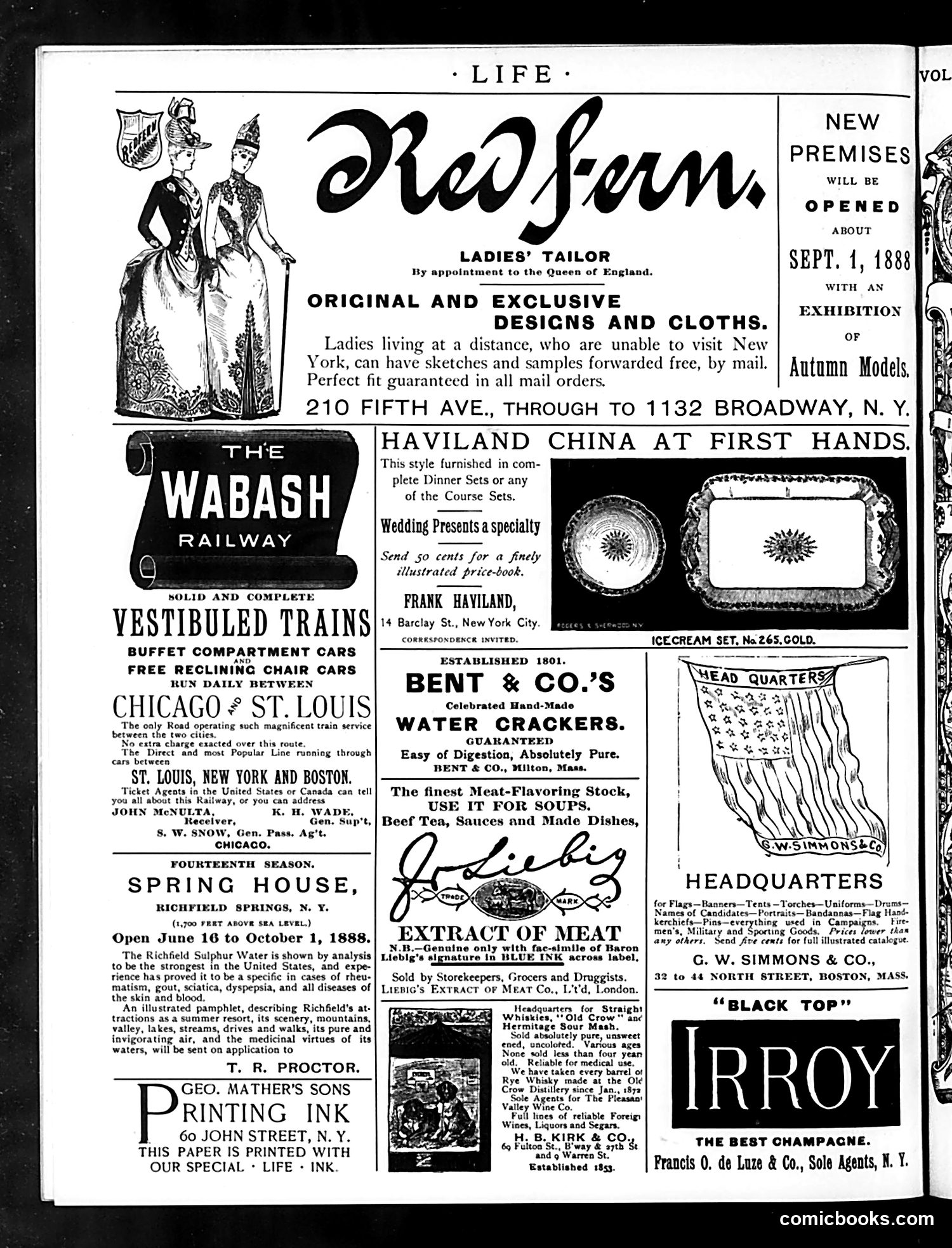
This is primarily an **advertising page** rather than editorial content. The page contains no political cartoons or satirical illustrations with commentary—instead, it's filled with commercial advertisements typical of the 1880s. The ads reflect period consumer products and services: a ladies' tailor claiming royal appointment, the Wabash Railway promoting luxury train travel between major cities, Bent & Co.'s water crackers, Liebig's meat extract (a popular convenience food), Spring House mineral spa, champagne, and campaign supplies vendor G.W. Simmons & Co. The only potentially interesting detail for modern readers is **G.W. Simmons' mention of campaign materials**—flags, banners, candidate portraits, and uniforms—indicating this was published during an election year (1888), when political merchandise was actively marketed. The page essentially documents **late-Victorian commercial culture**: mail-order shopping, patent medicines, luxury rail travel, and emerging processed foods.