
Life, 1888-08-30 · page 2 of 14
Life — August 30, 1888 — page 2: what you’re looking at
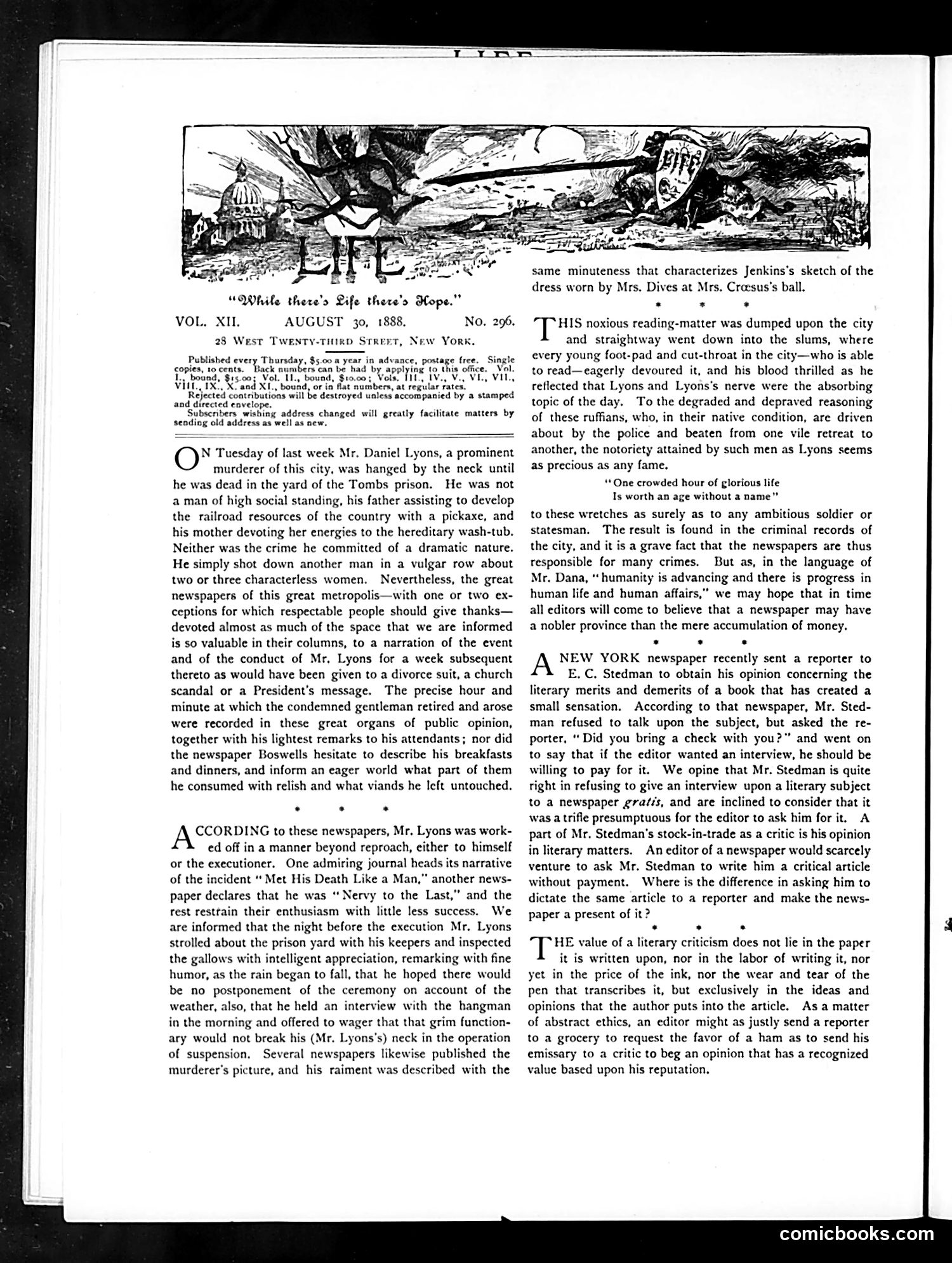
What you’re looking at
The masthead cartoon depicts a landscape with classical and allegorical elements, including what appears to be a capitol building and various symbolic figures—likely representing American institutions and progress. The main article discusses Mr. Daniel Lyons, a "prominent murderer" executed by hanging at the Tombs prison in New York City. Life satirizes how newspapers devoted extensive coverage to this execution, treating it as major news while the condemned man had little social standing. The satire criticizes sensationalist journalism—the disproportionate attention given to criminal cases in the press compared to weightier matters. The subsequent editorial disputes emphasize press ethics, questioning whether newspapers should pay subjects for interviews or favorable coverage. It's a critique of emerging yellow journalism practices.
📄 Transcribed text from this page (OCR, searchable)
Machine-transcribed from the original scan — historical spelling and the odd misread are preserved.
VOL, XII. AUGUST 30, 1888, No. 23 West Twenty-tittap Street, New York. Published ever Tharsday, $5.09 4 year in advance, postage free. copies, 10 cent i Back numbers can be had by applying to. fice. Voi Tits tv, Ve. Vis L., bound, $15.00; Vol. IL. bound, $10.00; Vill, 1X), Xvand XI., bound, or ia flat numbers, at regular rates. Rejected contributions will be destroyed unless accompanied by a stamped and directed envelope, Subscnbers wishing address changed will greatly facilitate matters by sending old address as well as new. N Tuesday of last week Mr. Daniel Lyons, a prominent murderer of this city, was hanged by the neck until he was dead in the yard of the Tombs prison. He was not a man of high social standing, his father assisting to develop the railroad resources of the country with a pickaxe, and his mother devoting her energies to the hereditary wash-tub. Neither was the crime he committed of a dramatic nature. He simply shot down another man in a vulgar row about two or three characterless women. Nevertheless, the great newspapers of this great metropolis—with one or two ex- ceptions for which respectable people should give thanks— devoted almost as much of the space that we are informed is so valuable in their columns, to a narration of the event and of the conduct of Mr. Lyons for a week subsequent thereto as would have been given to a divorce suit, a church scandal or a President's message. The precise hour and minute at which the condemned gentleman retired and arose were recorded in these great organs of public opinion, together with his lightest remarks to his attendants; nor did the newspaper Boswells hesitate to describe his breakfasts and dinners, and inform an eager world what part of them he consumed with relish and what viands he left untouched. . . . CCORDING to these newspapers, Mr. Lyons was work- ed off in a manner beyond reproach, either to himself or the executioner. One admiring journal heads its narrative of the incident ‘* Met His Death Like a Man,” another news- paper declares that he was “Nervy to the Last,” and the rest restrain their enthusiasm with little less success. We are informed that the night before the execution Mr, Lyons strolled about the prison yard with his keepers and inspected the gallows with intelligent appreciation, remarking with fine humor, as the rain began to fall, that he hoped there would be no postponement of the ceremony on account of the weather, also, that he held an interview with the hangman in the morning and offered to wager that that grim function- ary would not break his (Mr. Lyons’s) neck in the operation of suspension, Several newspapers likewise published the murderer's picture, and his raiment was described with the same minuteness that characterizes Jenkins’s sketch of the dress worn by Mrs. Dives at Mrs. Crovsus’s ball. . * * HIS noxious reading-matter was dumped upon the city and straightway went down into the slums, where every young foot-pad and cut-throat in the city—who is able to read—eagerly devoured it, and his blood thrilled as he reflected that Lyons and Lyons’s nerve were the absorbing topic of the day. To the degraded and depraved reasoning of these ruffians, who, in their native condition, are driven about by the police and beaten from one vile retreat to another, the notoriety attained by such men as Lyons seems as precious as any fame, “One crowded hour of glorious life Is worth an age without a name” to these wretches as surely as to any ambitious soldier or statesman. The result is found in the criminal records of the city, and it is a grave fact that the newspapers are thus responsible for many crimes. But as, in the language of Mr. Dana, “ humanity is advancing and there is progress in human life and human affairs,” we may hope that in time all editors will come to believe that a newspaper may have a nobler province than the mere accumulation of money. . . . NEW YORK newspaper recently sent a reporter to E. C. Stedman to obtain his opinion concerning the literary merits and demerits of a book that has created a small sensation. According to that newspaper, Mr. Sted- man refused to talk upon the subject, but asked the re- porter, “Did you bring a check with you?” and went on to say that if the editor wanted an interview, he should be willing to pay for it. We opine that Mr. Stedman is quite right in refusing to give an interview upon a literary subject to a newspaper grat/s, and are inclined to consider that it was a trifle presumptuous for the editor to ask him for it. A part of Mr. Stedman's stock-in-trade as a critic is his opinion in literary matters. An editor of a newspaper would scarcely venture to ask Mr. Stedman to write him a critical article without payment. Where is the difference in asking him to dictate the same article to a reporter and make the news- paper a present of it? . . . HE value of a literary criticism does not lie in the paper it is written upon, nor in the labor of writing it, nor yet in the price of the ink, nor the wear and tear of the pen that transcribes it, but exclusively in the ideas and opinions that the author puts into the article. Asa matter of abstract ethics, an editor might as justly send a reporter to a grocery to request the favor of a ham as to send his emissary to a critic to beg an opinion that has a recognized value based upon his reputation, comicbooks.com