
Life, 1888-08-30 · page 11 of 14
Life — August 30, 1888 — page 11: what you’re looking at
What you’re looking at
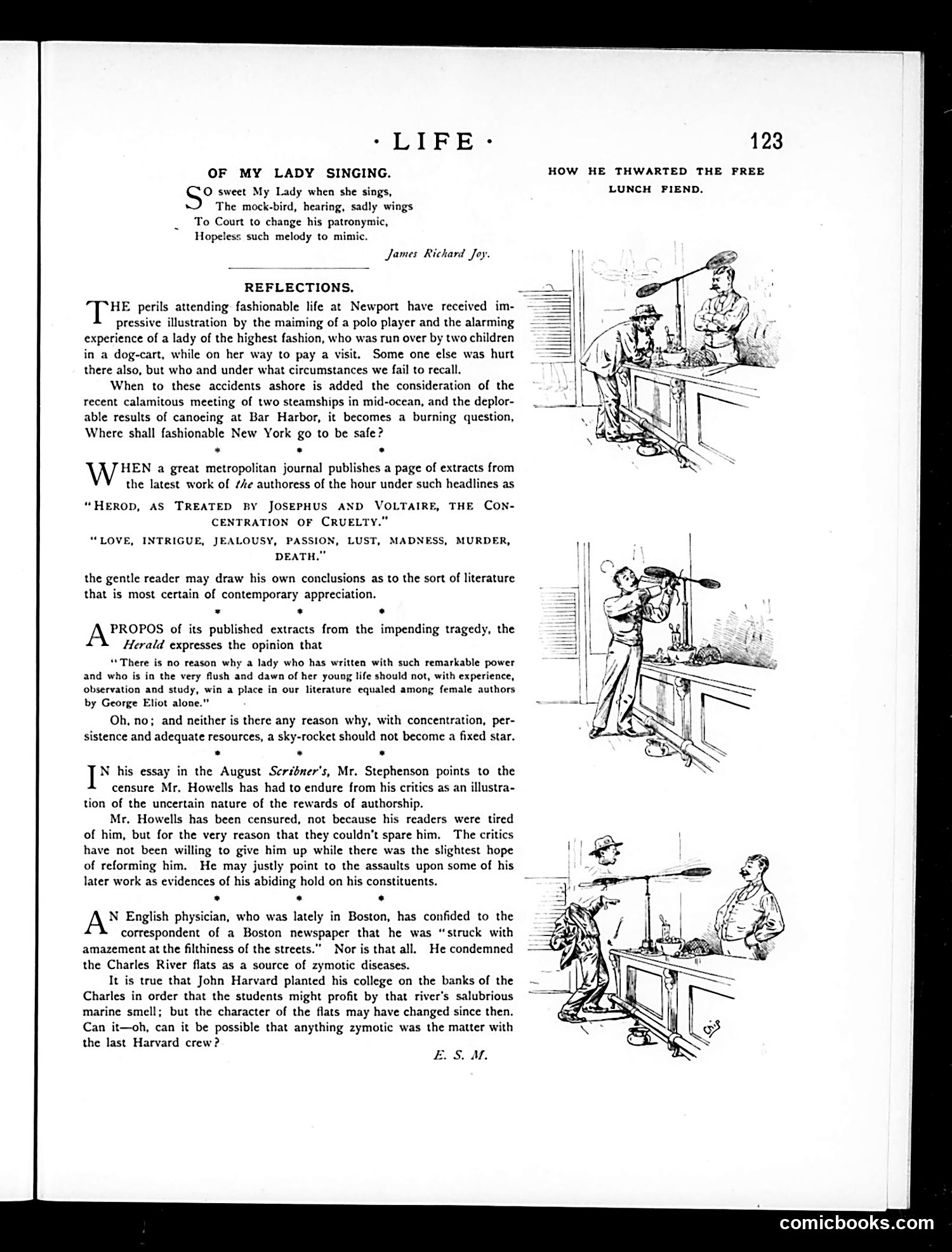
This page combines satirical commentary with humorous illustrations titled "How He Thwarted the Free Lunch Fiend." **The Illustrations:** Three cartoon panels show a man defending his lunch from an aggressive figure (the "fiend"), using a telescope or rod as a weapon. The joke appears to be about protecting food from someone trying to steal or mooch a free meal—a common working-class concern of the era. **The Text:** Multiple satirical pieces mock contemporary issues: 1. **Newport Society Dangers:** Ridicules fashionable New York's accidents (polo injuries, carriage mishaps, boating disasters), sarcastically asking where the wealthy can safely visit. 2. **Sensationalist Literature:** Critiques lurid novels with dramatic headlines about "Herod" featuring themes of "lust, madness, murder, death"—mocking popular female authors and cheap sensationalism. 3. **Literary Criticism:** Defends William Dean Howells against critics; compares unrealistic authorial ambitions to expecting a sky-rocket to become a fixed star. 4. **Boston Hygiene:** Jokes about an English physician's shock at Boston street filthiness and the Charles River's foul smell near Harvard.
📄 Transcribed text from this page (OCR, searchable)
Machine-transcribed from the original scan — historical spelling and the odd misread are preserved.
*LIFE- OF MY LADY SINGING. S° sweet My Lady when she sings, The mock-bird, hearing, sadly wings To Court to change his patronymic, Hopeless such melody to mimic. James Richard Joy. REFLECTIONS, Tt perils attending fashionable life at Newport have received im- pressive illustration by the maiming of a polo player and the alarming experience of a lady of the highest fashion, who was run over by two children in a dog-cart, while on her way to pay a visit. Some one else was hurt there also, but who and under what circumstances we fail to recall. When to these accidents ashore is added the consideration of the recent calamitous meeting of two steamships in mid-ocean, and the deplor- able results of canoeing at Bar Harbor, it becomes a burning question, Where shall fashionable New York go to be safe? . . . WHEN a great metropolitan journal publishes a page of extracts from the latest work of ¢/e authoress of the hour under such headlines as “HEROD, AS TREATED BY JOSEPHUS AND VOLTAIRE, THE CON- CENTRATION OF CRUELTY.” “LOVE, INTRIGUE, JEALOUSY, PASSION, LUST, MADNESS, MURDER, DEATH.” the gentle reader may draw his own conclusions as to the sort of literature that is most certain of contemporary appreciation. . . . fyeeeres of its published extracts from the impending tragedy, the Herald expresses the opinion that “There is no reason why a lady who has written with such remarkable power and who is in the very flush and dawn of her young life should not, with experience, observation and study, win a place in our literature equaled among female authors by George Eliot alone.” Oh, no; and neither is there any reason why, with concentration, per- sistence and adequate resources, a sky-rocket should not become a fixed star. . . . ]* his essay in the August Serréner's, Mr. Stephenson points to the censure Mr. Howells has had to endure from his critics as an illustra- tion of the uncertain nature of the rewards of authorship. Mr. Howells has been censured, not because his readers were tired of him, but for the very reason that they couldn't spare him. The critics have not been willing to give him up while there was the slightest hope of reforming him. He may justly point to the assaults upon some of his later work as evidences of his abiding hold on his constituents. . * . AS English physician, who was lately in Boston, has confided to the correspondent of a Boston newspaper that he was “struck with amazement at the filthiness of the streets.” Nor is that all. He condemned the Charles River flats as a source of zymotic diseases. It is true that John Harvard planted his college on the banks of the Charles in order that the students might profit by that river's salubrious marine smell; but the character of the flats may have changed since then. Can it—oh, can it be possible that anything zymotic was the matter with the last Harvard crew? ELS. M. 123 HOW HE THWARTED THE FREE LUNCH FIEND. comicbooks.com