
A complete issue · 18 pages · 1888
Life — April 26, 1888
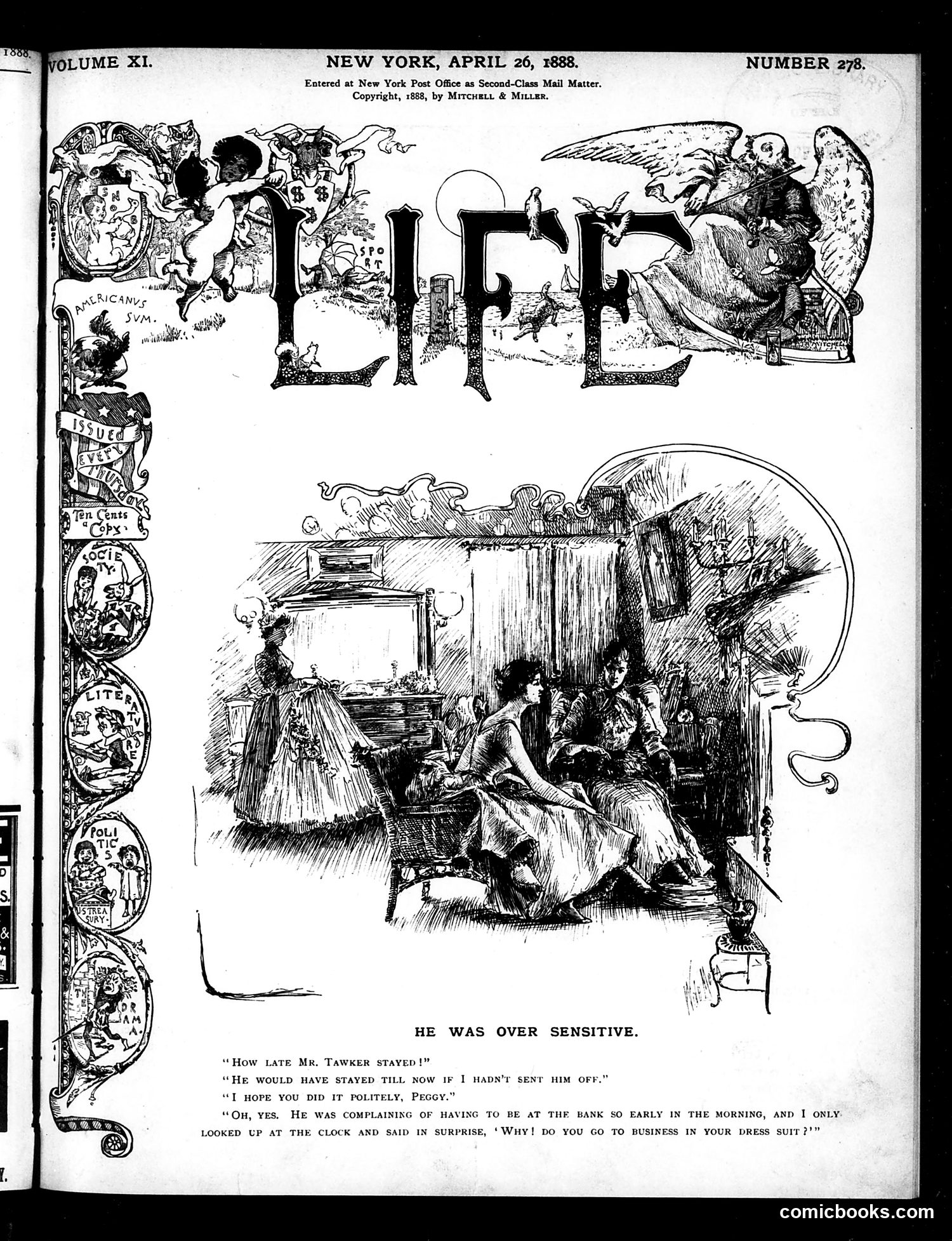
This domestic comedy sketch satirizes a husband's wounded pride. The caption reveals the joke: Mr. Tawker stayed out late, and his wife Peggy—concerned he'd been out in his business suit—asked why he wasn't dressed properly for evening. He interpreted her innocent question as criticism, taking excessive offense. The humor targets masculine oversensitivity: a man misreading casual domestic concern as nagging or insult, then sulking in response. The illustration shows the wife attempting to smooth things over while the husband sits wounded. This reflects 1880s gender dynamics where husbands expected deference, and wives had limited power except through indirect social pressure. The satire gently mocks men who weaponize emotional sensitivity to avoid accountability.
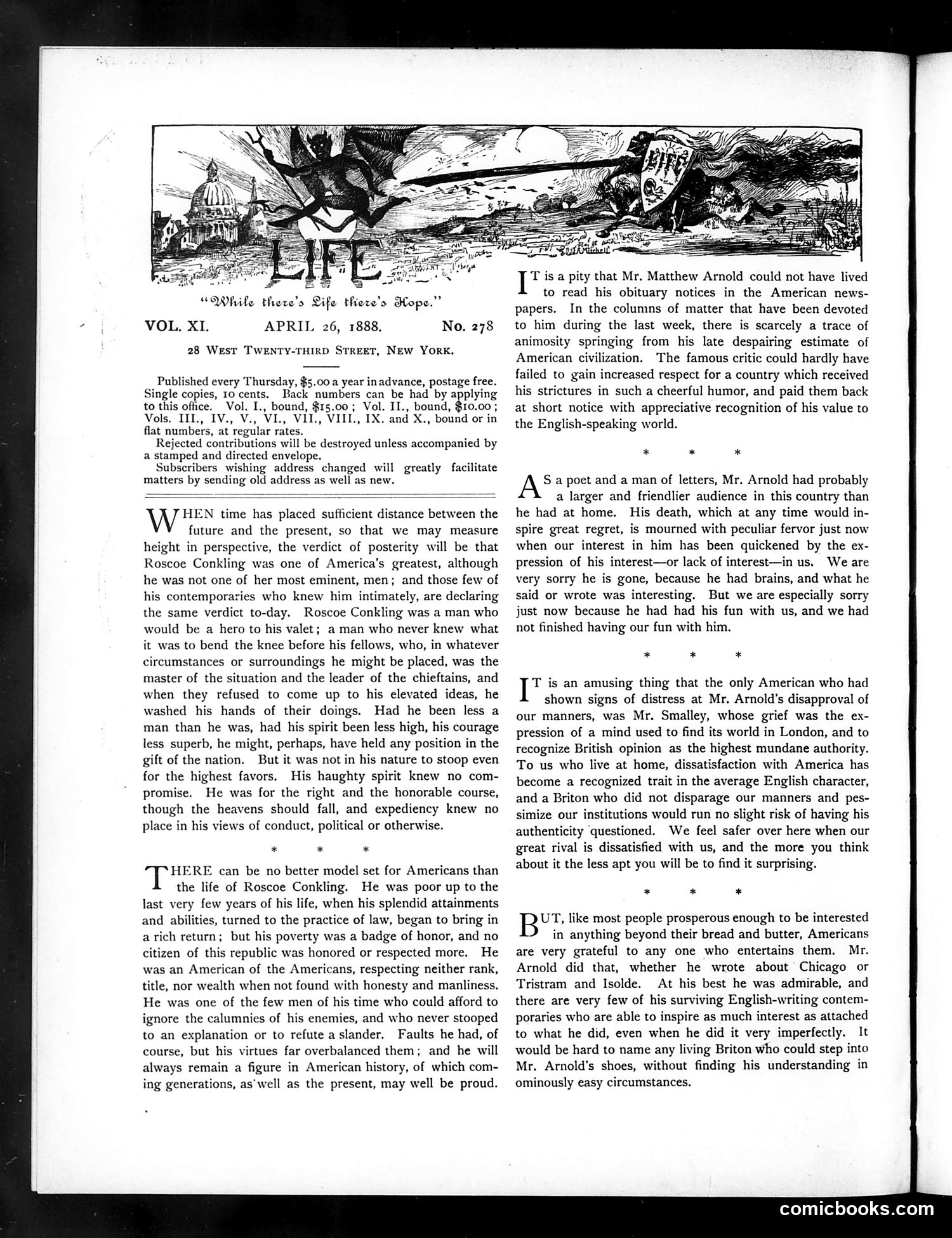
The page is primarily text—an editorial reflecting on the death of British critic Matthew Arnold. The small illustration at the top shows a landscape with "Where there's Life there's Hope" as its caption. The editorial notes that Arnold's American obituaries were harshly critical, reflecting his earlier disparaging remarks about American civilization. The writer defends Arnold's character while acknowledging his unflattering assessments of American culture were delivered "in cheerful humor" and appreciated by the English-speaking world. The piece observes that only one American—Mr. Smalley—publicly expressed distress at Arnold's disapproval of American manners, suggesting most Americans either ignored or accepted his critical perspective with indifference.
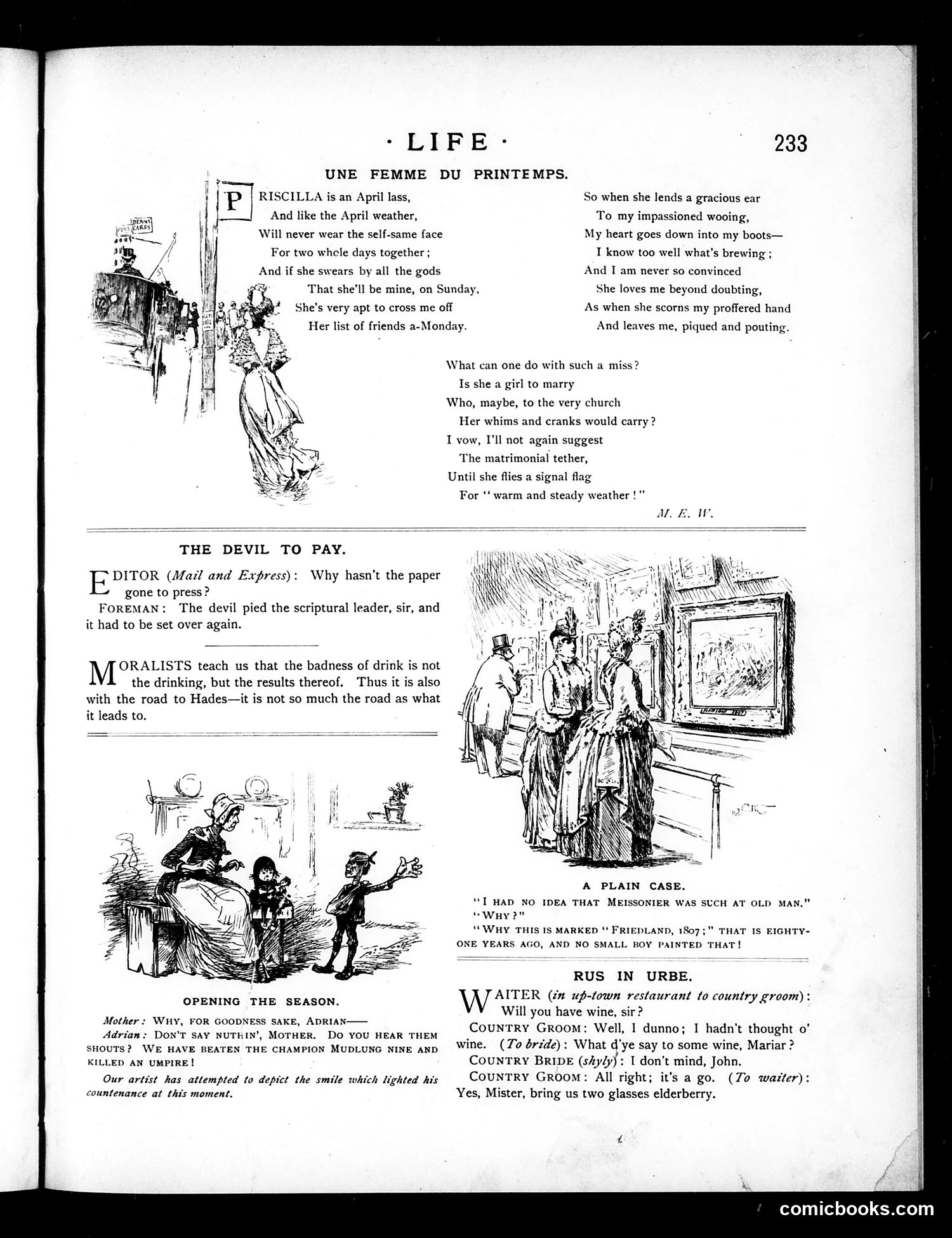
This page contains several satirical pieces targeting social behavior and morality: **"Une Femme du Printemps"** mocks an inconstant woman who changes lovers weekly, with the narrator despairing of ever winning her affection—a commentary on female fickleness. **"The Devil to Pay"** uses a dialogue between an editor and foreman about a missed newspaper deadline to comment on moral consequences: just as drinking's harm lies in its results rather than the act itself, sin's danger is in where it leads. **"Opening the Season"** depicts a mother and children, likely satirizing parental irresponsibility or domestic disorder. **"Rus in Urbe"** presents a comic conversation between a waiter and country couple at an uptown restaurant, where rustic confusion about wine and city manners provides humor through class contrast and rural ignorance of urban sophistication.
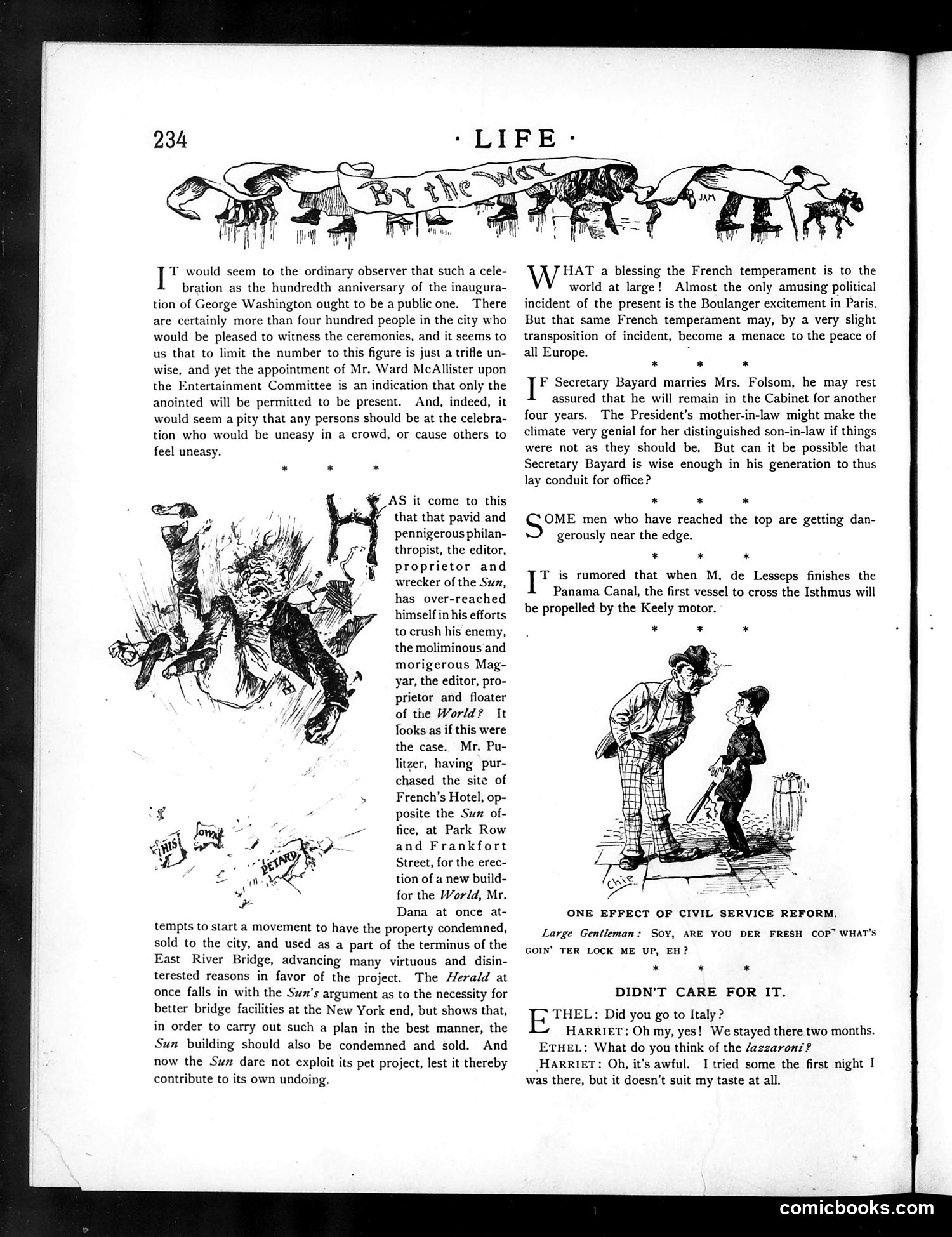
The page contains political commentary and satirical cartoons typical of early Life magazine. The main left cartoon depicts a chaotic scene with figures falling or tumbling, likely satirizing the editor/proprietor of the *Sun* newspaper's failed attempts to "crush his enemy." The text criticizes the *Sun*'s hypocrisy regarding condemning property (French's Hotel site) while exploiting its own projects. The right-side cartoon titled "ONE EFFECT OF CIVIL SERVICE REFORM" shows a well-dressed man confronting a boy, joking about the boy's disheveled appearance—satirizing how civil service reform affected employment practices. Below is a comedic dialogue between Ethel and Harriet about Italy and *lazzaroni* (street poor), with Harriet's negative dining experience serving as humor. The overall page mixes political critique with light social satire.
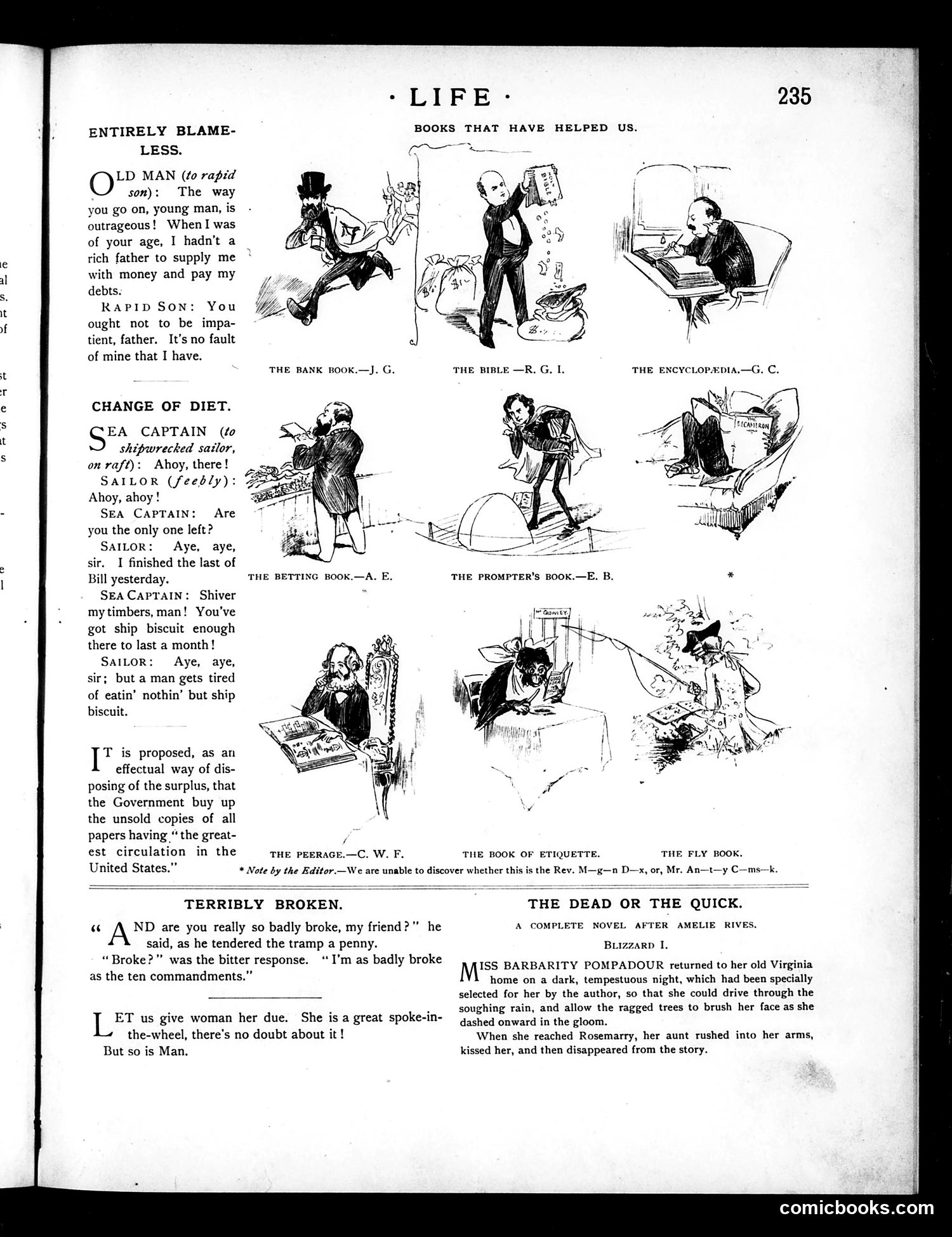
This page contains satirical humor pieces and illustrated jokes typical of early 20th-century American magazines. **"Entirely Blameless"** depicts a generational conflict: a young man defends himself against an older father's accusations of financial irresponsibility, claiming fault lies with his father's provision. **"Change of Diet"** features a sea captain and sailor joking about surviving on ship's biscuit—playing on the period's maritime hardship humor. **"Books That Have Helped Us"** uses cartoon illustrations to mock popular self-help and reference books (Bank Book, Bible, Encyclopedia, etc.)—satirizing the era's faith in books as solutions. The lower sections include brief humorous anecdotes and the beginning of a serial novel. The overall tone reflects early 1900s genteel American humor aimed at educated readers.
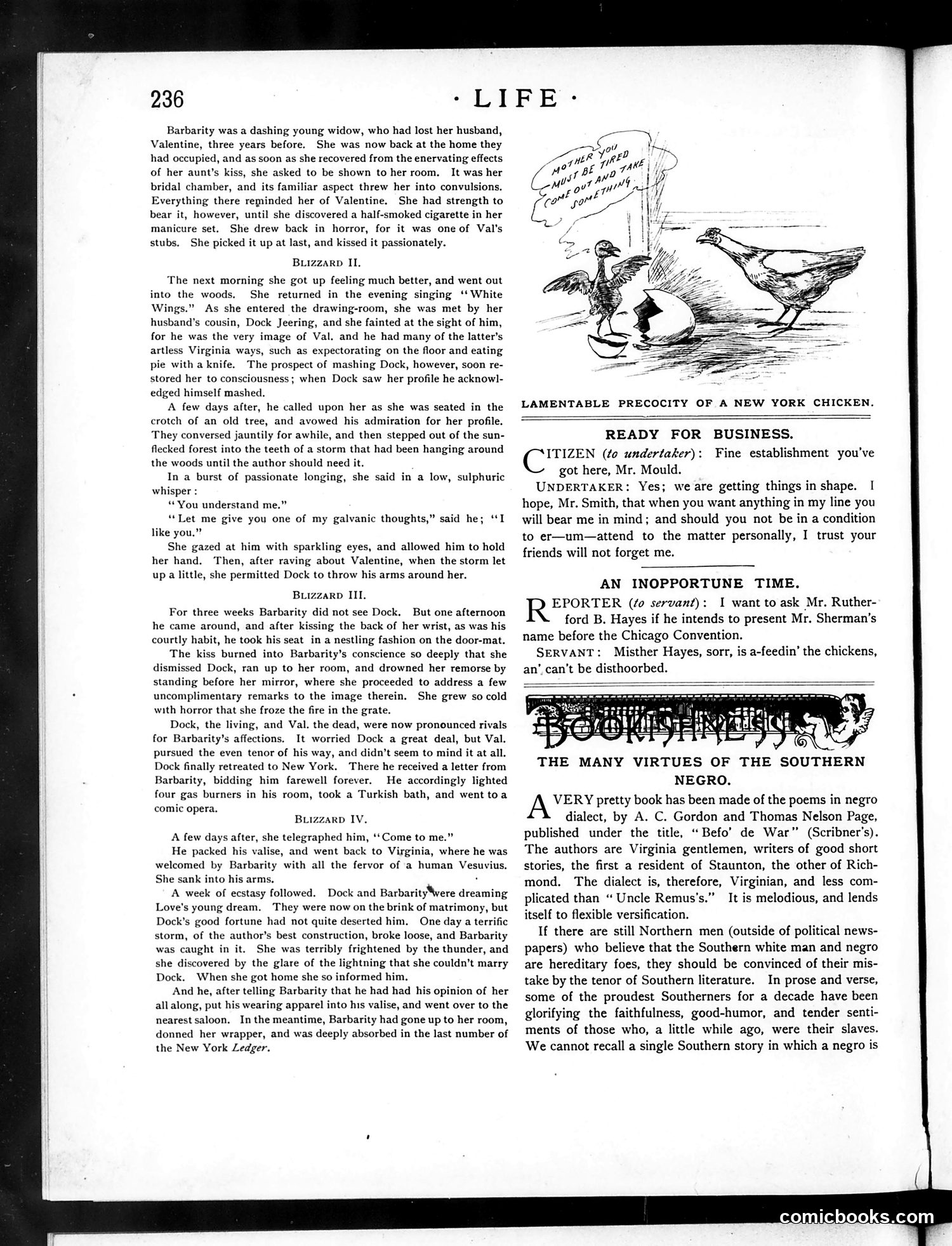
This page contains three distinct sections: a serialized story ("Blizzard" chapters II-IV) about a widow named Barbarity and her romantic entanglements, a small illustration captioned "LAMENTABLE PRECOCITY OF A NEW YORK CHICKEN" showing a bird, and two brief humorous dialogues labeled "READY FOR BUSINESS" and "AN INOPPORTUNE TIME." The cartoon's chicken caption appears to be gentle social satire about urban life. The dialogues are simple workplace humor involving an undertaker and various characters. The page's substantial text focuses on a book review of "The Many Virtues of the Southern Negro," praising its poetry and noting it counters Northern prejudices about the South. This appears to be typical Life magazine content from the early 1900s: mixed serialized fiction, light humor, and literary commentary.
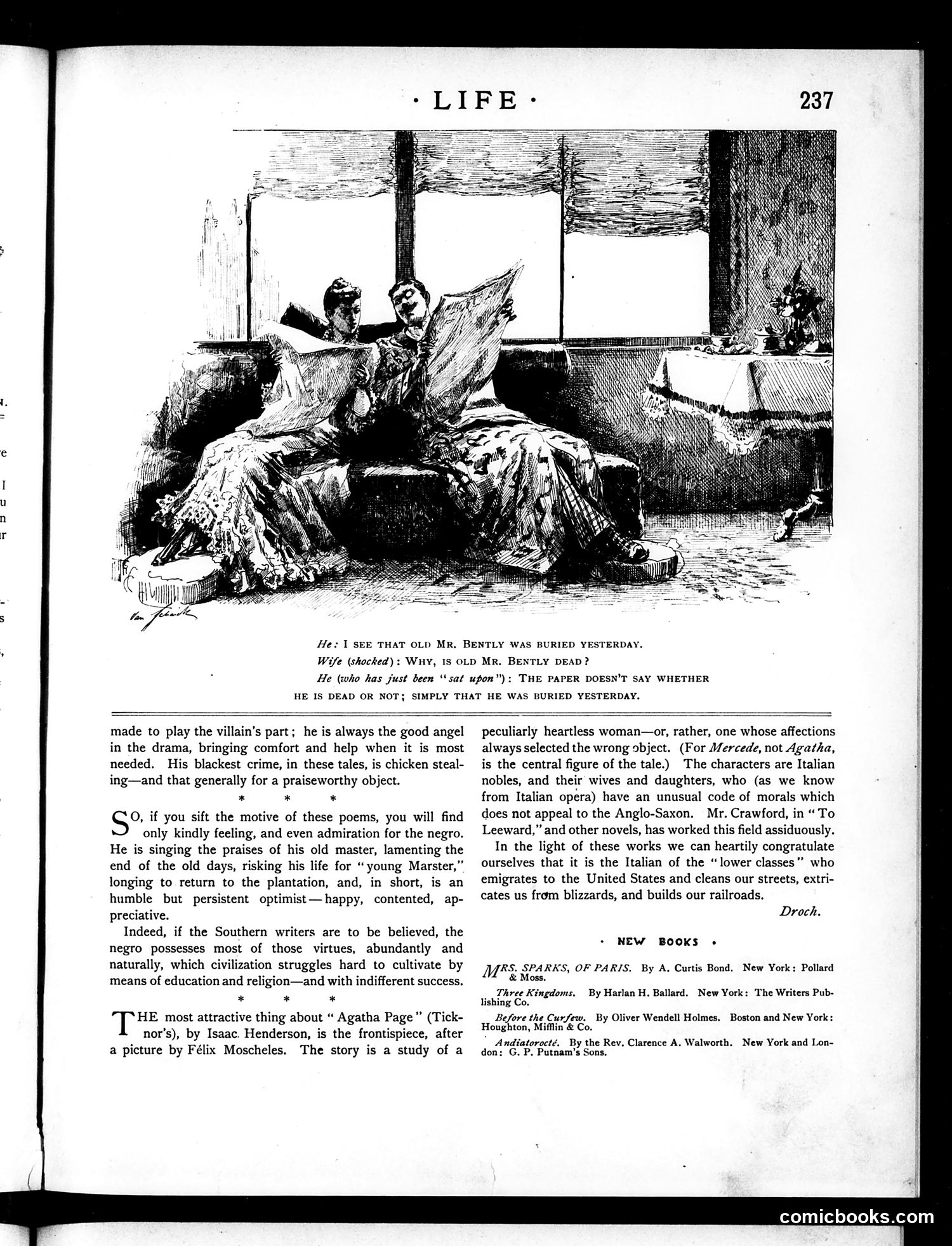
The illustration depicts two elegantly dressed figures examining what appears to be a newspaper or document while reclining on an ornate sofa. The caption reveals a dark joke about class and mortality: one character announces that "old Mr. Bently was buried yesterday," while the other, seemingly unconcerned, responds that the paper doesn't specify whether he's actually dead—only that he was buried. The satire targets upper-class indifference and the semantic games wealthy people play to avoid directly acknowledging unpleasant realities. It mocks how the privileged classes might dismiss practical details about death through linguistic evasion. The ornate furnishings emphasize the characters' wealth and leisured detachment from ordinary concerns.
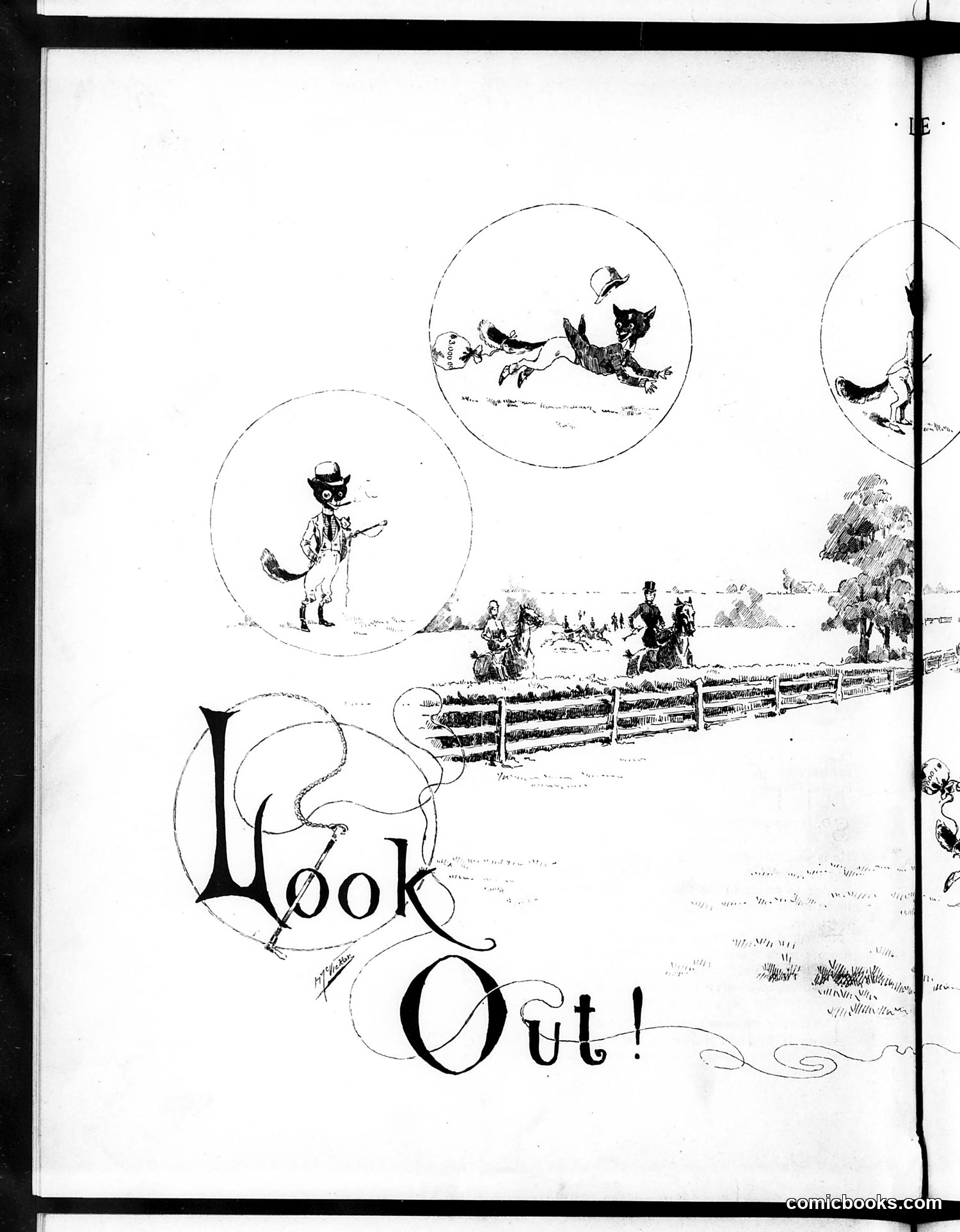
This appears to be a title page or advertisement featuring the phrase "Look Out!" in decorative lettering. The illustration shows a pastoral scene with a wooden fence and gathered spectators observing three circular vignettes above. The vignettes depict increasingly chaotic scenarios: a figure in formal dress (possibly a politician or gentleman) pointing, followed by what appears to be animals or figures in motion, and a third scene suggesting mayhem or disorder. The exact political targets are unclear from the image alone, but the composition suggests satirizing some contemporary event or public figure's increasingly reckless or foolish behavior. The "look out" warning appears directed at observers—suggesting impending disaster or absurdity worthy of public attention and ridicule.
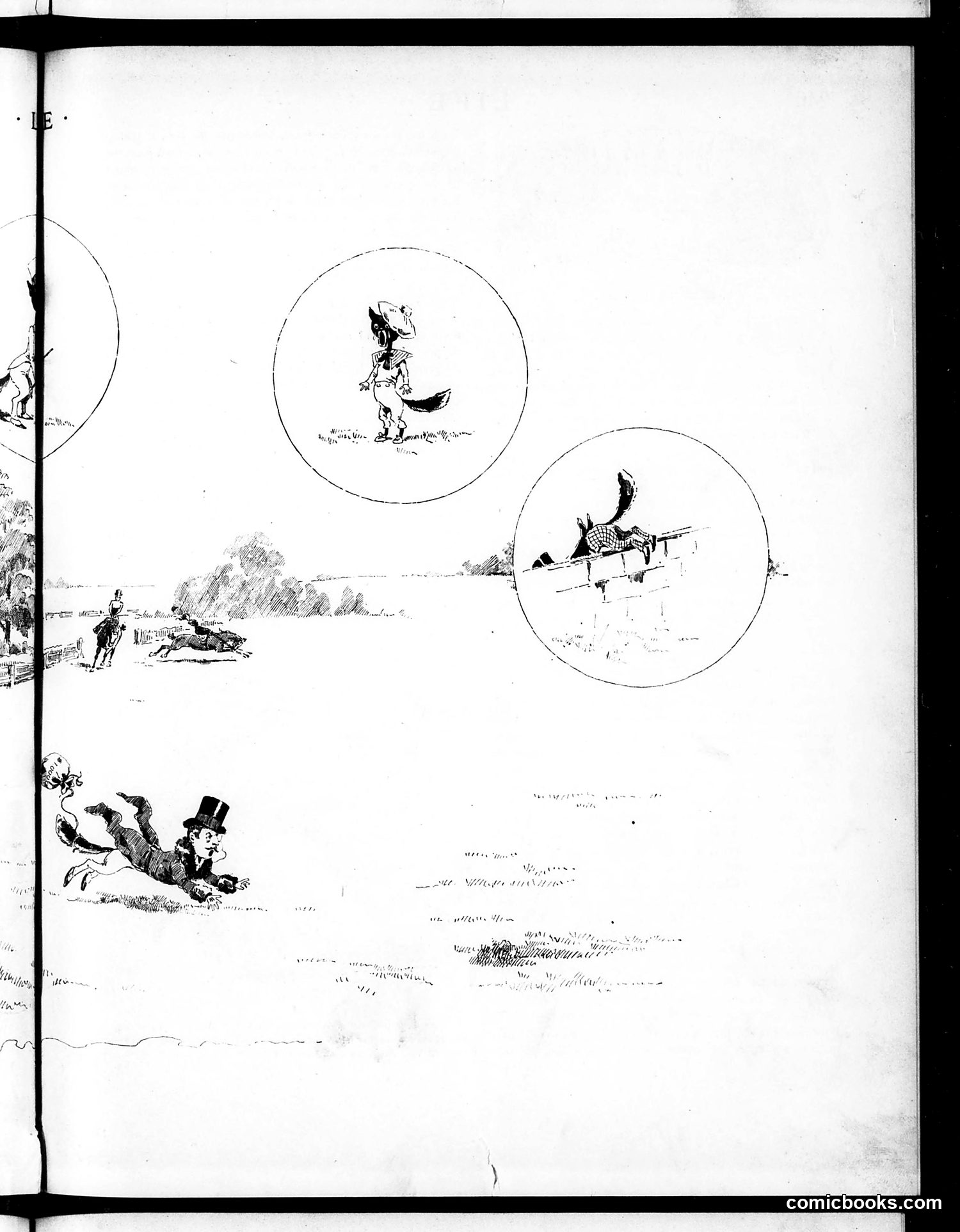
This page from *Life* magazine appears to be a satirical illustration featuring anthropomorphic animals in various scenarios. The central circular vignettes show: 1. **Top circle**: An upright animal figure (possibly a fox or similar creature) in formal dress 2. **Right circle**: An animal character appearing to engage in hunting or shooting activities 3. **Bottom left**: A figure wearing a top hat, lying or falling in grass The overall composition suggests social satire about human behavior—likely mocking contemporary society through animal characters. The formal dress, hunting scenes, and physical comedy are typical of *Life* magazine's approach to satirizing class pretensions, leisure activities, and social conventions of the era. Without visible text identifying specific figures or events, the exact political reference remains unclear, though the tone suggests mockery of upper-class or aristocratic behavior.
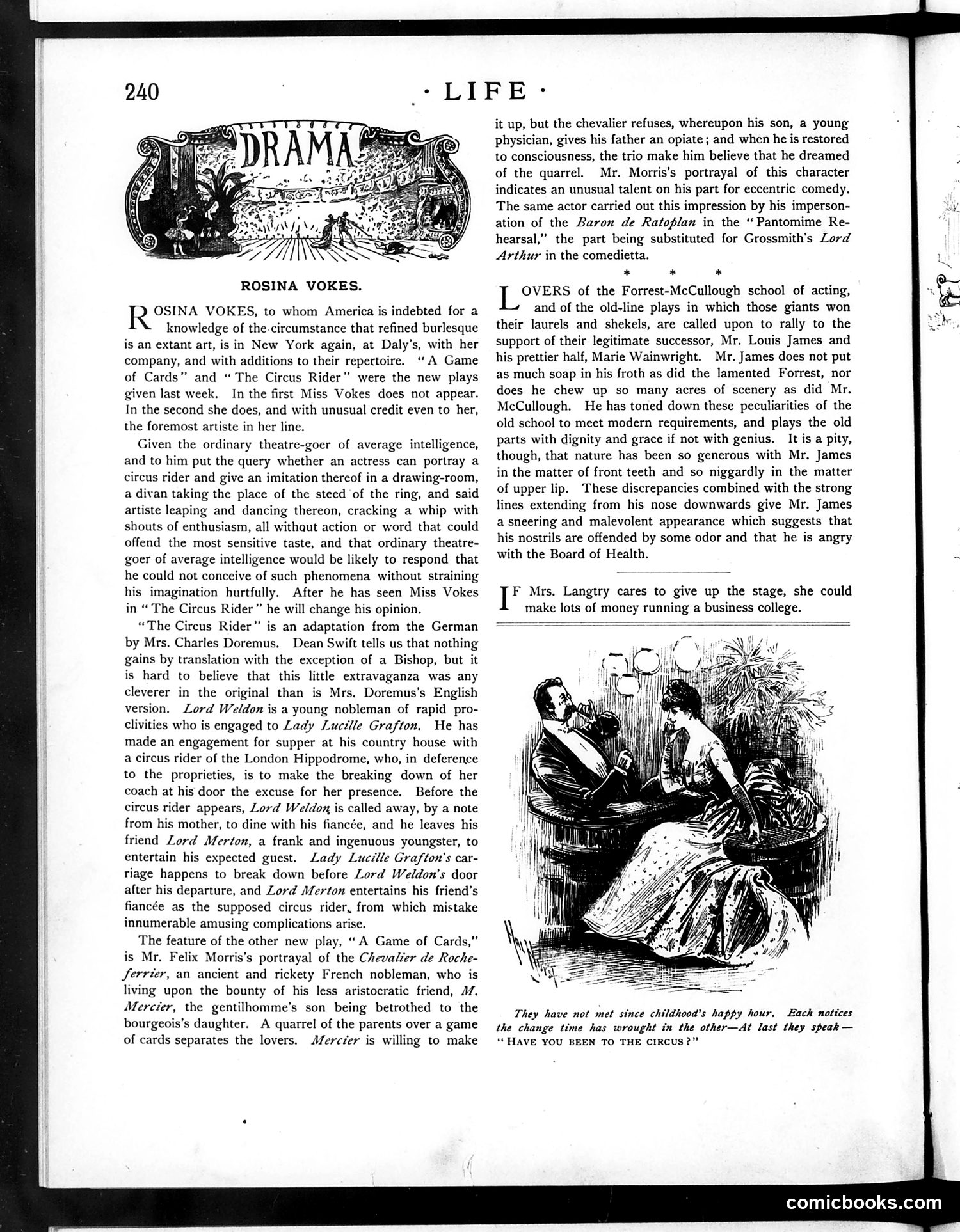
This page from *Life* magazine's drama section reviews theatrical performances. The main illustration shows two figures in what appears to be a parlor scene—likely depicting a moment from one of the plays discussed. The text reviews several productions, including "The Circus Rider" (an adaptation of a German work) and "A Game of Cards," featuring actor Felix Morris as a French nobleman character. The reviews critique the acting performances and adaptations, discussing how actors like Mr. James and Miss Vokes interpret their roles. The illustration's caption references childhood reconnection between characters: "Have you been to the circus?" suggesting plot complications arising from mistaken identity—a common theatrical device of the period.
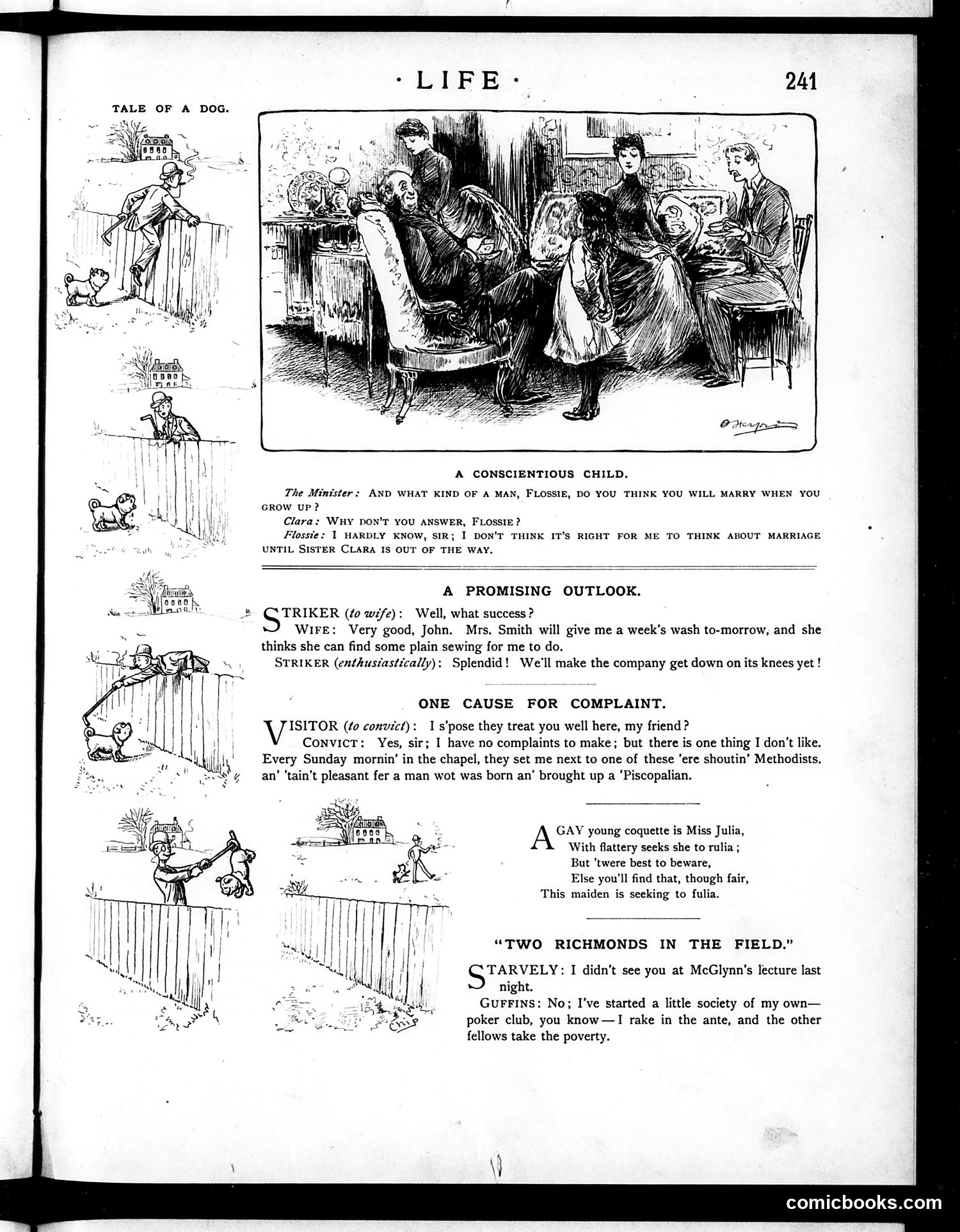
This page contains several short humorous sketches satirizing Victorian social hypocrisy and class dynamics: **"A Conscientious Child"**: A minister asks young Flossie what kind of man she'll marry. Her answer—that she mustn't think about marriage until her older sister Clara is settled—mocks both rigid social conventions (daughters must marry in birth order) and children's naive parroting of adult morality. **"A Promising Outlook"**: A labor striker celebrates getting laundry work, boasting they'll make "the company get down on its knees." The satire targets strikers' unrealistic optimism despite accepting low-wage work—undermining their own cause. **"One Cause for Complaint"**: A convict complains about sitting next to "shoutin' Methodists" in chapel, despite his Presbyterian upbringing. This mocks denominational snobbery even in prison. **"Two Richmonds in the Field"**: Guffins brags about his poker club where he "rakes in the ante" while others lose money—satirizing self-serving social clubs masked as innocent entertainment. The left-side illustrations ("Tale of a Dog") appear to show domestic dog scenes, likely separate comic strips.
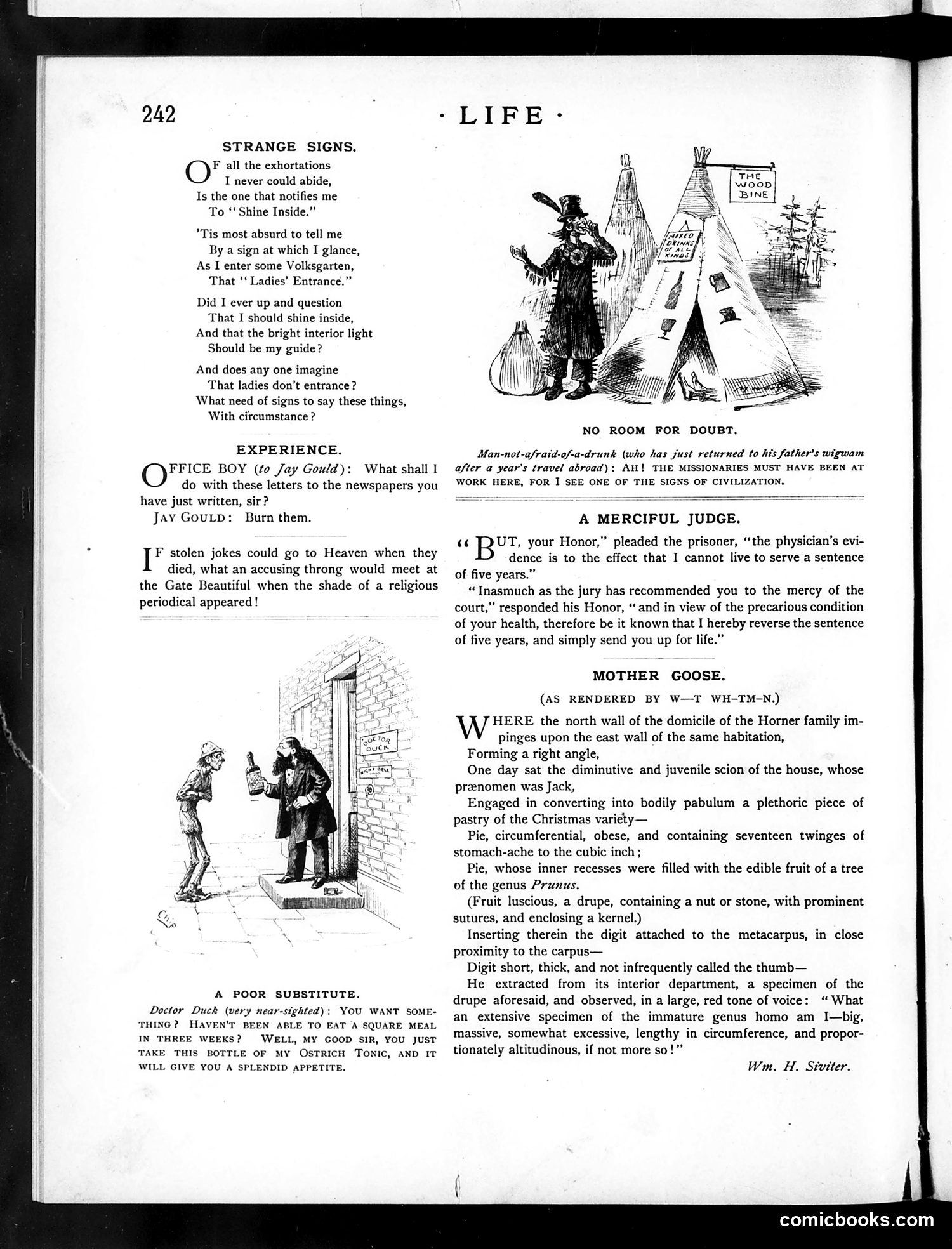
This page contains several short satirical pieces mocking contemporary absurdities and notable figures: **"Strange Signs"** ridicules unnecessary signage, particularly "Ladies' Entrance" markers at public venues—the satire being that women obviously know how to enter establishments without instruction. **"Experience"** is a one-liner joke about Jay Gould (the prominent Gilded Age industrialist/railroad magnate), implying he instructs his office boy to burn letters to newspapers—satirizing Gould's reputation for avoiding public scrutiny and controlling his image. **"A Poor Substitute"** features a nearsighted "Doctor Duck" hawking fake "Ostrich Tonic" as an appetite stimulant—mocking quack medicine and patent remedies common in the era. **"No Room for Doubt"** uses a Native American returning from abroad to satirize missionary efforts and "civilization," suggesting signs (like newspapers) represent colonial intrusion. **"A Merciful Judge"** presents dark humor: a judge reverses a five-year sentence to life imprisonment on medical grounds—ironic "mercy." **"Mother Goose"** parodies Walt Whitman's verbose, pseudo-scientific writing style through an absurdly overwrought retelling of "Jack Horner."
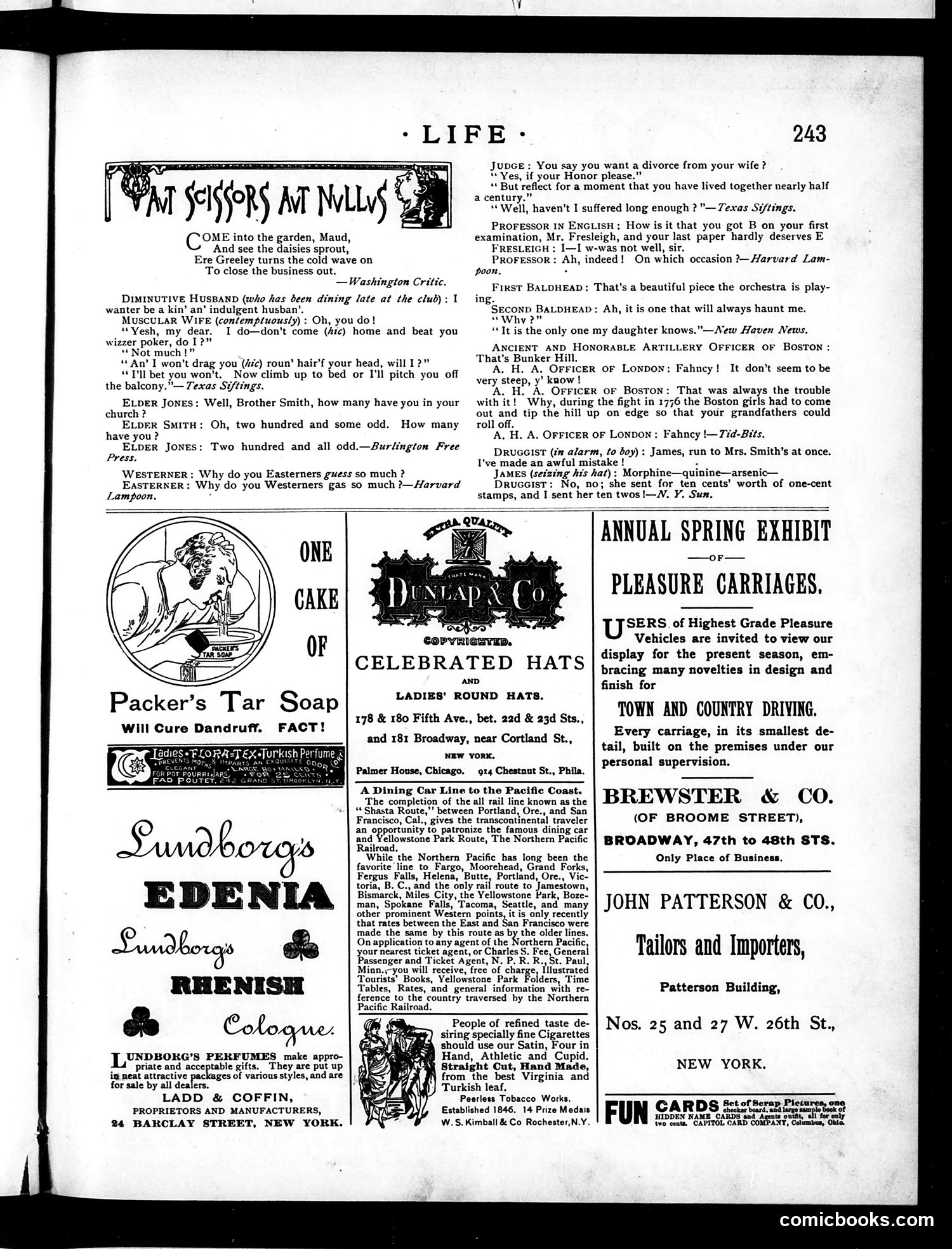
This page is primarily a **collection of short humorous anecdotes** from various sources (Texas Siftings, Harvard Lampoon, etc.), rather than political cartoons. The jokes mock domestic life, academic pretension, and regional differences: - A drunk husband faces his "muscular wife" (physical comedy about marital discord) - Professors and students with excuses for poor grades - A long-suffering divorce plaintiff who endured 50 years of marriage - Regional humor contrasting "Westerners" and "Easterners" stereotypes - A pharmacist's boy who misunderstands "ten cents' worth of one-cent stamps" as "ten twos" One item references **Horace Greeley** (the 1872 presidential candidate and editor), mentioned as "turning the cold wave on / to close the business out." The remaining content is **advertisements** for soap, perfume, hats, and railroad services. No significant political satire is present on this page—it's primarily light domestic and social humor typical of 1870s American magazines.
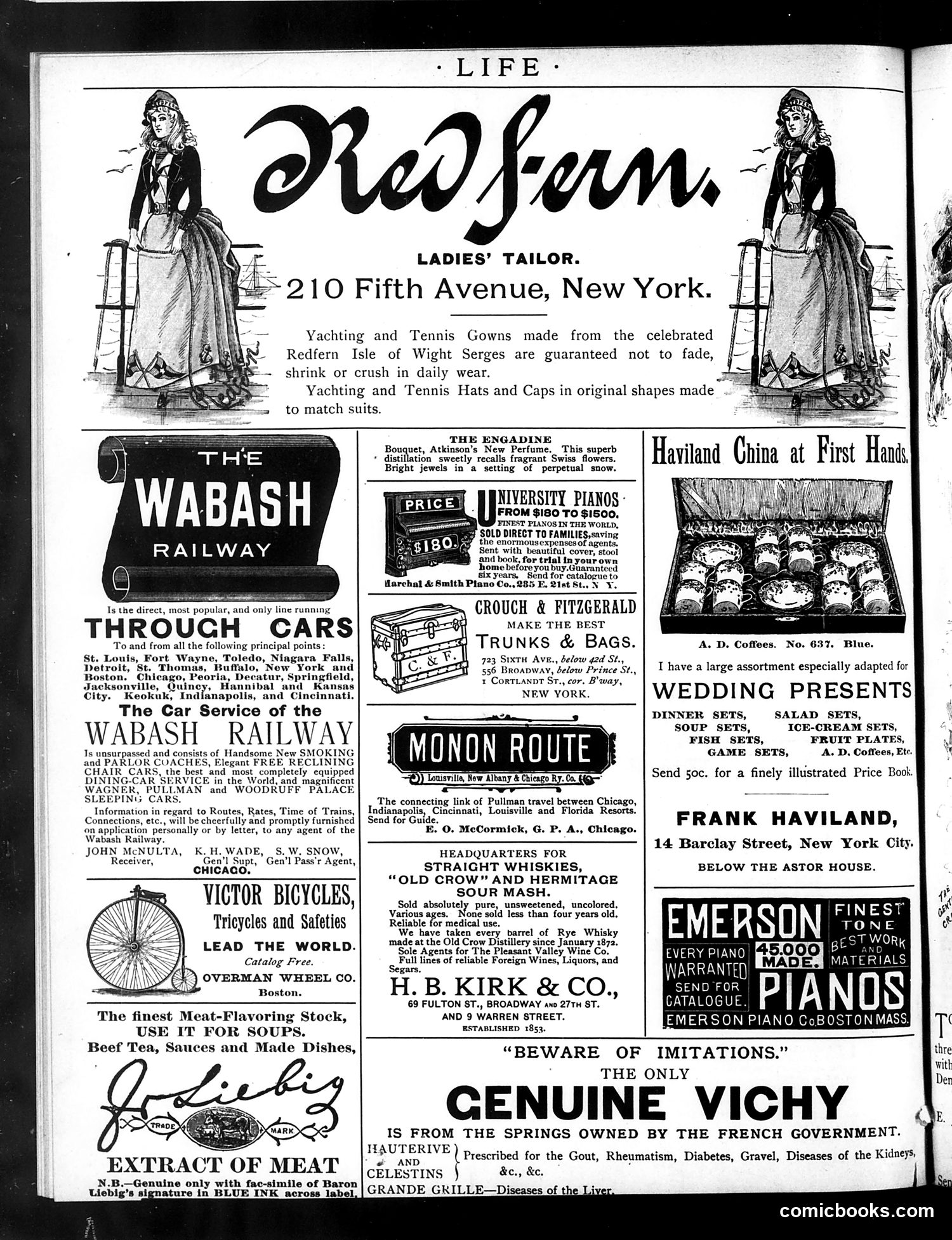
This is primarily an **advertising page**, not a satirical cartoon. The page showcases luxury consumer goods and services targeting wealthy Americans in the late 19th century. Key advertisements include: - **Red Fern Ladies' Tailor** (top): High-end yachting and tennis wear for affluent women - **Wabash Railway**: Promotes luxury rail travel with Pullman sleeping cars to major cities - **Victor Bicycles**: "Lead the World" messaging for this status symbol - **Liebig Extract of Meat**: Upscale cooking ingredient - **University Pianos**: Direct-to-home sales ($180-$1500) - **Vichy Water**: French mineral water prescribed for gout and kidney disease The page reflects **Gilded Age consumerism**—targeting the wealthy with leisure activities (yachting, cycling), luxury travel, and imported European goods. The repeated emphasis on purity, quality, and exclusivity ("genuine," "finest") reflects consumer anxieties about product authenticity in an increasingly commercialized marketplace. This is advertising as social aspiration rather than satire.
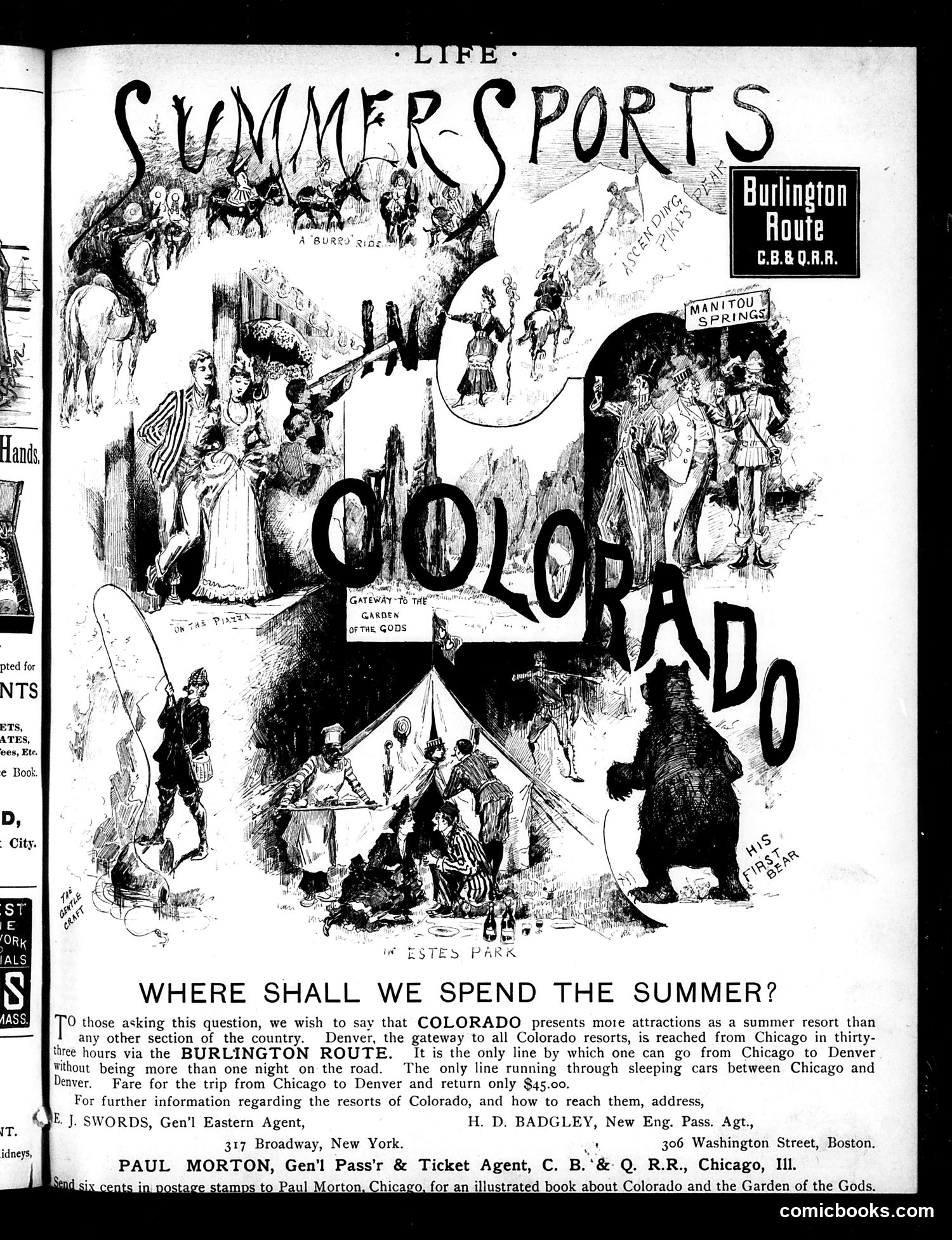
This is primarily a **railroad advertisement**, not political satire. The Burlington Route railroad company promotes Colorado as a summer destination, emphasizing Denver's accessibility from Chicago via their line (33 hours, one night only, $45 round-trip). The illustrative border depicts various summer activities and Colorado attractions: fishing, camping, horseback riding, and the famous "Garden of the Gods" landscape. A bear labeled "His Highness" and references to "Manitou Springs" and "Estes Park" showcase the region's natural wonders and wildlife. The page targets middle-class Eastern vacationers considering summer travel. Rather than satire, it uses playful imagery to make Colorado tourism appealing—the elaborate decorative frame transforms a commercial pitch into entertainment content suitable for Life magazine's audience, blending advertising with whimsical illustration typical of early 20th-century travel promotion.
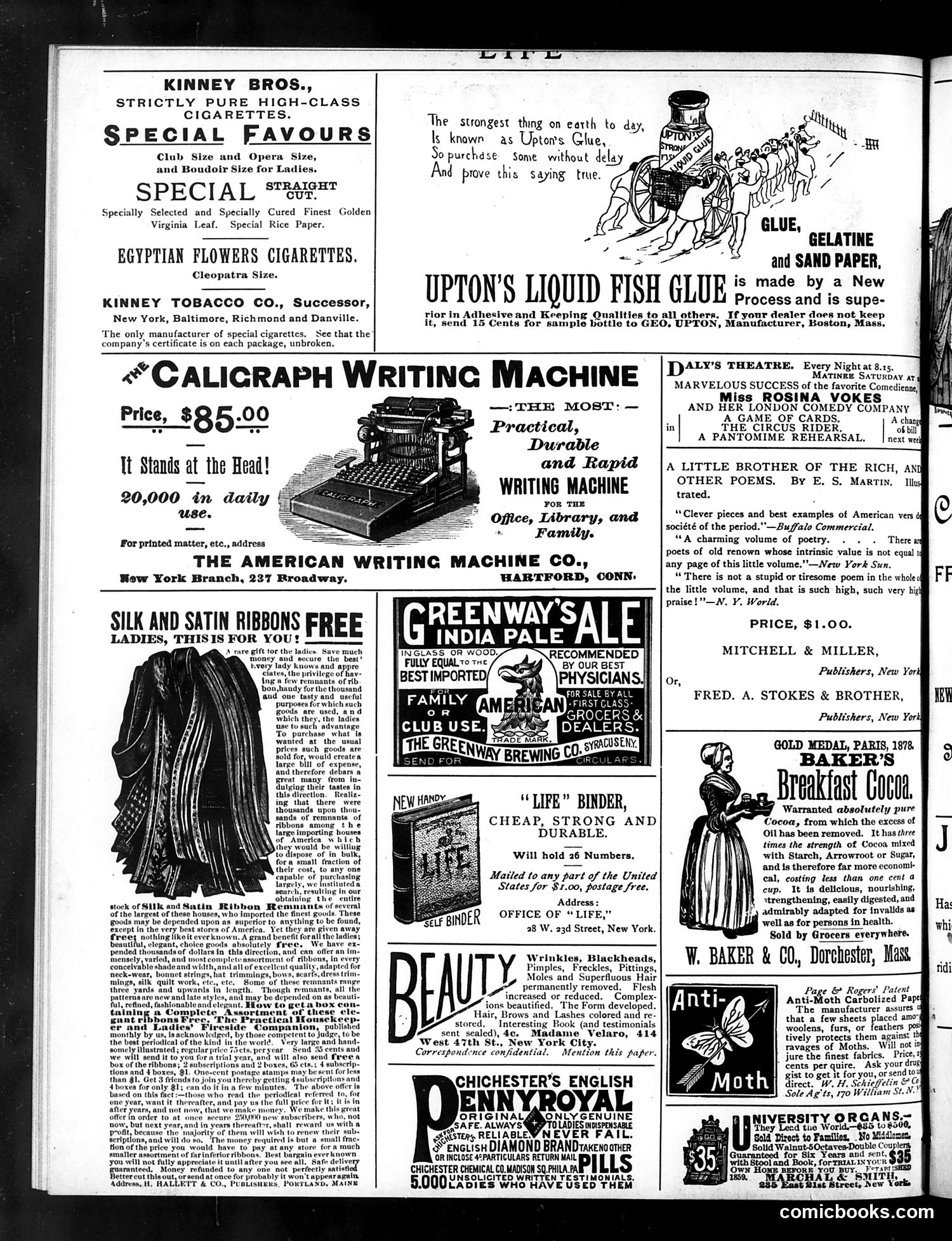
This is primarily an **advertising page** from Life magazine, with minimal editorial content. The layout features various product advertisements typical of the late 19th century, including cigarettes, writing machines, ribbons, cocoa, and patent medicines. The only substantive illustrated content is an **Upton's Glue advertisement** featuring a humorous cartoon of a sleigh team pulling an enormous load, captioned with doggerel verse claiming glue is "the strongest thing on earth." The joke is straightforward advertising humor—exaggerating the product's bonding strength through visual absurdity. The rest of the page is standard period advertising with no political satire or social commentary. There are notices for theatrical performances and beauty treatments, but these lack explanatory context beyond promotional copy. **This page demonstrates how Life supplemented satirical editorial content with advertising revenue**—a common magazine business model then and now.
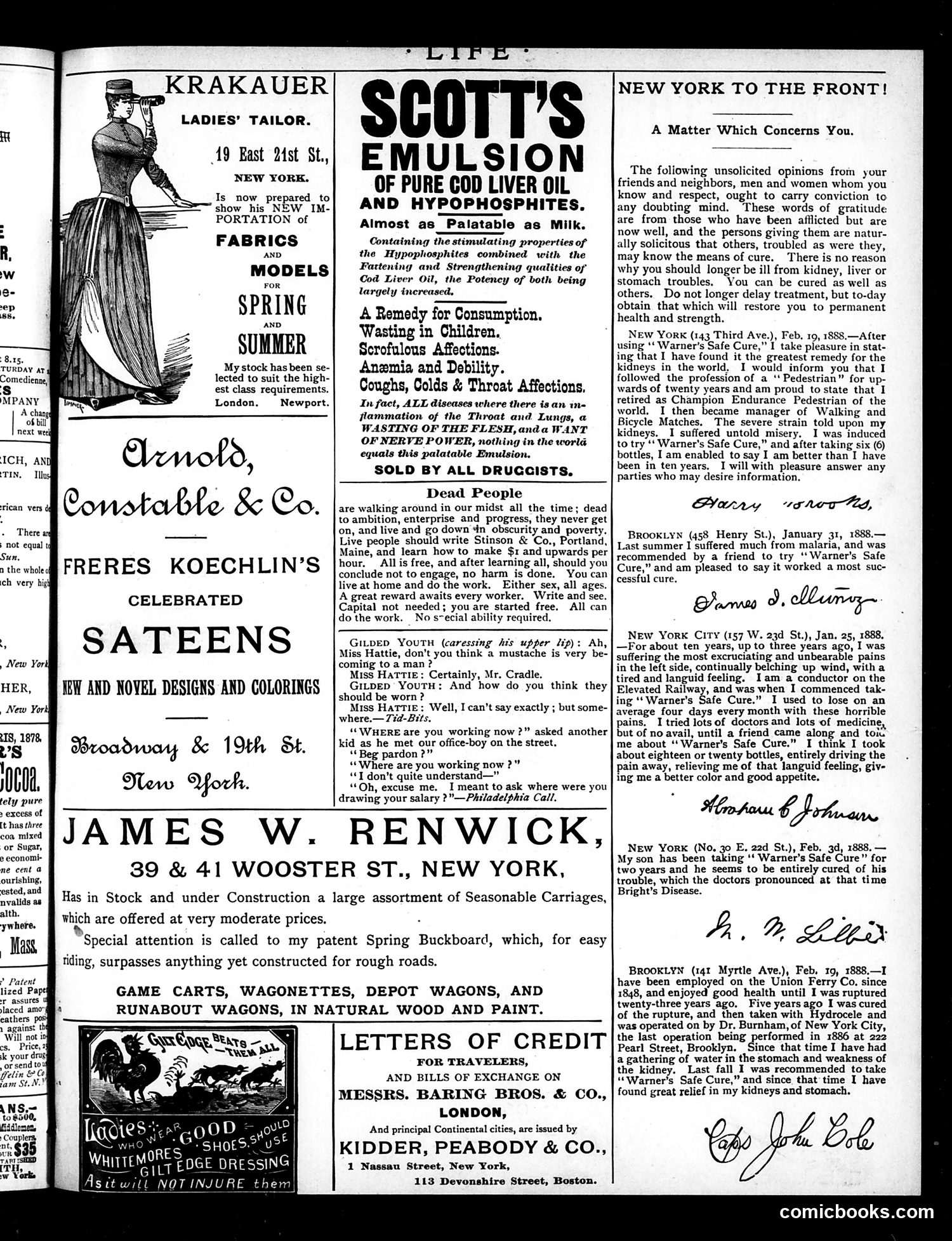
This page is primarily **advertisements and filler content** rather than political satire. The dominant feature is Scott's Emulsion, a patent medicine promoting cod liver oil as a cure-all for consumption, anemia, debility, and throat afflictions—typical of 1880s medical quackery. The small humorous items are mild **office comedy**: one dialogue jokes about a young man asking where to wear a mustache; another features an office boy misunderstanding "where are you working" as "where are you drawing your salary"—gentle wordplay about youth and employment. The "Dead People" section satirizes the "get rich quick" scheme industry, mocking people who lack ambition while simultaneously promoting Stinson & Co.'s dubious work-from-home opportunity ($1/hour claimed). The remaining content comprises **legitimate business advertisements**: tailors, carriage makers, and financial services (Kidder, Peabody & Co.). **For modern readers**: This reflects the 1880s landscape of unregulated patent medicines, mail-order schemes, and advertising-heavy magazines—the precursor to today's internet spam and dubious wellness products.
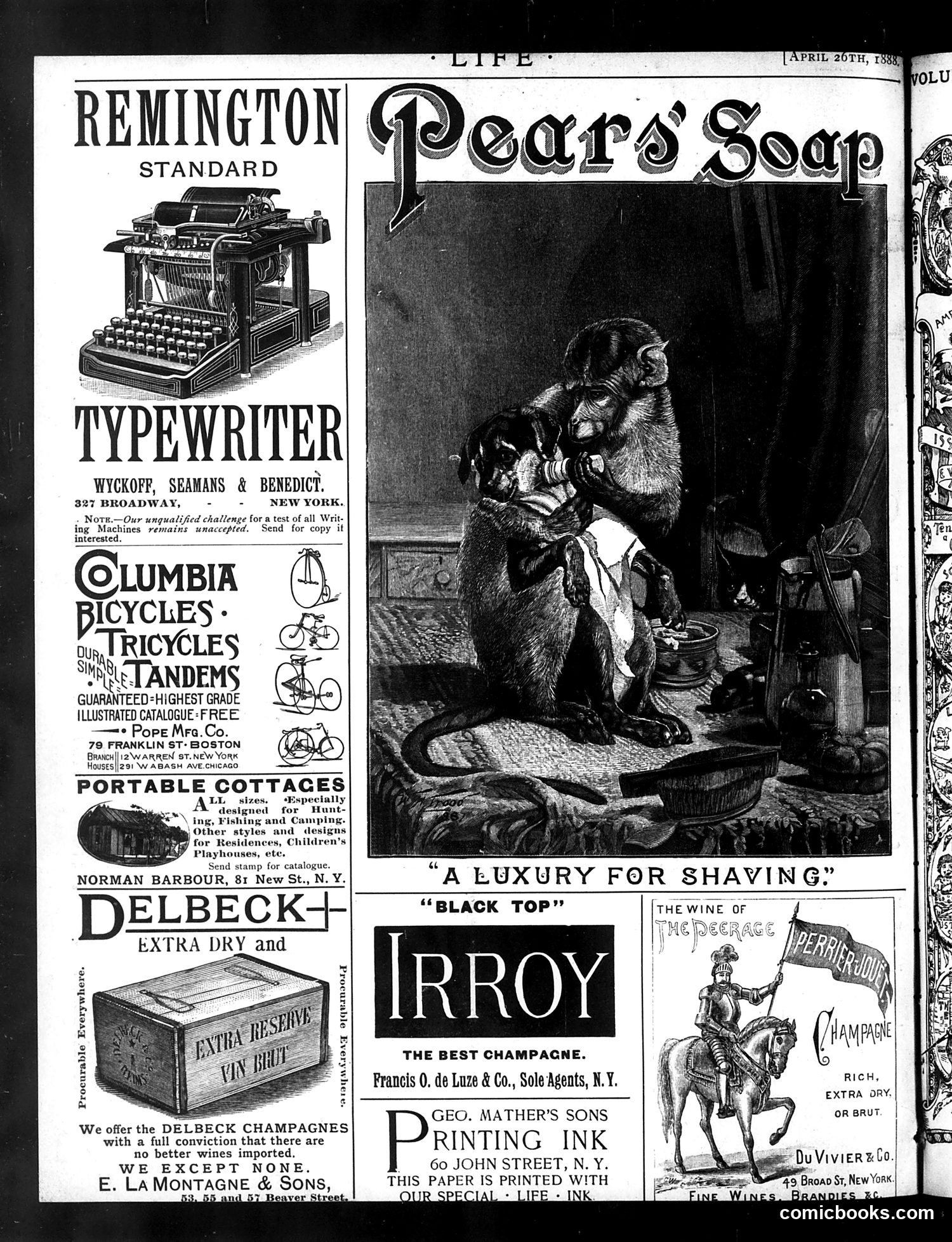
This page is primarily **advertisements** with one significant satirical illustration. The main cartoon, titled "A Luxury for Shaving," depicts two anthropomorphic apes or primates—one seated, one standing—with the standing figure applying **Pear's Soap** to the seated one's face, apparently for shaving. **The Satire:** This is a racist caricature playing on period stereotypes linking Black people or other races to primates. The "joke" exploits the pseudo-scientific racism common in the 1880s, suggesting that using Pear's Soap represents an attempt to "civilize" or "refine" an uncivilized being—the implication being darkly comedic to contemporary readers who held such prejudices. **Context:** This reflects the deeply offensive advertising and editorial standards of 1880s America, where racial caricature was routine in mainstream publications. The "luxury" framing adds insulting irony. The surrounding ads promote typewriters, bicycles, champagne, and printing ink—standard period advertising with no apparent satirical content.