
Life, 1888-04-26 · page 7 of 18
Life — April 26, 1888 — page 7: what you’re looking at
What you’re looking at
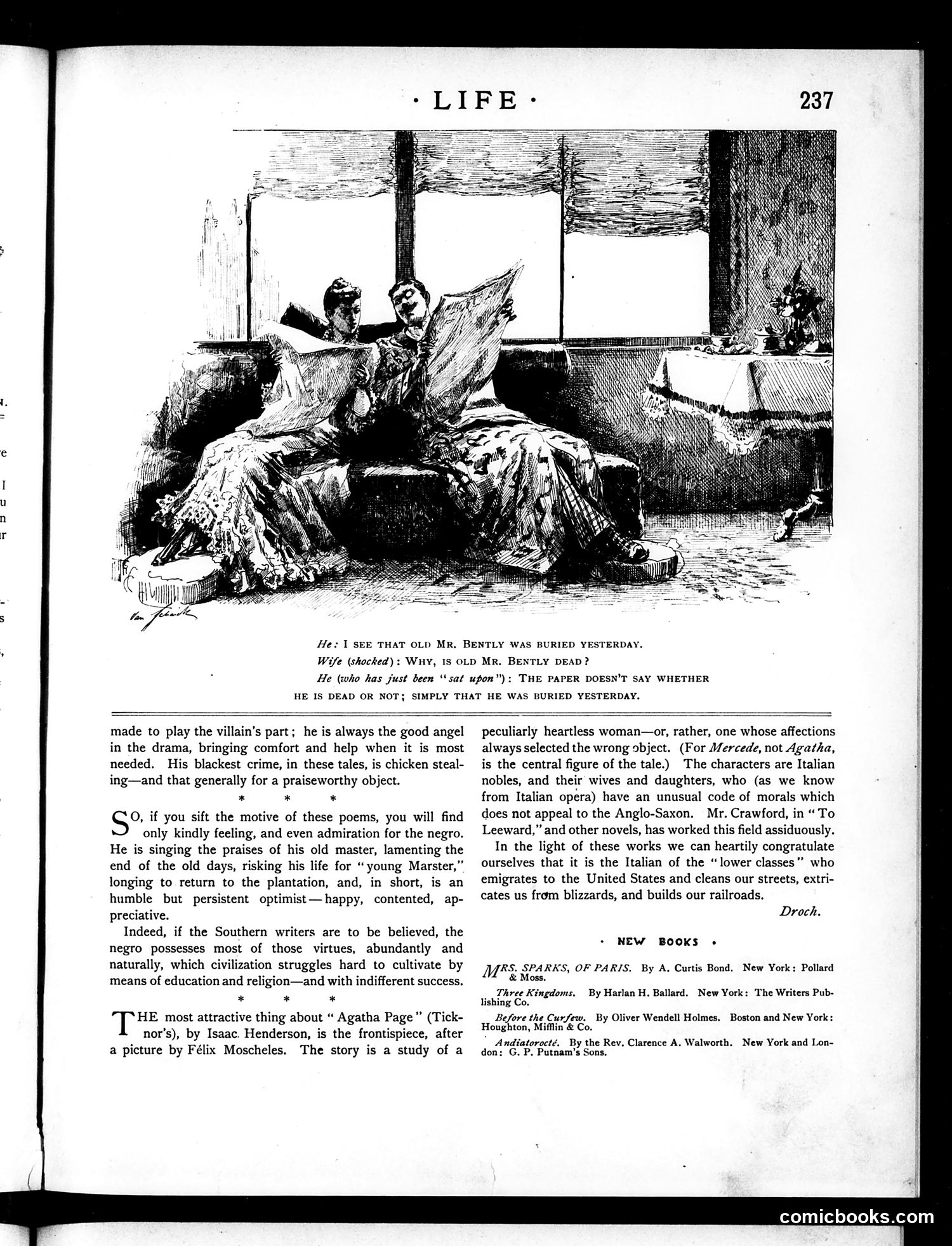
The illustration depicts two elegantly dressed figures examining what appears to be a newspaper or document while reclining on an ornate sofa. The caption reveals a dark joke about class and mortality: one character announces that "old Mr. Bently was buried yesterday," while the other, seemingly unconcerned, responds that the paper doesn't specify whether he's actually dead—only that he was buried. The satire targets upper-class indifference and the semantic games wealthy people play to avoid directly acknowledging unpleasant realities. It mocks how the privileged classes might dismiss practical details about death through linguistic evasion. The ornate furnishings emphasize the characters' wealth and leisured detachment from ordinary concerns.
📄 Transcribed text from this page (OCR, searchable)
Machine-transcribed from the original scan — historical spelling and the odd misread are preserved.
He: 1 SEE THAT OLD MR, BENTLY WAS BURIED YESTERDAY. Wife (shocked): WHY, 18 OLD MR. BENTLY DEAD? He (who has just been ‘‘ sat upon”): THE PAPER DOESN’T SAY WHETHER HE IS DEAD OR NOT; SIMPLY THAT HE WAS BURIED YESTERDAY. made to play the villain’s part; he is always the good angel in the drama, bringing comfort and help when it is most needed. His blackest crime, in these tales, is chicken steal- ing—and that generally for a praiseworthy object. * * * S° if you sift the motive of these poems, you will find only kindly feeling, and even admiration for the negro. He is singing the praises of his old master, lamenting the end of the old days, risking his life for “young Marster,” longing to return to the plantation, and, in short, is an humble but persistent optimist—happy, contented, ap- preciative. Indeed, if the Southern writers are to be believed, the Negro possesses most of those virtues, abundantly and naturally, which civilization struggles hard to cultivate by means of education and religion—and with indifferent success. * * * HE most attractive thing about “ Agatha Page” (Tick- nor’s), by Isaac. Henderson, is the frontispiece, after a picture by Félix Moscheles. The story is a study of a peculiarly heartless woman—or, rather, one whose affections always selected the wrong object. (For Mercede, not Agatha, is the central figure of the tale.) The characters are Italian nobles, and their wives and daughters, who (as we know from Italian opera) have an unusual code of morals which does not appeal to the Anglo-Saxon. Mr. Crawford, in “To Leeward,” and other novels, has worked this field assiduously. In the light of these works we can heartily congratulate ourselves that it is the Italian of the “lower classes” who emigrates to the United States and cleans our streets, extri- cates us from blizzards, and builds our railroads. Droch. NEW BOOKS + Ms: PA RKS, OF PARIS, By A, Curtis Bond. New York: Pollard & Moss. Three Kingdoms. By Harlan H. Ballard. New York: The Writers Pub- lishing Co. Before the Curfew. Houghton, Mifflin & Co. " Andiatorocté. By the Rev. Clarence A. Walworth. New York and Lon- don: G. P, Putnam’s Sons, By Oliver Wendell Holmes. Boston and New York: comicbooks.com