
Life, 1888-04-26 · page 6 of 18
Life — April 26, 1888 — page 6: what you’re looking at
What you’re looking at
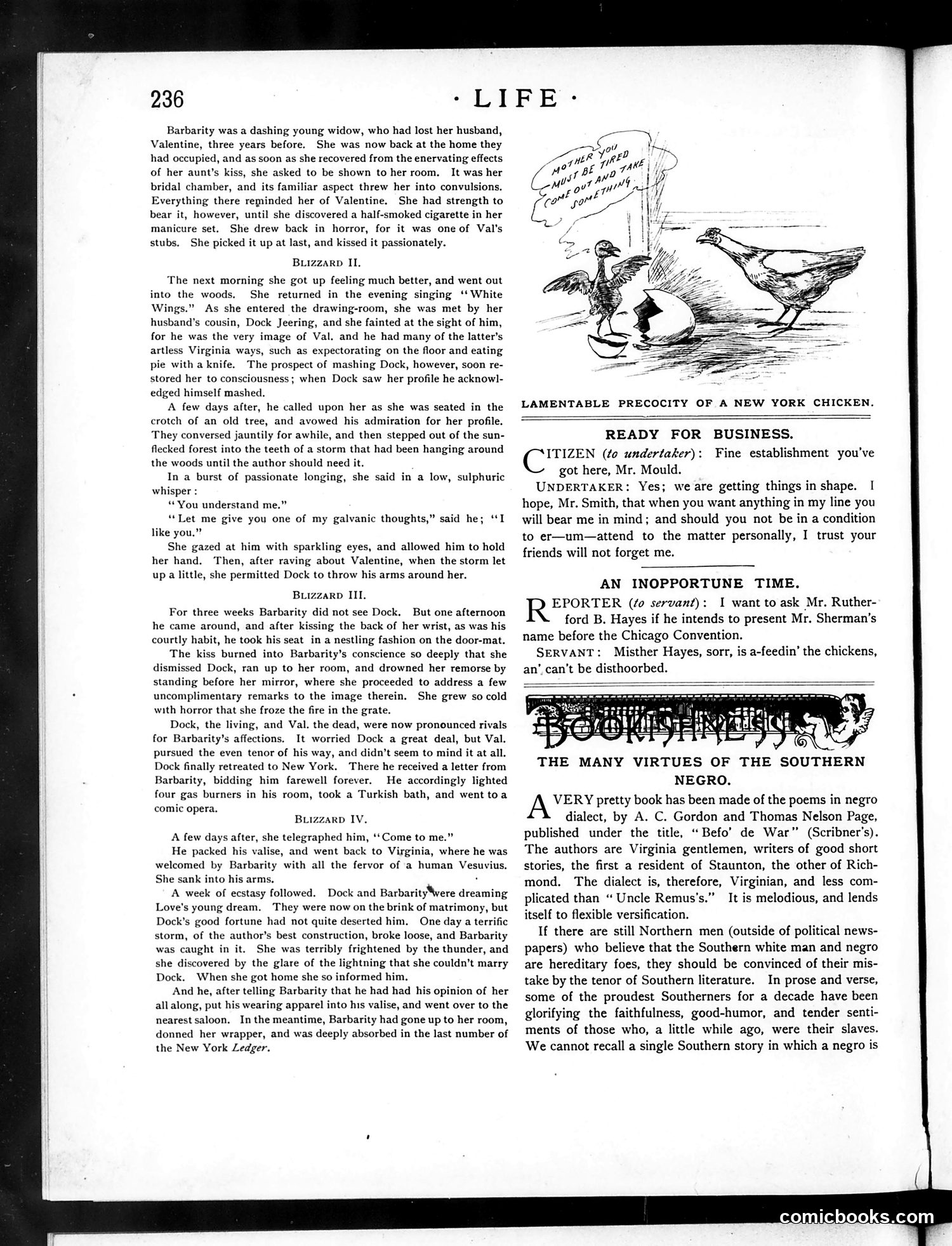
This page contains three distinct sections: a serialized story ("Blizzard" chapters II-IV) about a widow named Barbarity and her romantic entanglements, a small illustration captioned "LAMENTABLE PRECOCITY OF A NEW YORK CHICKEN" showing a bird, and two brief humorous dialogues labeled "READY FOR BUSINESS" and "AN INOPPORTUNE TIME." The cartoon's chicken caption appears to be gentle social satire about urban life. The dialogues are simple workplace humor involving an undertaker and various characters. The page's substantial text focuses on a book review of "The Many Virtues of the Southern Negro," praising its poetry and noting it counters Northern prejudices about the South. This appears to be typical Life magazine content from the early 1900s: mixed serialized fiction, light humor, and literary commentary.
📄 Transcribed text from this page (OCR, searchable)
Machine-transcribed from the original scan — historical spelling and the odd misread are preserved.
236 Barbarity was a dashing young widow, who had lost her husband, Valentine, three years before. She was now back at the home they had occupied, and as soon as she recovered from the enervating effects of her aunt's kiss, she asked to be shown to her room. It was her bridal chamber, and its familiar aspect threw her into convulsions. Everything there reminded her of Valentine. She had strength to bear it, however, until she discovered a half-smoked cigarette in her manicure set. She drew back in horror, for it was one of Val’s stubs. She picked it up at last, and kissed it passionately. Buizzarp II. The next morning she got up feeling much better, and went out into the woods, She returned in the evening singing ‘“ White Wings.” As she entered the drawing-room, she was met by her husband's cousin, Dock Jeering, and she fainted at the sight of him, for he was the very image of Val. and he had many of the latter's artless Virginia ways, such as expectorating on the floor and eating pie with a knife. The prospect of mashing Dock, however, soon re- stored her to consciousness; when Dock saw her profile he acknowl- edged himself mashed. A few days after, he called upon her as she was seated in the crotch of an old tree, and avowed his admiration for her profile. They conversed jauntily for awhile, and then stepped out of the sun- flecked forest into the teeth of a storm that had been hanging around the woods until the author should need it. In a burst of passionate longing, she said in a low, sulphuric whisper : “You understand me,” “Let me give you one of my galvanic thoughts,” said he; “I like you.” She gazed at him with sparkling eyes, and allowed him to hold her hand. Then, after raving about Valentine, when the storm let up a little, she permitted Dock to throw his arms around her. BuizzarD III. For three weeks Barbarity did not see Dock, But one afternoon he came around, and after kissing the back of her wrist, as was his courtly habit, he took his seat in a nestling fashion on the door-mat. The kiss burned into Barbarity’s conscience so deeply that she dismissed Dock, ran up to her room, and drowned her remorse by standing before her mirror, where she proceeded to address a few uncomplimentary remarks to the image therein. She grew so cold with horror that she froze the fire in the grate. Dock, the living, and Val. the dead, were now pronounced rivals for Barbarity’s affections. It worried Dock a great deal, but Val. pursued the even tenor of his way, and didn’t seem to mind it at all. Dock finally retreated to New York. There he received a letter from Barbarity, bidding him farewell forever. He accordingly lighted four gas burners in his room, took a Turkish bath, and went toa comic opera. Buizzarp IV. ‘A few days after, she telegraphed him, ‘Come to me.” He packed his valise, and went back to Virginia, where he was welcomed by Barbarity with all the fervor of a human Vesuvius. She sank into his arms. A week of ecstasy followed. Dock and Barbarity“were dreaming Love's young dream. They were now on the brink of matrimony, but Dock’s good fortune had not quite deserted him. One day a terrific storm, of the author’s best construction, broke loose, and Barbarity was caught in it. She was terribly frightened by the thunder, and she discovered by the glare of the lightning that she couldn’t marry Dock. When she got home she so informed him. And he, after telling Barbarity that he had had his opinion of her allalong, put his wearing apparel into his valise, and went over to the nearest saloon. In the meantime, Barbarity had gone up to her room, donned her wrapper, and was deeply absorbed in the last number of the New York Ledger. > LIFE: LAMENTABLE PRECOCITY OF A NEW YORK CHICKEN. READY FOR BUSINESS. ITIZEN (to undertaker): Fine establishment you’ve got here, Mr. Mould. UNDERTAKER: Yes; we are getting things in shape. | hope, Mr. Smith, that when you want anything in my line you will bear me in mind; and should you not be in a condition to er—um—attend to the matter personally, I trust your friends will not forget me. AN INOPPORTUNE TIME. EPORTER (¢o servant): 1 want to ask Mr. Ruther- ford B. Hayes if he intends to present Mr. Sherman's name before the Chicago Convention. SERVANT: Misther Hayes, sorr, is a-feedin’ the chickens, an’.can’t be disthoorbed. THE MANY VIRTUES OF THE SOUTHERN NEGRO. VERY pretty book has been made of the poems in negro dialect, by A. C. Gordon and Thomas Nelson Page, published under the title, “ Befo’ de War” (Scribner's). The authors are Virginia gentlemen, writers of good short stories, the first a resident of Staunton, the other of Rich- mond. The dialect is, therefore, Virginian, and less com- plicated than “ Uncle Remus’s.” It is melodious, and lends itself to flexible versification. If there are still Northern men (outside of political news- papers) who believe that the Southern white man and negro are hereditary foes, they should be convinced of their mis- take by the tenor of Southern literature. In prose and verse, some of the proudest Southerners for a decade have been glorifying the faithfulness, good-humor, and tender senti- ments of those who, a little while ago, were their slaves. We cannot recall a single Southern story in which a negro is