
Life, 1888-04-26 · page 2 of 18
Life — April 26, 1888 — page 2: what you’re looking at
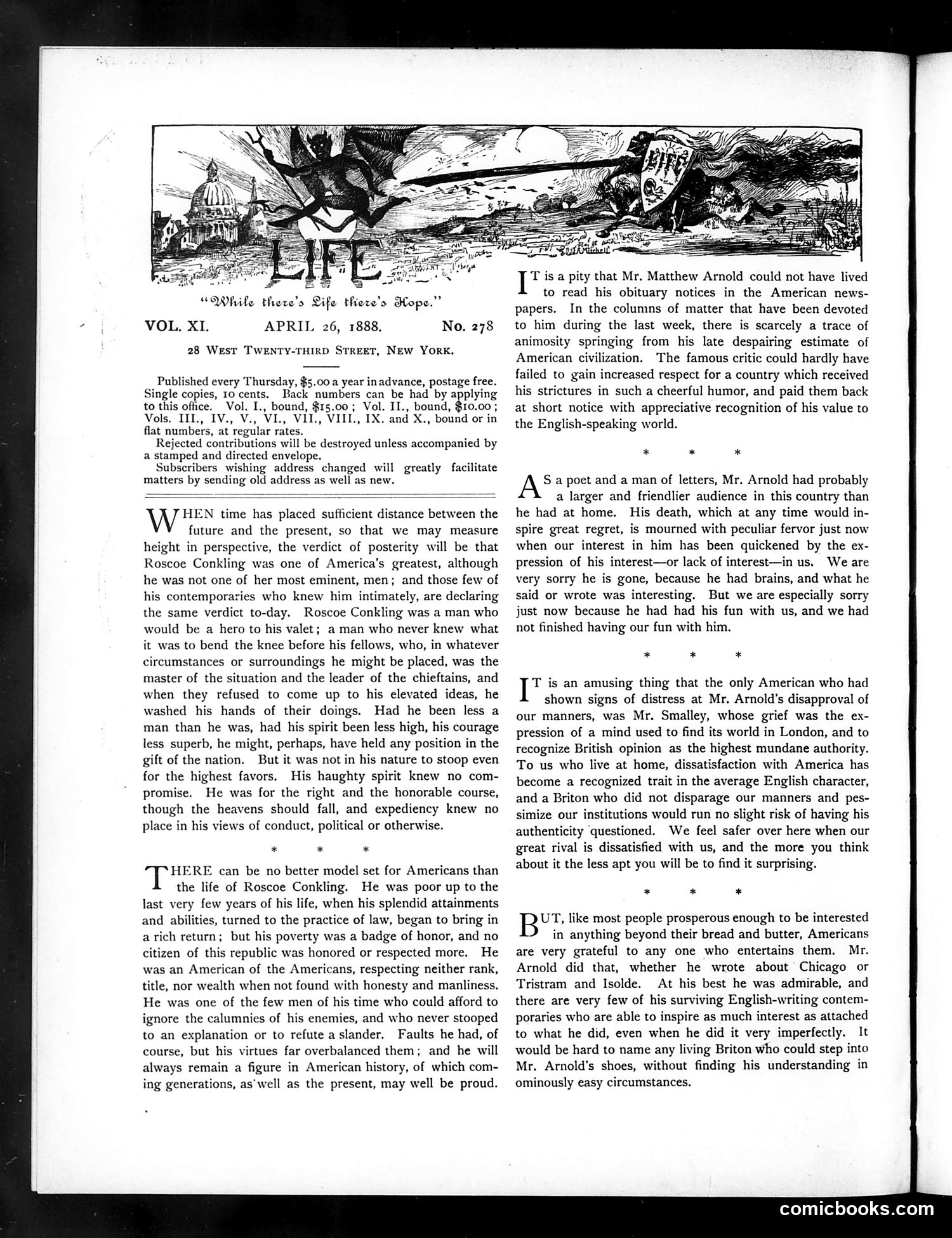
What you’re looking at
The page is primarily text—an editorial reflecting on the death of British critic Matthew Arnold. The small illustration at the top shows a landscape with "Where there's Life there's Hope" as its caption. The editorial notes that Arnold's American obituaries were harshly critical, reflecting his earlier disparaging remarks about American civilization. The writer defends Arnold's character while acknowledging his unflattering assessments of American culture were delivered "in cheerful humor" and appreciated by the English-speaking world. The piece observes that only one American—Mr. Smalley—publicly expressed distress at Arnold's disapproval of American manners, suggesting most Americans either ignored or accepted his critical perspective with indifference.
📄 Transcribed text from this page (OCR, searchable)
Machine-transcribed from the original scan — historical spelling and the odd misread are preserved.
“While there's Life there’s Hope.” VOL. XI. APRIL 26, 1888. No. 278 28 West TWENTY-THIRD STREET, NEW York. Published every Thursday, $5.00 a year inadvance, postage free. Single copies, 10 cents. Back numbers can be had by applying to this office. Vol. I., bound, $15.00; Vol. II., bound, $10.00 ; Vols. IIL, IV., V., VI., VII., VIII., IX. and X., bound or in flat numbers, at regular rates. Rejected contributions will be destroyed unless accompanied by a stamped and directed envelope. Subscribers wishing address changed will greatly facilitate matters by sending old address as well as new HEN time has placed sufficient distance between the future and the present, so that we may measure height in perspective, the verdict of posterity will be that Roscoe Conkling was one of America’s greatest, although he was not one of her most eminent, men; and those few of his contemporaries who knew him intimately, are declaring the same verdict to-day. Roscoe Conkling was a man who would be a hero to his valet; a man who never knew what it was to bend the knee before his fellows, who, in whatever circumstances or surroundings he might be placed, was the master of the situation and the leader of the chieftains, and when they refused to come up to his elevated ideas, he washed his hands of their doings. Had he been less a man than he was, had his spirit been less high, his courage less superb, he might, perhaps, have held any position in the gift of the nation. But it was not in his nature to stoop even for the highest favors. His haughty spirit knew no com- promise. He was for the right and the honorable course, though the heavens should fall, and expediency knew no place in his views of conduct, political or otherwise. * * * HERE can be no better model set for Americans than the life of Roscoe Conkling. He was poor up to the last very few years of his life, when his splendid attainments and abilities, turned to the practice of law, began to bring in arich return; but his poverty was a badge of honor, and no citizen of this republic was honored or respected more. He was an American of the Americans, respecting neither rank, title, nor wealth when not found with honesty and manliness. He was one of the few men of his time who could afford to ignore the calumnies of his enemies, and who never stooped to an explanation or to refute a slander. Faults he had, of course, but his virtues far overbalanced them; and he will always remain a figure in American history, of which com- ing generations, as‘well as the present, may well be proud. T is a pity that Mr. Matthew Arnold could not have lived to read his obituary notices in the American news- papers. In the columns of matter that have been devoted to him during the last week, there is scarcely a trace of animosity springing from his late despairing estimate of American civilization. The famous critic could hardly have failed to gain increased respect for a country which received his strictures in such a cheerful humor, and paid them back at short notice with appreciative recognition of his value to the English-speaking world. * * * S a poet and a man of letters, Mr. Arnold had probably a larger and friendlier audience in this country than he had at home. His death, which at any time would in- spire great regret, is mourned with peculiar fervor just now when our interest in him has been quickened by the ex- pression of his interest—or lack of interest—in us. We are very sorry he is gone, because he had brains, and what he said or wrote was interesting. But we are especially sorry just now because he had had his fun with us, and we had not finished having our fun with him. * * * T is an amusing thing that the only American who had shown signs of distress at Mr. Arnold's disapproval of our manners, was Mr. Smalley, whose grief was the ex- pression of a mind used to find its world in London, and to recognize British opinion as the highest mundane authority. To us who live at home, dissatisfaction with America has become a recognized trait in the average English character, and a Briton who did not disparage our manners and pes- simize our institutions would run no slight risk of having his authenticity questioned. We feel safer over here when our great rival is dissatisfied with us, and the more you think about it the less apt you will be to find it surprising. * * * UT, like most people prosperous enough to be interested in anything beyond their bread and butter, Americans are very grateful to any one who entertains them. Mr. Arnold did that, whether he wrote about Chicago or Tristram and Isolde. At his best he was admirable, and there are very few of his surviving English-writing contem- poraries who are able to inspire as much interest as attached to what he did, even when he did it very imperfectly. It would be hard to name any living Briton who could step into Mr. Arnold’s shoes, without finding his understanding in ominously easy circumstances. comicbooks.com