
Life, 1888-04-26 · page 10 of 18
Life — April 26, 1888 — page 10: what you’re looking at
What you’re looking at
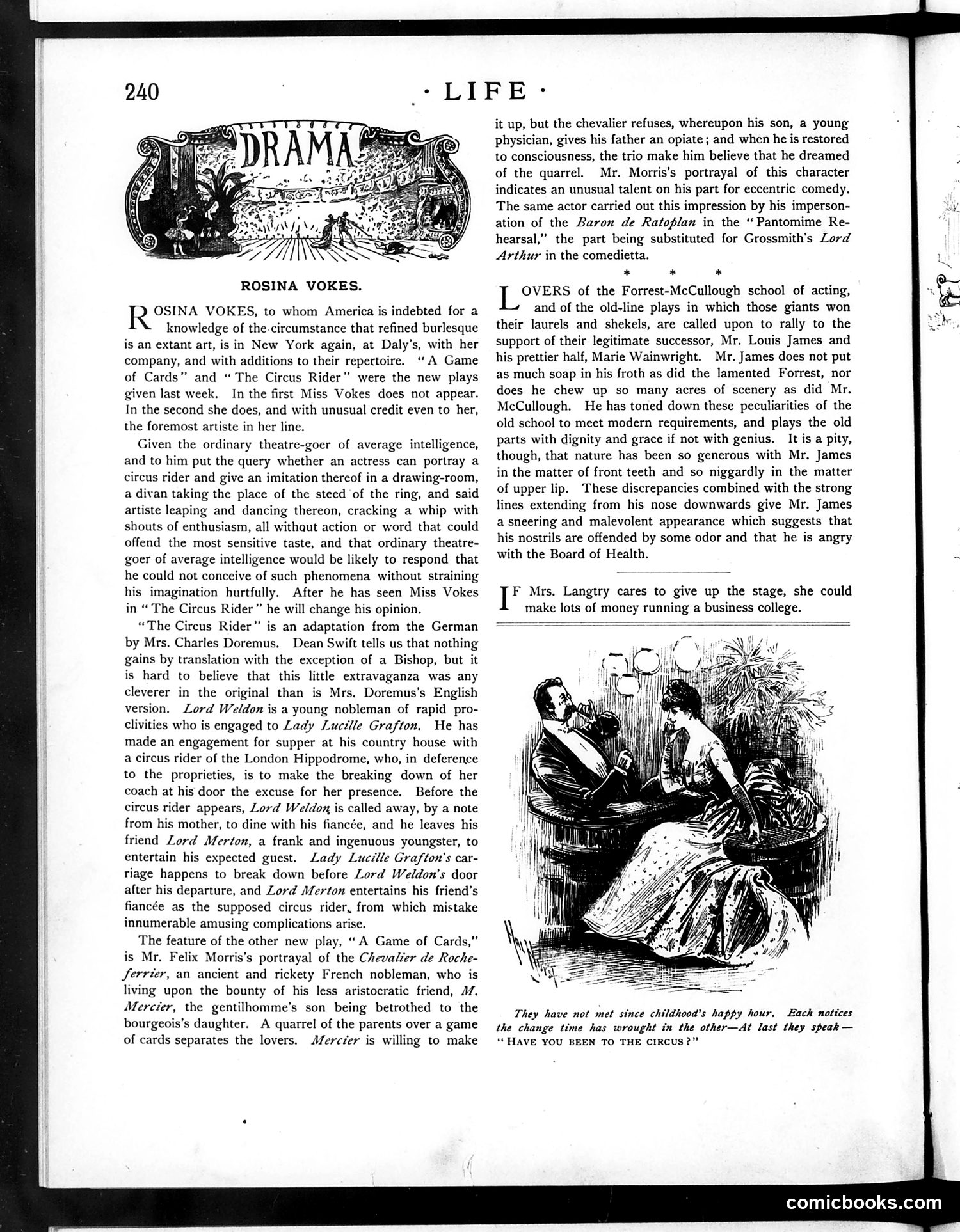
This page from *Life* magazine's drama section reviews theatrical performances. The main illustration shows two figures in what appears to be a parlor scene—likely depicting a moment from one of the plays discussed. The text reviews several productions, including "The Circus Rider" (an adaptation of a German work) and "A Game of Cards," featuring actor Felix Morris as a French nobleman character. The reviews critique the acting performances and adaptations, discussing how actors like Mr. James and Miss Vokes interpret their roles. The illustration's caption references childhood reconnection between characters: "Have you been to the circus?" suggesting plot complications arising from mistaken identity—a common theatrical device of the period.
📄 Transcribed text from this page (OCR, searchable)
Machine-transcribed from the original scan — historical spelling and the odd misread are preserved.
+ LIFE: ROSINA VOKES. OSINA VOKES, to whom America is indebted for a knowledge of the-circumstance that refined burlesque is an extant art, is in New York again, at Daly’s, with her company, and with additions to their repertoire. “A Game of Cards” and “ The Circus Rider” were the new plays given last week. In the first Miss Vokes does not appear. In the second she does, and with unusual credit even to her, the foremost artiste in her line. Given the ordinary theatre-goer of average intelligence, and to him put the query whether an actress can portray a circus rider and give an imitation thereof in a drawing-room, a divan taking the place of the steed of the ring, and said artiste leaping and dancing thereon, cracking a whip with shouts of enthusiasm, all withaut action or word that could offend the most sensitive taste, and that ordinary theatre- goer of average intelligence would be likely to respond that he could not conceive of such phenomena without straining his imagination hurtfully. After he has seen Miss Vokes in “ The Circus Rider” he will change his opinion. “The Circus Rider” is an adaptation from the German by Mrs. Charles Doremus. Dean Swift tells us that nothing gains by translation with the exception of a Bishop, but it is hard to believe that this little extravaganza was any cleverer in the original than is Mrs. Doremus’s English version. Lord Weldon is a young nobleman of rapid pro- clivities who is engaged to Lady Lucille Grafton. He has made an engagement for supper at his country house with a circus rider of the London Hippodrome, who, in deference to the proprieties, is to make the breaking down of her coach at his door the excuse for her presence. Before the circus rider appears, Lord Weldon is called away, by a note from his mother, to dine with his fiancée, and he leaves his friend Lord Merton, a frank and ingenuous youngster, to entertain his expected guest. Lady Lucille Grafton's car- riage happens to break down before Lord Weldon’s door after his departure, and Lord Merton entertains his friend’s fiancée as the supposed circus rider, from which mistake innumerable amusing complications arise. The feature of the other new play, “A Game of Cards,” is Mr. Felix Morris's portrayal of the Chevalier de Roche- Jferrier, an ancient and rickety French nobleman, who is living upon the bounty of his less aristocratic friend, 47. Merczer, the gentilhomme’s son being betrothed to the bourgeois’s daughter. A quarrel of the parents over a game of cards separates the lovers. Mercéer is willing to make it up, but the chevalier refuses, whereupon his son, a young physician, gives his father an opiate ; and when he is restored to consciousness, the trio make him believe that he dreamed of the quarrel. Mr. Morris's portrayal of this character indicates an unusual talent on his part for eccentric comedy. The same actor carried out this impression by his imperson- ation of the Baron de Ratoplan in the “ Pantomime Re- hearsal,” the part being substituted for Grossmith’s Lord Arthur in the comedietta. * * * OVERS of the Forrest-McCullough school of acting, and of the old-line plays in which those giants won their laurels and shekels, are called upon to rally to the support of their legitimate successor, Mr. Louis James and his prettier half, Marie Wainwright. Mr. James does not put as much soap in his froth as did the lamented Forrest, nor does he chew up so many acres of scenery as did Mr. McCullough. He has toned down these peculiarities of the old school to meet modern requirements, and plays the old parts with dignity and grace if not with genius. It is a pity, though, that nature has been so generous with Mr. James in the matter of front teeth and so niggardly in the matter of upper lip. These discrepancies combined with the strong lines extending from his nose downwards give Mr. James a sneering and malevolent appearance which suggests that his nostrils are offended by some odor and that he is angry with the Board of Health. F Mrs. Langtry cares to give up the stage, she could make lots of money running a business college. They have not met since childhood’s happy hour, Each notices the change time has wrought in the other—At last they speak— “HAVE YOU BEEN TO THE CIRCUS?” comicbooks.com