
A complete issue · 16 pages · 1888
Life — February 23, 1888
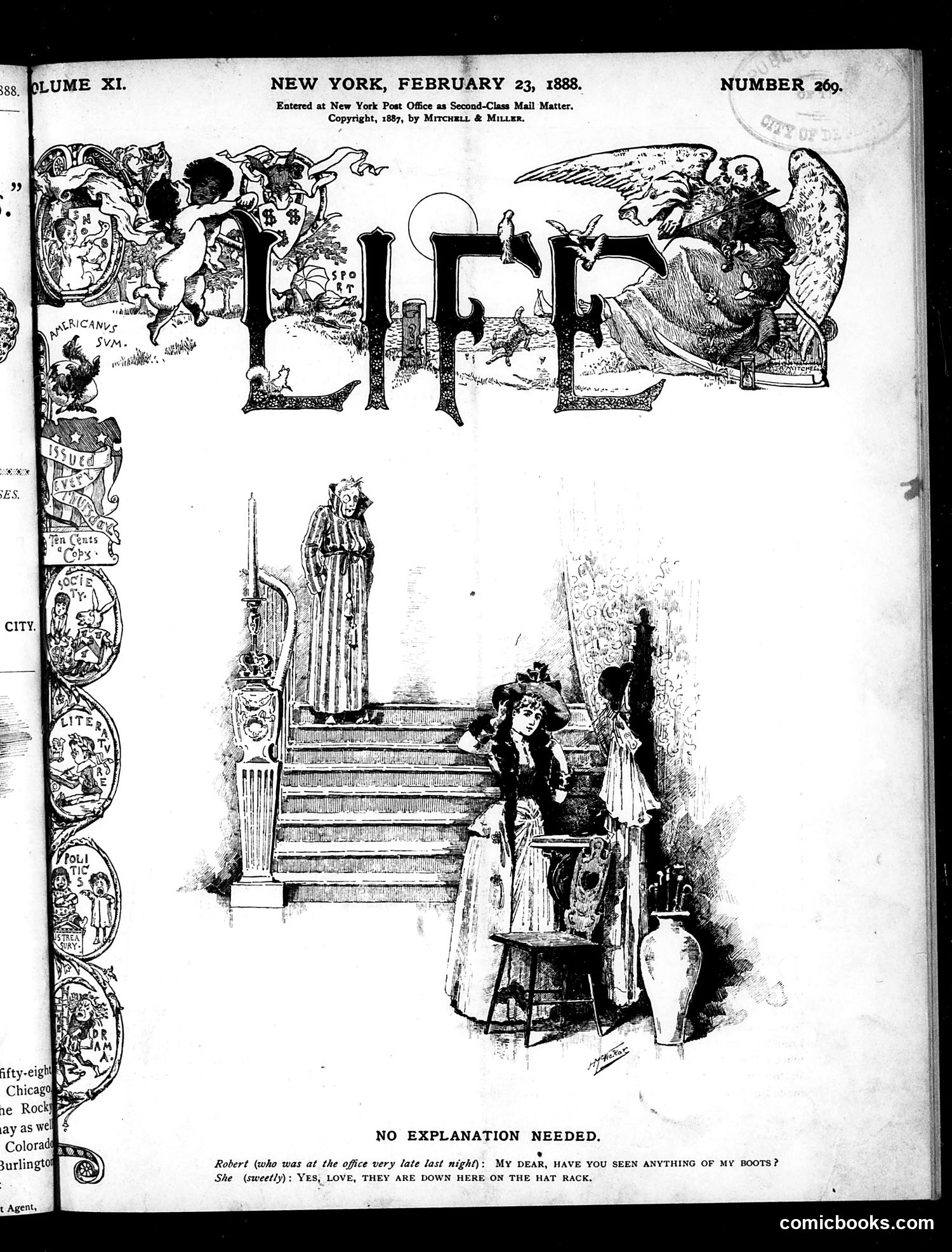
The main cartoon titled "NO EXPLANATION NEEDED" depicts a domestic scene with satirical humor. A woman (labeled "She") admits to her husband Robert that his boots are "down here on the hat rack"—meaning she has carelessly placed his footwear where his hats belong, mixing up their storage spaces. The joke relies on the visual pun and the absurdity of the situation: the wife's casual misplacement of his belongings suggests domestic disorganization or perhaps a subtle jab at women's housekeeping. The title "No Explanation Needed" implies the humor is self-evident to readers familiar with such household mishaps and marital dynamics of the Victorian era.
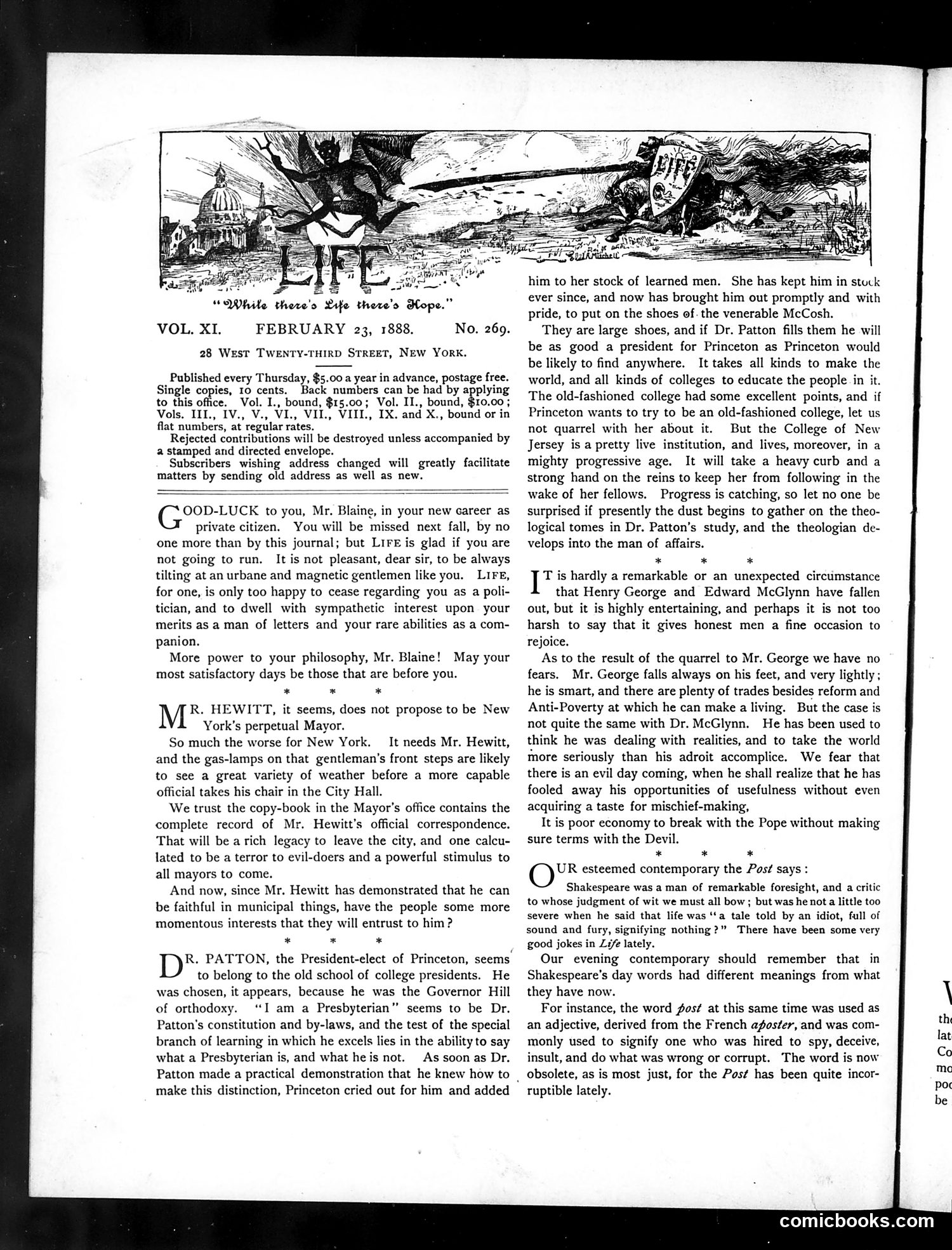
The page contains editorial commentary rather than cartoons. The visible masthead illustration shows a classical "Life" figure, but the content focuses on three separate satirical notes: 1. **Blaine's retirement**: A farewell to James G. Blaine, the former politician transitioning to private citizenship, noting his absence from public life won't be greatly missed. 2. **Hewitt as Mayor**: Commentary questioning whether New York's mayor has sufficient capabilities, suggesting his administration lacks meaningful accomplishment. 3. **Dr. Patton at Princeton**: Discussion of the new Princeton president, a Presbyterian theologian, contrasting his old-fashioned educational philosophy with modern progressive approaches. The text suggests tensions between traditional and contemporary college values. The final section discusses Shakespeare's language, noting how word meanings have changed over centuries—specific to the term "post."
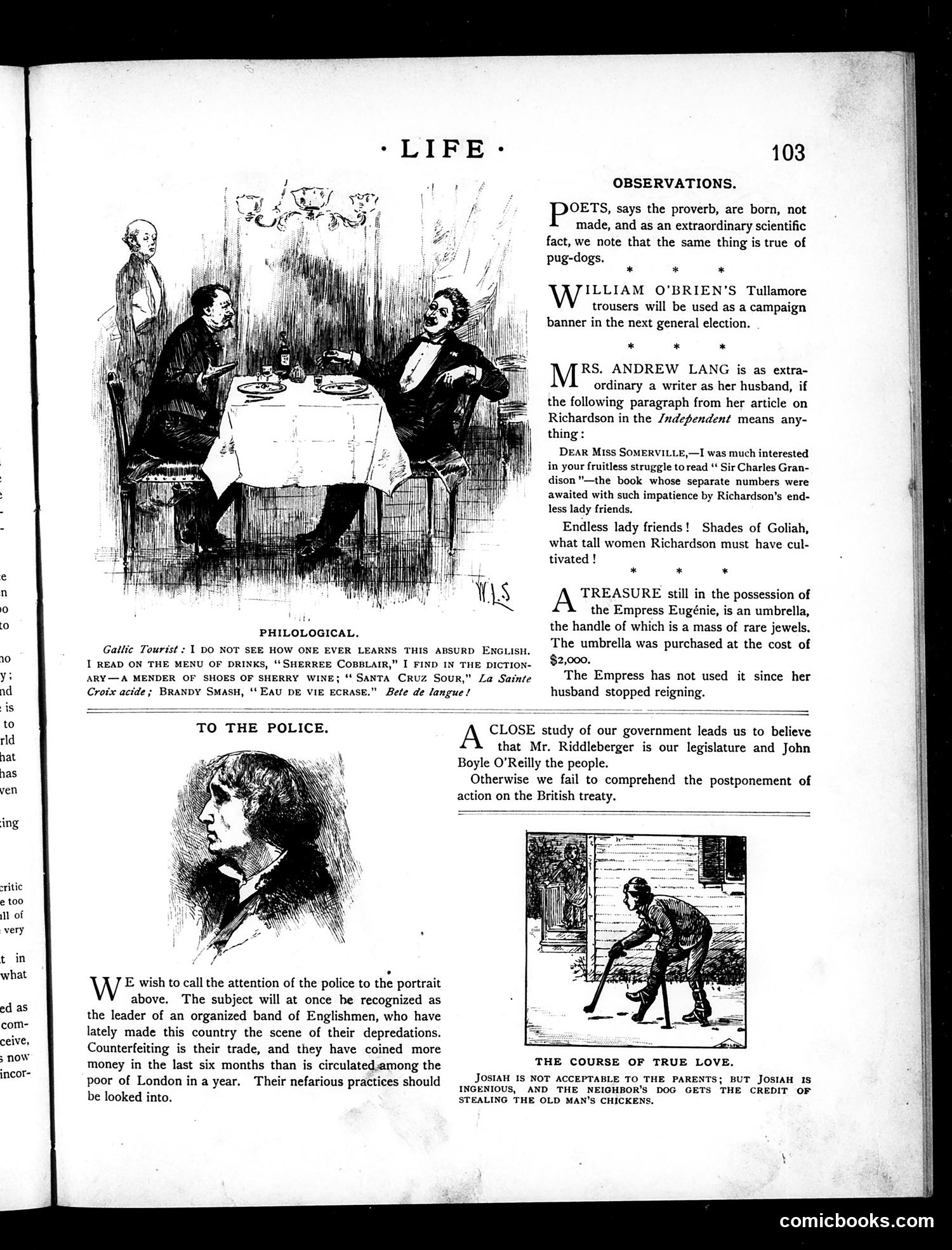
This page contains several brief satirical items typical of Life magazine's humor section: **"Observations"** includes quips about poets being "born, not made" (comparing them to pug-dogs), William O'Brien's Tullamore trousers as campaign material, and Mrs. Andrew Lang's writing about Richardson novels. **"To the Police"** features a sketch of a man's profile accompanying text alerting police to a portrait of an organized band of counterfeiters flooding London with fake currency—describing their operation as more lucrative than legitimate poor relief in the city annually. **"The Course of True Love"** shows a humorous illustration of a boy stealing an old man's chicken, with caption indicating Josiah receives credit while the neighbor's dog gets blamed. These are typical period satirical humor pieces without specific political candidates or major events referenced.
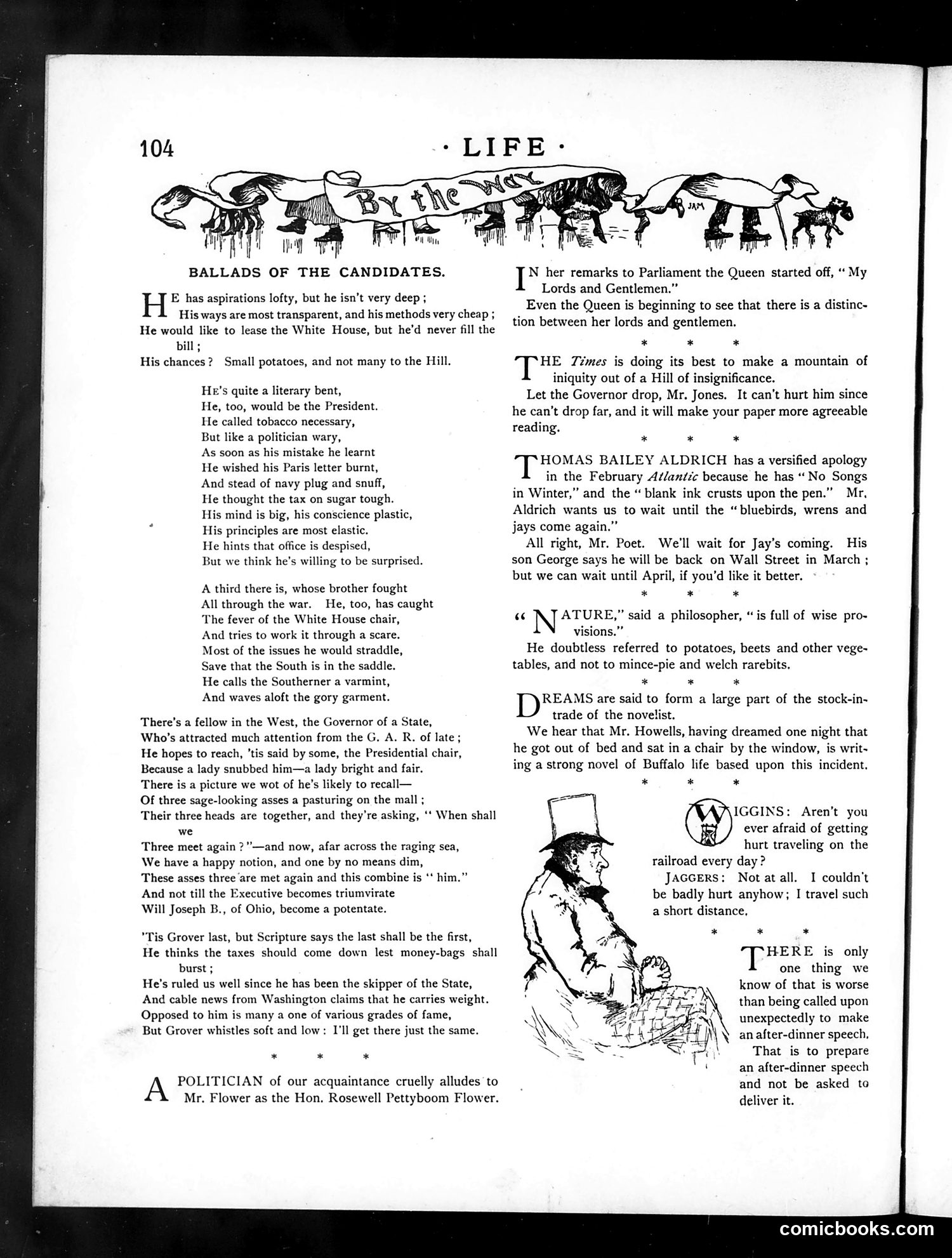
This page contains political satire about presidential candidates. The left column presents mocking verses about unnamed contenders—one with "lofty aspirations" but poor prospects for reaching the White House, another described as literary but calling tobacco "necessary," and a third whose brother fought in war. The right column includes brief satirical notes mocking contemporary political figures and publications. References include criticism of *The Times* newspaper, comments on Governor Jones, and ridicule of poet Thomas Bailey Aldrich's apology in *Atlantic* magazine about lacking winter songs. A small illustration shows a figure with a basket, possibly representing political baggage or campaign burdens. The overall tone is dismissive toward various political candidates and public figures of the era, typical of Life's satirical commentary.
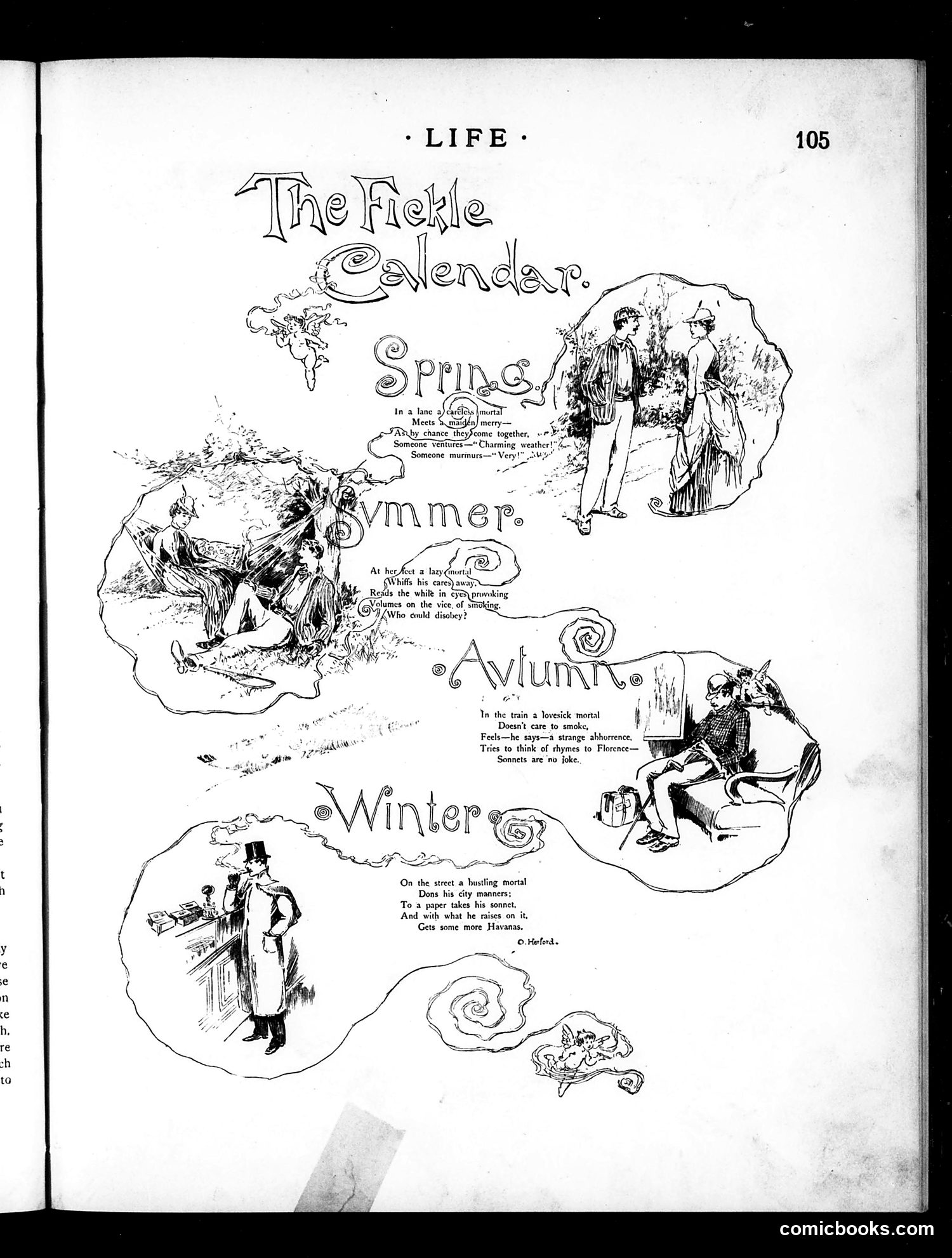
This is a humorous illustrated essay on the four seasons, presented as vignettes showing how people behave differently depending on the weather and time of year. Each seasonal panel contains sketched scenes with accompanying verse commentary. **Spring** depicts romance and outdoor gatherings. **Summer** shows leisure activities. **Autumn** (labeled "Autumn") presents someone traveling or departing. **Winter** features a street scene with what appears to be a man in formal dress (top hat) conducting business, with a note crediting "O. Herford" as the artist. The satire appears gentle—poking fun at how human behavior and mood shift seasonally, a universal human experience. The "fickle" in the title suggests people's inconstant nature as seasons change. This is lighthearted social commentary rather than political satire.
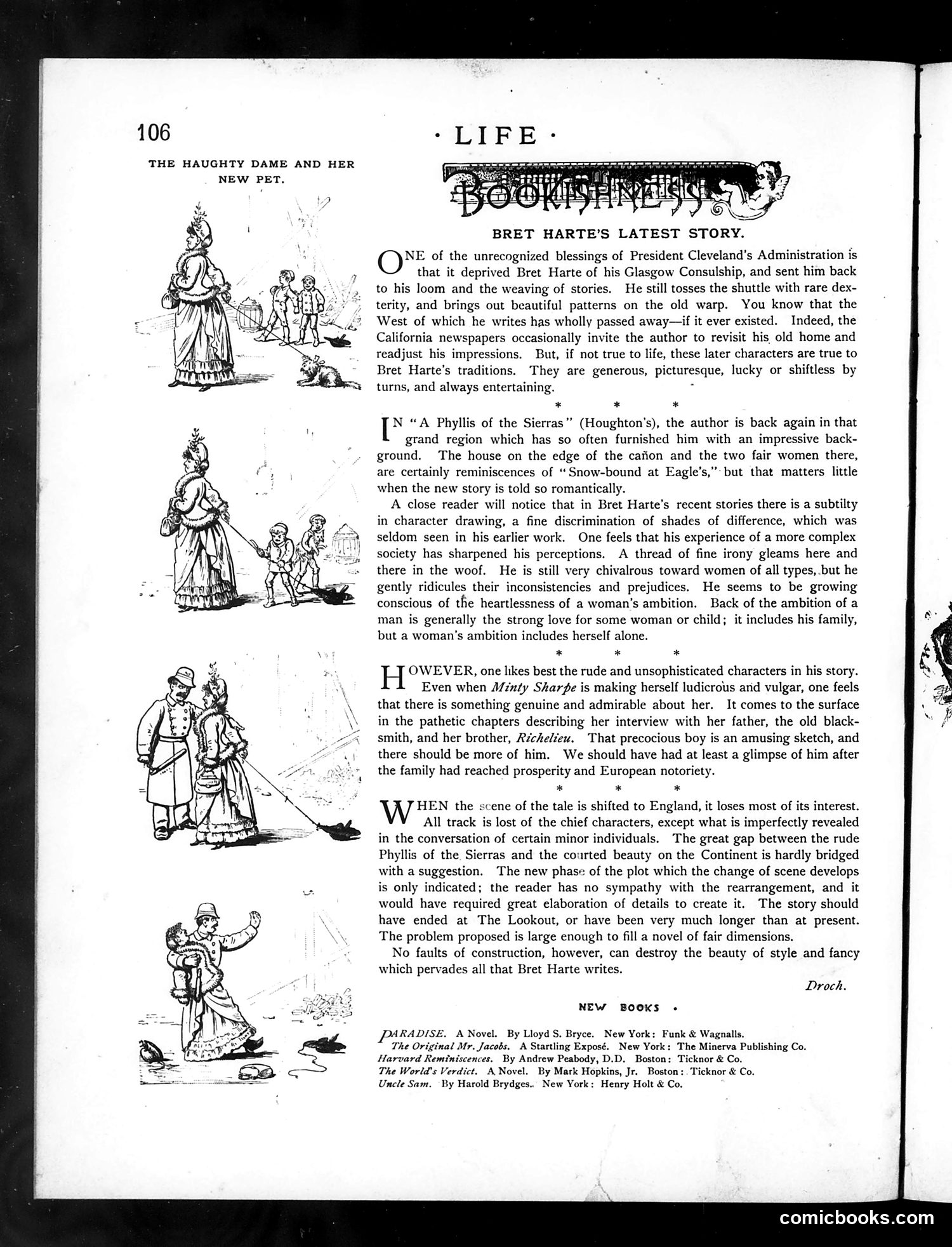
This page reviews Bret Harte's latest story, "A Phyllis of the Sierras," published in Houghton's magazine. The accompanying illustrations depict a Victorian-era woman in various scenes—appearing to show her interactions with frontier characters and children. The review praises Harte's character development and his nuanced portrayal of women, noting his evolution as a writer. It critiques the story's structure, particularly the weak English section that disrupts narrative momentum. The critic (signed "Droch") appreciates Harte's descriptive style and romantic treatment of California settings while acknowledging construction flaws. The page is primarily literary criticism rather than political satire, with illustrations serving as decorative accompaniment to the book review rather than political commentary.
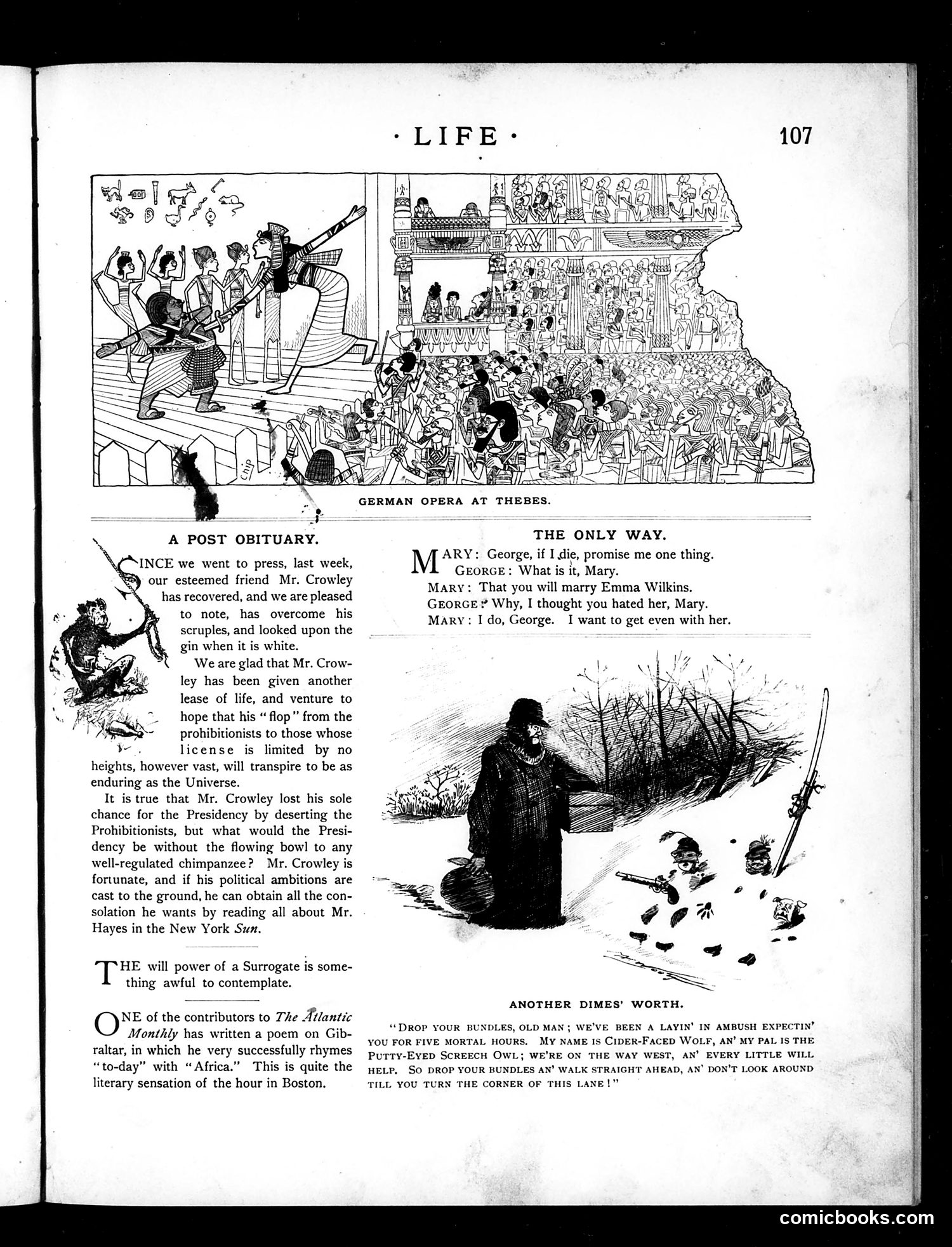
The top illustration depicts "German Opera at Thebes," a humorous anachronism combining ancient Egyptian settings with German operatic performance—likely satirizing the grandiosity of German opera culture. Below, "A Post Obituary" celebrates Mr. Crowley's recovery from illness, sarcastically suggesting he abandoned prohibitionism to recover. The passage critiques his political ambitions, implying his principles are flexible. "The Only Way" presents a dialogue between George and Mary about marriage, with Mary demanding George marry Emma Wilkins as condition for their own union—a comedic scenario about romantic entanglement. "Another Dimes' Worth" shows a figure in winter/outdoor hardship, with quoted dialogue from "Cider-Faced Wolf" and "Putty-Eyed Screech Owl" engaging in frontier-style banter, likely parodying rough Western or rural dialect humor popular in contemporary literature.
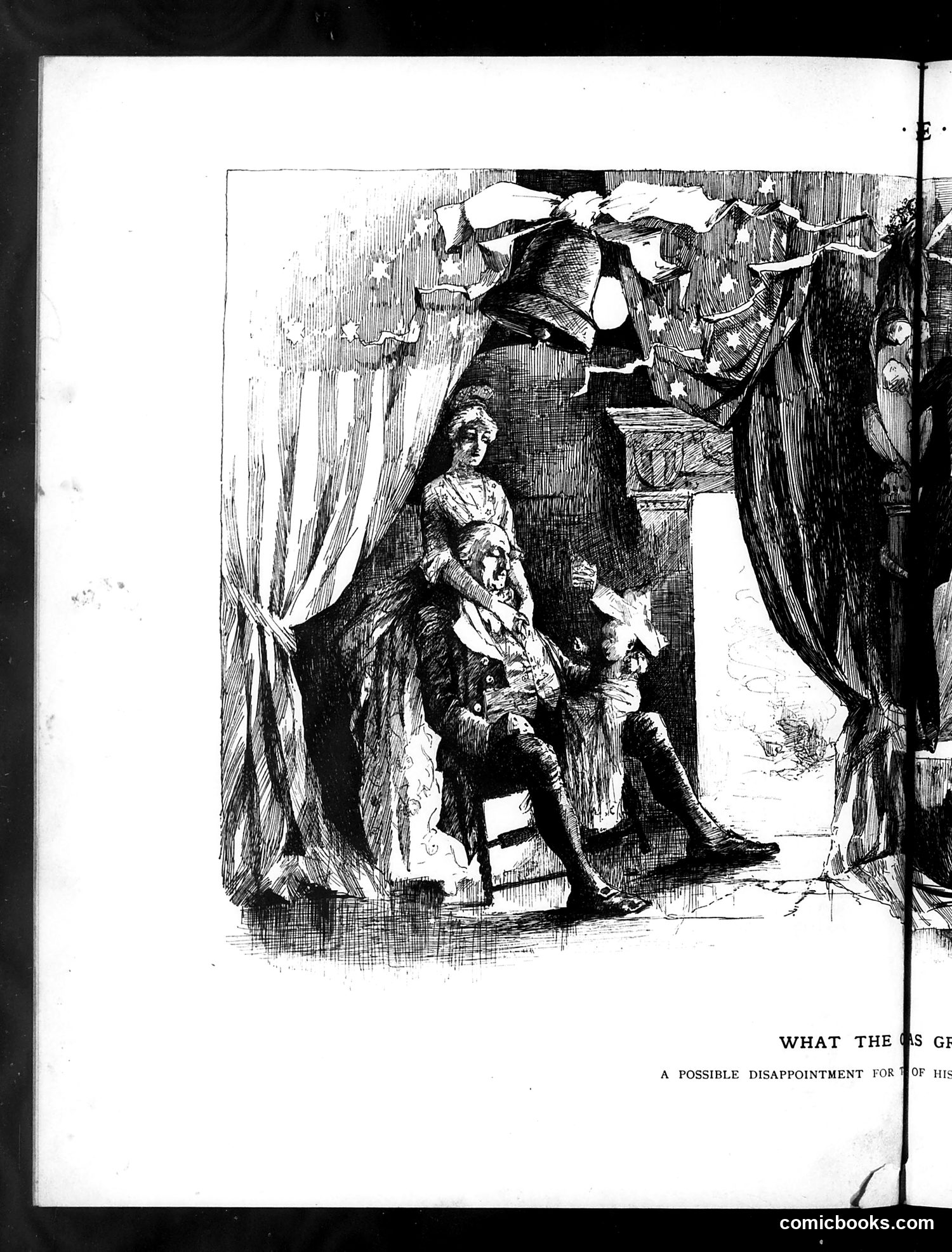
This engraving depicts an interior domestic scene with elegant furnishings and heavy curtains. A woman stands while two men sit—one appears to be a young man in military or formal dress, and another figure beside him. The partially visible caption reads "WHAT THE GAS GE[?]" and "A POSSIBLE DISAPPOINTMENT FOR [?] OF HIS[?]" Without the complete caption, the specific satirical target is unclear. However, the formal dress and domestic setting suggest this likely comments on romantic or social expectations—possibly satirizing disappointment in courtship, military life, or social advancement among the upper classes. The caption's reference to "gas" (possibly gaslight or gas service) might indicate social pretension or domestic concerns of the era. The engraving style and Life magazine context suggest late 19th or early 20th-century American social satire, but the exact meaning remains uncertain without the full caption text.
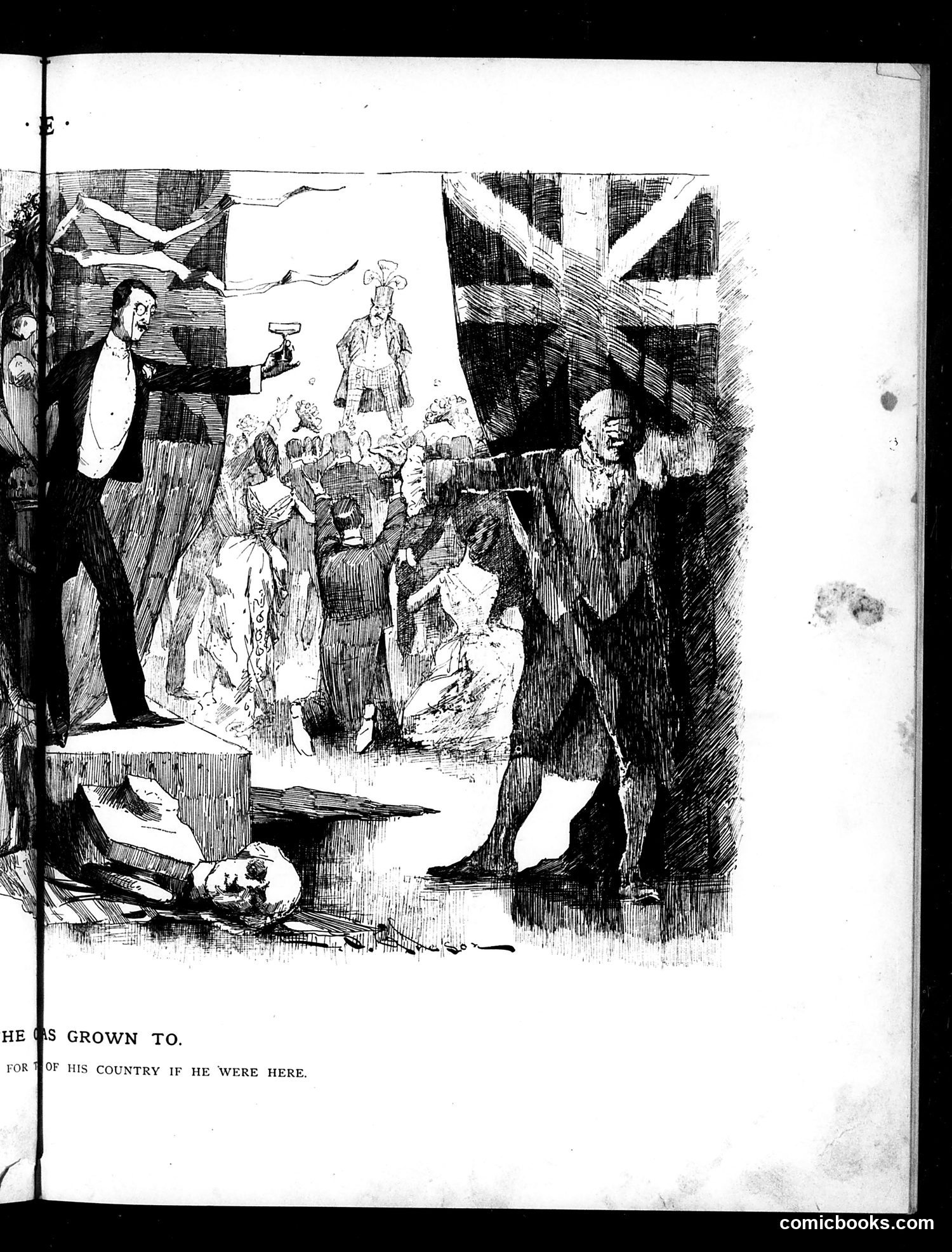
This appears to be a satirical scene depicting a formal gathering or reception. On the left stands a well-dressed man in formal attire gesturing toward the assembled crowd. A figure in military or official dress stands prominently in the center-background. The incomplete caption reads: "HE AS GROWN TO. / FOR T OF HIS COUNTRY IF HE WERE HERE." The text suggests this cartoon critiques how someone has "grown to" importance or changed in status, with ironic commentary about what would benefit "his country" if a particular person were present. Without the complete caption and more context about Life magazine's publication date, the specific figures and political reference remain unclear, though this appears to be commentary on a contemporary political or military figure's absence or influence.
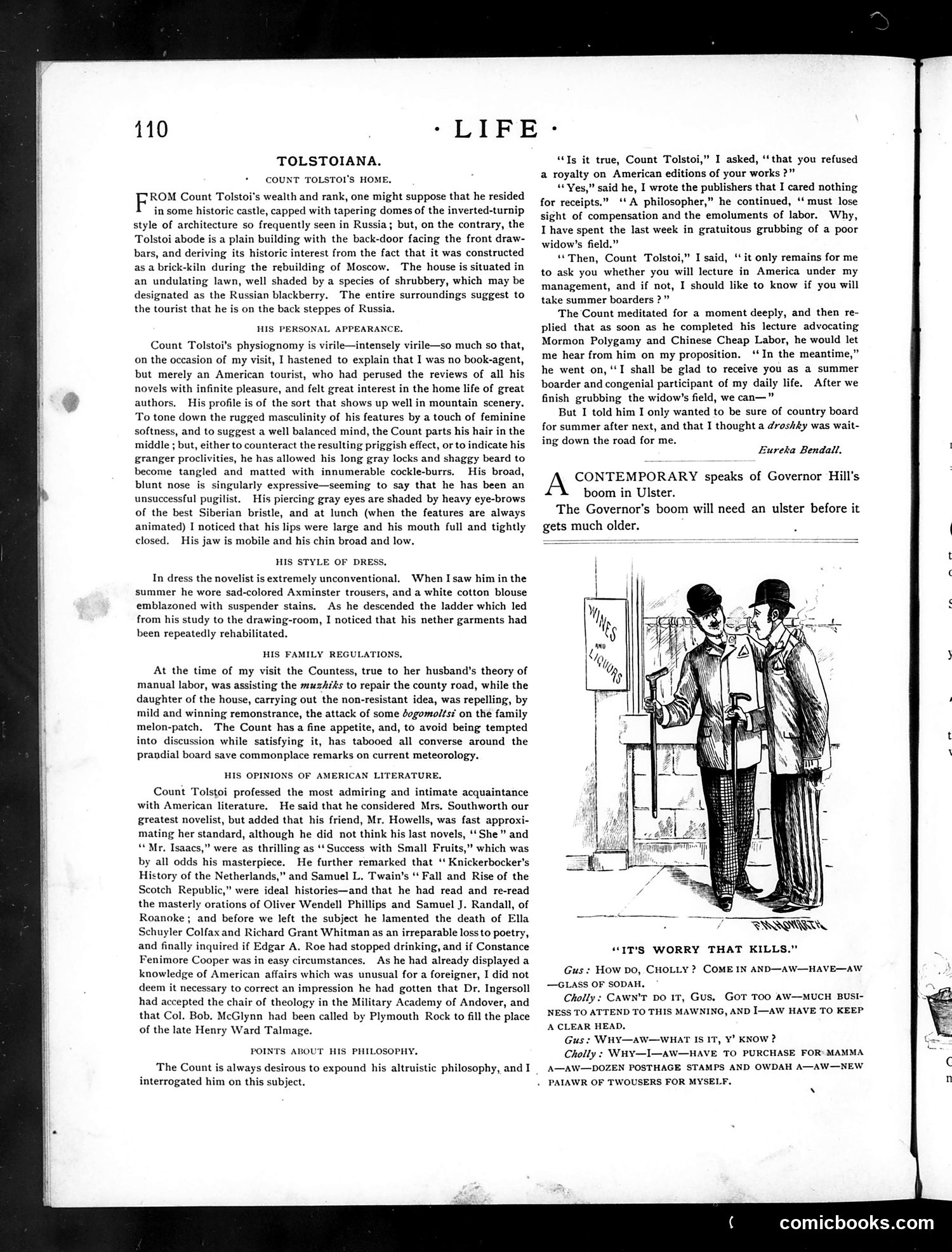
This page from *Life* magazine features an article about Leo Tolstoy's estate and philosophy, accompanied by a cartoon titled "It's Worry That Kills." The cartoon depicts two men at a doorway—one appears to be a servant or working-class figure speaking to a well-dressed gentleman. The dialogue reveals satire about urban anxieties: the working man lists various worries (glass of soda, attending morning appointments, purchasing postage stamps and new trousers), while the gentleman seems unbothered. The joke suggests that wealthy people worry about trivial matters, while working-class people concern themselves with basic necessities—satirizing class-based anxiety and the disconnect between rich and poor. The article itself celebrates Tolstoy's intellectual accomplishments and modest lifestyle at his Russian estate.
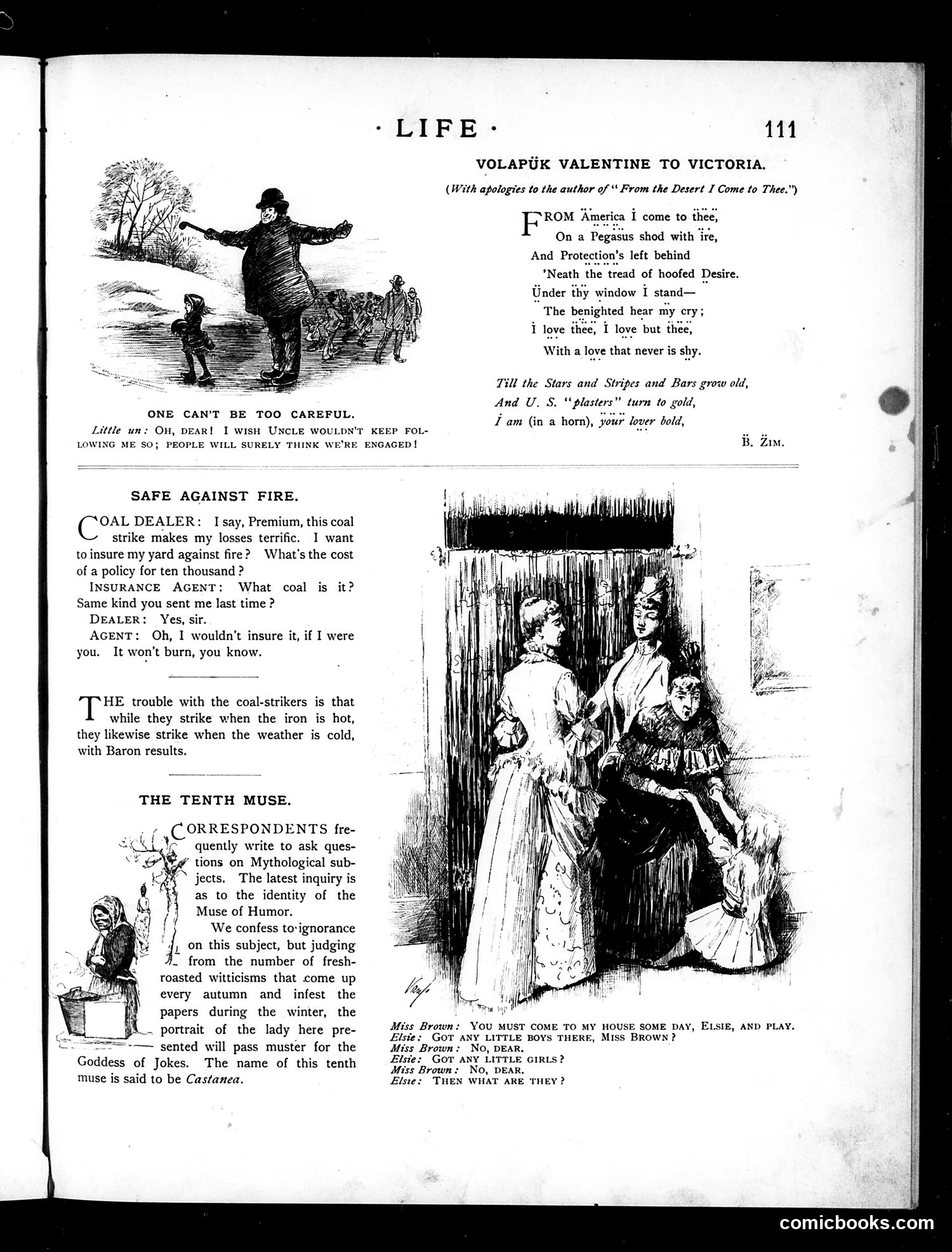
**Top Cartoon ("One Can't Be Too Careful"):** A satirical "Valentine to Victoria" (Queen Victoria of Britain), written as a love poem from America. The verse mocks American protectionist trade policies and expansionist desires, with lines like "Protection's left behind / 'Neath the tread of hoofed Desire." The accompanying sketch shows an uncle pursuing a young couple, with the girl worried about appearing "engaged"—a visual pun on America's political/economic entanglement with Britain. **"Safe Against Fire":** A joke about coal dealer insurance during labor strikes. An insurance agent refuses to insure coal because the dealer's coal "won't burn"—a dig at poor quality or that coal strikes make the product worthless. **"The Tenth Muse":** Discusses the mythological "Muse of Humor," suggesting autumn brings fresh jokes annually to newspapers. The accompanying dialogue with Miss Brown suggests humor comes from questionable social situations. All pieces use wordplay and mild social commentary typical of Life's satirical style.
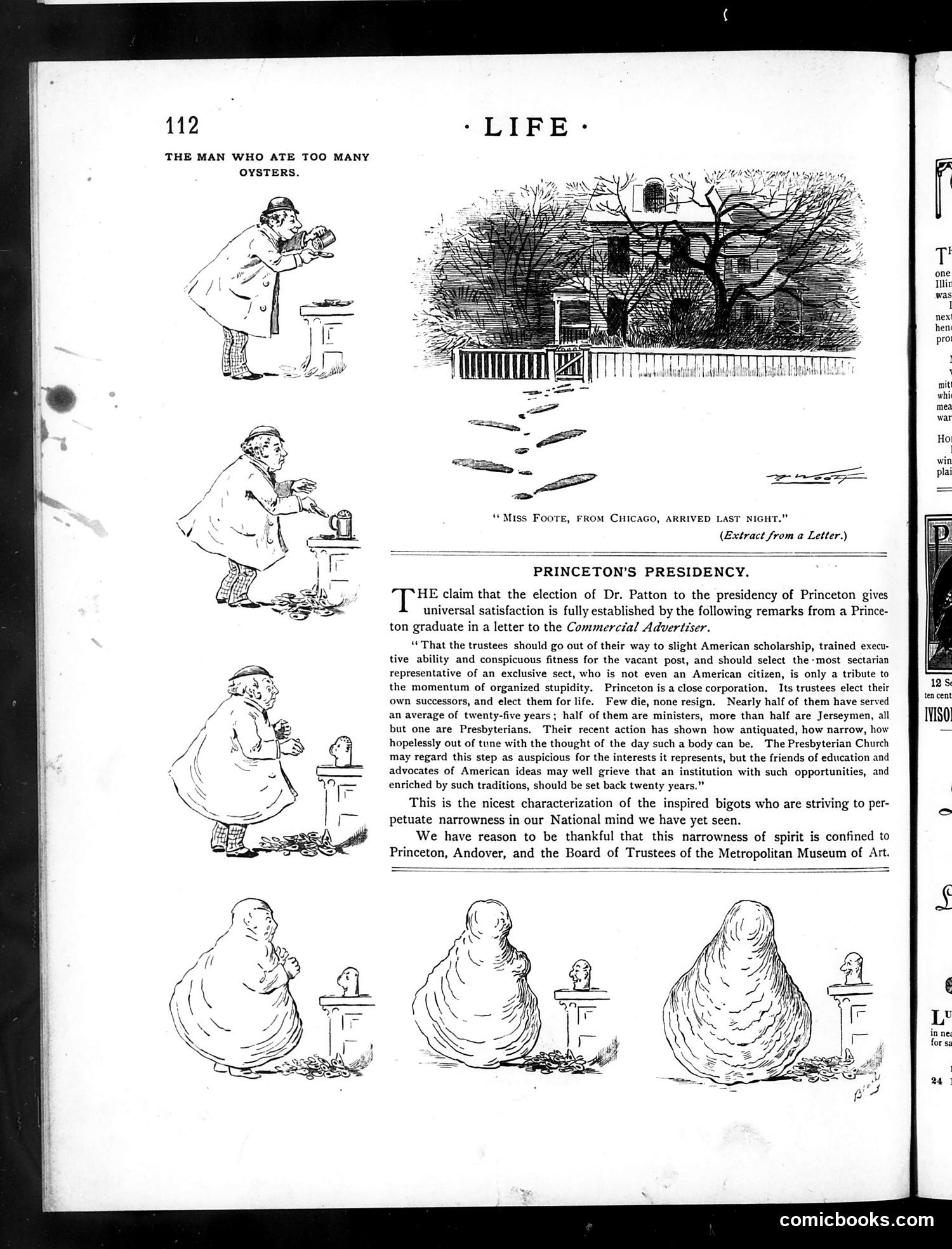
The upper cartoon uses visual humor: a man progressively swells after eating oysters, shown in four sequential panels depicting his expanding waistline. This is straightforward satirical comedy about gluttony. The lower section attacks Princeton University's selection of Dr. Patton as president. A quoted letter (attributed to a Princeton graduate) criticizes the trustees for choosing "the most sectarian representative of an exclusive sect, who is not even an American citizen" over qualified American scholars. The author condemns Princeton's self-perpetuating board of elderly Presbyterian ministers as "organized stupidity" that ignores modern thought. Life's editors endorse this critique, sarcastically celebrating it as the "nicest characterization of inspired bigots," then expand the complaint to include Andover and the Metropolitan Museum's trustees—suggesting these institutions represent narrow, entrenched East Coast elitism resistant to progressive American ideas.
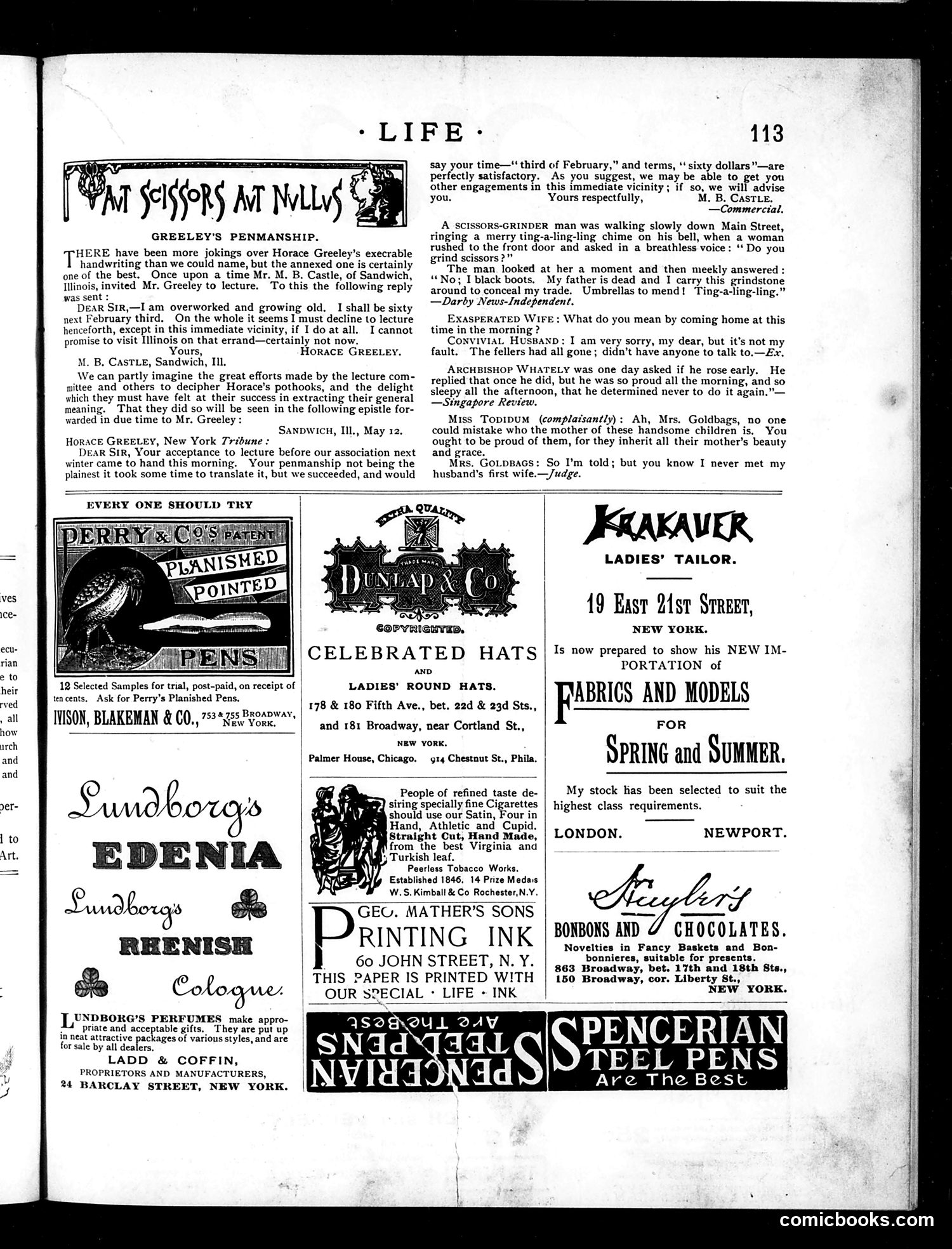
This page centers on a humorous anecdote about **Horace Greeley**, the famous editor of the *New York Tribune*, whose infamously illegible handwriting was a standing joke of the era. A lecture organizer from Illinois, M.B. Castle, invited Greeley to speak but received a reply so difficult to read that Castle's committee spent considerable effort deciphering it. The joke: Castle misread Greeley's polite *refusal* as an *acceptance*, understanding "I must decline" and age references as lecture terms. Castle's response letter—reading back what he believed were agreed terms—perfectly captures the comedy of misinterpretation stemming from Greeley's terrible penmanship. The anecdote reflects genuine contemporary frustration with Greeley's writing, which was frequently ridiculed in 19th-century newspapers. The page includes unrelated humorous short pieces and period advertisements (pens, hats, tailoring).
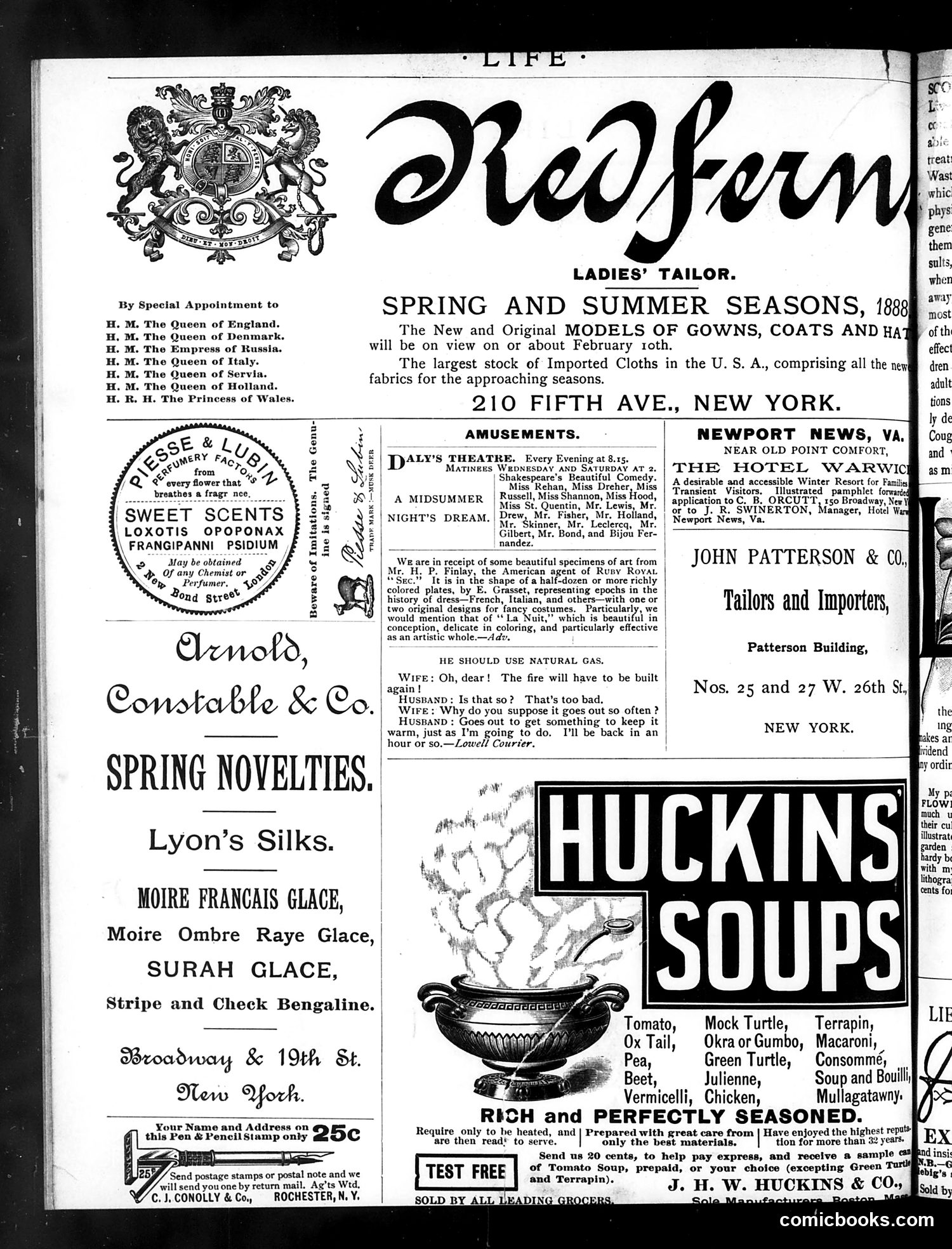
This is primarily an **advertising page** from Life magazine (1888), not a political cartoon. The dominant feature is a large advertisement for "Red Fern," a ladies' tailor at 210 Fifth Avenue, New York, boasting royal patronage by appointment to various European queens and royalty listed at top left. The page contains typical late-Victorian advertisements for luxury goods: imported silks, perfumes, soups, and hotel services. There is one small **satirical dialogue** about natural gas—a husband and wife joking that their fire "goes out to get something to keep it warm," a humorous anthropomorphization suggesting their heating system is unreliable or lazy. The advertisements reflect Gilded Age prosperity and consumer culture, targeting wealthy New Yorkers. The emphasis on European royal approval was a common marketing tactic to confer prestige on American luxury goods and services.
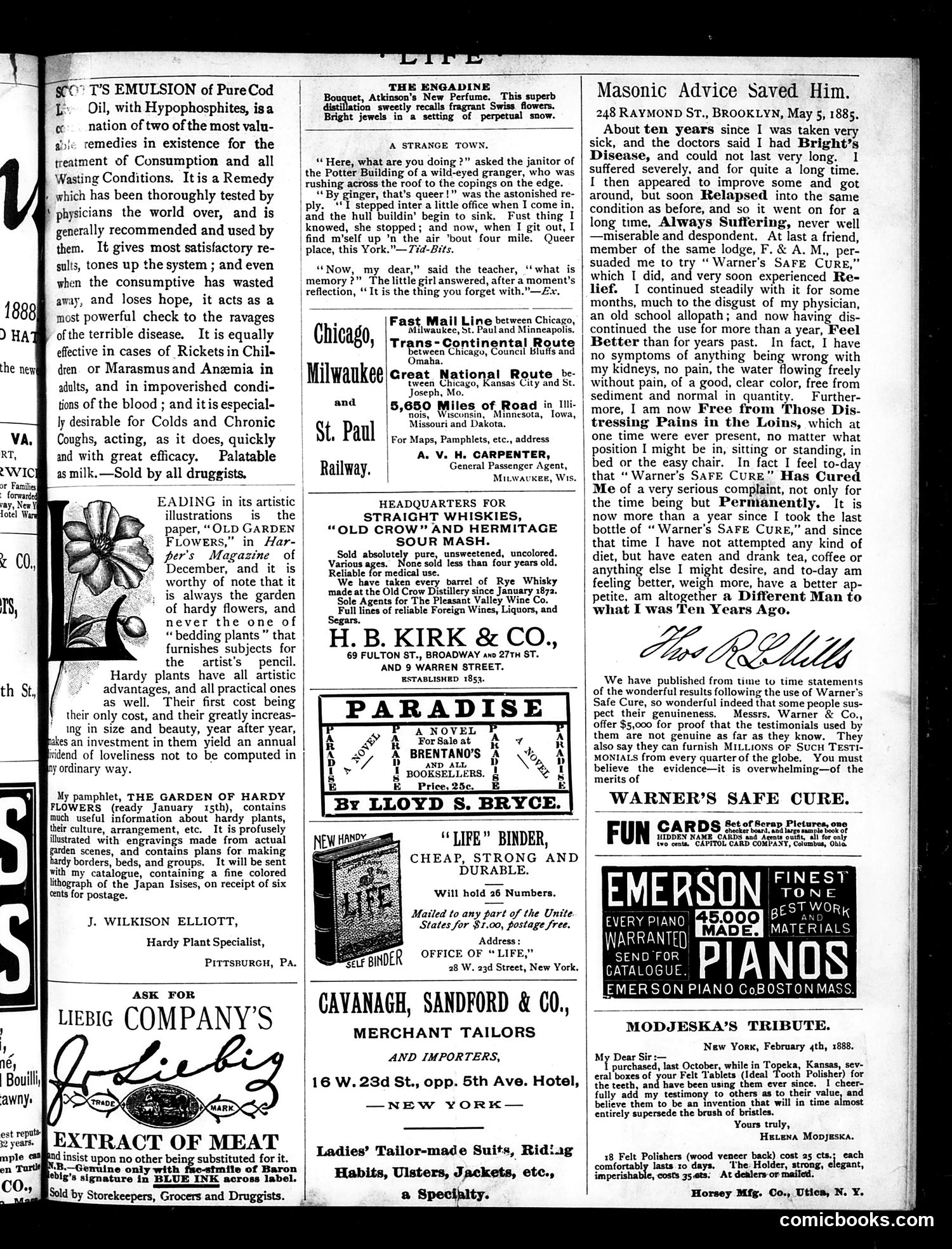
This page is primarily **advertisements and filler content**, not political cartoons. The only satirical piece is a brief anecdote titled "A Strange Town" (about two paragraphs), depicting a rural "granger" (farmer) who becomes confused by the tall Potter Building in New York City. Thinking the building is sinking when he enters an elevator, he panics and runs onto the roof, where he's shocked to find himself high above the ground. The joke mocks rural inexperience with urban architecture and modern technology. The page otherwise contains ads for Scott's Cod Oil Emulsion (a patent medicine for consumption/tuberculosis), hardy plants, perfume, railroad service, whiskey, and pianos—typical period advertising with no discernible satire beyond the brief anecdote.
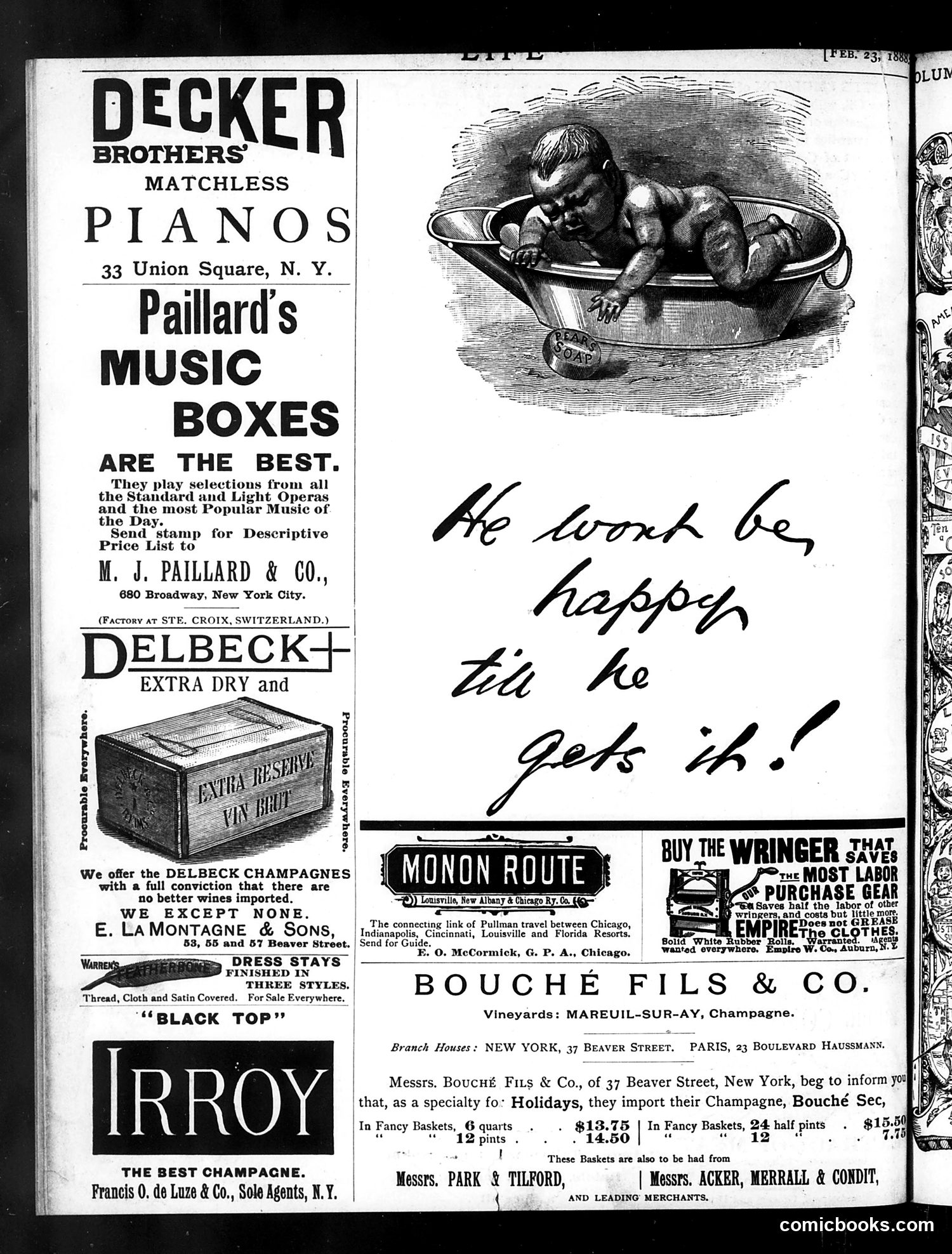
This is primarily an **advertising page**, not a satirical cartoon. The central image—a cherubic baby in a champagne coupe with handwritten text reading "He work be happy til he gets it!"—is a **product endorsement illustration** for Bouché Fils & Co. champagne, presented as humor rather than satire. The page features luxury goods advertisements typical of the Gilded Age: pianos, music boxes, champagne (multiple brands), dress stays, and a laundry wringer. The baby imagery suggests the joke that this champagne brings such happiness even infants desire it—a humorous exaggeration common in period advertising. The handwriting mimics baby speech ("He work be happy til he gets it!"), playing on contemporary sentimentality about children while promoting an adult luxury product. No political satire or specific figures are present; this reflects the magazine's shift toward commercial content rather than editorial commentary.