
Life, 1888-02-23 · page 10 of 16
Life — February 23, 1888 — page 10: what you’re looking at
What you’re looking at
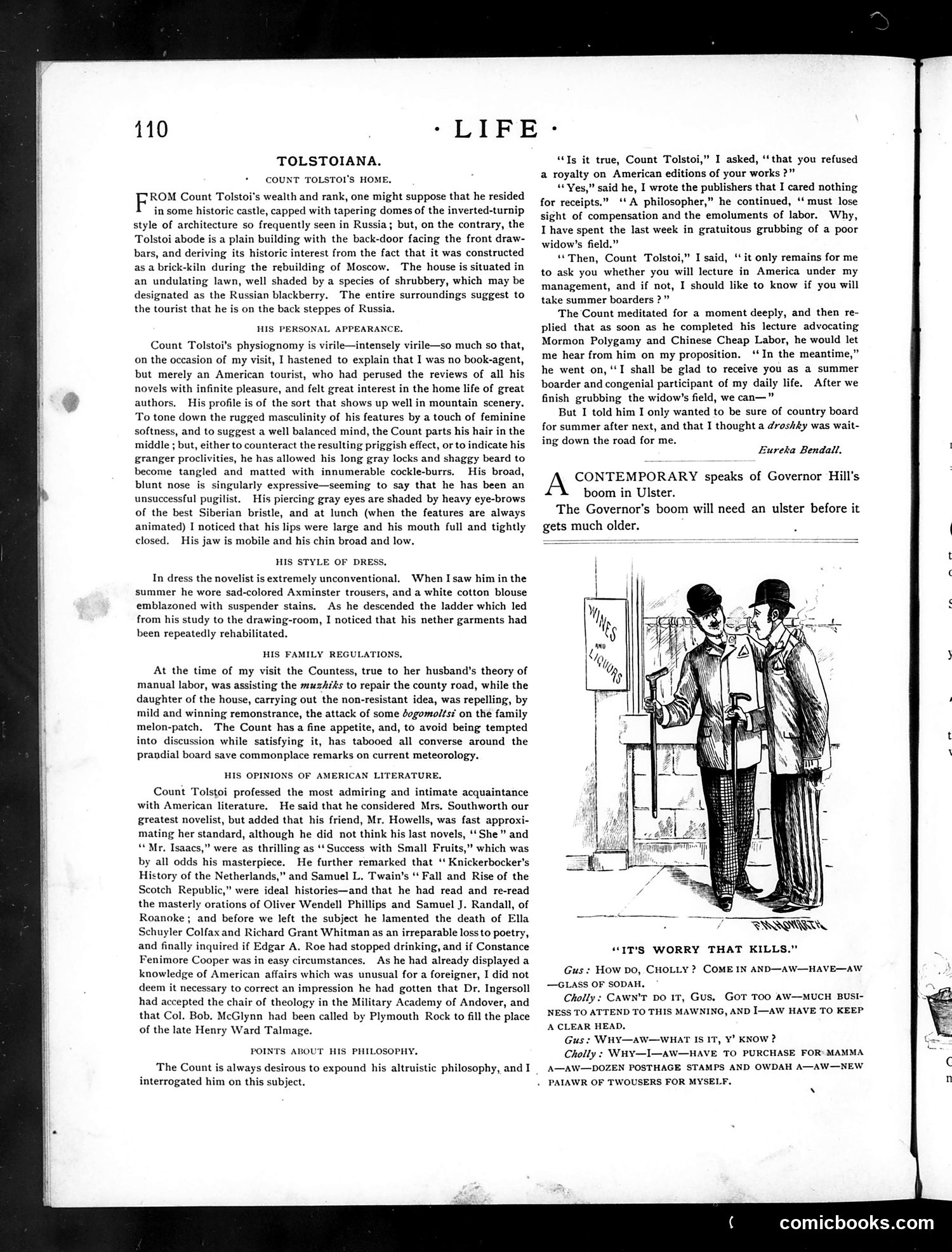
This page from *Life* magazine features an article about Leo Tolstoy's estate and philosophy, accompanied by a cartoon titled "It's Worry That Kills." The cartoon depicts two men at a doorway—one appears to be a servant or working-class figure speaking to a well-dressed gentleman. The dialogue reveals satire about urban anxieties: the working man lists various worries (glass of soda, attending morning appointments, purchasing postage stamps and new trousers), while the gentleman seems unbothered. The joke suggests that wealthy people worry about trivial matters, while working-class people concern themselves with basic necessities—satirizing class-based anxiety and the disconnect between rich and poor. The article itself celebrates Tolstoy's intellectual accomplishments and modest lifestyle at his Russian estate.
📄 Transcribed text from this page (OCR, searchable)
Machine-transcribed from the original scan — historical spelling and the odd misread are preserved.
110 TOLSTOIANA. COUNT TOLSTOI'S HOME, ROM Count Tolstoi's wealth and rank, one might suppose that he resided in some historic castle, capped with tapering domes of the inverted-turnip style of architecture so frequently seen in Russia; but, on the contrary, the Tolstoi abode is a plain building with the back-door facing the front draw- bars, and deriving its historic interest from the fact that it was constructed asa brick-kiln during the rebuilding of Moscow. The house is situated in an undulating lawn, well shaded by a species of shrubbery, which may be designated as the Russian blackberry. The entire surroundings suggest to the tourist that he is on the back steppes of Russia. HIS PERSONAL APPEARANCE. Count Tolstoi’s physiognomy is virile—intensely virile—so much so that, on the occasion of my visit, I hastened to explain that I was no book-agent, but merely an American tourist, who had perused the reviews of all his novels with infinite pleasure, and felt great interest in the home life of great authors. His profile is of the sort that shows up well in mountain scenery. To tone down the rugged masculinity of his features by a touch of feminine softness, and to suggest a well balanced mind, the Count parts his hair in the middle ; but, either to counteract the resulting priggish effect, or to indicate his granger proclivities, he has allowed his long gray locks and shaggy beard to become tangled and matted with innumerable cockle-burrs. His broad, blunt nose is singularly expressive—seeming to say that he has been an unsuccessful pugilist. His piercing gray eyes are shaded by heavy eye-brows of the best Siberian bristle, and at lunch (when the features are always animated) I noticed that his lips were large and his mouth full and tightly closed. His jaw is mobile and his chin broad and low. HIS STYLE OF DRESS, In dress the novelist is extremely unconventional. When I saw him in the summer he wore sad-colored Axminster trousers, and a white cotton blouse emblazoned with suspender stains, As he descended the ladder which led from his study to the drawing-room, I noticed that his nether garments had been repeatedly rehabilitated. HIS FAMILY REGULATIONS, At the time of my visit the Countess, true to her husband’s theory of manual labor, was assisting the mushihs to repair the county road, while the daughter of the house, carrying out the non-resistant idea, was repelling, by mild and winning remonstrance, the attack of some dogomol/ts? on the family melon-patch. The Count has a fine appetite, and, to avoid being tempted into discussion while satisfying it, has tabooed all converse around the prandial board save commonplace remarks on current meteorology. HIS OPINIONS OF AMERICAN LITERATURE, Count Tolstoi professed the most admiring and intimate acquaintance with American literature, He said that he considered Mrs. Southworth our greatest novelist, but added that his friend, Mr. Howells, was fast approxi- mating her standard, although he did not think his last novels, “She” and “Mr, Isaacs,” were as thrilling as “Success with Small Fruits,” which was by all odds his masterpiece. He further remarked that ‘ Knickerbocker’s History of the Netherlands,” and Samuel L. Twain's ‘ Fall and Rise of the Scotch Republic,” were ideal histories—and that he had read and re-read the masterly orations of Oliver Wendell Phillips and Samuel J. Randall, of Roanoke ; and before we left the subject he lamented the death of Ella Schuyler Colfax and Richard Grant Whitman as an irreparable loss to poetry, and finally inquired if Edgar A. Roe had stopped drinking, and if Constance Fenimore Cooper was in easy circumstances, As he had already displayed a knowledge of American affairs which was unusual for a foreigner, I did not deem it necessary to correct an impression he had gotten that Dr. Ingersoll had accepted the chair of theology in the Military Academy of Andover, and that Col. Bob. McGlynn had been called by Plymouth Rock to fill the place of the late Henry Ward Talmage. POINTS ABOUT HIS PHILOSOPHY. ‘The Count is always desirous to expound his altruistic philosophy, and I interrogated him on this subject. -LIFE: “Is it true, Count Tolstoi,” I asked, “that you refused a royalty on American editions of your works ?” “Yes,” said he, I wrote the publishers that I cared nothing for receipts.” ‘A philosopher,” he continued, ‘ must lose sight of compensation and the emoluments of labor. Why, Ihave spent the last week in gratuitous grubbing of a poor widow’s field.” “Then, Count Tolstoi,” I said, “ it only remains for me to ask you whether you will lecture in America under my management, and if not, I should like to know if you will take summer boarders ?” ‘The Count meditated for a moment deeply, and then re- plied that as soon as he completed his lecture advocating Mormon Polygamy and Chinese Cheap Labor, he would let me hear from him on my proposition. ‘In the meantime,” he went on, ‘I shall be glad to receive you as a summer boarder and congenial participant of my daily life. After we finish grubbing the widow’s field, we can—” But I told him I only wanted to be sure of country board for summer after next, and that I thought a droshky was wait- ing down the road for me. Eureka Bendall. A CONTEMPORARY speaks of Governor Hill's boom in Ulster. The Governor's boom will need an ulster before it gets much older. “IT’S WORRY THAT KILLS.” Gus : How Do, CHOLLY ? COME IN AND—AW—HAVE—AW —GLASS OF SODAH. Cholly: Cawn’? po 1T, Gus, GOT TOO AW—MUCH BUSI- NESS TO ATTEND TO THIS MAWNING, AND I—AW HAVE TO KEEP A CLEAR HEAD. Gus; WHY—AW—WHAt Is IT, ¥’ KNOW? Cholly ; WHy—I—AW—HAVE TO PURCHASE FOR-MAMMA A—AW—DOZEN POSTHAGE STAMPS AND OWDAH A—AW—NEW . PAIAWR OF TWOUSERS FOR MYSELF. N comicbooks.com