
Life, 1888-02-23 · page 6 of 16
Life — February 23, 1888 — page 6: what you’re looking at
What you’re looking at
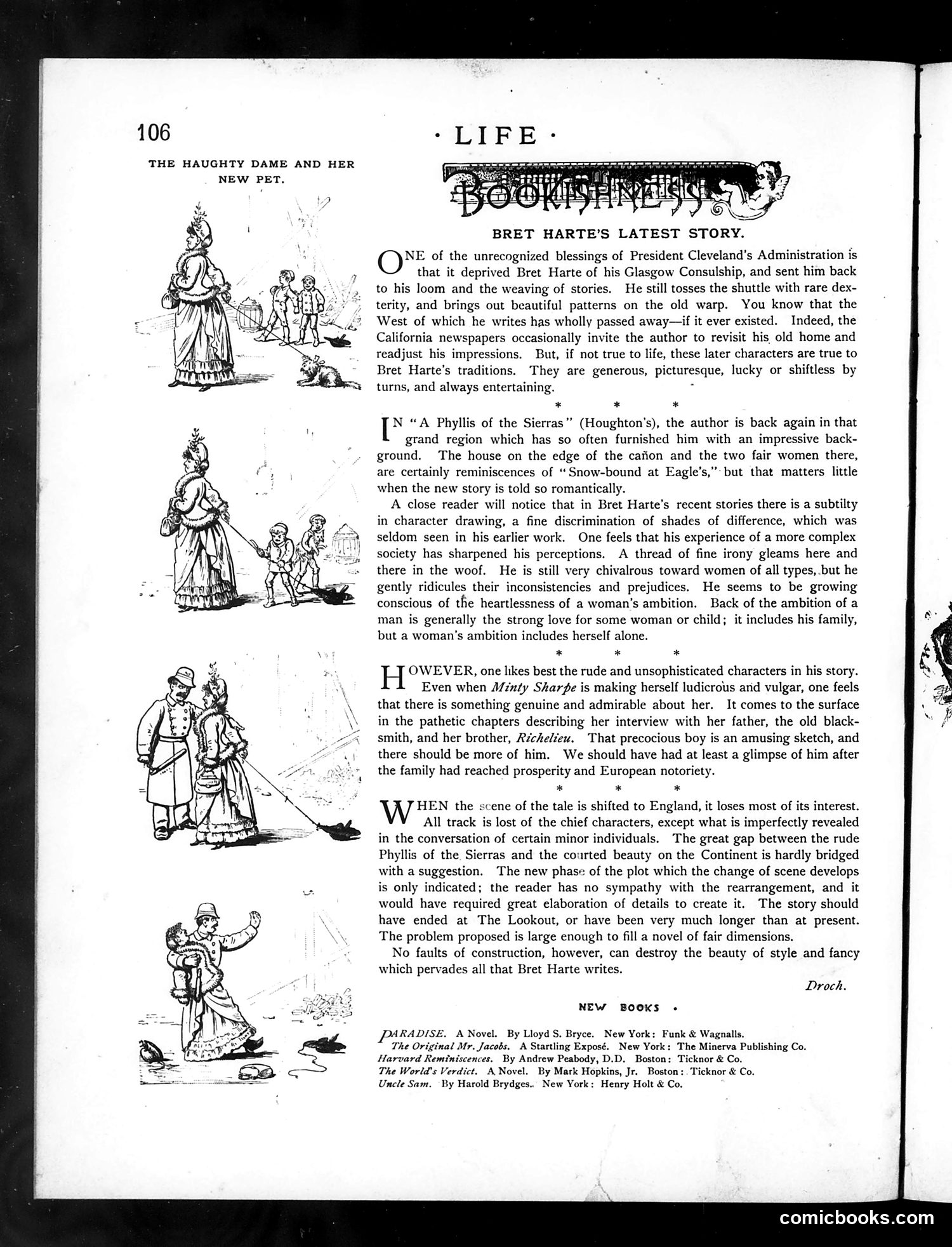
This page reviews Bret Harte's latest story, "A Phyllis of the Sierras," published in Houghton's magazine. The accompanying illustrations depict a Victorian-era woman in various scenes—appearing to show her interactions with frontier characters and children. The review praises Harte's character development and his nuanced portrayal of women, noting his evolution as a writer. It critiques the story's structure, particularly the weak English section that disrupts narrative momentum. The critic (signed "Droch") appreciates Harte's descriptive style and romantic treatment of California settings while acknowledging construction flaws. The page is primarily literary criticism rather than political satire, with illustrations serving as decorative accompaniment to the book review rather than political commentary.
📄 Transcribed text from this page (OCR, searchable)
Machine-transcribed from the original scan — historical spelling and the odd misread are preserved.
106 THE HAUGHTY DAME AND HER BRET HARTE’S LATEST STORY. O™ of the unrecognized blessings of President Cleveland's Administration is > that it deprived Bret Harte of his Glasgow Consulship, and sent him back », to his loom and the weaving of stories. He still tosses the shuttle with rare dex- terity, and brings out beautiful patterns on the old warp. You know that the West of which he writes has wholly passed away—if it ever existed. Indeed, the California newspapers occasionally invite the author to revisit his, old home and readjust his impressions. But, if not true to life, these later characters are true to Bret Harte’s traditions. They are generous, picturesque, lucky or shiftless by turns, and always entertaining. . * * * | “A Phyllis of the Sierras” (Houghton’s), the author is back again in that grand region which has so often furnished him with an impressive back- ground. The house on the edge of the cafion and the two fair women there, are certainly reminiscences of “Snow-bound at Eagle’s,”’ but that matters little when the new story is told so romantically. A close reader will notice that in Bret Harte’s recent stories there is a subtilty in character drawing, a fine discrimination of shades of difference, which was seldom seen in his earlier work. One feels that his experience of a more complex society has sharpened his perceptions. A thread of fine irony gleams here and there in the woof. He is still very chivalrous toward women of all types, .but he gently ridicules their inconsistencies and prejudices. He seems to be growing conscious of the heartlessness of a woman's ambition. Back of the ambition of a man is generally the strong love for some woman or child; it includes his family, but a woman's ambition includes herself alone. * * * OWEVER, one likes best the rude and unsophisticated characters in his story. Even when Minty Sharfe is making herself ludicrous and vulgar, one feels that there is something genuine and admirable about her. It comes to the surface in the pathetic chapters describing her interview with her father, the old black- smith, and her brother, Rzchel‘eu. That precocious boy is an amusing sketch, and there should be more of him. We should have had at least a glimpse of him after the family had reached prosperity and European notoriety. * * * HEN the scene of the tale is shifted to England, it loses most of its interest. All track is lost of the chief characters, except what is imperfectly revealed in the conversation of certain minor individuals. The great gap between the rude Phyllis of the Sierras and the courted beauty on the Continent is hardly bridged with a suggestion. The new phase of the plot which the change of scene develops is only indicated; the reader has no sympathy with the rearrangement, and it would have required great elaboration of details to create it. The story should have ended at The Lookout, or have been very much longer than at present. The problem proposed is large enough to fill a novel of fair dimensions. No faults of construction, however, can destroy the beauty of style and fancy which pervades all that Bret Harte writes. Droch. NEW BOOKS - RADISE. A Novel. By Lloyd S, Bryce. New York: Funk & Wagnalls, The Original Mr. Jacobs, A Startling Exposé. New York: The Minerva Publishing Co. Harvard Reminiscences. By Andrew Peabody, D.D. Boston: Ticknor & Co. The World's Verdict. A Novel. By Mark Hopkins, Jr. Boston: Ticknor & Co. Uncle Sam. By Harold Brydges.. New York: Henry Holt & Co. comicbooks.com