
Life, 1888-02-23 · page 2 of 16
Life — February 23, 1888 — page 2: what you’re looking at
What you’re looking at
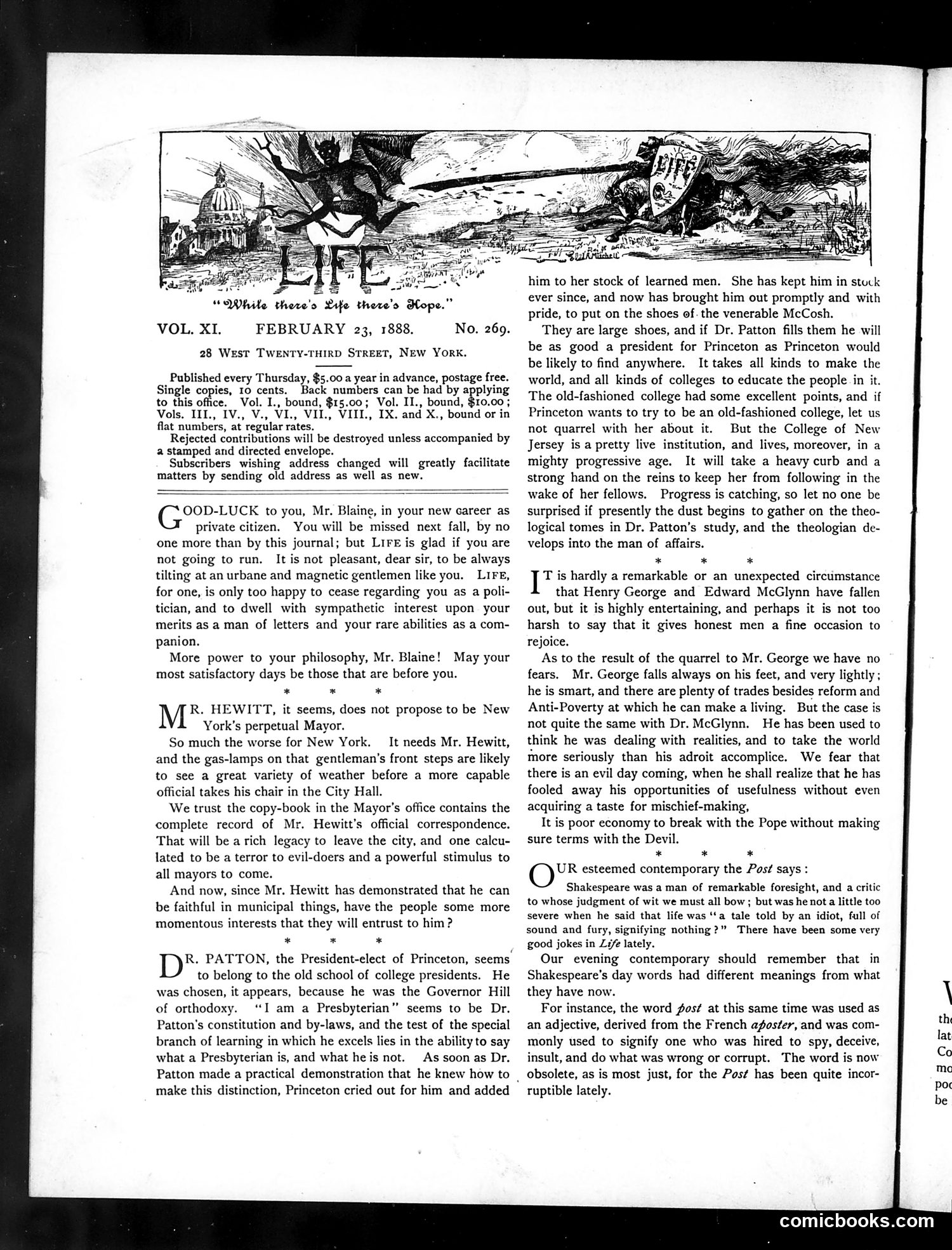
The page contains editorial commentary rather than cartoons. The visible masthead illustration shows a classical "Life" figure, but the content focuses on three separate satirical notes: 1. **Blaine's retirement**: A farewell to James G. Blaine, the former politician transitioning to private citizenship, noting his absence from public life won't be greatly missed. 2. **Hewitt as Mayor**: Commentary questioning whether New York's mayor has sufficient capabilities, suggesting his administration lacks meaningful accomplishment. 3. **Dr. Patton at Princeton**: Discussion of the new Princeton president, a Presbyterian theologian, contrasting his old-fashioned educational philosophy with modern progressive approaches. The text suggests tensions between traditional and contemporary college values. The final section discusses Shakespeare's language, noting how word meanings have changed over centuries—specific to the term "post."
📄 Transcribed text from this page (OCR, searchable)
Machine-transcribed from the original scan — historical spelling and the odd misread are preserved.
VOL. XI. FEBRUARY 23, 1888. No. 269. 28 West TWENTY-THIRD STREET, NEw York. Published every Thursday, $5.00 a year in advance, postage free. Single copies, 10 cents. Back numbers can be had by applying to this office. Vol. I., bound, $15.00; Vol. II., bound, $10.00 ; Vols. III., IV., V., VI., VII., VIII, IX. and X., bound or in flat numbers, at regular rates. Rejected contributions will be destroyed unless accompanied by a stamped and directed envelope. Subscribers wishing address changed will greatly facilitate matters by sending old address as well as new. OOD-LUCK to you, Mr. Blaine, in your new career as private citizen. You will be missed next fall, by no one more than by this journal; but Lire is glad if you are not going to run. It is not pleasant, dear sir, to be always tilting at an urbane and magnetic gentlemen like you. LIFE, for one, is only too happy to cease regarding you as a poli- tician, and to dwell with sympathetic interest upon your merits as a man of letters and your rare abilities as a com- panion. More power to your philosophy, Mr. Blaine! May your most satisfactory days be those that are before you. * x * R. HEWITT, it seems, does not propose to be New York's perpetual Mayor. So much the worse for New York. It needs Mr. Hewitt, and the gas-lamps on that gentleman's front steps are likely to see a great variety of weather before a more capable official takes his chair in the City Hall. We trust the copy-book in the Mayor's office contains the complete record of Mr. Hewitt’s official correspondence. That will be a rich legacy to leave the city, and one calcu- lated to be a terror to evil-doers and a powerful stimulus to all mayors to come. And now, since Mr. Hewitt has demonstrated that he can be faithful in municipal things, have the people some more momentous interests that they will entrust to him ? * * * R. PATTON, the President-elect of Princeton, seems to belong to the old school of college presidents. He was chosen, it appears, because he was the Governor Hill of orthodoxy. “I am a Presbyterian” seems to be Dr. Patton's constitution and by-laws, and the test of the special branch of learning in which he excels lies in the ability to say what a Presbyterian is, and what heis not. As soon as Dr. Patton made a practical demonstration that he knew how to , make this distinction, Princeton cried out for him and added him to her stock of learned men. She has kept him in stuck ever since, and now has brought him out promptly and with pride, to put on the shoes of. the venerable McCosh. They are large shoes, and if Dr. Patton fills them he will be as good a president for Princeton as Princeton would be likely to find anywhere. It takes all kinds to make the world, and all kinds of colleges to educate the people in it. The old-fashioned college had some excellent points, and if Princeton wants to try to be an old-fashioned college, let us not quarrel with her about it. But the College of New Jersey is a pretty live institution, and lives, moreover, in a mighty progressive age. It will take a heavy curb and a strong hand on the reins to keep her from following in the wake of her fellows. Progress is catching, so let no one be surprised if presently the dust begins to gather on the theo- logical tomes in Dr. Patton’s study, and the theologian de- velops into the man of affairs. * * * J’ is hardly a remarkable or an unexpected circumstance that Henry George and Edward McGlynn have fallen out, but it is highly entertaining, and perhaps it is not too harsh to say that it gives honest men a fine occasion to rejoice. As to the result of the quarrel to Mr. George we have no fears. Mr. George falls always on his feet, and very lightly ; he is smart, and there are plenty of trades besides reform and Anti-Poverty at which he can make a living. But the case is not quite the same with Dr. McGlynn. He has been used to think he was dealing with realities, and to take the world more seriously than his adroit accomplice. We fear that there is an evil day coming, when he shall realize that he has fooled away his opportunities of usefulness without even acquiring a taste for mischief-making, It is poor economy to break with the Pope without making sure terms with the Devil. * * * UR esteemed contemporary the Pos? says : Shakespeare was a man of remarkable foresight, and a critic to whose judgment of wit we must all bow ; but was he not a little too severe when he said that life was ‘a tale told by an idiot, full of sound and fury, signifying nothing?” There have been some very good jokes in Lif lately. Our evening contemporary should remember that in Shakespeare's day words had different meanings from what they have now. For instance, the word Zos¢ at this same time was used as an adjective, derived from the French afoster, and was com- monly used to signify one who was hired to spy, deceive, insult, and do what was wrong or corrupt. The word is now obsolete, as is most just, for the Post has been quite incor- ruptible lately. comicbooks.com