
Life, 1888-02-23 · page 12 of 16
Life — February 23, 1888 — page 12: what you’re looking at
What you’re looking at
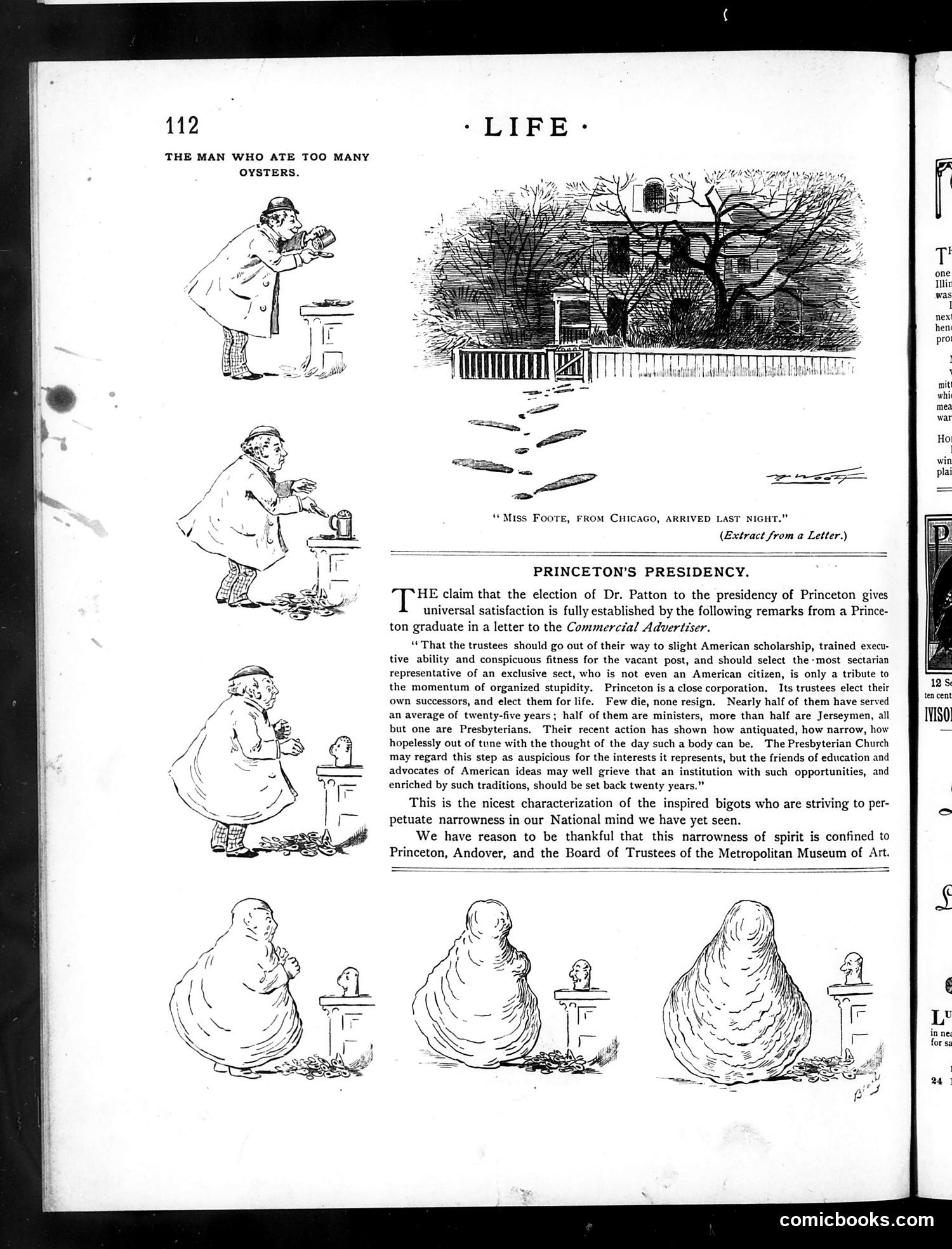
The upper cartoon uses visual humor: a man progressively swells after eating oysters, shown in four sequential panels depicting his expanding waistline. This is straightforward satirical comedy about gluttony. The lower section attacks Princeton University's selection of Dr. Patton as president. A quoted letter (attributed to a Princeton graduate) criticizes the trustees for choosing "the most sectarian representative of an exclusive sect, who is not even an American citizen" over qualified American scholars. The author condemns Princeton's self-perpetuating board of elderly Presbyterian ministers as "organized stupidity" that ignores modern thought. Life's editors endorse this critique, sarcastically celebrating it as the "nicest characterization of inspired bigots," then expand the complaint to include Andover and the Metropolitan Museum's trustees—suggesting these institutions represent narrow, entrenched East Coast elitism resistant to progressive American ideas.
📄 Transcribed text from this page (OCR, searchable)
Machine-transcribed from the original scan — historical spelling and the odd misread are preserved.
112 THE MAN WHO ATE TOO MANY OYSTERS. “Miss Foore, FROM CHICAGO, ARRIVED LAST NIGHT.” (Extract from a Letter.) PRINCETON’S PRESIDENCY. T= claim that the election of Dr. Patton to the presidency of Princeton gives universal satisfaction is fully established by the following remarks from a Prince- ton graduate in a letter to the Commerctal Advertiser. “That the trustees should go out of their way to slight American scholarship, trained execu- tive ability and conspicuous fitness for the vacant post, and should select the: most sectarian representative of an exclusive sect, who is not even an American citizen, is only a tribute to the momentum of organized stupidity. Princeton is a close corporation. Its trustees elect their own successors, and elect them for life. Few die, none resign. Nearly half of them have served an average of twenty-five years; half of them are ministers, more than half are Jerseymen, all MISO but one are Presbyterians. Their recent action has shown how antiquated, how narrow, how ge hopelessly out of tune with the thought of the day such a body can be. The Presbyterian Church may regard this step as auspicious for the interests it represents, but the friends of education and advocates of American ideas may well grieve that an institution with such opportunities, and enriched by such traditions, should be set back twenty years.” This is the nicest characterization of the inspired bigots who are striving to per- petuate narrowness in our National mind we have yet seen. We have reason to be thankful that this narrowness of spirit is confined to Princeton, Andover, and the Board of Trustees of the Metropolitan Museum of Art. 12S ten cent comicbooks.com