
A complete issue · 20 pages · 1887
Life — November 3, 1887
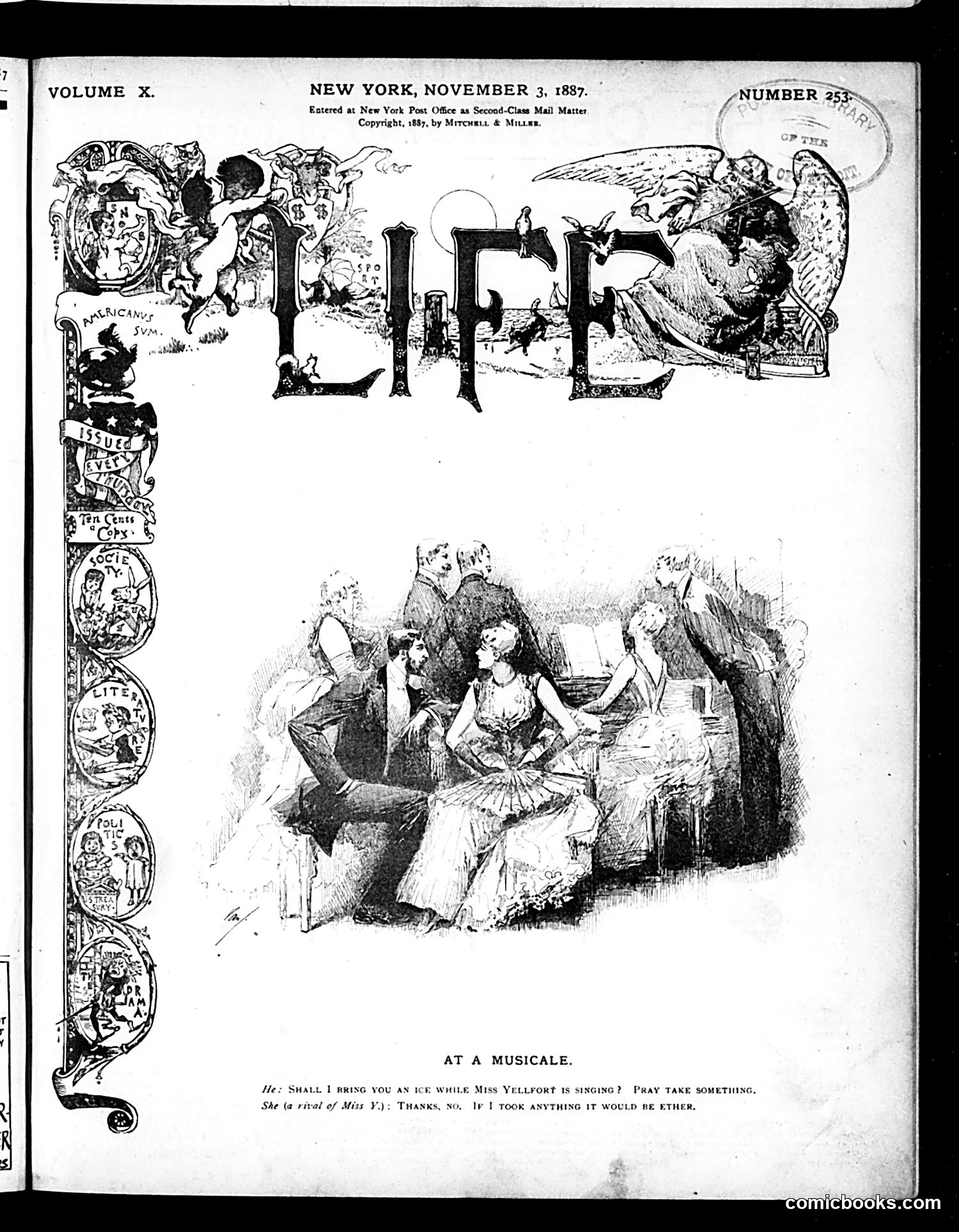
**Main Cartoon: "At a Musicale"** This is a domestic humor scene depicting a social gathering. The caption shows a gentleman asking a woman (identified as "Miss Vellfort") if she'd like an ice while she's singing, with her dismissive response that accepting refreshment would be "ether" (a pun—possibly suggesting she'd be anesthetized or escape the discomfort). The joke appears to target amateur musical performances at social gatherings—a common Victorian entertainment where guests, often women, would perform. The satirical point seems to be that Miss Vellfort's singing is so unpleasant that the gentleman's polite offer is actually a humorous escape route, and her refusal indicates she'll continue subjecting the audience to her performance. This reflects 19th-century social satire about tedious home entertainment culture.
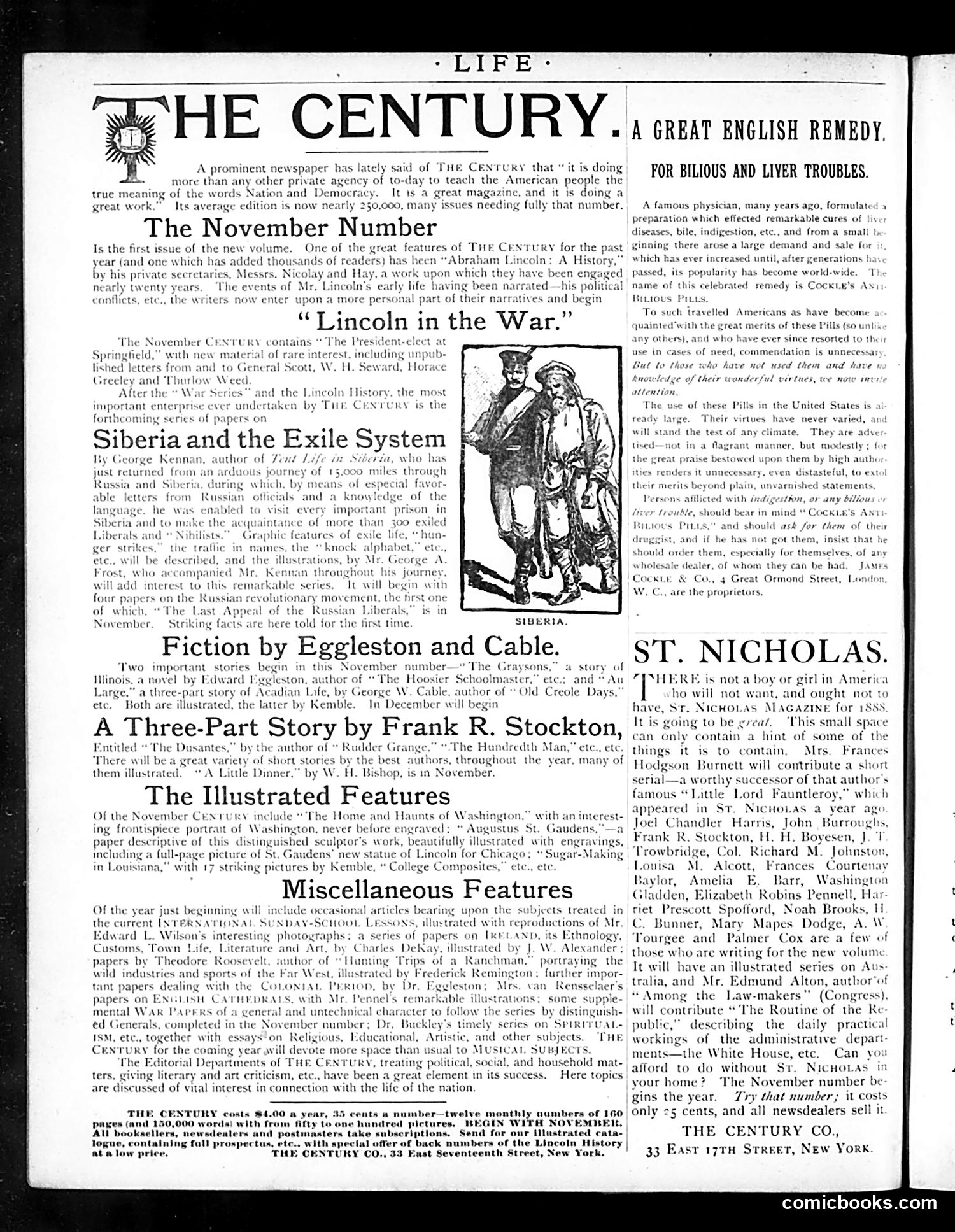
This page is primarily **promotional content** for The Century magazine's November issue, not political satire. The main illustration titled "SIBERIA" appears to depict a figure in heavy winter clothing, likely referencing George Kennan's forthcoming article series on Russian prisons and exile. The accompanying text emphasizes The Century's prestige, noting its November issue will feature "Lincoln in the War" and Kennan's "Striking and Exile System" about Russian imprisonment. The right column advertises St. Nicholas Magazine for children and Cockle's Anti-Bilious Pills (a patent medicine). **This is essentially a trade publication advertisement**, not satirical commentary. Any humor or critique is indirect—embedded in the literary content being promoted rather than in visual caricature or editorial cartooning.
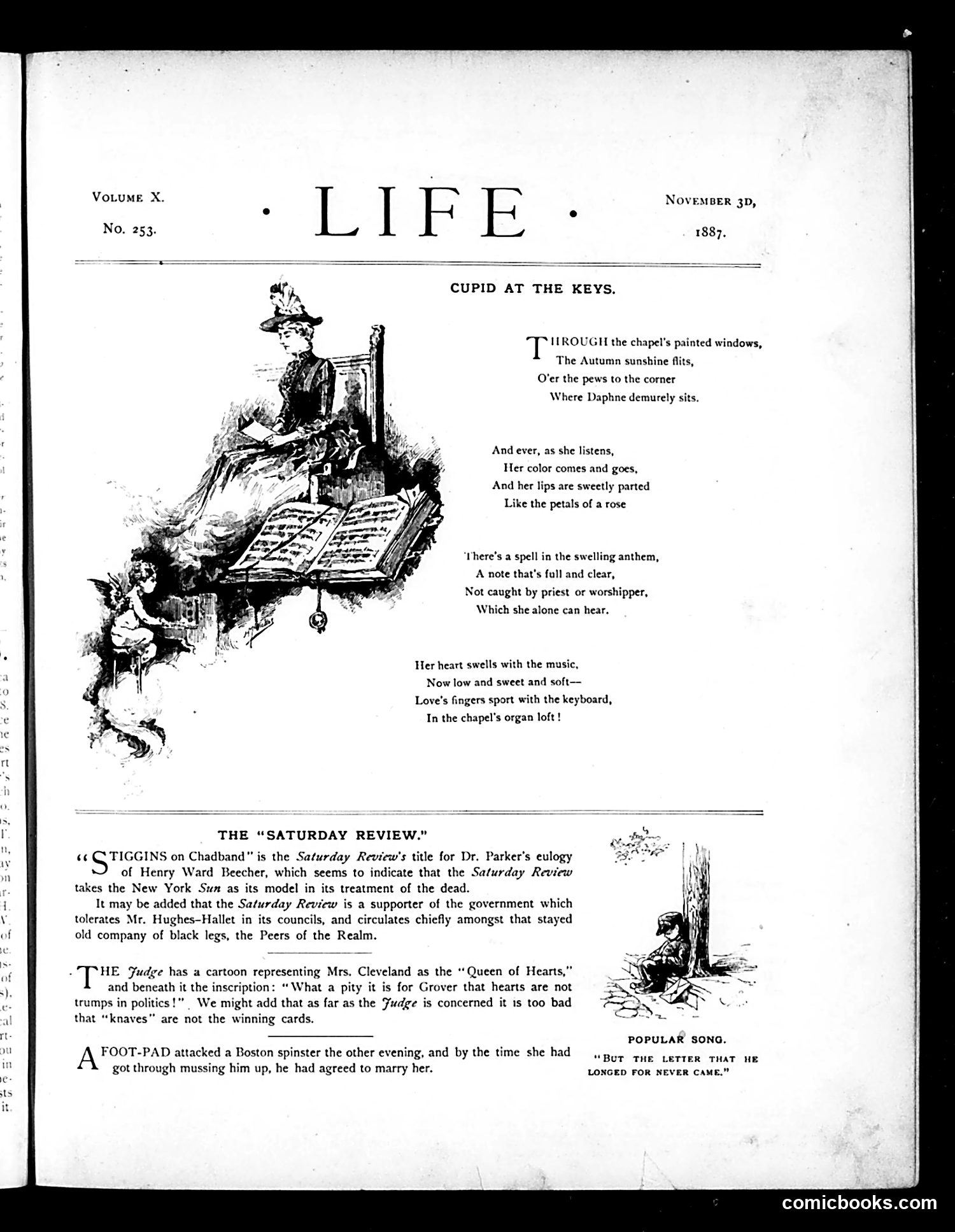
This page contains three distinct pieces: 1. **"Cupid at the Keys"** - A romantic poem with accompanying illustration of a woman at an organ while Cupid hovers nearby, celebrating music's power to inspire love. 2. **"The Saturday Review"** - Brief commentary on the *Saturday Review's* coverage, noting its support for the government and tolerance of the "Peers of the Realm" (aristocracy). References Dr. Parker's eulogy of Henry Ward Beecher. 3. **Judge Magazine cartoon** - Depicts Mrs. Cleveland as the "Queen of Hearts," with a political jab suggesting that "knaves" (unclear which political figures) aren't winning cards—likely commentary on Cleveland administration politics. 4. **Humor snippet** - A brief joke about a Boston spinster and marriage. The page mixes romantic sentiment with mild political satire typical of 1880s American periodicals.
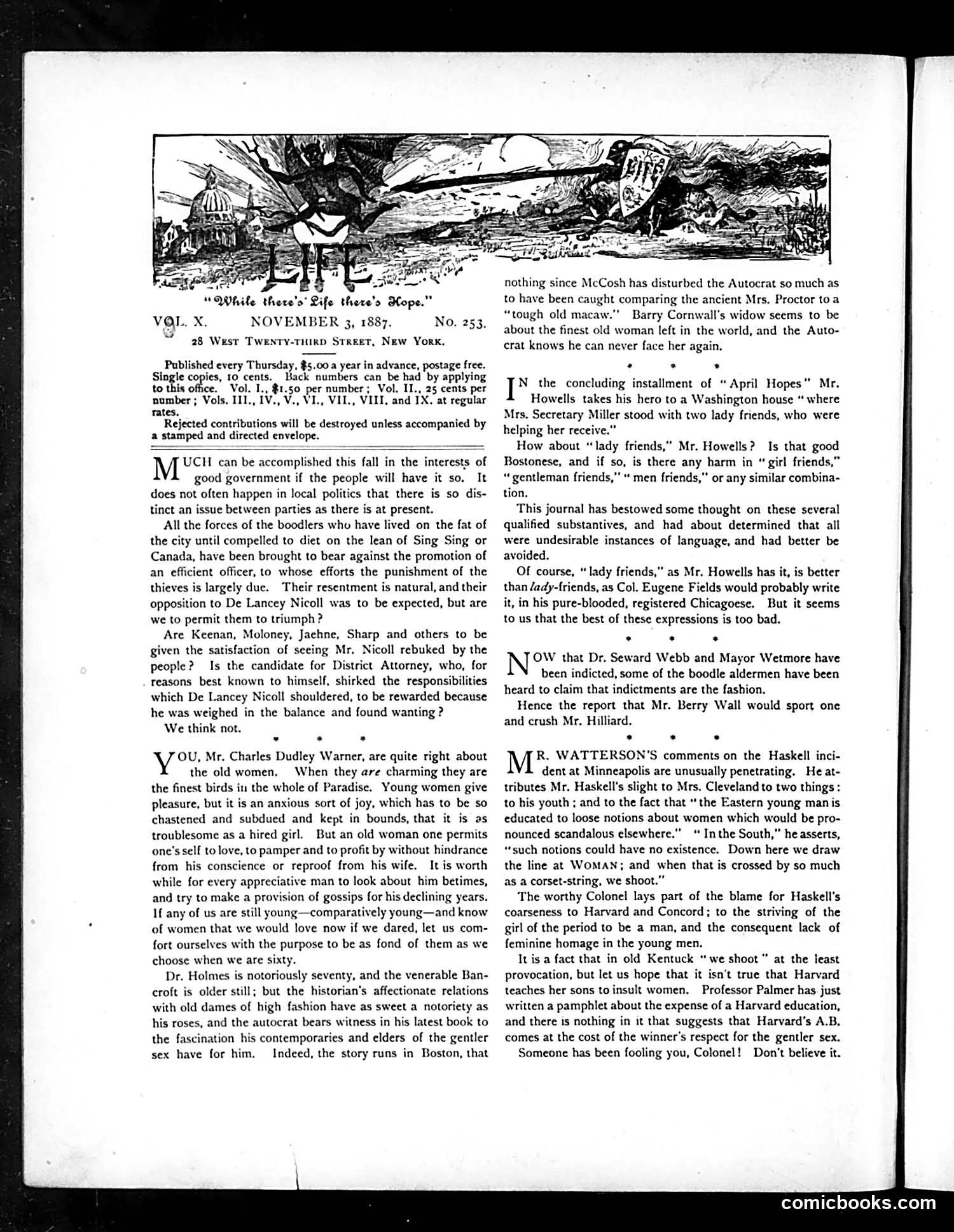
The masthead cartoon depicts a nightmarish landscape with a skeletal or death-like figure looming over a cityscape with a domed building (likely the Capitol). A sign reading "RUIN" is visible. This appears to be satirizing fears about economic or political collapse during the Gilded Age. The text discusses government corruption, including references to "thieves" and criticism of political parties. The editorial content critiques poor governance and suggests that political corruption is rampant. References to "De Lancey Nicoll" and District Attorney elections suggest commentary on New York politics and law enforcement failures. The overall tone warns that without addressing systemic corruption and incompetence in government, the nation faces catastrophic consequences—hence the apocalyptic imagery.
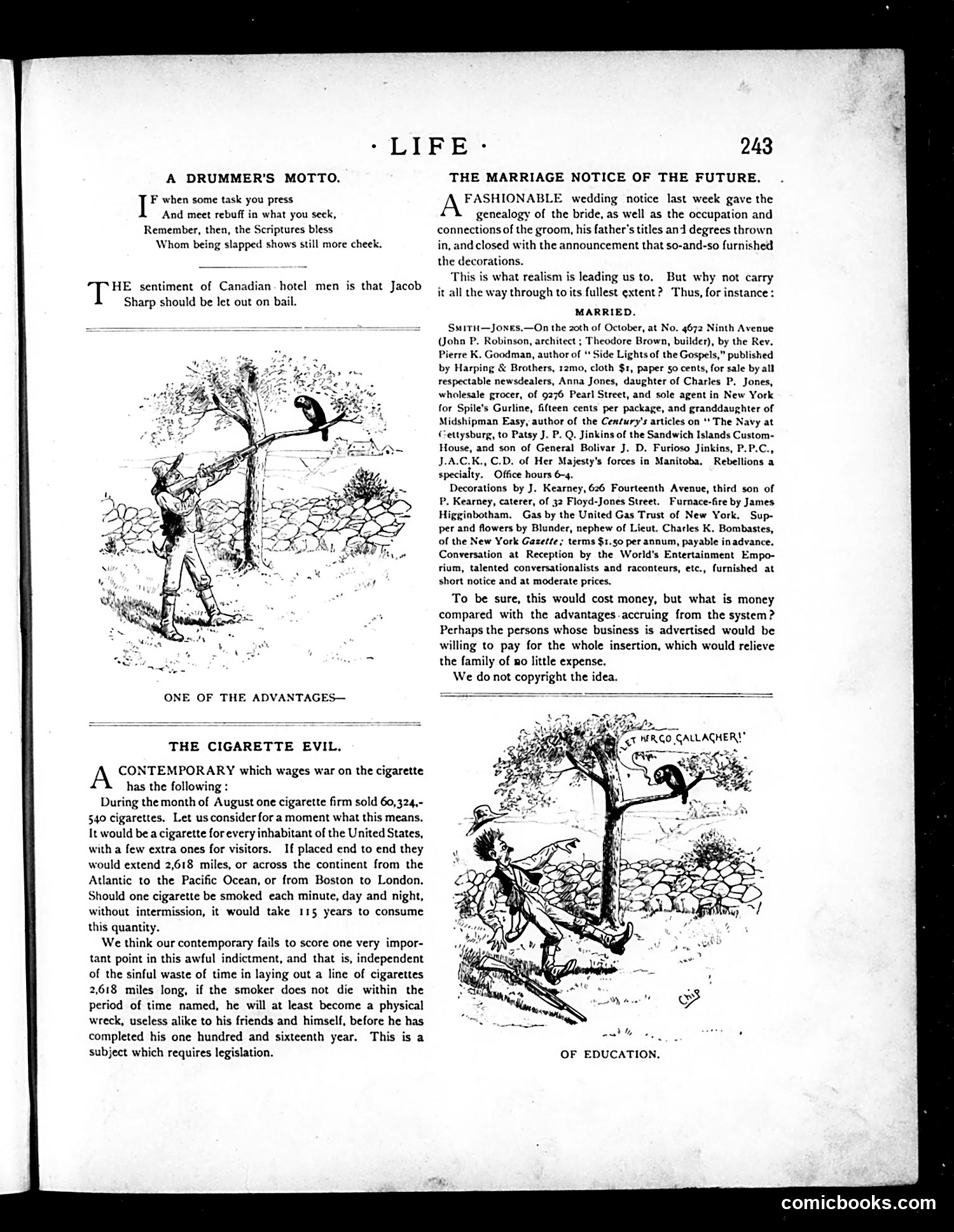
This page contains three distinct satirical pieces: 1. **"A Drummer's Motto"**: A brief poem mocking Jacob Sharp, a Canadian hotel man, suggesting he should be released on bail—likely referencing a specific legal case from the period. 2. **"The Marriage Notice of the Future"**: Satirizes the commercialization of weddings, imagining elaborate paid announcements listing every vendor, sponsor, and contributor. The joke critiques how weddings become advertisements for businesses willing to pay for mentions. 3. **"The Cigarette Evil"**: A serious social commentary calculating that a firm sold 60,324-540 cigarettes in August, arguing this quantity, if smoked continuously, would extend 2,618 miles and would harm smokers' health over time. This reflects period concerns about tobacco's dangers. The cartoons illustrate everyday social problems through exaggeration and calculation.
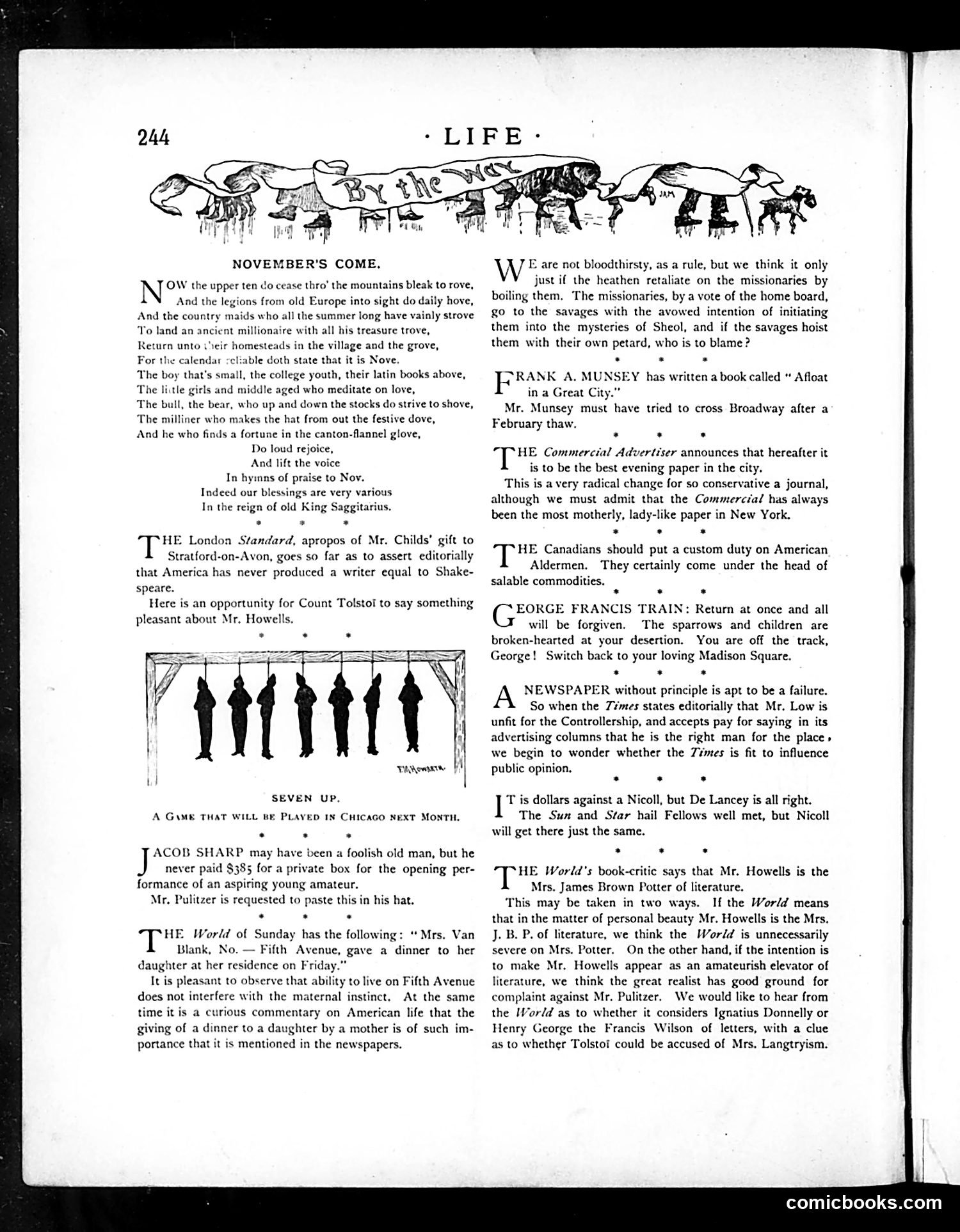
This cartoon depicts seven silhouetted figures hanging from a gallows, titled "Seven Up: A Game That Will Be Played in Chicago Next Month." The satire references an upcoming execution or executions in Chicago. Without additional context, the specific identity of these seven figures is unclear from the image alone. However, the darkly humorous framing as a "game" exemplifies Life magazine's satirical style—treating a serious judicial matter with sardonic wit to critique either the justice system, public fascination with executions, or specific criminals awaiting punishment. The accompanying text discusses various social and literary matters but doesn't clarify which Chicago case is referenced. The cartoon's bluntness reflects late 19th/early 20th-century magazine conventions of explicit political commentary.
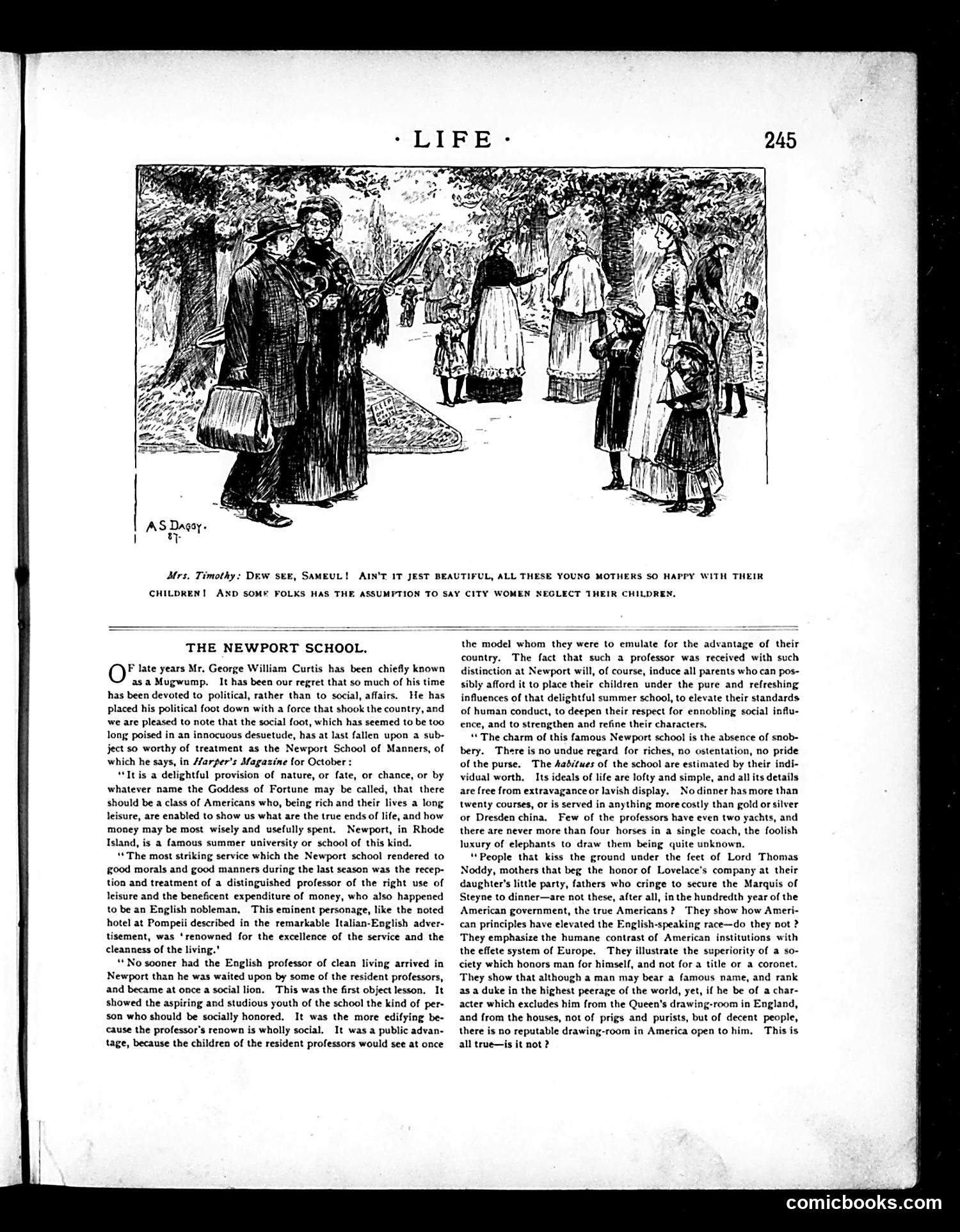
This satirical piece critiques the Newport School of Manners—an exclusive institution teaching American wealthy elites refined behavior. The cartoon depicts well-dressed mothers and children on a tree-lined path, illustrating the school's social function. The satire targets American aspirations to European aristocratic culture. The text mocks how Newport residents emulate British upper-class standards (mentioning Lord Thomas Noddy and references to English drawing-rooms), suggesting this mimicry is unnecessary and artificial for Americans. The central joke: wealthy Americans absurdly pay to learn "proper" social conduct from European models, despite America's democratic principles. The cartoon satirizes both the pretentiousness of the wealthy and their insecurity about social status—needing external validation through fashionable schools rather than inherent character.
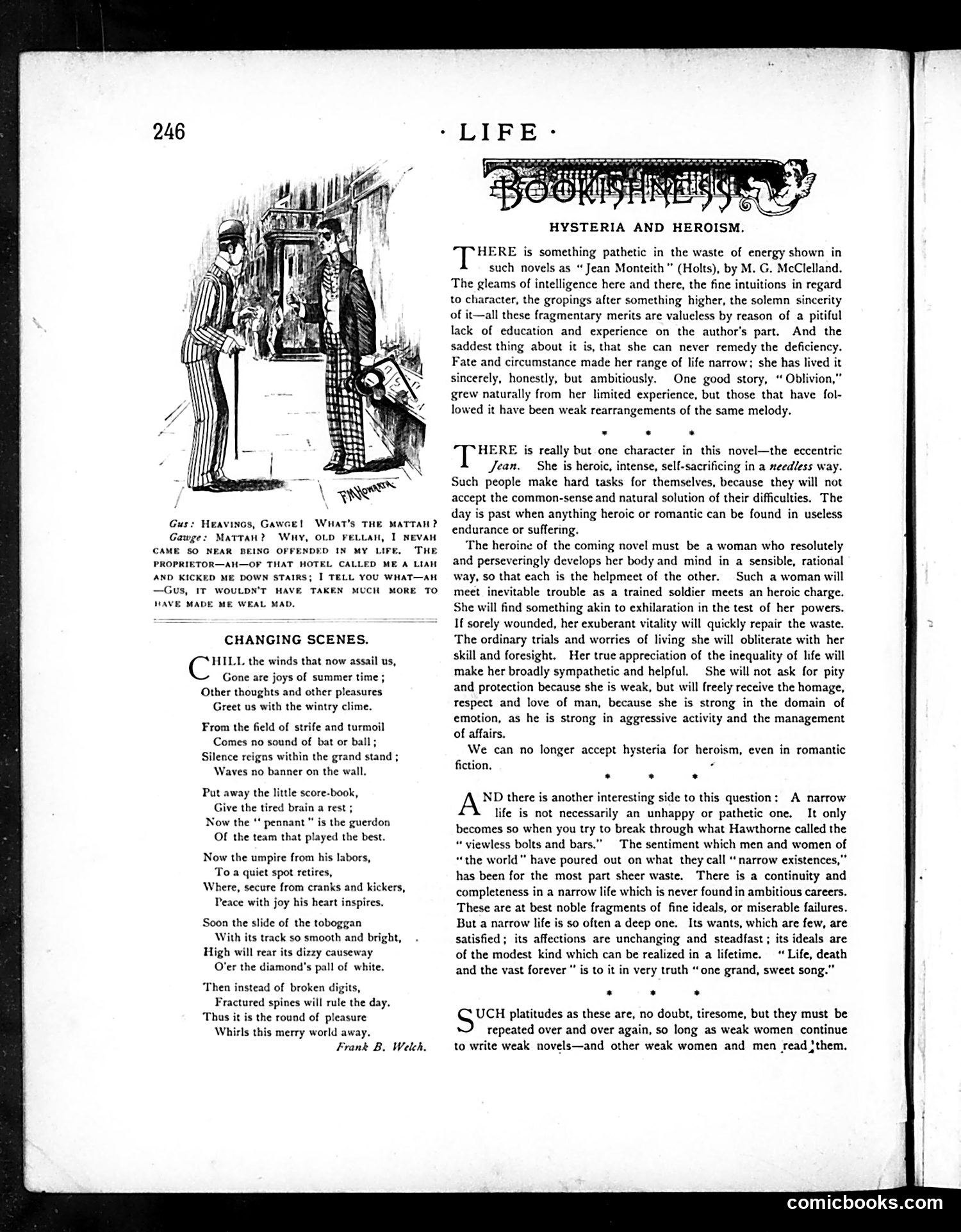
This page contains a literary book review titled "Hysteria and Heroism" rather than a political cartoon. The review critiques the novel "Jean Monteith" by M.C. McClelland. The illustration at top-left shows two men in period dress having a conversation—likely a scene from the novel being reviewed. The dialogue beneath ("Gus: Heavings, Gawge! What's the mattah?" etc.) appears to mock provincial or working-class speech patterns. The review's main argument criticizes the novel's protagonist as hysterical and argues against romanticizing weak heroines in fiction. The author advocates instead for female characters who develop rationally and practically, meeting challenges through strength rather than emotional excess. This reflects early-20th-century literary debates about female characterization and the critique of sentimental Victorian fiction. The poem "Changing Scenes" by Frank B. Welsh appears below the review text.
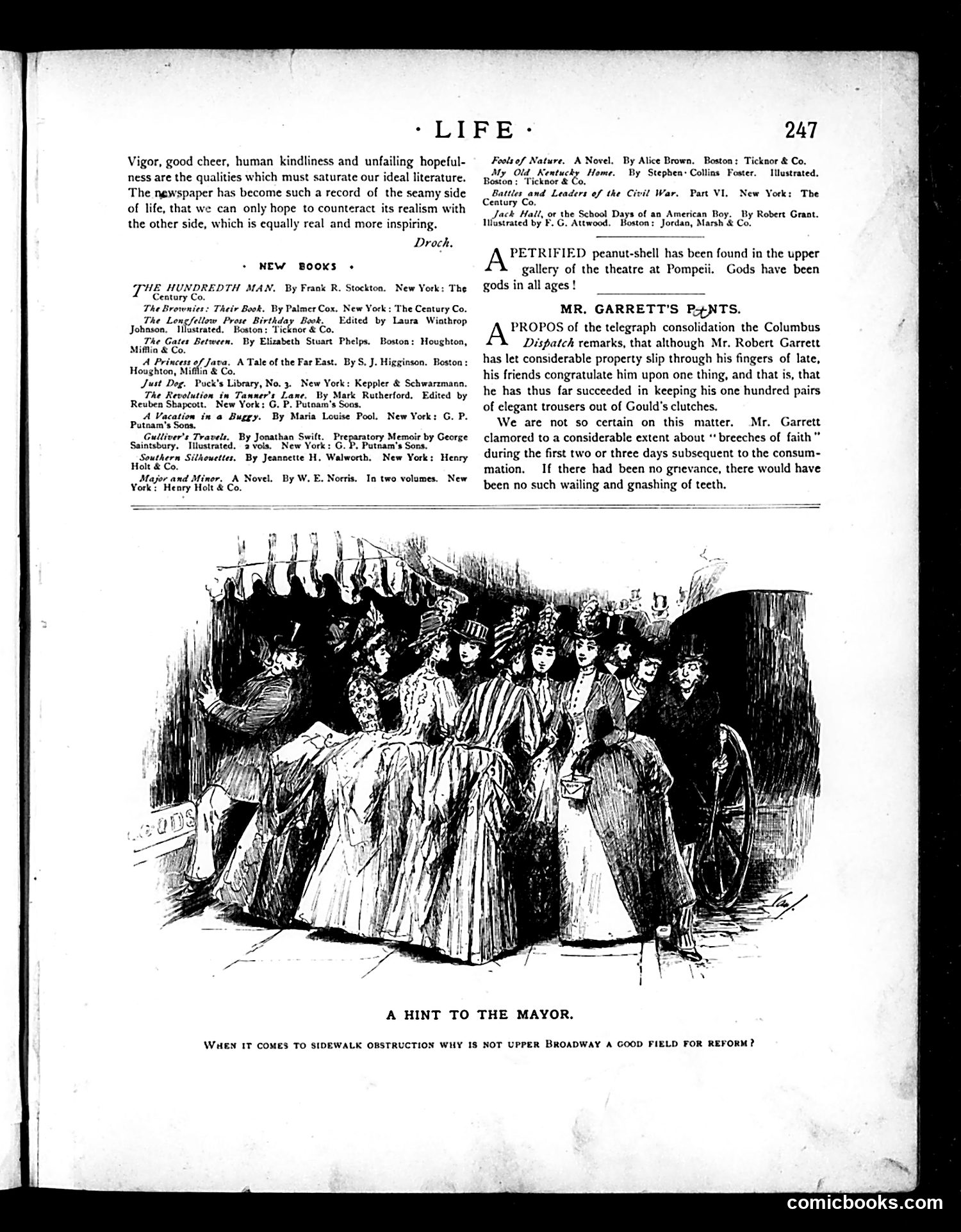
This satirical cartoon critiques urban infrastructure problems in what appears to be early 20th-century New York City. The illustration shows a large crowd of well-dressed women clustered on a sidewalk, their voluminous skirts and elaborate hats creating obvious obstruction to foot traffic. The caption reads: "When it comes to sidewalk obstruction why is not upper Broadway a good field for reform?" The satire targets municipal authorities (the Mayor) for selectively enforcing regulations. The cartoon suggests that if city leaders genuinely cared about clearing sidewalk obstructions, they should address the real problem: fashionable women's clothing styles that consumed excessive public space. It's social commentary on both urban congestion and the absurdity of women's contemporary fashion.
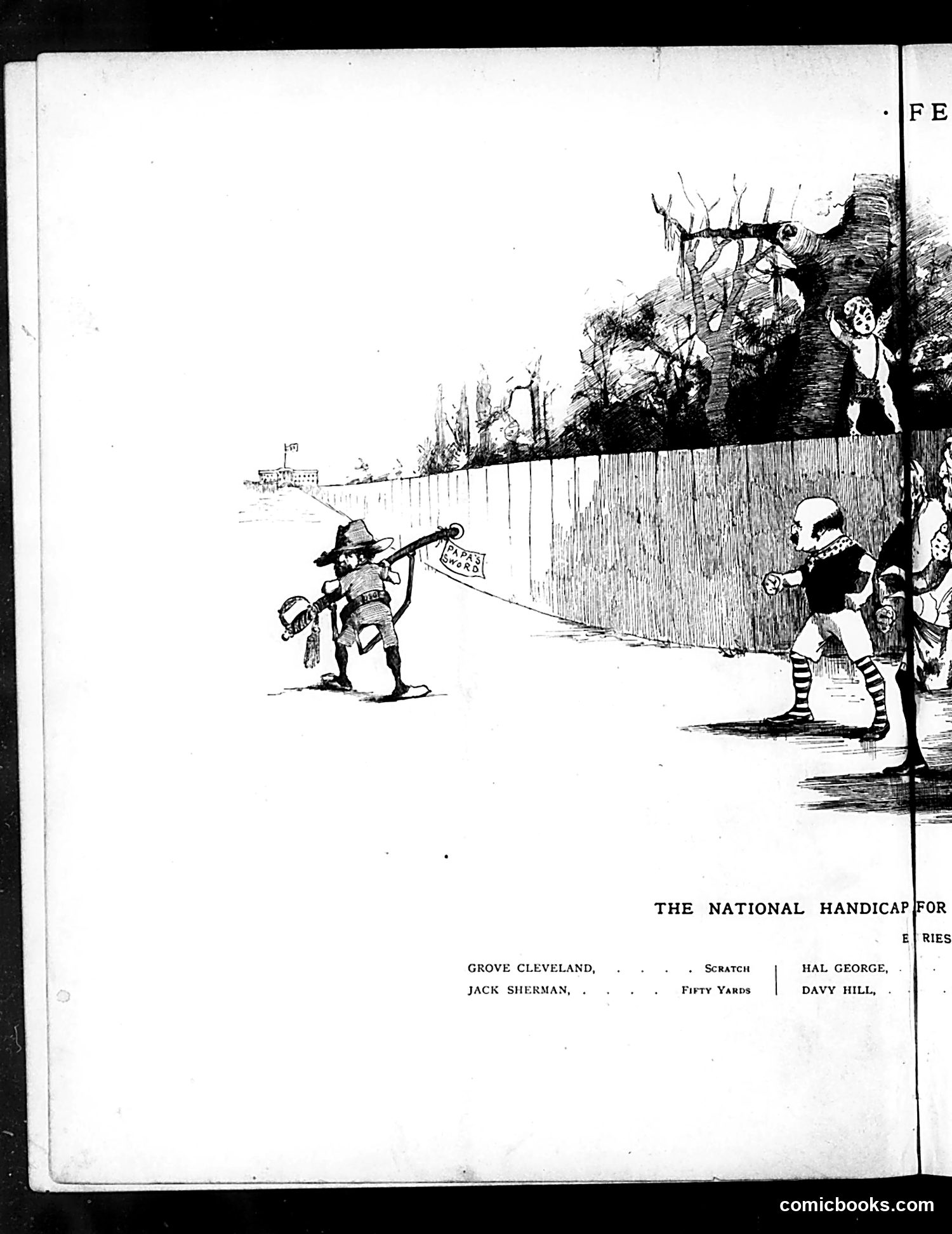
This political cartoon depicts a horse race competition titled "The National Handicap For." The visible participants listed are: - **Grove Cleveland** - assigned "Scratch" (meaning no handicap) - **Jack Sherman** - assigned "Fifty Yards" (a disadvantage) - **Hal George** and **Davy Hill** - also competing The cartoon shows one figure with a telescope or spyglass aimed at what appears to be a distant finish line or structure, while another figure stands ready to race. The "handicap" format suggests this is satirizing an actual political race or competition among these figures, likely from the late 19th century based on the artistic style. The different handicaps assigned imply commentary on their relative advantages or disadvantages in whatever competition is being depicted—probably electoral or political in nature.
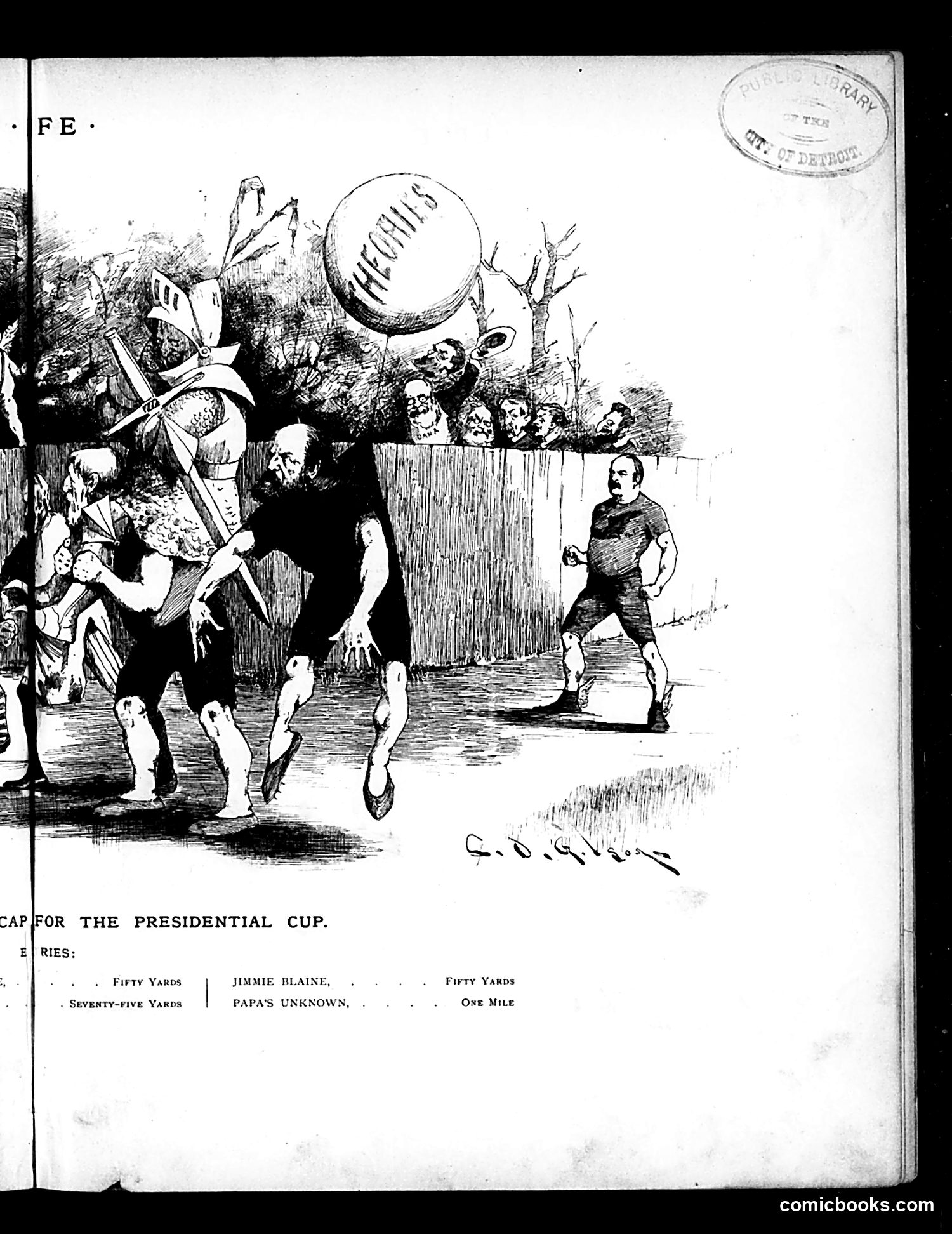
This political cartoon satirizes the 1884 presidential race through a sports metaphor. The illustration shows competitors in what appears to be a bizarre athletic contest, with "Jimmie Blaine" (James G. Blaine, the Republican candidate) and "Papa's Unknown" (likely referring to the Democratic candidate, whose parentage or background is being mocked) competing for the "Presidential Cup." The varying distances listed—fifty yards, seventy-five yards, one mile—suggest the candidates are handicapped differently, implying unequal chances or unfair advantages. The chaotic scene with spectators reflects the contentious nature of this election. The cartoon mocks both candidates through exaggerated physical caricature and absurdist competition, a common satirical approach in Gilded Age political humor.
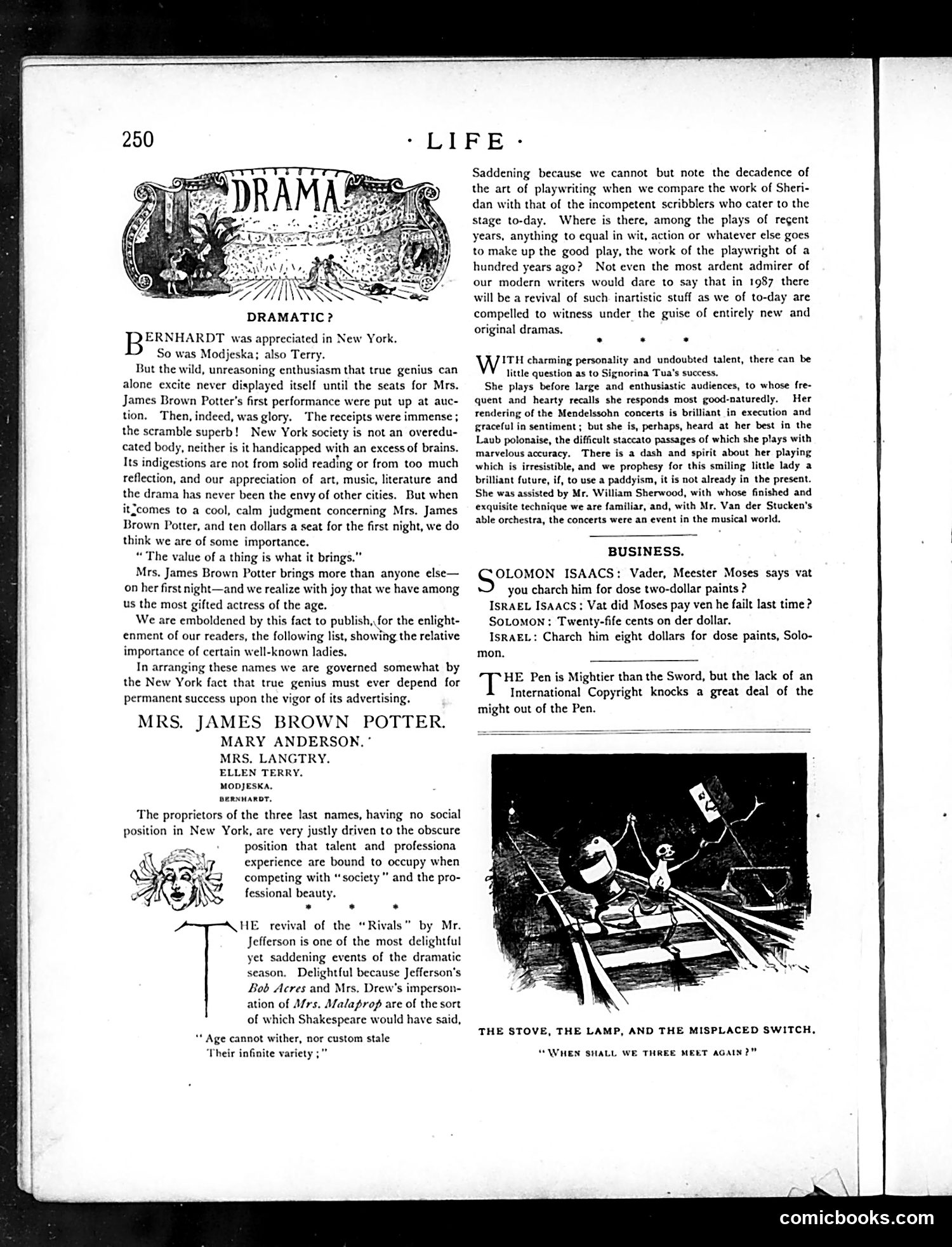
This page satirizes the New York theatrical world's obsession with celebrity and wealth over genuine talent. The unnamed author mocks Mrs. James Brown Potter, a socialite-actress whose auction of first-night seats generated enormous money and public frenzy. Life ranks her *above* legendary performers like Sarah Bernhardt, Mary Anderson, and Lillie Langtry—not for acting ability, but because she possesses social position and effective self-promotion. The satire's bitter point: New York judges artistic merit by ticket prices and advertising power, not actual talent. Professional actresses of real accomplishment rank below a society woman simply because she lacks their professional status. The piece also laments modern playwriting's decline compared to 18th-century dramatists like Sheridan. It's a critique of American cultural shallowness and mercenary values masquerading as appreciation for art.
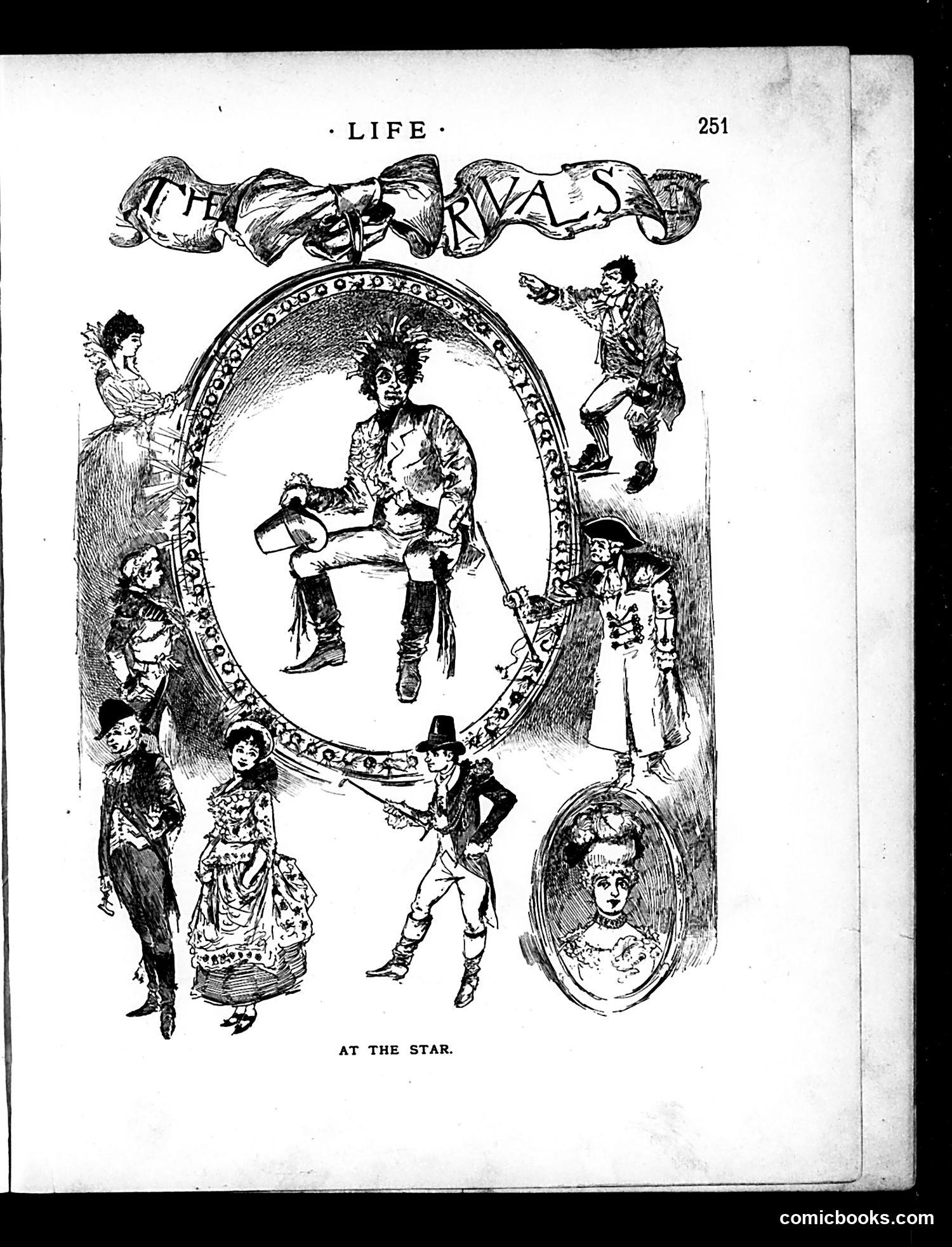
This is a theatrical satire centered on a large oval frame (representing a stage or spotlight) containing a central figure in period costume holding what appears to be a musical instrument. Around this frame stand various theatrical characters in Victorian-era dress—performers, possibly including dancers, gentlemen in top hats, and women in elaborate gowns. The title "At the Star" suggests commentary on theater or performance culture. The ornate oval frame mimics theatrical presentation conventions of the era. The composition appears to satirize theatrical pretension, amateur dramatics, or the social scene surrounding theater-going in turn-of-the-century America. The variety of characters suggests mockery of diverse theatrical types or audience members. Without additional context, the specific theatrical production or personalities referenced remains unclear.
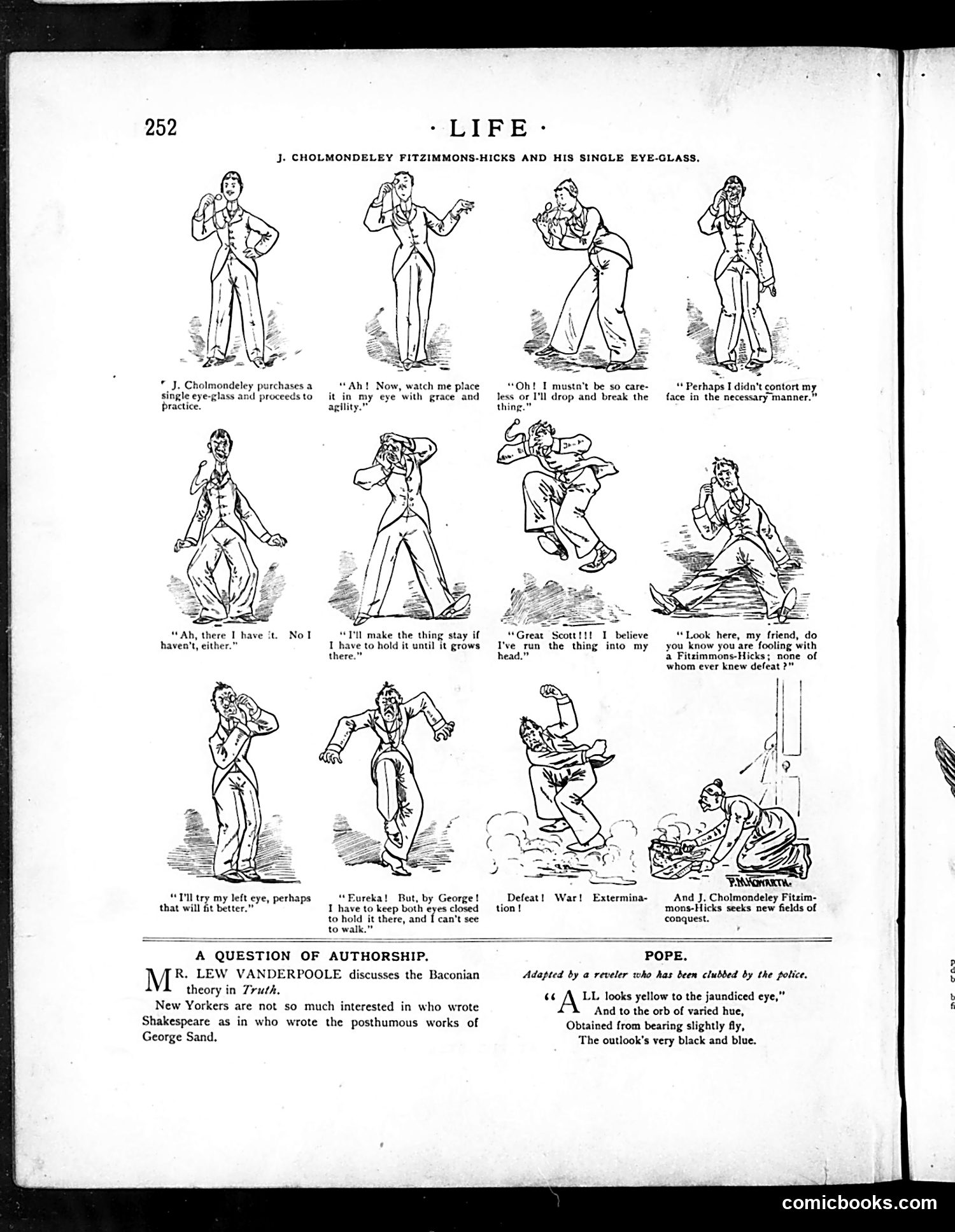
This is a comic strip mocking **J. Cholmondeley Fitzimmons-Hicks**, who appears to be a fictional British aristocrat characterized by affected pretension and incompetence. The satire centers on his absurd attempts to wear a **monocle (single eye-glass)**, which becomes an extended physical comedy—he can't keep it in his eye, nearly blinds himself, runs it into his head, and eventually abandons the effort. The joke relies on class-based satire: the monocle was a stereotypical affectation of pompous upper-class Britons. The character's repeated failures, combined with his boastful claim that his family "never knew defeat," mock the gap between aristocratic pretension and actual incompetence. The page also includes unrelated content: a brief discussion of Shakespeare authorship theories and a poem ("Pope") about someone beaten by police, likely separate satirical pieces from the magazine's issue.
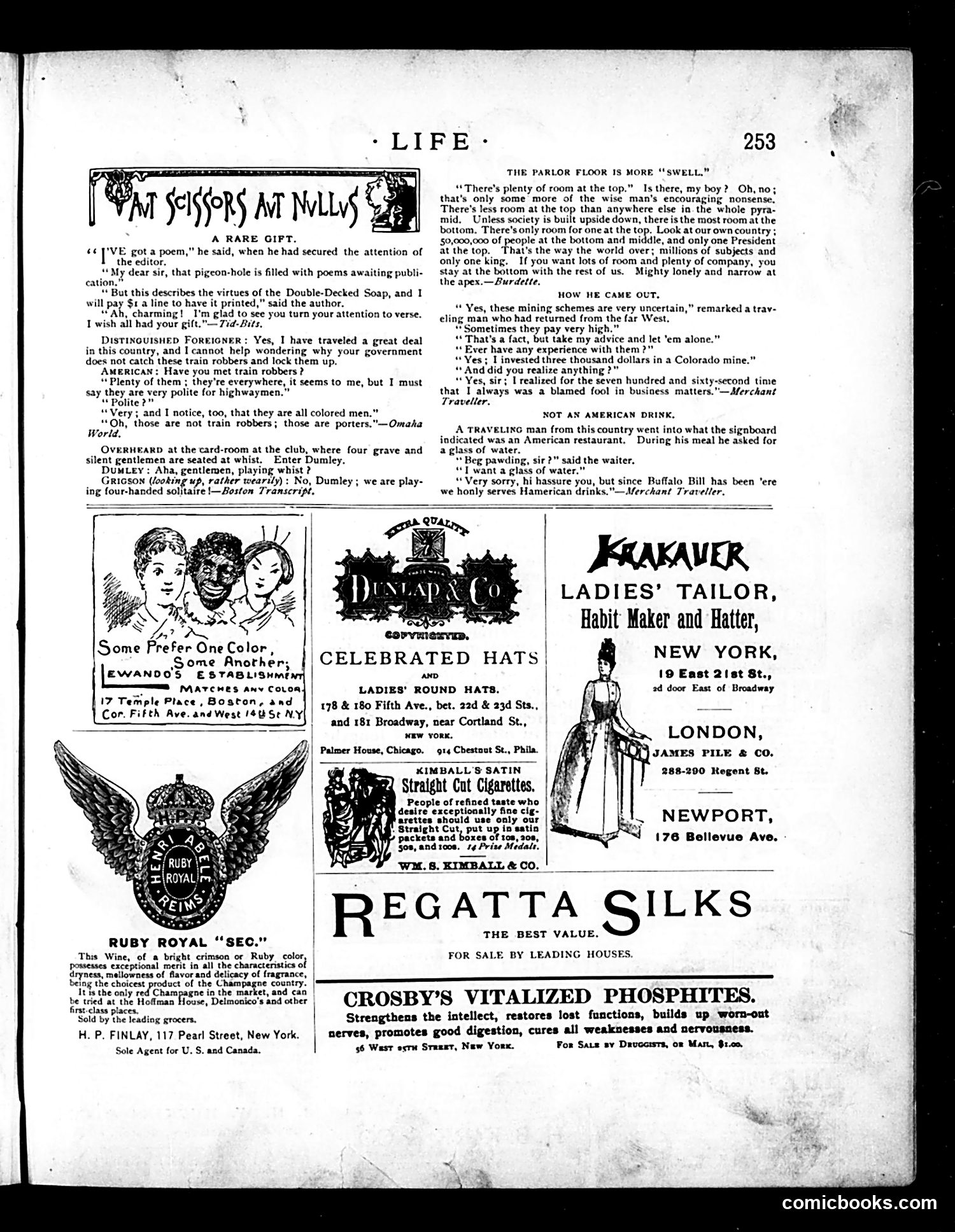
This page is primarily **advertisements and short humorous anecdotes** rather than political cartoons. The jokes mock American pretensions and social absurdities: - **"A Rare Gift"**: Editor eagerly accepts a poem once he learns it's paid advertising—satirizing mercenary journalism. - **"Distinguished Foreigner"**: A visitor mistakes railroad porters (likely Black workers) for train robbers, then is corrected that these "polite" men are just porters—a racial joke playing on stereotypes and the visitor's ignorance. - **"The Parlor Floor"**: Mocks the saying "there's plenty of room at the top," arguing wealth/success pyramids are actually most crowded at the apex (one president, one king). - **"How He Came Out"**: A mining investor realizes he's a fool after losing money. - **"Not An American Drink"**: A traveling salesman asks for water at an "American restaurant" but is told they only serve alcohol now—mocking American drinking culture. The page is dominated by period **fashion and product advertisements** (silks, hats, cigarettes, soap, pharmaceuticals).
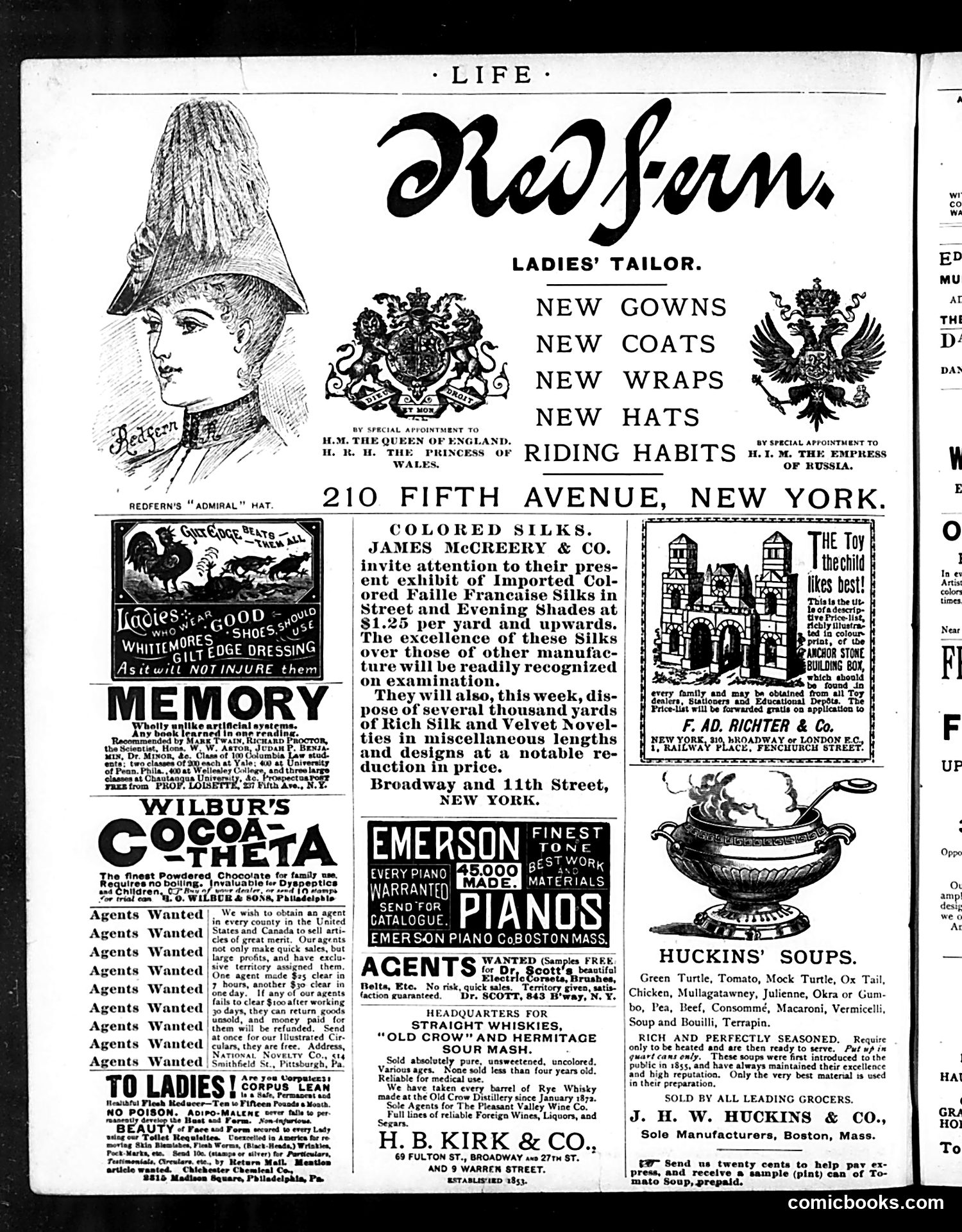
This is primarily a **fashion advertisement** rather than political satire. The page features Red Fern, a ladies' tailor at 210 Fifth Avenue in New York, advertising new gowns, coats, wraps, hats, and riding habits. The satirical element appears modest: Red Fern claims **"By Special Appointment to H.M. The Queen of England"** and **"By Special Appointment to H.I.M. The Empress of Russia."** For a modern reader, this is mock-pretentious advertising—claiming royal patronage to suggest exclusivity and prestige. The inclusion of both British and Russian imperial crests reinforces the claim to international sophistication. The page is dominated by surrounding advertisements (silks, pianos, soups, whiskeys, agents wanted) typical of period magazines. The actual satirical commentary, if any, is subtle—likely poking gentle fun at how retailers invoked aristocratic endorsements to market luxury goods to wealthy American customers.
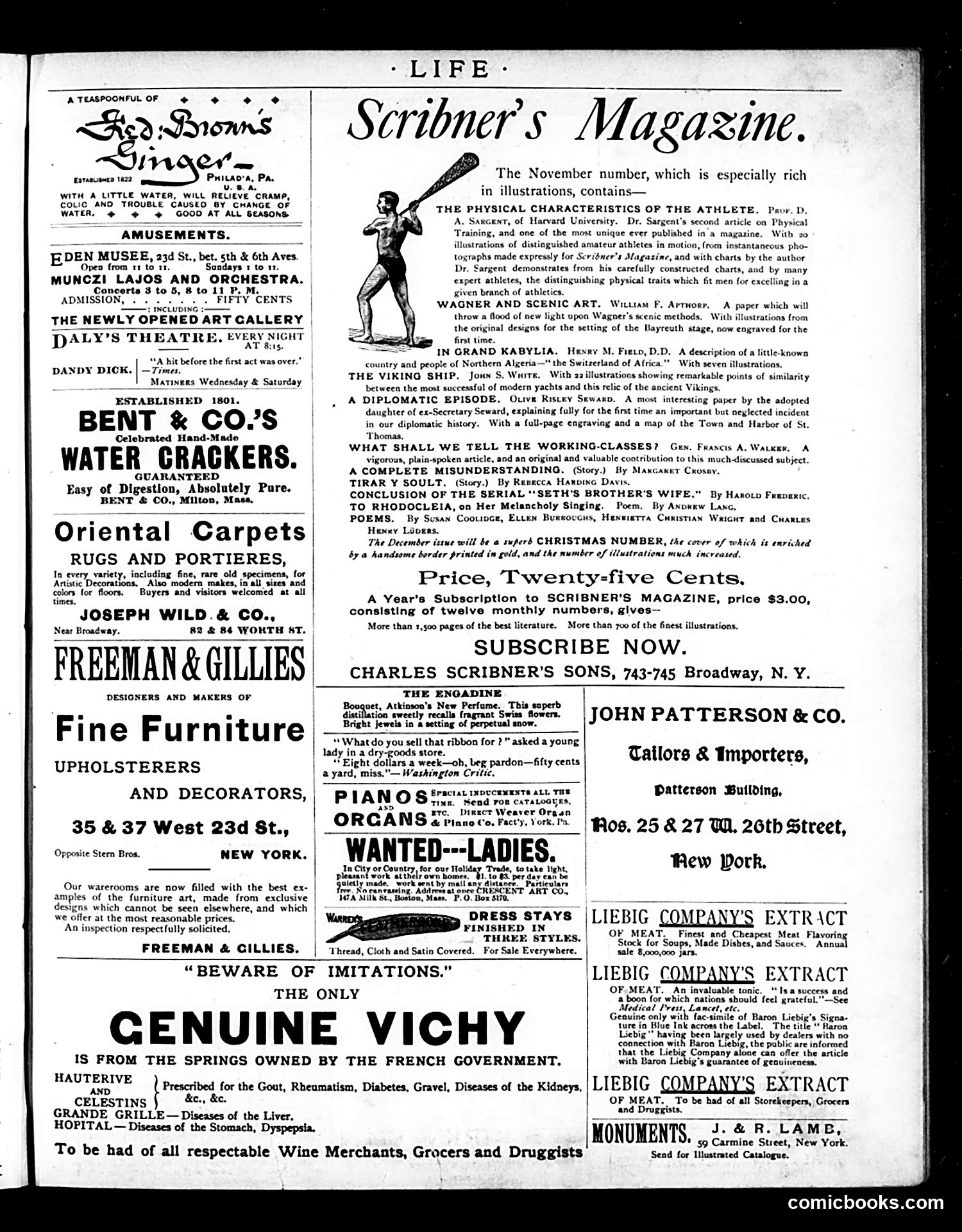
This is primarily an **advertising page from Scribner's Magazine** (likely November 1880s era based on typography and style), not a political cartoon page. The content is almost entirely **commercial advertisements** and **magazine promotional material**. The left half contains ads for: Bjorn's Ginger, entertainment venues (Eden Musee, Daly's Theatre), water crackers, Oriental carpets, and furniture makers. The right side advertises Scribner's Magazine itself, listing the contents of the November issue featuring articles on athlete physiology, Wagner's scenic designs, the Viking Ship, and various stories and poems. There are **no political cartoons** visible. The only illustration is a simple line drawing of an athlete with a baseball bat—a promotional image advertising Scribner's article on "The Physical Characteristics of the Athlete." The page essentially serves as a **marketplace showcase** for consumer goods and cultural publications available to educated, affluent readers.
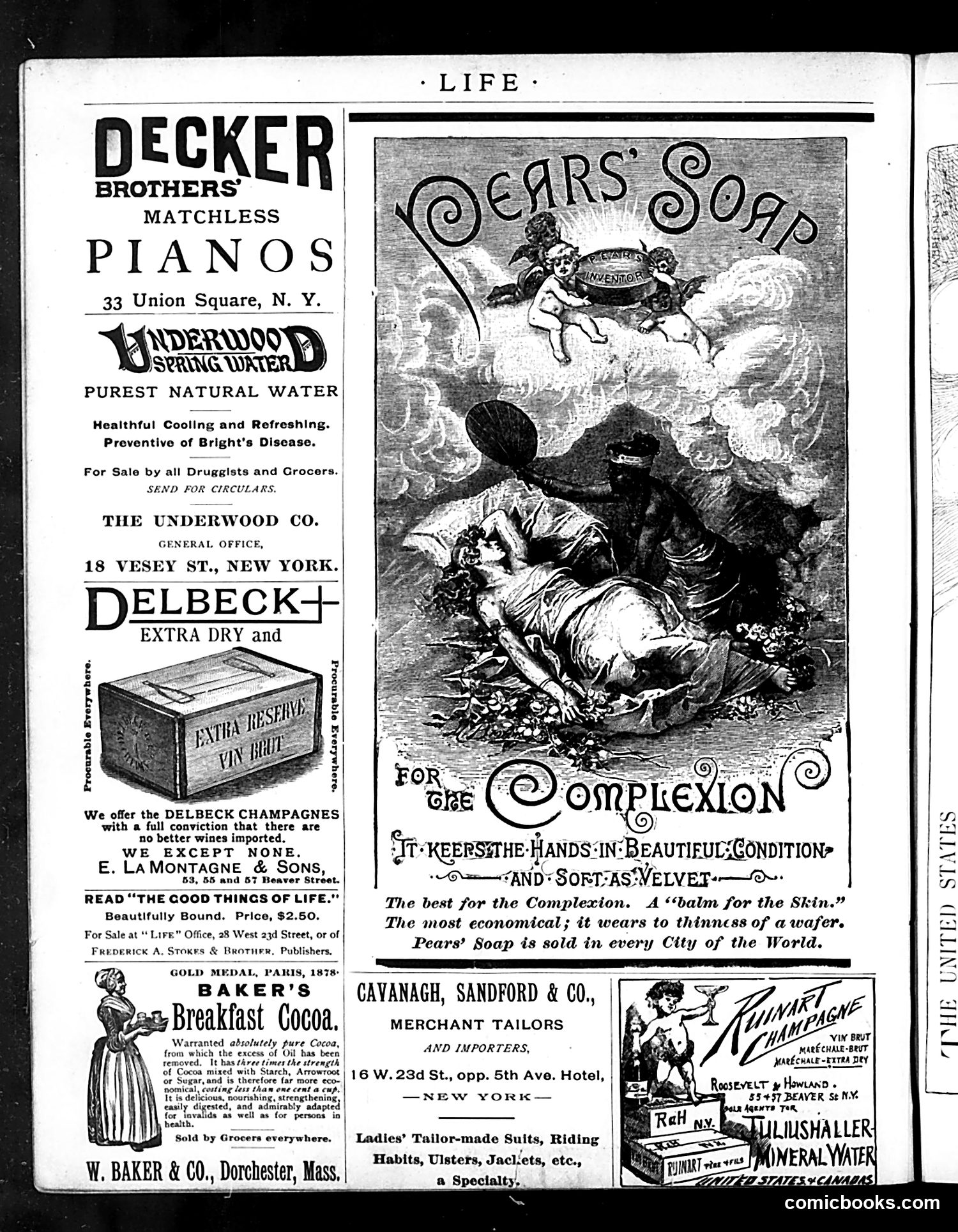
This page is primarily **advertisements**, not political satire. The central image is a commercial advertisement for **Pears' Soap**. The illustration depicts cherubs or putti (classical baby figures) in clouds, one holding a soap bar labeled "Pears'," attending to a reclining woman. The image promises the soap will keep "the hands in beautiful condition and soft as velvet" and claims it's "the best for the complexion." This exemplifies **Victorian-era beauty advertising**: the fantastical imagery and health claims (calling soap a "balm for the skin") reflect period marketing conventions. The cherubs suggest luxury and purity—common motifs in 19th-century cosmetic advertising. The surrounding ads (piano dealers, champagne, cocoa, tailoring services) target wealthy urban consumers in New York. There is **no political satire** present; this is straightforward period commercial content from *Life* magazine's advertising section.
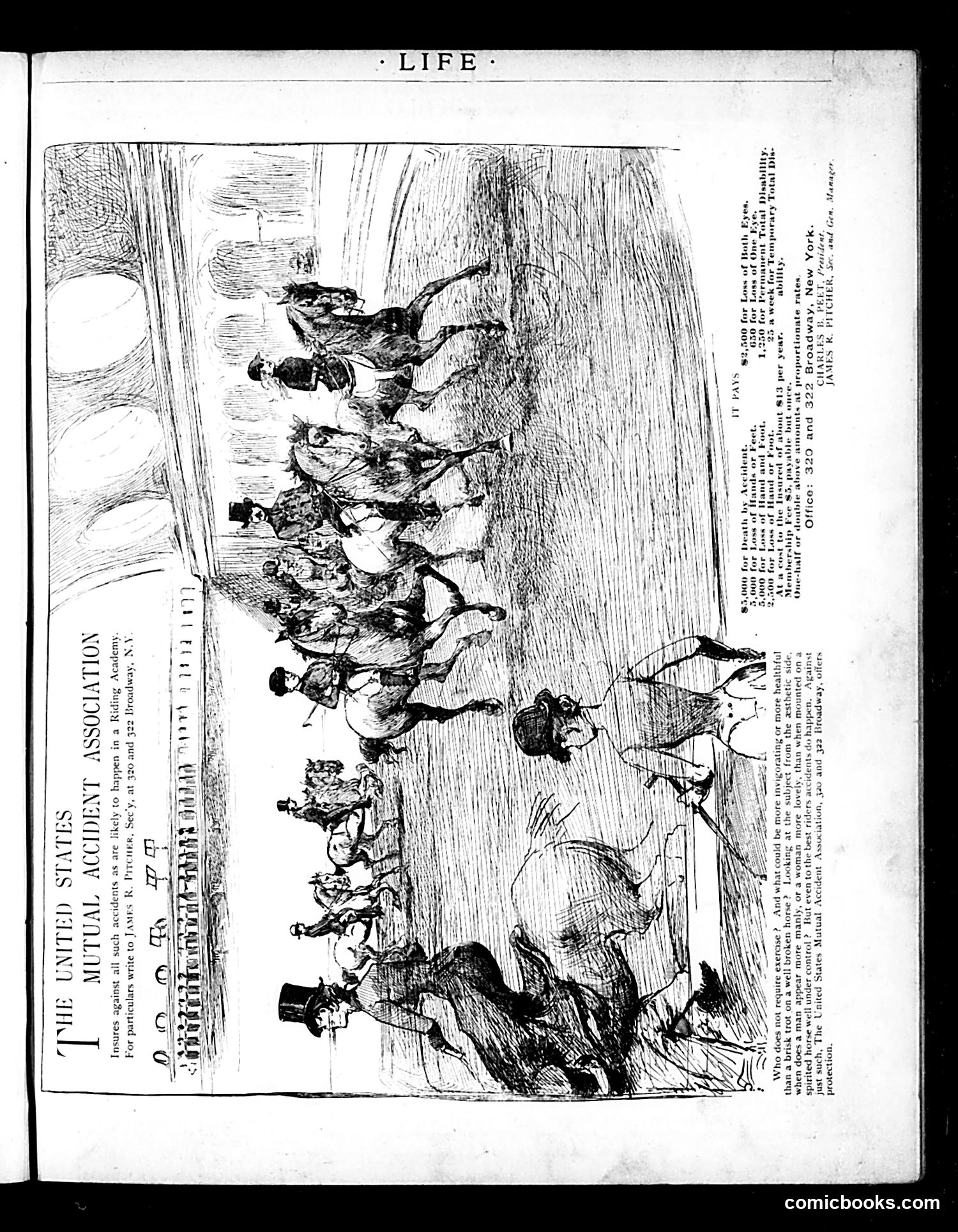
This page features a satirical illustration critiquing what appears to be a mutual accident insurance or fraternal organization. The cartoon depicts numerous figures in formal dress arranged in a chaotic, accident-prone scene—people falling, colliding, and endangering each other. The satire targets the contradiction inherent in such organizations: members are supposed to protect each other from accidents, yet the illustration suggests the "mutual" association itself creates dangerous conditions. The crowded, disorderly composition emphasizes the irony—rather than providing safety, membership apparently increases members' exposure to mishaps. The exact organization referenced is unclear from the visible text, but the humor relies on exposing the gap between an insurance organization's protective promises and the actual chaos of its operations.
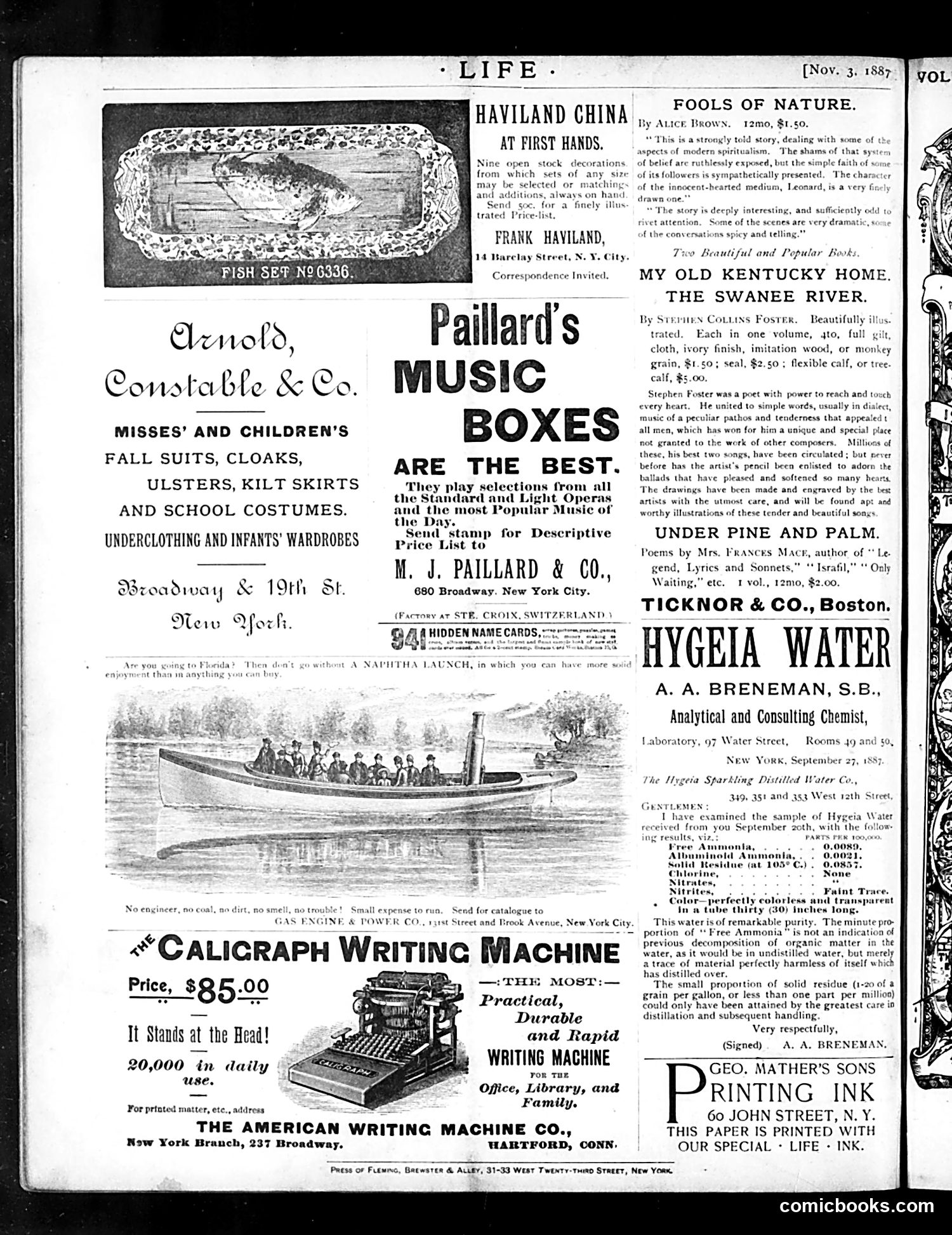
This is primarily an **advertising page** rather than a satirical cartoon page. The page contains commercial advertisements typical of late 19th-century magazines, including: - Paillard's Music Boxes - Arnold, Constable & Co. (children's clothing) - Caligraph Writing Machine ($85) - Hygeia Water (with a chemical analysis letter) - Various book advertisements **The only illustrative content** is a generic engraving of a **small steamboat** with passengers—likely advertising the Caligraph machine or serving as generic period imagery. There are no identifiable political figures, caricatures, or satirical commentary visible. The page reflects the commercial nature of American magazines in the Gilded Age, where advertising revenue was essential. Without cartoon imagery or political commentary, this appears to be filler advertising space rather than the satirical content Life magazine was known for.