
Life, 1887-11-03 · page 8 of 20
Life — November 3, 1887 — page 8: what you’re looking at
What you’re looking at
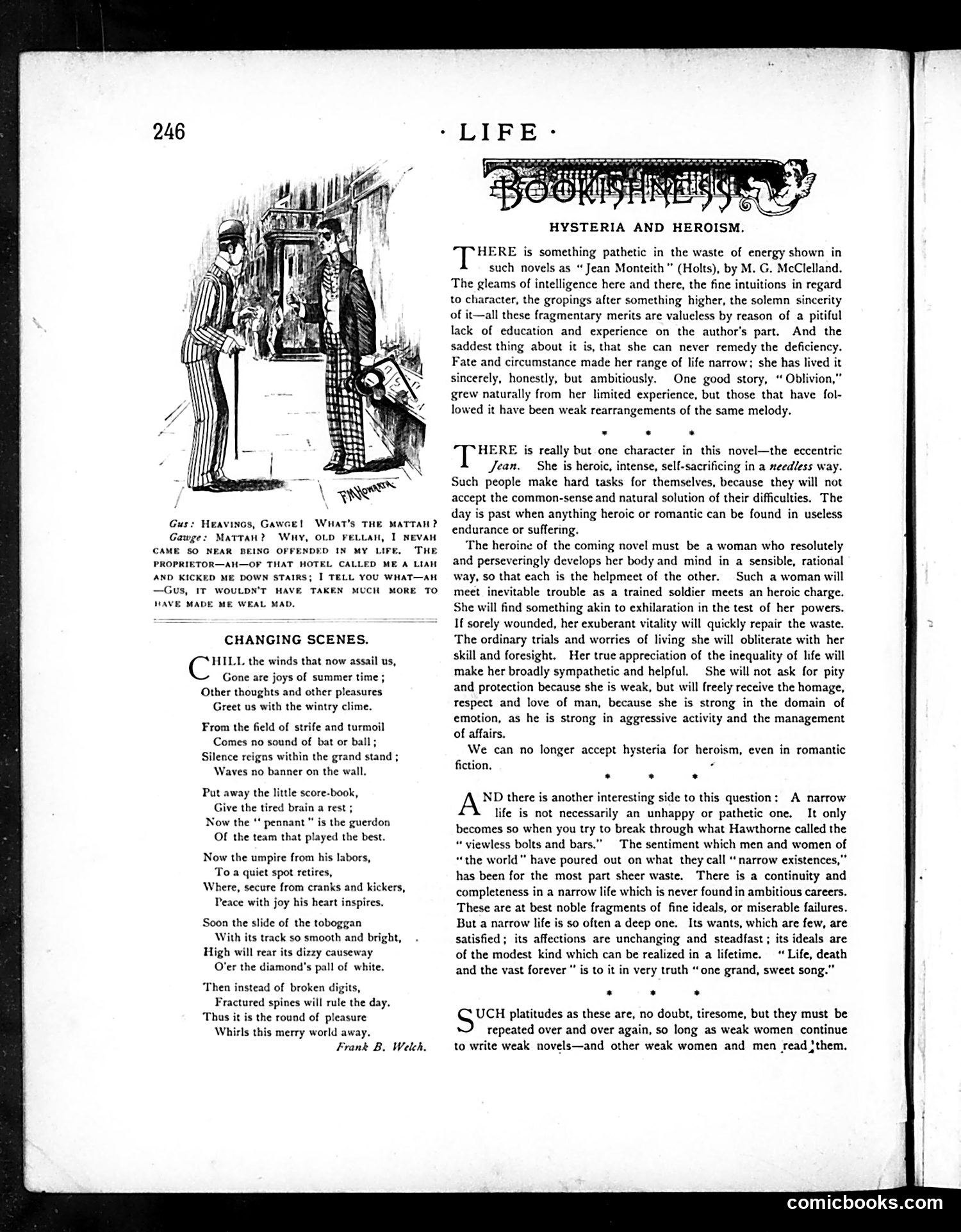
This page contains a literary book review titled "Hysteria and Heroism" rather than a political cartoon. The review critiques the novel "Jean Monteith" by M.C. McClelland. The illustration at top-left shows two men in period dress having a conversation—likely a scene from the novel being reviewed. The dialogue beneath ("Gus: Heavings, Gawge! What's the mattah?" etc.) appears to mock provincial or working-class speech patterns. The review's main argument criticizes the novel's protagonist as hysterical and argues against romanticizing weak heroines in fiction. The author advocates instead for female characters who develop rationally and practically, meeting challenges through strength rather than emotional excess. This reflects early-20th-century literary debates about female characterization and the critique of sentimental Victorian fiction. The poem "Changing Scenes" by Frank B. Welsh appears below the review text.
📄 Transcribed text from this page (OCR, searchable)
Machine-transcribed from the original scan — historical spelling and the odd misread are preserved.
Gus: Heavixos, Gawce! Gawge: MATTAN? CAME, SO NEAR BEING OFF! Wuat’s THE MATTAH ? OLD FELLAN, I NEVA DED IN MY LIFE, THE Wu PROPRIETOR—AN—OF THAT HOTEL CALLED ME A LIAH AND KICKED ME DOWN STAIRS; —Gus, IT WOULDN'T HAVE I TELL YoU WHAT—AH TAKEN MUCH MORE TO NAVE MADE ME WEAL MAD. CHANGING SCENES. HILL the winds that now assail us, Gone are joys of summer time ; Other thoughts and other pleasures Greet us with the wintry clime. From the field of strife and turmoil Comes no sound of bat or ball ; Silence reigns within the grand stand ; Waves no banner on the wall. Pat away the little score-book, Give the tired brain a rest ; Now the ‘ pennant” is the guerdon Of the team that played the best. Now the umpire from his labors, To a quiet spot retires, Where, secure from cranks and kickers, Peace with joy his heart inspires. Soon the slide of the toboggan With its track so smooth and bright, High will rear its dizzy causeway O’er the diamond's pall of white. ‘Then instead of broken digits, Fractured spines will rule the day. ‘Thus it is the round of pleasure Whirls this merry world away. Frank B, Welch. HYSTERIA AND HEROISM. HERE is something pathetic in the waste of energy shown in such novels as “Jean Monteith” (Holts), by M. G. McClelland. The gleams of intelligence here and there, the fine intuitions in regard to character, the gropings after something higher, the solemn sincerity of it—all these fragmentary merits are valucless by reason of a pitiful lack of education and experience on the author's part. And the saddest thing about it is, that she can never remedy the deficiency. Fate and circumstance made her range of life narrow; she has lived it sincerely, honestly, but ambitiously. One good story, “ Oblivion,” grew naturally from her limited experience, but those that have fol- lowed it have been weak rearrangements of the same melody. . . . HERE is really but one character in this novel—the eccentric Jean. She is heroic, intense, self-sacrificing in a needless way. Such people make hard tasks for themselves, because they will not accept the common-sense and natural solution of their difficulties. The day is past when anything heroic or romantic can be found in useless endurance or suffering. The heroine of the coming novel must be a woman who resolutely and perseveringly develops her body and mind in a sensible, rational way, so that each is the helpmeet of the other. Such a woman will meet inevitable trouble as a trained soldier meets an heroic charge. She will find something akin to exhilaration in the test of her powers. If sorely wounded, her exuberant vitality will quickly repair the waste. The ordinary trials and worries of living she will obliterate with her skill and foresight. Her true appreciation of the inequality of life will make her broadly sympathetic and helpful. She will not ask for pity and protection because she is weak, but will freely receive the homage, respect and love of man, because she is strong in the domain of emotion, as he is strong in aggressive activity and the management of affairs. We can no longer accept hysteria for heroism, even in romantic fiction. 2 . . . ND there is another interesting side to this question: A narrow life is not necessarily an unhappy or pathetic one. It only becomes so when you try to break through what Hawthorne called the “ viewless bolts and bars." The sentiment which men and women of “the world” have poured out on what they call “narrow existences,” has been for the most part sheer waste. There is a continuity and completeness in a narrow life which is never found in ambitious careers. These are at best noble fragments of fine ideals, or miserable failures. But a narrow life is so often a deep one. Its wants, which are few, are satisfied; its affections are unchanging and steadfast ; its ideals are of the modest kind which can be realized in a lifetime. “Life, death and the vast forever ” is to it in very truth “one grand, sweet song.” * . . UCH platitudes as these are, no doubt, tiresome, but they must be repeated over and over again, so long as weak women continue to write weak novels—and other weak women and men read }them. comicbooks.com