
Life, 1887-11-03 · page 7 of 20
Life — November 3, 1887 — page 7: what you’re looking at
What you’re looking at
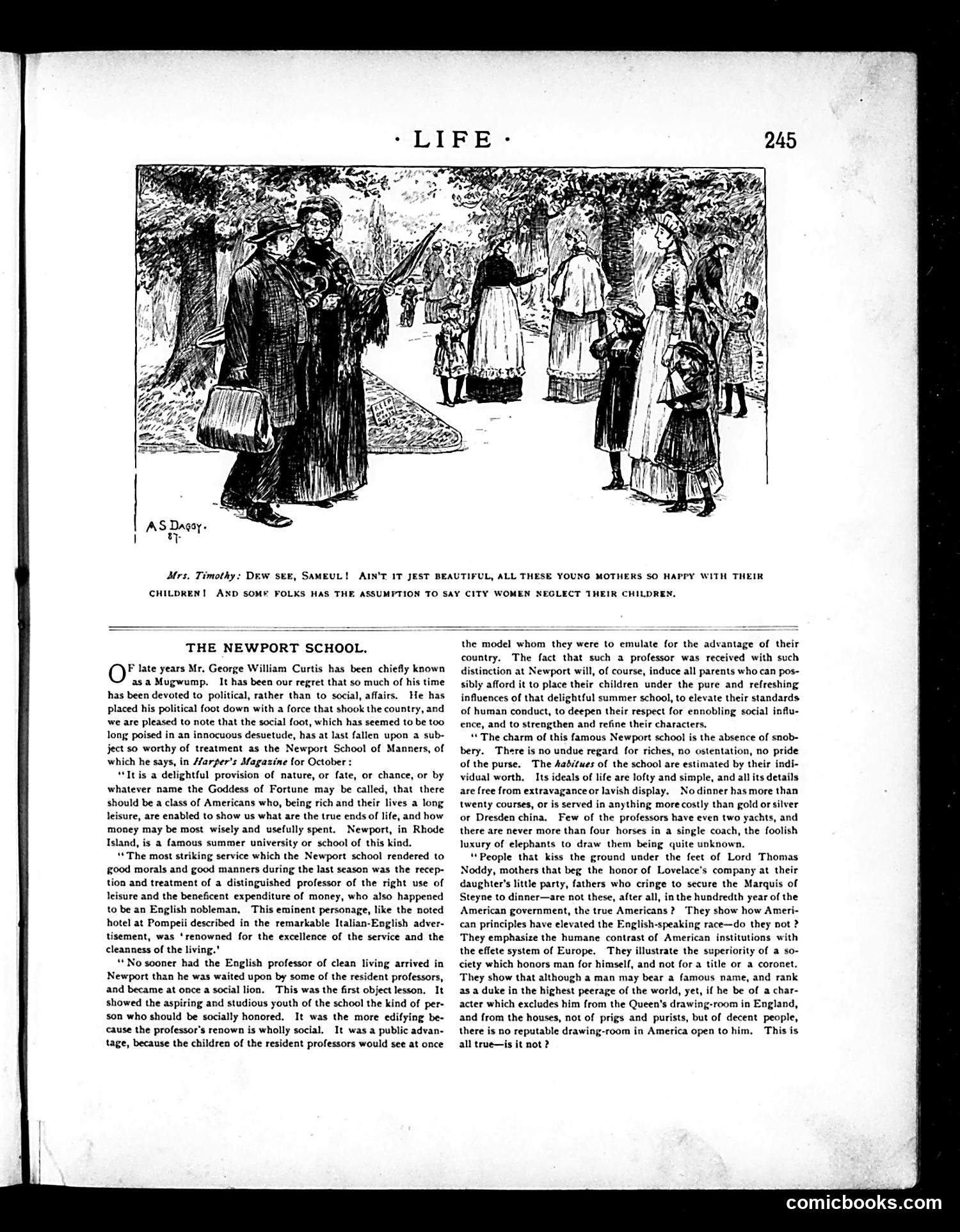
This satirical piece critiques the Newport School of Manners—an exclusive institution teaching American wealthy elites refined behavior. The cartoon depicts well-dressed mothers and children on a tree-lined path, illustrating the school's social function. The satire targets American aspirations to European aristocratic culture. The text mocks how Newport residents emulate British upper-class standards (mentioning Lord Thomas Noddy and references to English drawing-rooms), suggesting this mimicry is unnecessary and artificial for Americans. The central joke: wealthy Americans absurdly pay to learn "proper" social conduct from European models, despite America's democratic principles. The cartoon satirizes both the pretentiousness of the wealthy and their insecurity about social status—needing external validation through fashionable schools rather than inherent character.
📄 Transcribed text from this page (OCR, searchable)
Machine-transcribed from the original scan — historical spelling and the odd misread are preserved.
AS Dagsy- ty Mrs. Timothy: Dew see, SAMEUL! CHILDREN! THE NEWPORT SCHOOL. F late years Mr. George William Curtis has been chiefly known asa Mugwump. It has been our regret that so much of his time has been devoted to political, rather than to social, affairs. He has placed his political foot down with a force that shook the country, and we are pleased to note that the social foot, which has seemed to be too long poised in an innocuous desuetude, has at last fallen upon a sub- ject so worthy of treatment as the Newport School of Manners, of which he says, in Harper's Magazine for October: “It is a delightful provision of nature, or fate, or chance, or by whatever name the Goddess of Fortune may be called, that there should be a class of Americans who, being rich and their lives a long leisure, are enabled to show us what are the true ends of life, and how money may be most wisely and usefully spent. Newport, in Rhode Island, is a famous summer university or school of this kind. “The most striking service which the Newport school rendered to good morals and good manners during the last season was the recep- tion and treatment of a distinguished professor of the right use of leisure and the beneficent expenditure of money, who also happened to be an English nobleman, This eminent personage, like the noted hotel at Pompeii described in the remarkable Italian-English adver- tisement, was ‘renowned for the excellence of the service and the cleanness of the living." “No sooner had the English professor of clean living arrived in Newport than he was waited upon by some of the resident professors, and became at once a social lion. This was the first object lesson. It showed the aspiring and studious youth of the school the kind of per- son who should be socially honored, It was the more edifying be- cause the professor's renown is wholly social. It was a public advan- tage, because the children of the resident professors would see at once AIN'T IT JEST BEAUTIFUL, ALL THESE YOUNG MOTHERS SO HAPPY WITH THEIR AND SOMF FOLKS HAS THE ASSUMPTION TO SAY CITY WOMEN NEGLECT THEIR CHILDREN, the model whom they were to emulate for the advantage of their country. The fact that such a professor was received with such distinction at Newport will, of course, induce all parents who can pos- sibly afford it to place their children under the pure and refreshing influences of that delightful summer school, to elevate their standards of human conduct, to deepen their respect for ennobling social influ- ence, and to strengthen and refine their characters. “The charm of this famous Newport school is the absence of snob- bery. There is no undue regard for riches, no ostentation, no pride of the purse. The Aaditues of the school are estimated by their indi- vidual worth. Its ideals of life are lofty and simple, and all its details are free from extravagance or lavish display. No dinner hasmore than twenty courses, or is served in anything more costly than gold or silver or Dresden china, Few of the professors have even two yachts, and there are never more than four horses in a single coach, the foolish luxury of elephants to draw them being quite unknown, “People that kiss the ground under the feet of Lord Thomas Noddy, mothers that beg the honor of Lovelace’s company at their daughter's little party, fathers who cringe to secure the Marquis of Steyne to dinner—are not these, after all, in the hundredth year of the American government, the true Americans? ‘They show how Ameri- can principles have elevated the English-speaking race—do they not ? ‘They emphasize the humane contrast of American institutions with the effete system of Europe, They illustrate the superiority of a so- ciety which honors man for himself, and not for a title or a coronet. ‘They show that although a man may bear a famous name, and rank as a duke in the highest peerage of the world, yet, if he be of a char- acter which excludes him from the Queen's drawing-room in England, and from the houses, not of prigs and purists, but of decent people, there is no reputable drawing-room in America open to him, This is all true—is it not ? comicbooks.com