
Life, 1887-11-03 · page 4 of 20
Life — November 3, 1887 — page 4: what you’re looking at
What you’re looking at
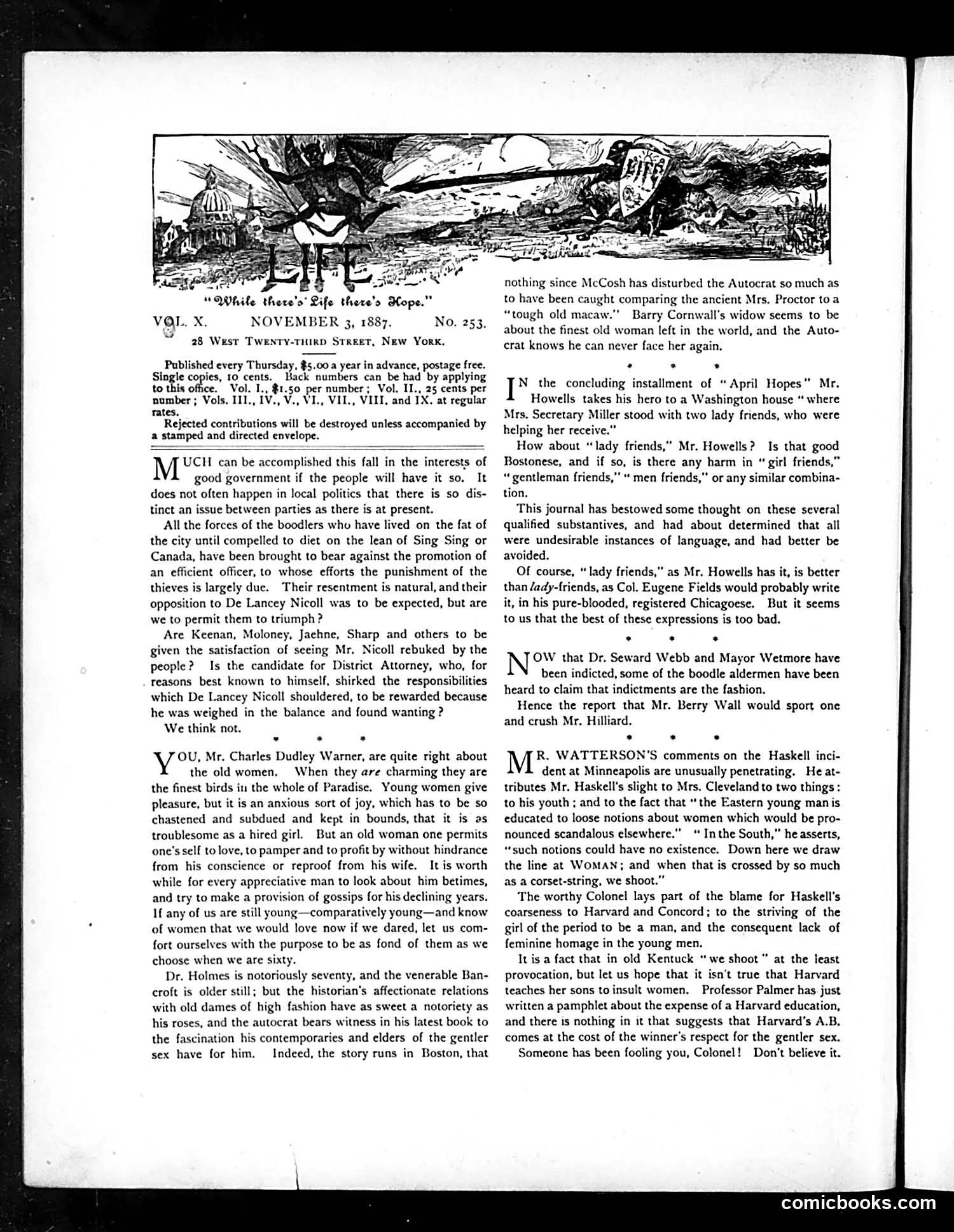
The masthead cartoon depicts a nightmarish landscape with a skeletal or death-like figure looming over a cityscape with a domed building (likely the Capitol). A sign reading "RUIN" is visible. This appears to be satirizing fears about economic or political collapse during the Gilded Age. The text discusses government corruption, including references to "thieves" and criticism of political parties. The editorial content critiques poor governance and suggests that political corruption is rampant. References to "De Lancey Nicoll" and District Attorney elections suggest commentary on New York politics and law enforcement failures. The overall tone warns that without addressing systemic corruption and incompetence in government, the nation faces catastrophic consequences—hence the apocalyptic imagery.
📄 Transcribed text from this page (OCR, searchable)
Machine-transcribed from the original scan — historical spelling and the odd misread are preserved.
“While there's’ Life there’s Hope.” VOL. X. NOVEMBER 3, 1887. No. 253. 28 West TWENTY-THIRD STREET, New York, Published every Thursday, $5.00 a year in advance, postage free. Single copies, 10 cents. Back numbers can be had by applying to this office. Vol. I., $1.50 per number; Vol. II., 25 cents per number; Vols, III, IV., V., VI., VIL, VIII, and IX. at regular rates. Rejected contributions will be destroyed unless accompanied by a stamped and directed envelope. UCH can be accomplished this fall in the interests of good government if the people will have it so. It does not often happen in local politics that there is so dis- tinct an issue between parties as there is at present. All the forces of the boodlers who have lived on the fat of the city until compelled to diet on the lean of Sing Sing or Canada, have been brought to bear against the promotion of an efficient officer, to whose efforts the punishment of the thieves is largely due. Their resentment is natural, and their opposition to De Lancey Nicoll was to be expected, but are we to permit them to triumph ? Are Keenan, Moloney, Jaehne, Sharp and others to be given the satisfaction of seeing Mr. Nicoll rebuked by the people? Is the candidate for District Attorney, who, for reasons best known to himself, shirked the responsibilities which De Lancey Nicoll shouldered, to be rewarded because he was weighed in the balance and found wanting ? We think not. OU, Mr. Charles Dudley Warner, are quite right about the old women, When they ave charming they are the finest birds in the whole of Paradise. Young women give pleasure, but it is an anxious sort of joy, which has to be so chastened and subdued and kept in bounds, that it is as troublesome as a hired girl. But an old woman one permits one’s self to love, to pamper and to profit by without hindrance from his conscience or reproof from his wife. It is worth while for every appreciative man to look about him betimes, and try to make a provision of gossips for his declining years. If any of us are still young—comparatively young—and know of women that we would love now if we dared, let us com- fort ourselves with the purpose to be as fond of them as we choose when we are sixty. Dr. Holmes is notoriously seventy, and the venerable Ban- croft is older still; but the historian’s affectionate relations with old dames of high fashion have as sweet a notoriety as his roses, and the autocrat bears witness in his latest book to the fascination his contemporaries and elders of the gentler sex have for him. Indeed, the story runs in Boston, that nothing since McCosh has disturbed the Autocrat so much as to have been caught comparing the ancient Mrs. Proctor toa “tough old macaw.’ Barry Cornwall's widow seems to be about the finest old woman left in the world, and the Auto- crat knows he can never face her again. . . . ]* the concluding installment of “April Hopes” Mr. Howells takes his hero to a Washington house “ where Mrs. Secretary Miller stood with two lady friends, who were helping her receive.” How about “lady friends,” Mr. Howells? Is that good Bostonese, and if so, is there any harm in “girl friends,” “gentleman friends,” “ men friends,” or any similar combina- tion. This journal has bestowed some thought on these several qualified substantives, and had about determined that all were undesirable instances of language, and had better be avoided. Of course, “ lady friends,” as Mr. Howells has it, is better than /ady-friends, as Col. Eugene Fields would probably write it, in his pure-blooded, registered Chicagoese. But it seems to us that the best of these expressions is too bad. . . * OW that Dr, Seward Webb and Mayor Wetmore have been indicted, some of the boodle aldermen have been heard to claim that indictments are the fashion. Hence the report that Mr. Berry Wall would sport one and crush Mr. Hilliard. . . . R. WATTERSON'S comments on the Haskell inci- dent at Minneapolis are unusually penetrating. He at- tributes Mr. Haskell's slight to Mrs, Cleveland to two things : to his youth ; and to the fact that “the Eastern young manis educated to loose notions about women which would be pro- nounced scandalous elsewhere.” ‘ Inthe South,” he asserts, “such notions could have no existence. Down here we draw the line at WOMAN; and when that is crossed by so much as a corset-string, we shoot.” The worthy Colonel lays part of the blame for Haskell’s coarseness to Harvard and Concord; to the striving of the girl of the period to be a man, and the consequent lack of feminine homage in the young men. It is a fact that in old Kentuck “we shoot” at the least provocation, but let us hope that it isn’t true that Harvard teaches her sons to insult women. Professor Palmer has just written a pamphlet about the expense of a Harvard education, and there is nothing in it that suggests that Harvard's A.B. comes at the cost of the winner's respect for the gentler sex. Someone has been fooling you, Colonel! Don't believe it. comicbooks.com