
Life, 1887-11-03 · page 12 of 20
Life — November 3, 1887 — page 12: what you’re looking at
What you’re looking at
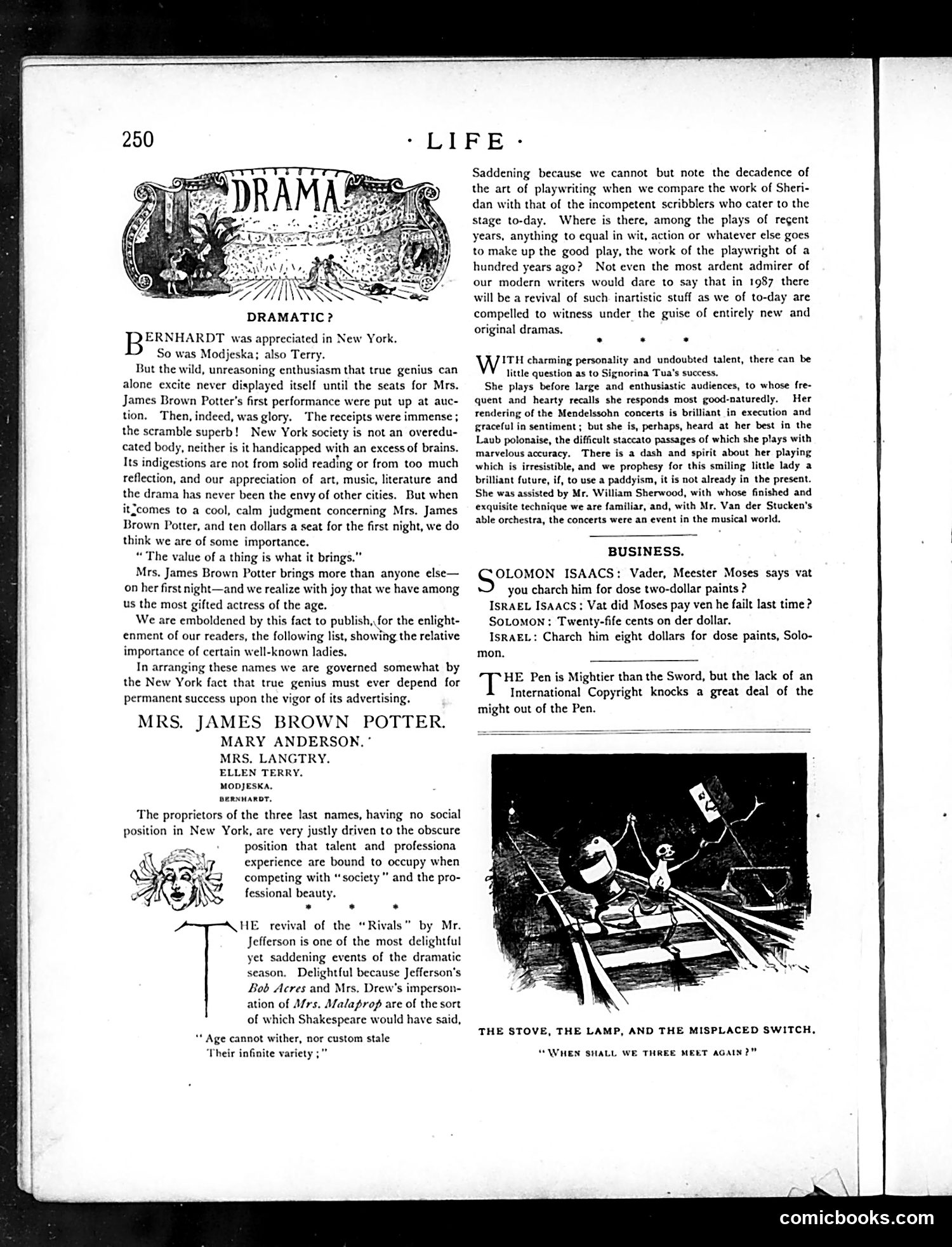
This page satirizes the New York theatrical world's obsession with celebrity and wealth over genuine talent. The unnamed author mocks Mrs. James Brown Potter, a socialite-actress whose auction of first-night seats generated enormous money and public frenzy. Life ranks her *above* legendary performers like Sarah Bernhardt, Mary Anderson, and Lillie Langtry—not for acting ability, but because she possesses social position and effective self-promotion. The satire's bitter point: New York judges artistic merit by ticket prices and advertising power, not actual talent. Professional actresses of real accomplishment rank below a society woman simply because she lacks their professional status. The piece also laments modern playwriting's decline compared to 18th-century dramatists like Sheridan. It's a critique of American cultural shallowness and mercenary values masquerading as appreciation for art.
📄 Transcribed text from this page (OCR, searchable)
Machine-transcribed from the original scan — historical spelling and the odd misread are preserved.
‘LIFE: DRAMATIC? ERNHARDT was appreciated in New York. So was Modjeska; also Terry. But the wild, unreasoning enthusiasm that true genius can alone excite never displayed itself until the seats for Mrs. James Brown Potter's first performance were put up at auc- tion. Then, indeed, was glory. The receipts were immens the scramble superb! New York society is not an overedu- cated body, neither is it handicapped with an excess of brains. Its indigestions are not from solid reading or from too much reflection, and our appreciation of art, music, literature and the drama has never been the envy of other cities. But when itZcomes to a cool, calm judgment concerning Mrs. James Brown Potter, and ten dollars a seat for the first night, we do think we are of some importance. “ The value of a thing is what it brings.” Mrs, James Brown Potter brings more than anyone else— on her first night—and we realize with joy that we have among us the most gifted actress of the age. We are emboldened by this fact to publish, for the enlight- enment of our readers, the following list, showing the relative importance of certain well-known ladies. In arranging these names we are governed somewhat by the New York fact that true genius must ever depend for Permanent success upon the vigor of its advertising. MRS. JAMES BROWN POTTER. MARY ANDERSON. ’* MRS. LANGTRY. ELLEN TERRY. MODJESKA. BERNHARDT. The proprietors of the three last names, having no social position in New York, are very justly driven to the obscure position that talent and professiona experience are bound to occupy when competing with “society” and the pro- fessional beauty. . . . HE revival of the “Riv: by Mr. Jefferson is one of the most delightful yet saddening events of the dramatic season. Delightful because Jefferson's Bob Acres and Mrs, Drew's imperson- ation of Mrs. Malaprop are of the sort of which Shakespeare would have said, “* Age cannot wither, nor custom stale ‘Their infinite variety ;" Saddening because we cannot but note the decadence of the art of playwriting when we compare the work of Sheri- dan with that of the incompetent scribblers who cater to the stage to-day. Where is there, among the plays of regent years, anything to equal in wit, action or whatever else goes to make up the good play, the work of the playwright of a hundred years ago? Not even the most ardent admirer of our modern writers would dare to say that in 1987 there will be a revival of such inartistic stuff as we of to-day are compelled to witness under the guise of entirely new and original dramas. . . . wie charming personality and undoubted talent, there can be little question as to Signorina Tua’s success. She plays before large and enthusiastic audiences, to whose fre- quent and hearty recalls she responds most good-naturedly. Her rendering of the Mendelssohn concerts is brilliant in execution and graceful in sentiment; but she is, perhaps, heard at her best in the Laub polonaise, the difficult staccato passages of which she plays with marvelous accuracy. There is a dash and spirit about her playing which is irresistible, and we prophesy for this smiling little lady a brilliant future, if, to use a paddyism, it is not already in the present. She was assisted by Mr. William Sherwood, with whose finished and exquisite technique we are familiar, and, with Mr. Van der Stucken's able orchestra, the concerts were an event in the musical world. BUSINESS. OLOMON ISAACS: Vader, Meester Moses says vat you charch him for dose two-dollar paints ? ISRAEL ISAACS: Vat did Moses pay ven he failt last time ? SOLOMON: Twenty-fife cents on der dollar. ISRAEL: Charch him eight dollars for dose paints, Solo- mon. Te Pen is Mightier than the Sword, but the lack of an International Copyright knocks a great deal of the might out of the Pen. THE STOVE, THE LAMP, AND THE MISPLACED SWITCH, “WHEN SHALL WE THREE MEET AGAIN?” comicbooks.com