
A complete issue · 16 pages · 1887
Life — July 7, 1887
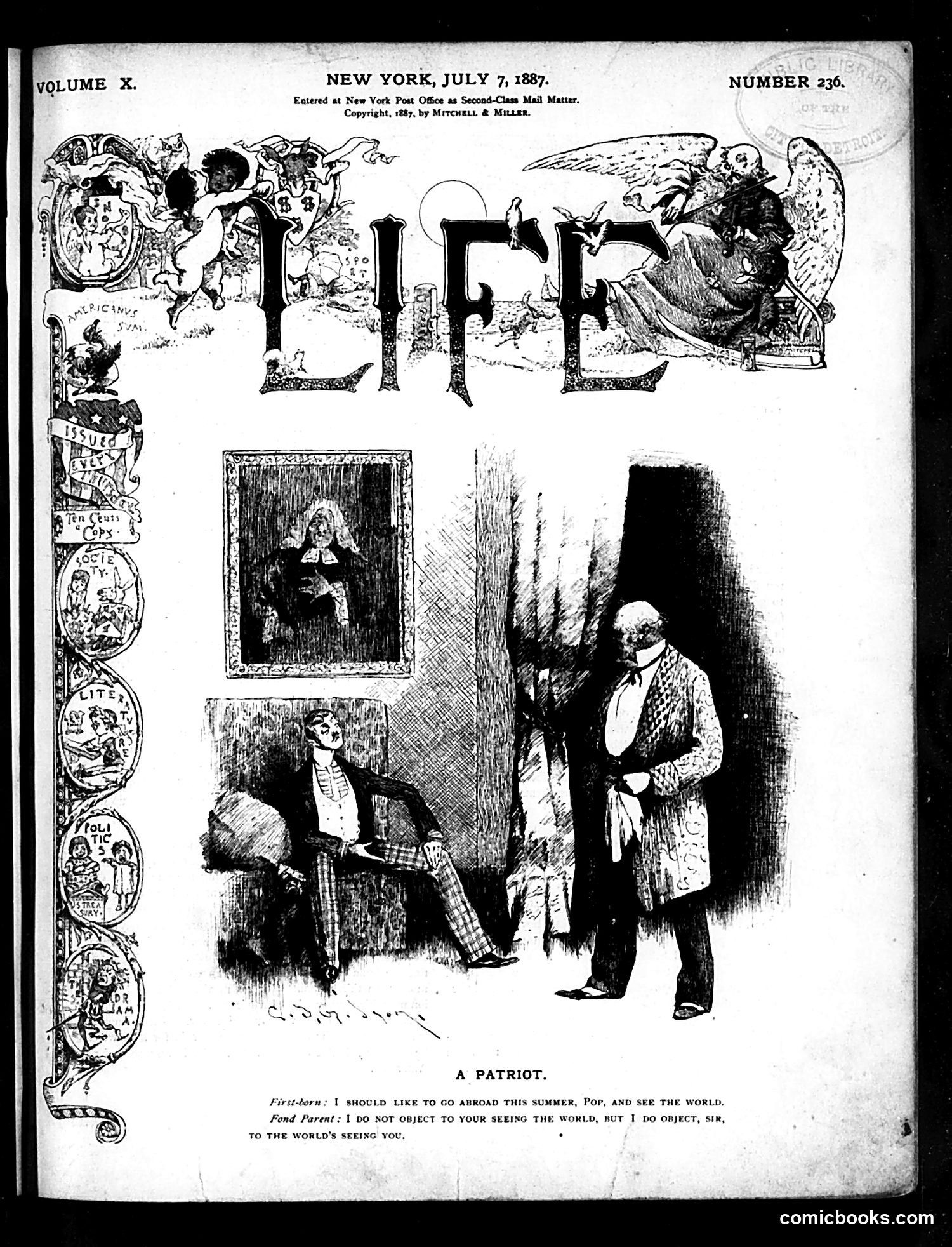
This cartoon satirizes American nationalism and hypocrisy regarding foreign travel. A first-born son declares he wants to travel abroad "this summer, Pop, and see the world." His father objects, saying "I do not object to your seeing the world, but I do object, sir, to the world's seeing you." The joke mocks wealthy Americans who claim patriotic motives while actually being embarrassed by their countrymen abroad. The father's response suggests American travelers were viewed unfavorably internationally—perhaps as crude, loud, or otherwise representing the nation poorly. The cartoon criticizes the contradiction between professed patriotism and the desire to hide one's nationality from foreign scrutiny, common anxiety among 19th-century American travelers in Europe.
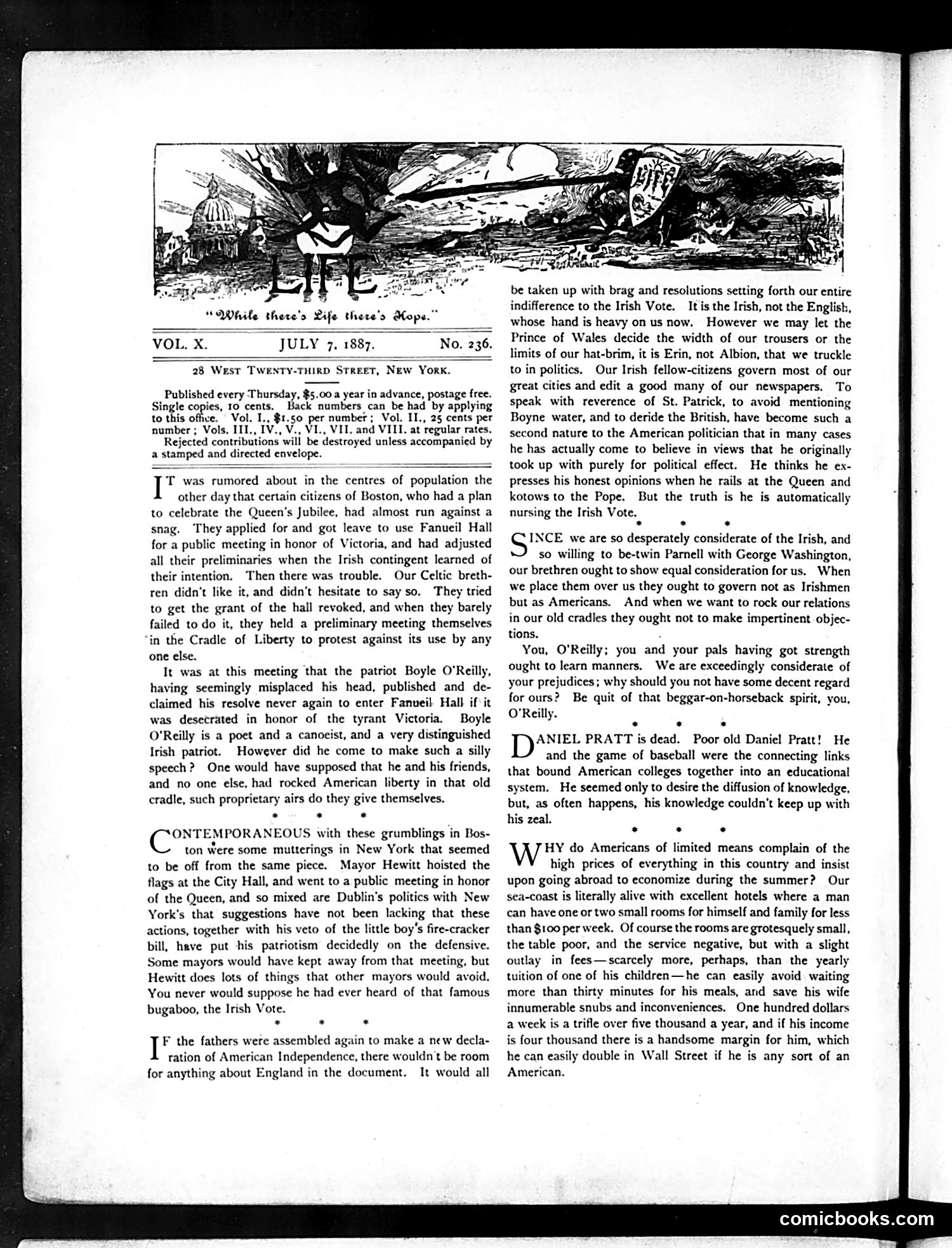
The masthead cartoon "While there's Life there's Hope" depicts a chaotic scene with references to Irish-American political tensions of the era. The text discusses Boyle O'Reilly, an Irish patriot and poet, and criticizes Irish-American leaders for prioritizing political agendas over American interests. The satire targets Irish-Americans who, the author argues, govern American cities while maintaining divided loyalties to Ireland and the Catholic Church rather than embracing full American citizenship. The piece mocks their perceived arrogance—"beggar-on-horseback spirit"—and advocates for assimilation over ethnic political identity. The page also includes brief commentary on Daniel Pratt's death and summer travel economics for middle-class Americans, reflecting Life's typical mix of political and social satire.
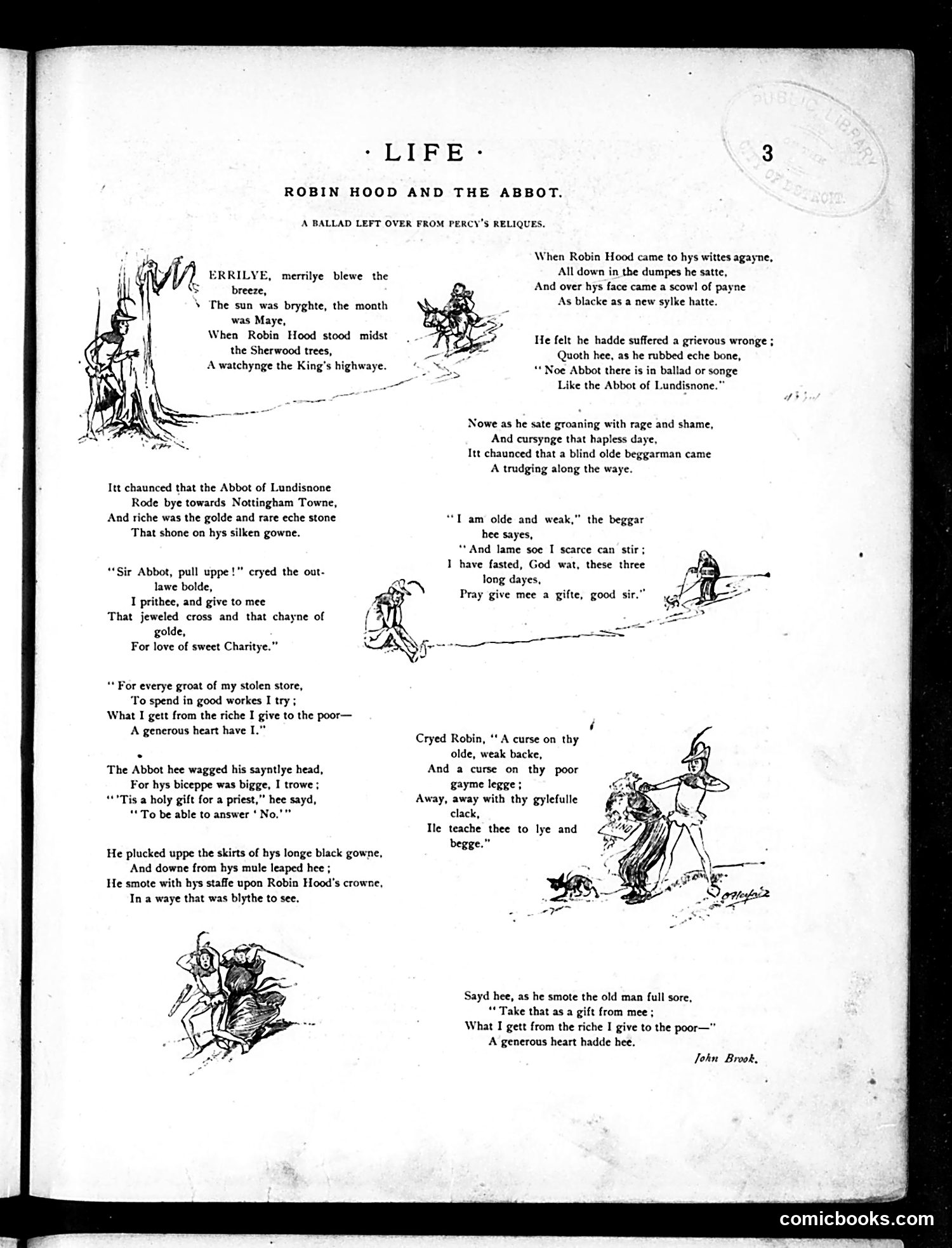
This is a literary piece rather than political satire—a ballad adaptation about Robin Hood encountering the Abbot of Lindelisonne. The narrative depicts Robin's rage upon learning the Abbot mistreated him, followed by the Abbot's encounter with a beggar (Robin in disguise) who requests charity. The ballad's satirical edge targets ecclesiastical hypocrisy: the Abbot boasts of his generous charitable works while actually refusing to help a poor beggar. The illustrations by Kemble show the confrontation between Robin and the Abbot, emphasizing the irony of the church's claimed virtue versus its actual callousness. This reflects historical anticlerical sentiment common in satirical literature and medieval folklore traditions.
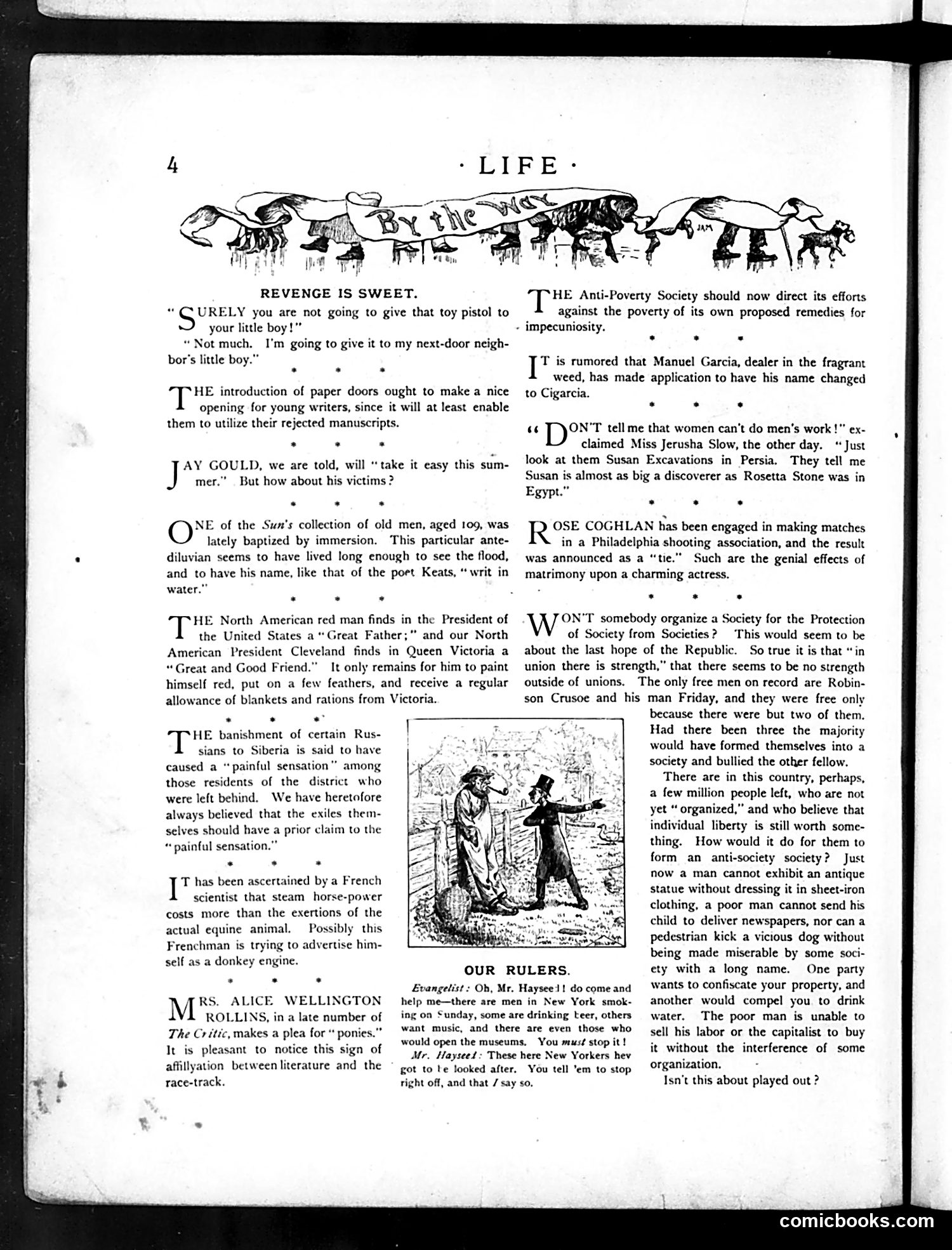
This satirical page contains several brief social commentaries typical of Life magazine's format. The main cartoon, titled "OUR RULERS," depicts an interaction between what appears to be a well-dressed man and a working-class figure, likely satirizing class divisions and social hypocrisy. The surrounding text items mock various contemporary issues: the Anti-Poverty Society's ineffective remedies, women's capabilities (referencing Susan Excavations and Rosetta Stone), Rose Coghlan's engagement in shooting sports, and labor organization. The concluding commentary critiques proposed restrictions on poor people's freedoms—preventing them from selling labor independently or engaging in basic activities without organizational permission. The satire targets what the author sees as excessive social regulation disguised as reform. The page's tone is characteristically acerbic and class-conscious.
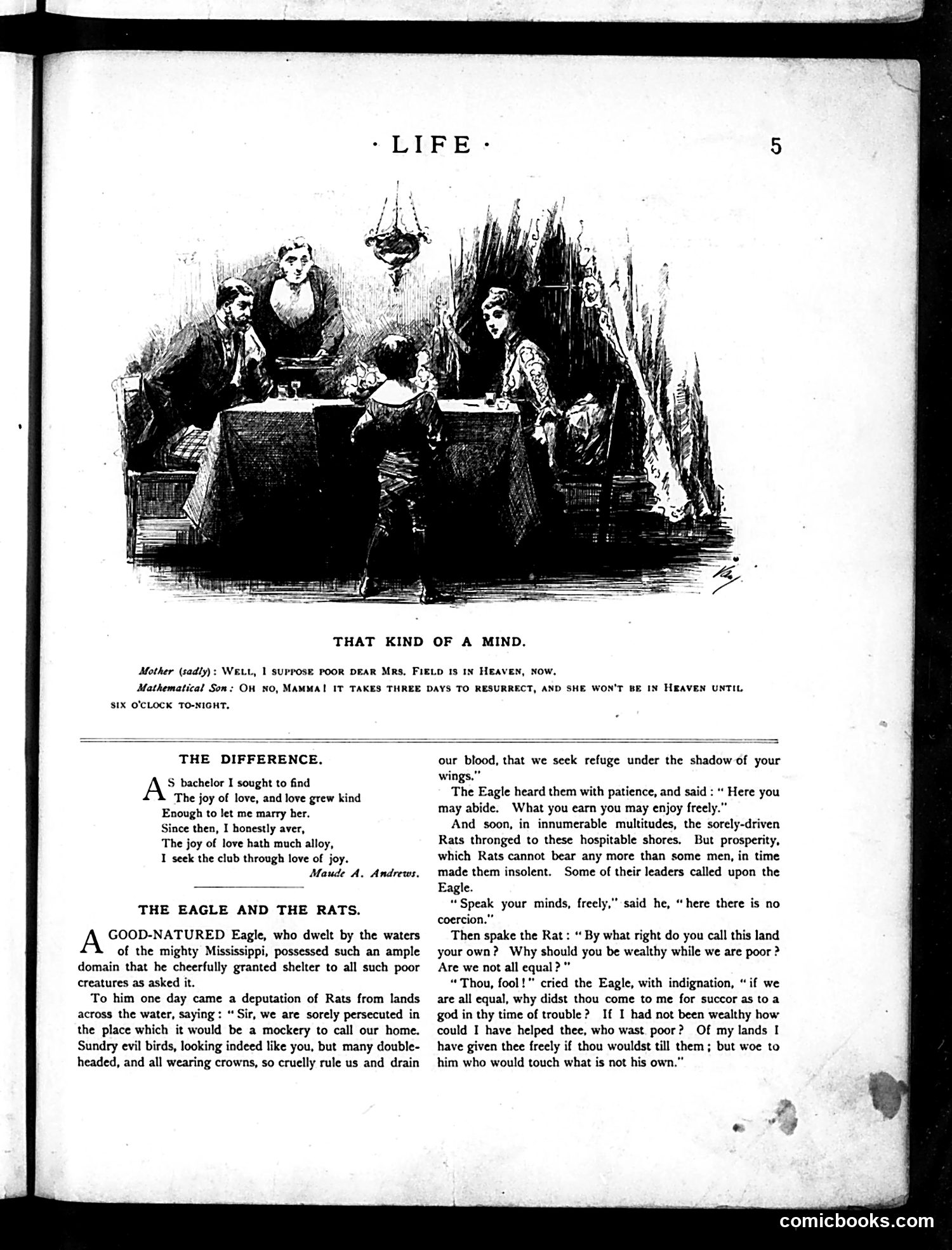
This page from *Life* magazine contains two distinct pieces: **"That Kind of a Mind"** (top cartoon): A domestic scene showing a mother telling her son that their neighbor Mrs. Field has died but won't reach Heaven for three days—it takes that long for her to be resurrected. The joke satirizes Mrs. Field's character as someone so difficult or contentious that even death itself seems reluctant to accept her permanently. It's a cruel joke about an unpleasant personality. **"The Eagle and the Rats"** (fable): This is a moral tale where persecuted Rats seek shelter from an Eagle, who initially offers refuge but then refuses, claiming property rights. The story appears to critique wealth inequality and privilege—the Eagle's argument that the poor don't deserve aid because they lack property. It's likely social commentary on class conflict and economic justice, though the specific historical reference remains unclear without additional context.
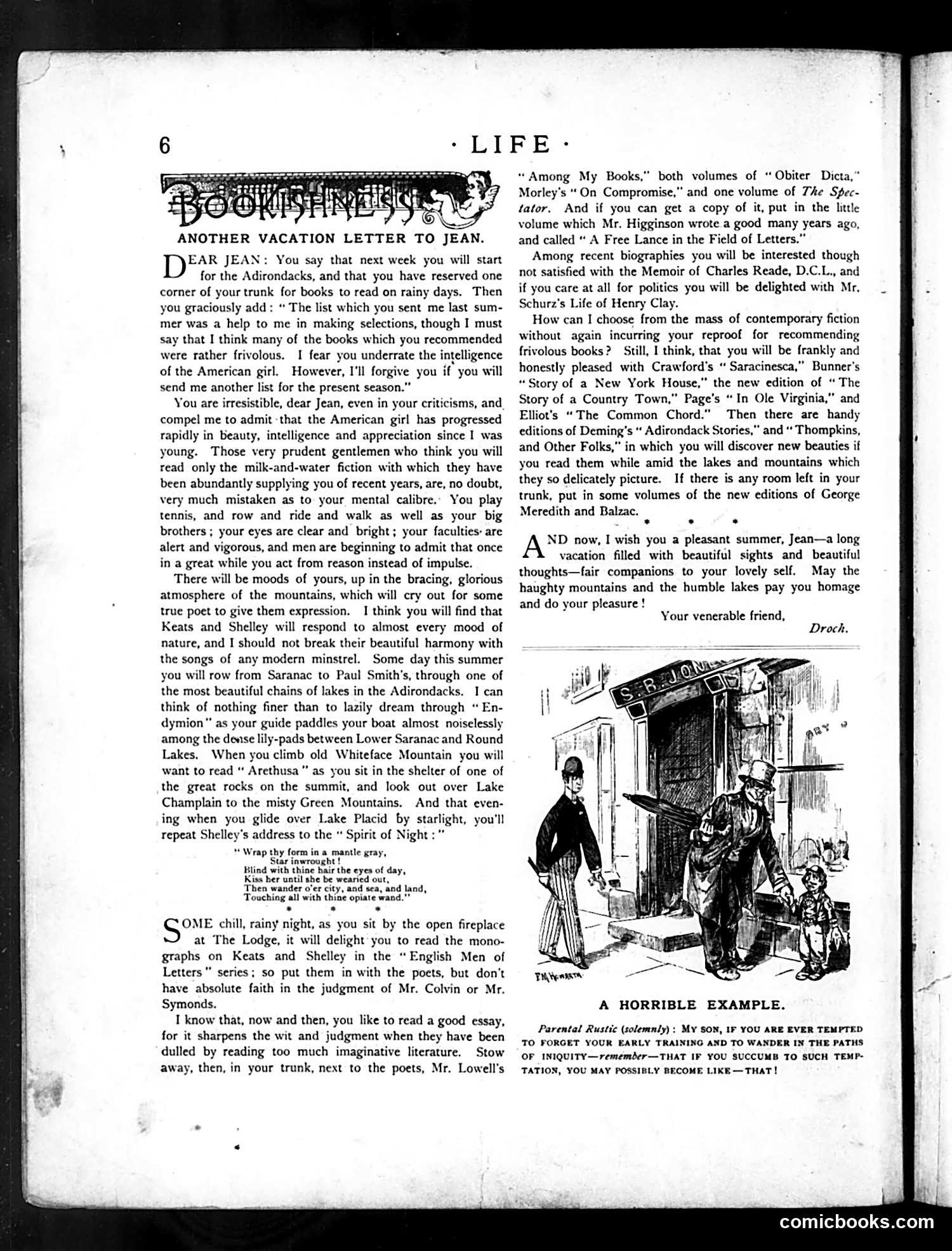
This illustration depicts a cautionary scene about parental discipline and child-rearing. A well-dressed man stands at a doorway while a woman (likely his wife) gestures toward unruly children inside a home. The caption, addressed to parents, warns that neglecting a child's early training and allowing them to "wander in the paths of iniquity" may result in the child becoming "like that!" — pointing to the chaotic scene within. The satire targets permissive parenting practices of the era. Rather than political commentary, this is social satire about Victorian moral education, using exaggerated domestic disorder to warn middle-class readers about the consequences of insufficient parental authority and discipline over children.
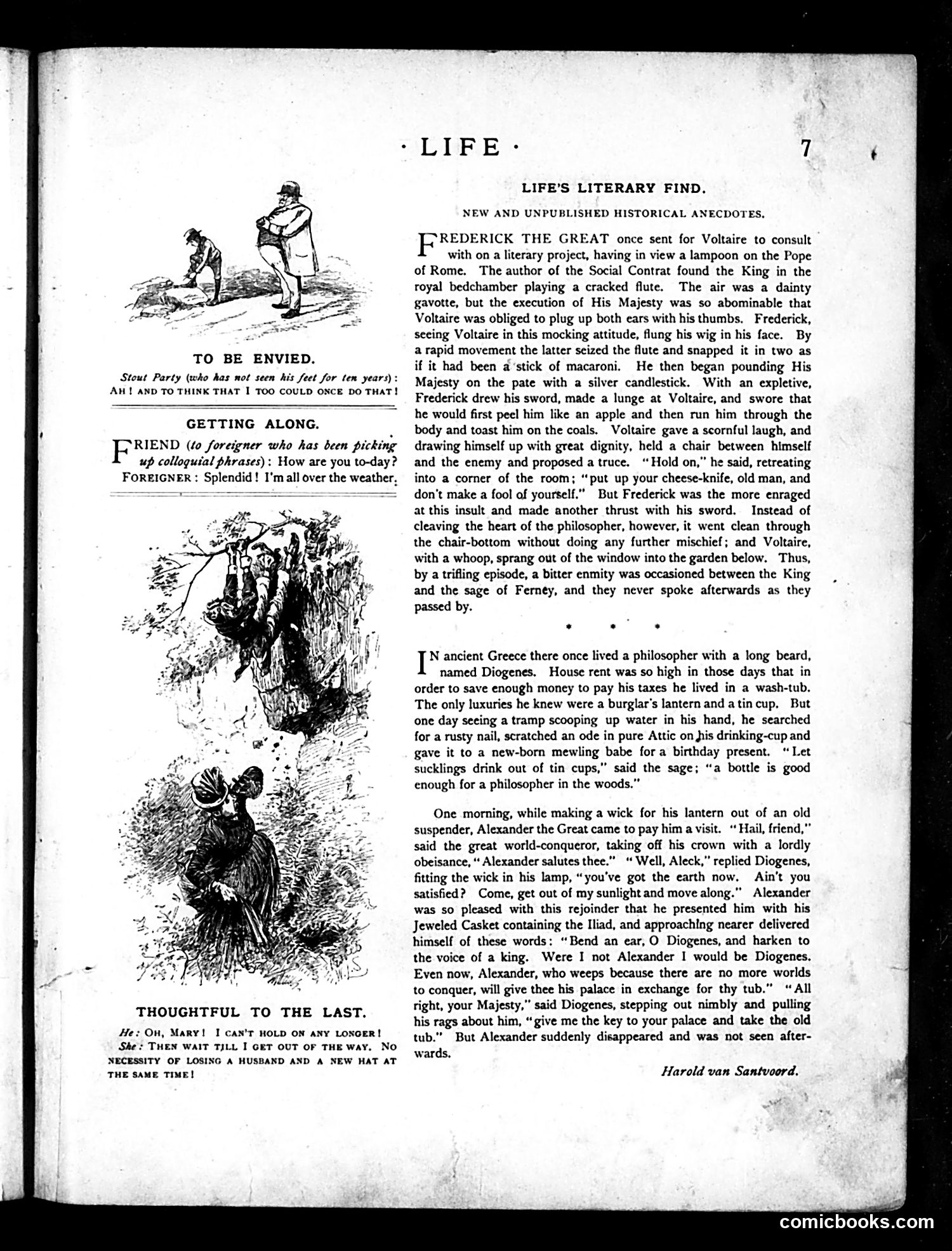
This page contains three humorous anecdotes rather than political cartoons. The illustrations are decorative vignettes supporting literary pieces titled "Life's Literary Find." The first anecdote depicts **Frederick the Great** (Prussian king) and **Voltaire** (French philosopher) in a mocking encounter—Frederick summoned Voltaire for a literary project but treated him with contempt, including having him play a flute badly. When Voltaire retaliated verbally, Frederick attacked him with a sword, but Voltaire escaped through a window. The second story concerns **Alexander the Great** meeting **Diogenes**, the ancient Greek philosopher famous for rejecting material possessions. Alexander offers Diogenes anything he wants; Diogenes requests Alexander simply move aside, blocking his sunlight. These anecdotes illustrate wit and intellectual defiance against authority—themes appealing to Life's educated readership.
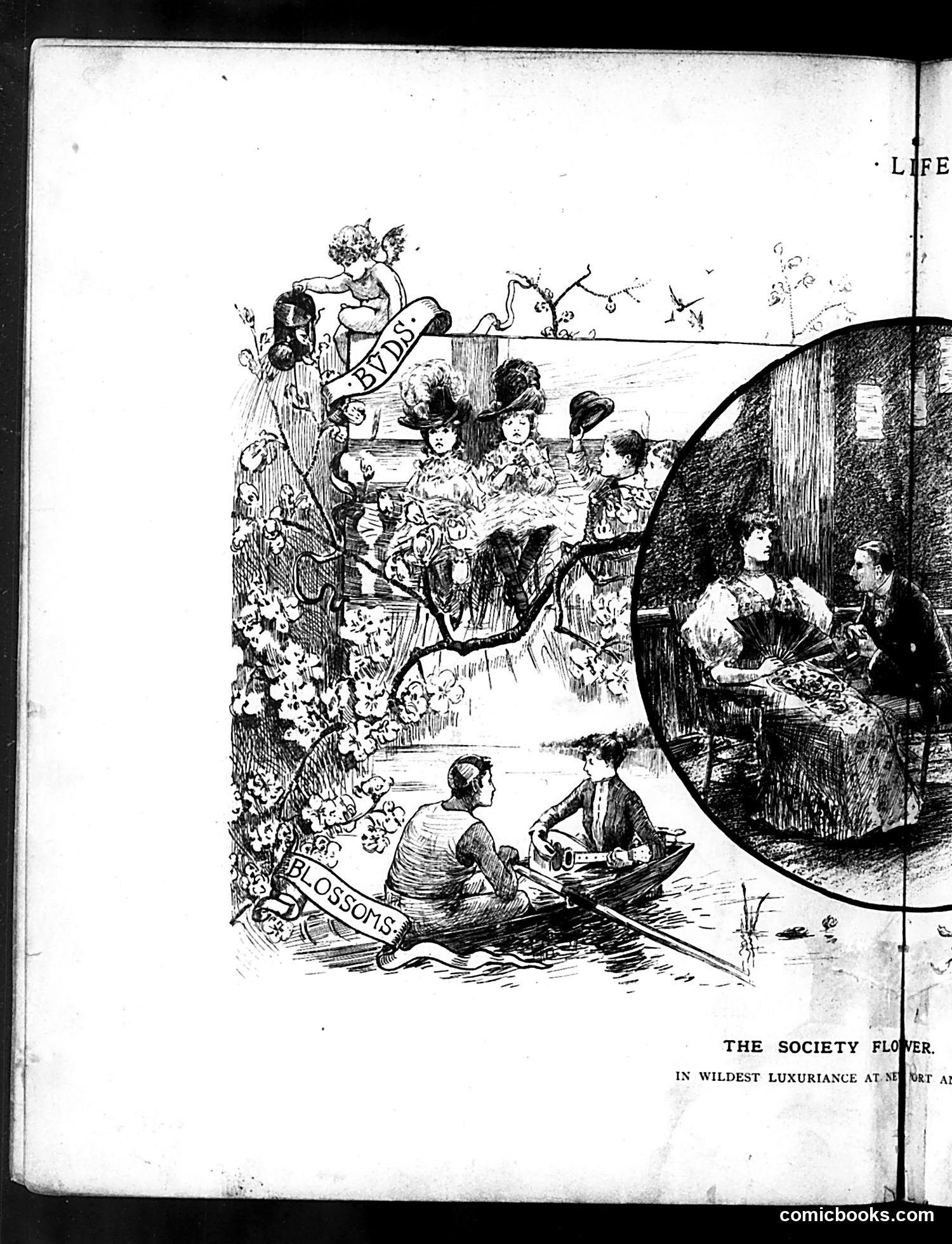
This satirical illustration critiques wealthy society women and the excesses of the Newport, Rhode Island leisure class. The left panel shows an elaborately dressed woman in a boat being attended by servants, surrounded by decorative flora labeled "BLOSSOMS"—a metaphor for her as a cultivated, artificial "flower" of high society. The right panel depicts indoor social gatherings of similarly well-dressed figures in luxurious settings. The satire mocks the idle leisure, extravagant fashion, and self-indulgent lifestyle of the wealthy elite during this Gilded Age period. Newport was America's premier resort destination for the ultra-rich, making it an obvious target for critique of conspicuous consumption and social pretension.
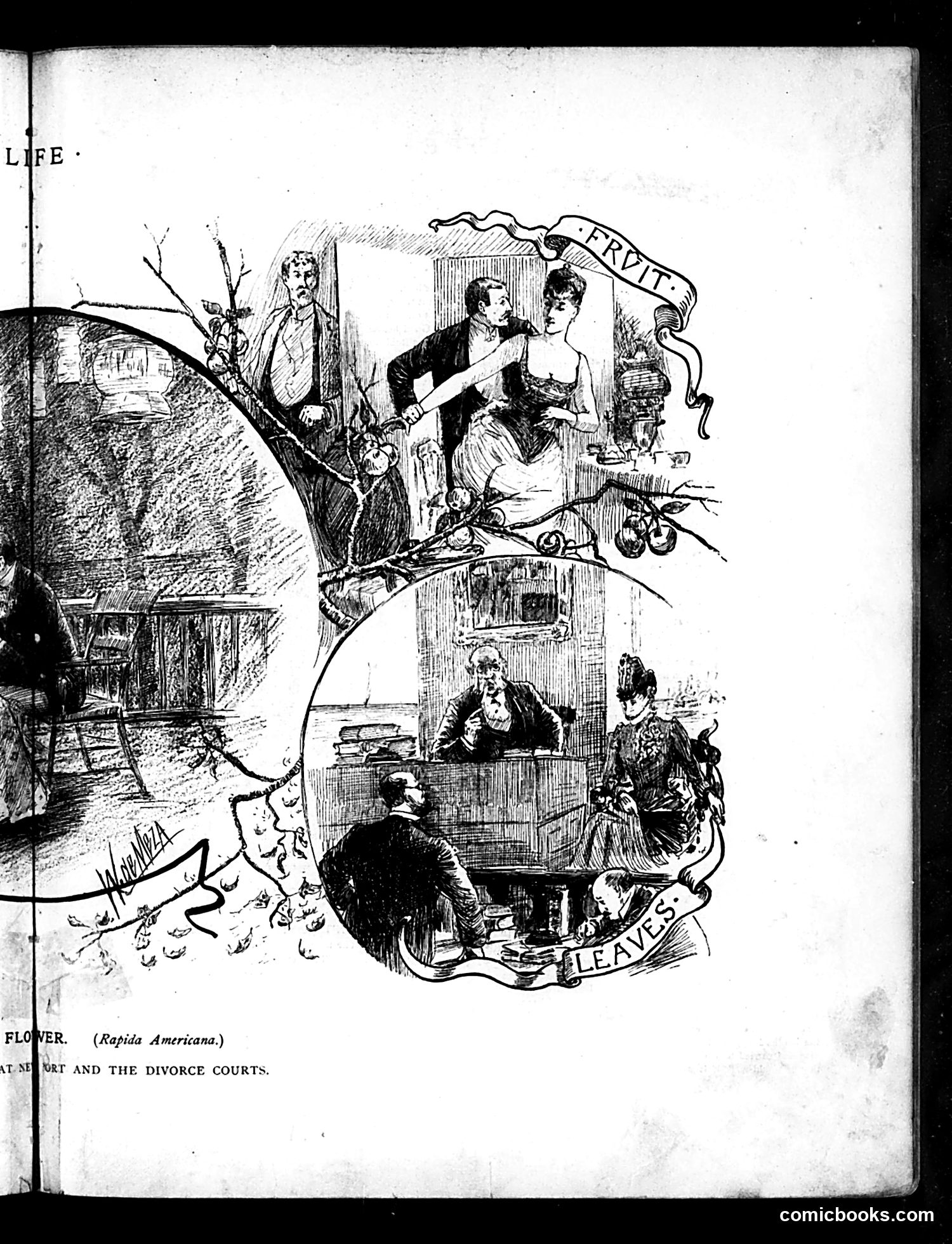
This satirical illustration uses a tree-of-life metaphor to critique American marital instability and the divorce courts. The tree's roots are labeled "LEAVES" (departures/separations), while "FRUIT" at the top represents the outcomes of failed marriages. The cartoon depicts various scenes within the tree's structure: couples in romantic situations at the top, a judge presiding over proceedings in the middle, and domestic conflict at the base. The scientific notation "(Rapida Americana)" mockingly categorizes American divorce as if it were a natural species—suggesting marital breakdown was becoming endemic to American culture. The satire targets how divorce courts had become a routine, almost expected institution rather than an exceptional remedy. The page critiques both the frequency of divorces and the social acceptance surrounding them in early 20th-century America.
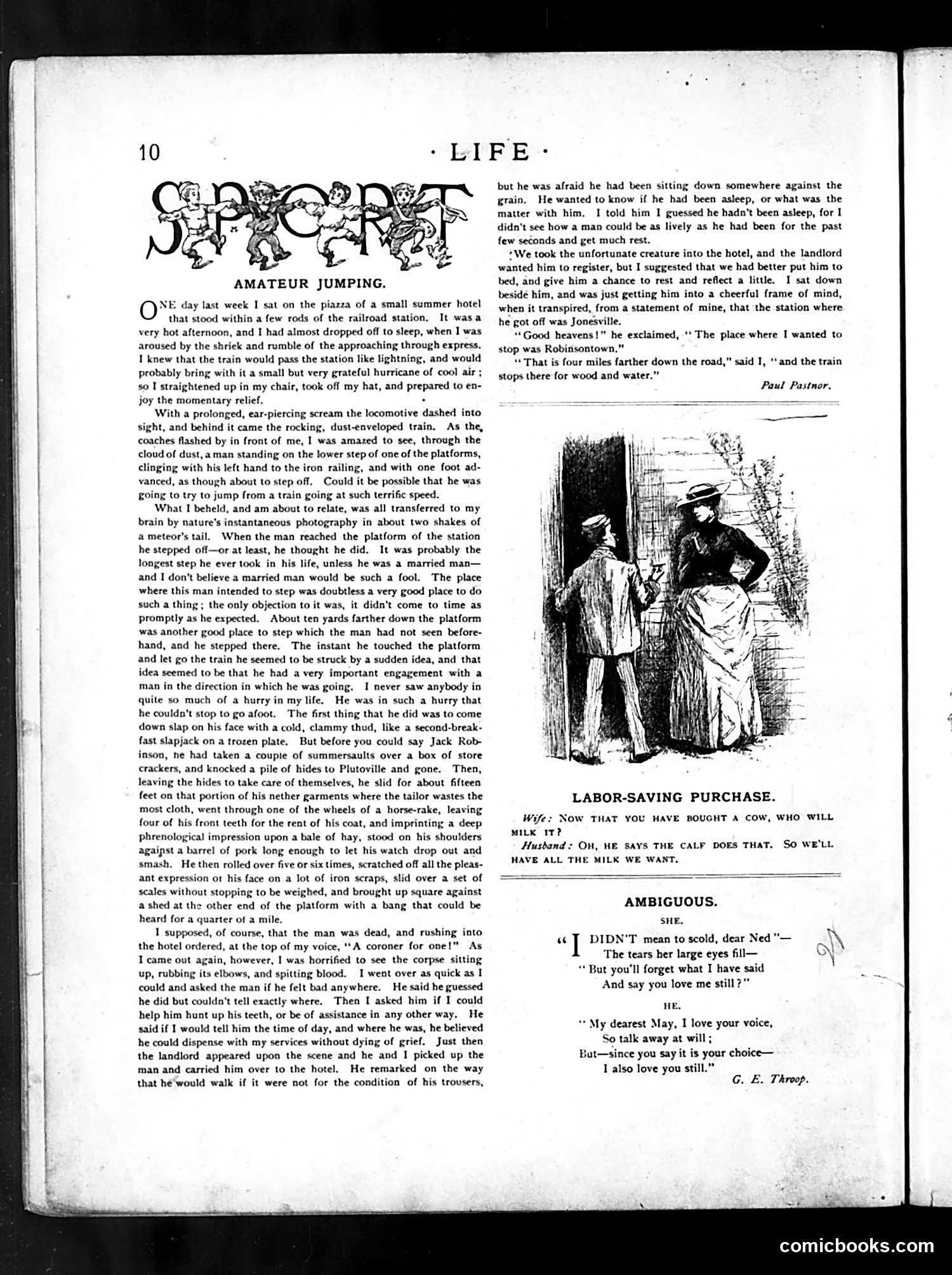
This page contains three separate humor pieces rather than political cartoons: 1. **"Amateur Jumping"** - A narrative anecdote about witnessing a man leap from a moving train near a railroad station, apparently in distress or haste. The humor derives from the narrator's bewilderment at the man's reckless behavior and subsequent discovery that the passenger had urgent business elsewhere. 2. **"Labor-Saving Purchase"** - A brief domestic joke about a husband buying a cow, with the wife assuming it will reduce their workload, only to learn the calf will produce all the milk they need anyway—inverting her expectation. 3. **"Ambiguous"** - A sentimental poem about romantic ambiguity, where a woman questions whether a man's affection is genuine. These are general-audience humor pieces without specific political references.
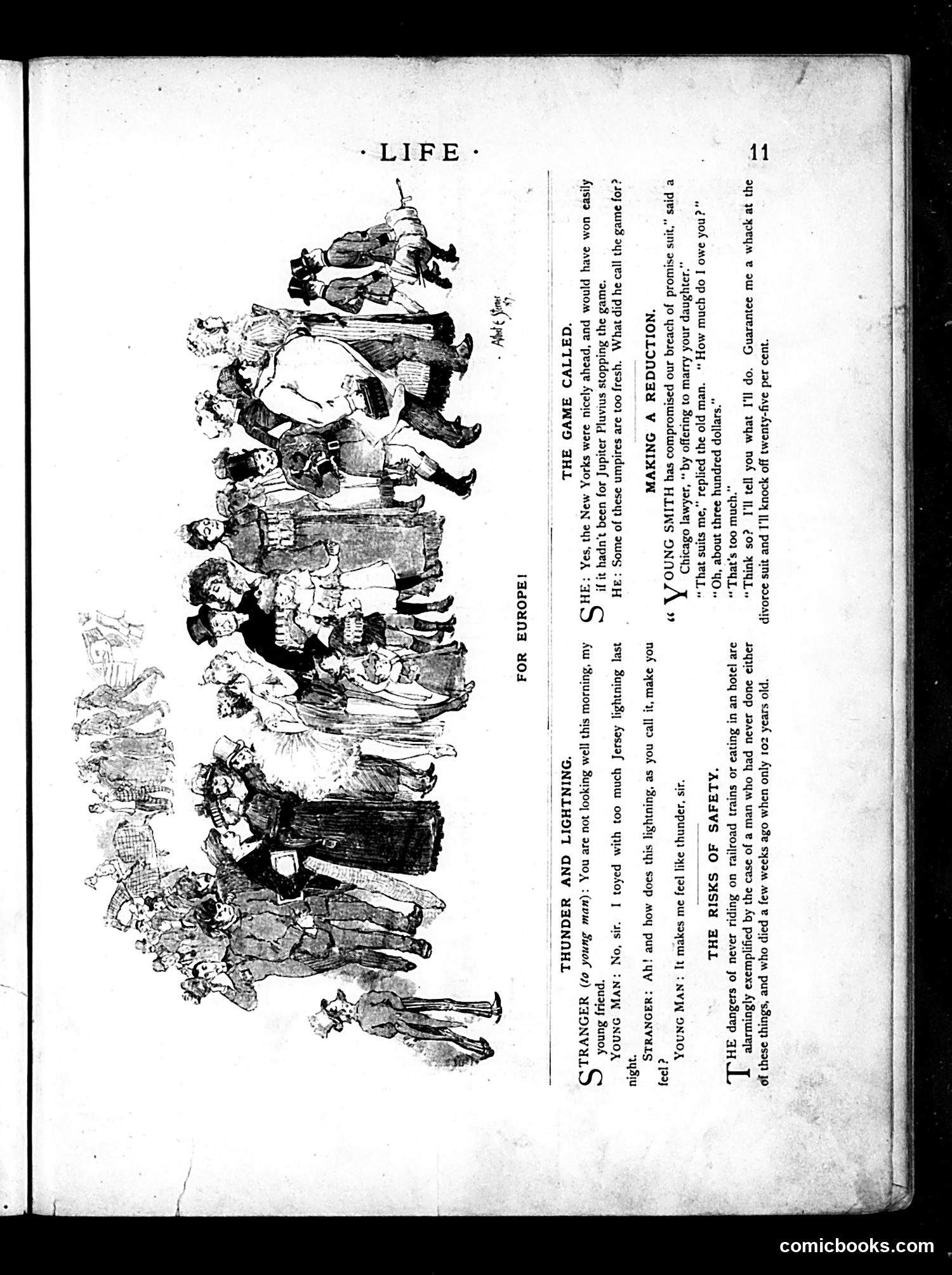
This page features a vertical satirical cartoon titled "Stranger Thunder and Lightning for Europe" with accompanying text sections labeled "The Game Called," "Young with Making Reduction," and "The Risks of Safety." The image shows a stack of caricatured figures arranged vertically, appearing to depict European political or military leaders of the early 20th century in a chaotic, precarious arrangement. The composition suggests instability and danger—the stacked figures could topple at any moment. The satirical point critiques European political tensions and the fragile balance of power among competing nations and leaders. The "thunder and lightning" metaphor suggests violent conflict looming. The multiple warning sections about "risks" and "reduction" indicate Life magazine's concerns about escalating international tensions, likely during a period of pre-war or wartime European instability. The OCR text is too corrupted to extract specific details about which leaders are depicted or precise historical events referenced.
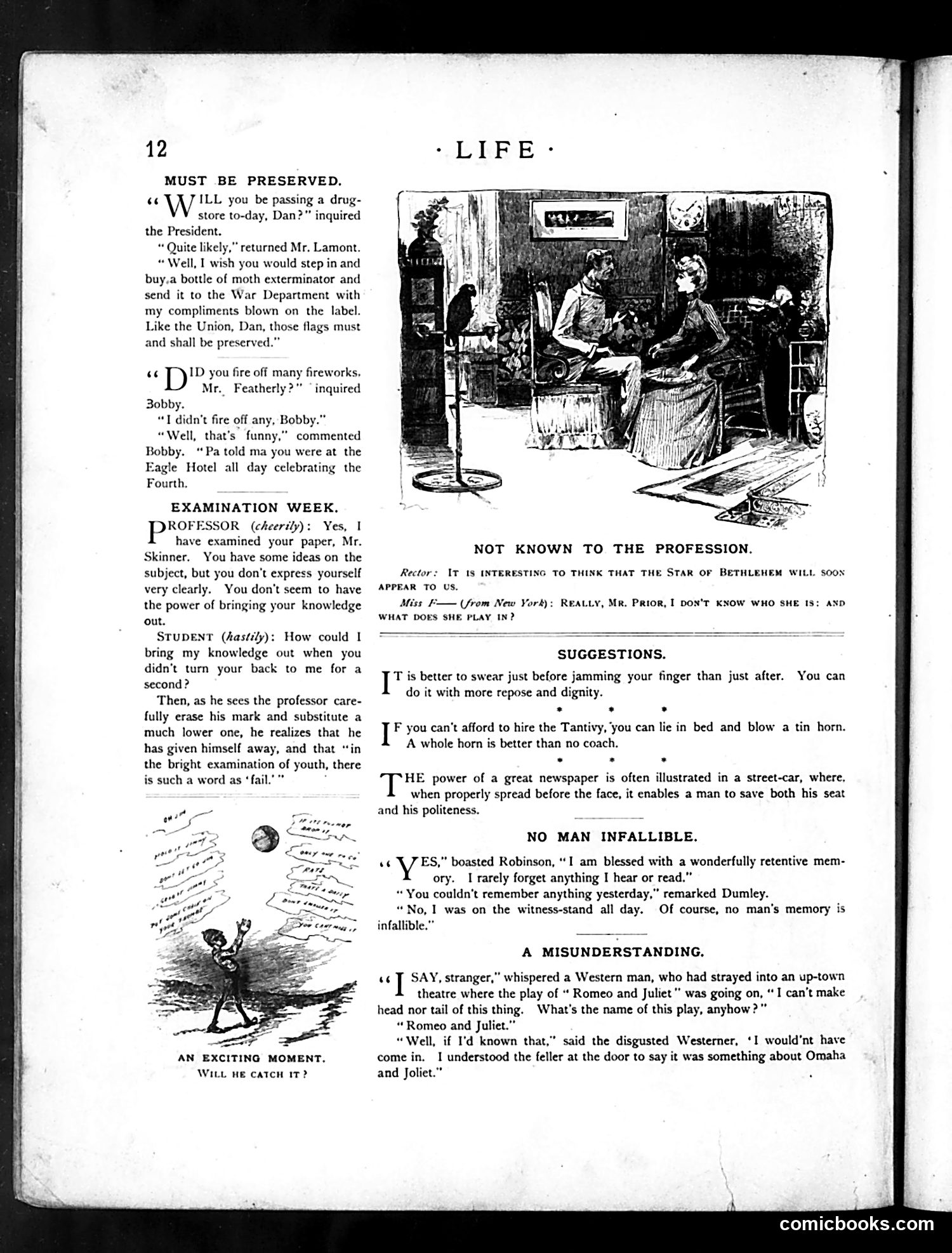
This page from *Life* (a 19th-century satirical weekly) contains several brief humorous sketches mocking American society: **"Must Be Preserved"** jokes about President Cleveland asking aide Dan Lamont to buy moth exterminator for the War Department's flags—a pun on preserving both literal flags and "the Union." **"Examination Week"** satirizes academic dishonesty: a student admits to cheating during an exam, and the professor—caught—lowers his grade anyway, implying the professor was also complicit or caught off-guard. **"Not Known to the Profession"** mocks a New York woman's ignorance: a rector discusses the Star of Bethlehem (a biblical/astronomical reference), but she mistakes it for an actress, asking what she "plays in." **"A Misunderstanding"** depicts a confused Westerner at a theater production of *Romeo and Juliet*, mishearing it as "Omaha and Joliet" (two Midwestern cities)—poking fun at rural/uncultured audiences unfamiliar with Shakespeare. The humor relies on wordplay, social pretension, and regional stereotypes typical of *Life's* satirical voice.
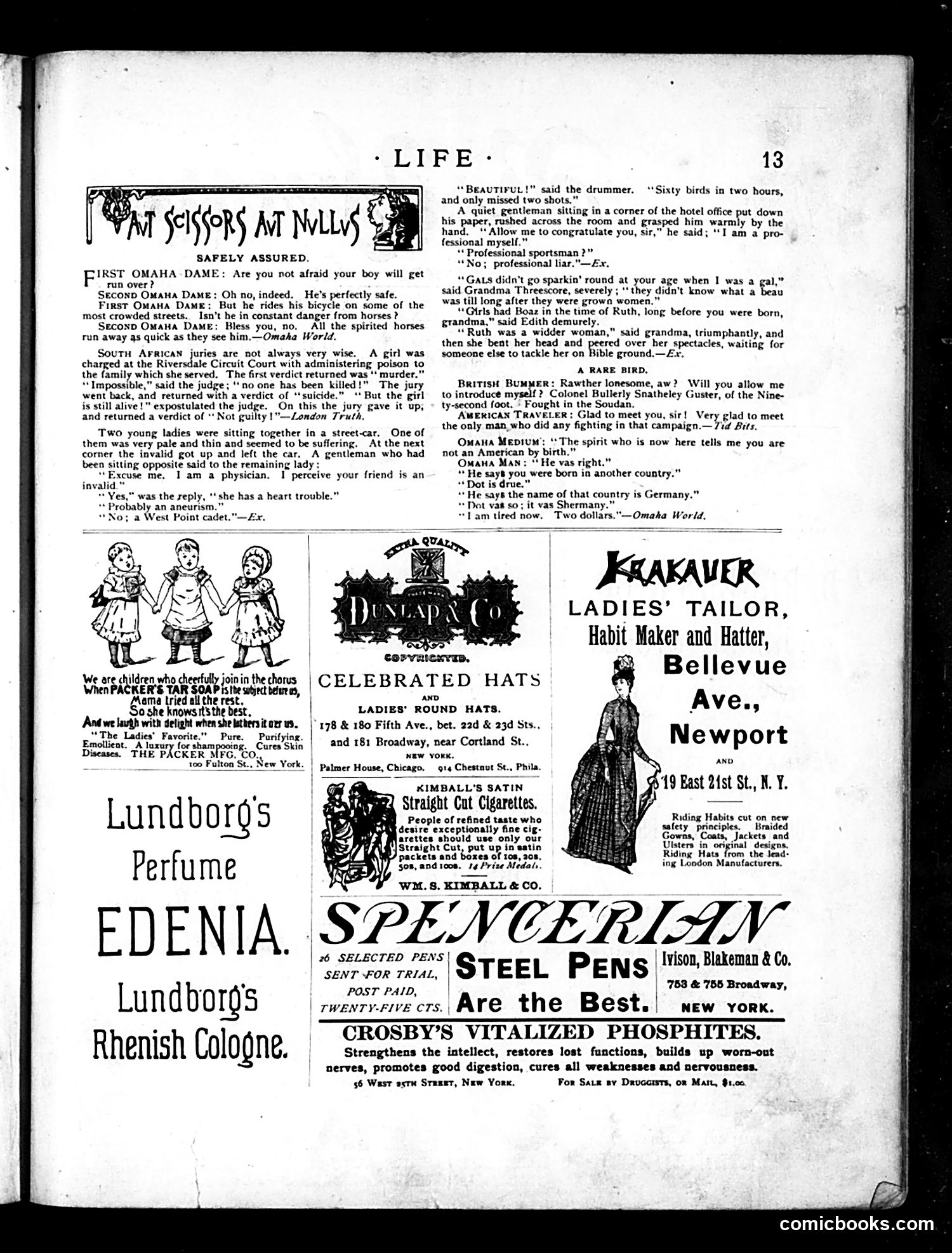
This page contains several short humor pieces reflecting late 19th-century American attitudes: **"West Point Cadet"**: A young woman has "heart trouble"—a euphemism for romantic distraction caused by a West Point military cadet. The joke relies on the period's convention of coded language about courtship and women's supposed emotional vulnerability. **"Professional Liar"**: A hunter brags about his shooting prowess to someone who claims to be a "professional"—revealed to be a professional *liar*, suggesting the hunter's exaggerated boasting marks him as one too. **"Sherman vs. Germany"**: A German immigrant and American discuss national geography with absurdist confusion—likely referencing General Sherman and the American Civil War versus the European nation, poking fun at immigrant unfamiliarity with American history and geography. **"South African Juries"**: Satirizes colonial court incompetence through absurd verdict contradictions. The remaining content is primarily **period advertisements** for perfume, hats, tailoring, pens, and patent medicines—typical of Life's revenue model.
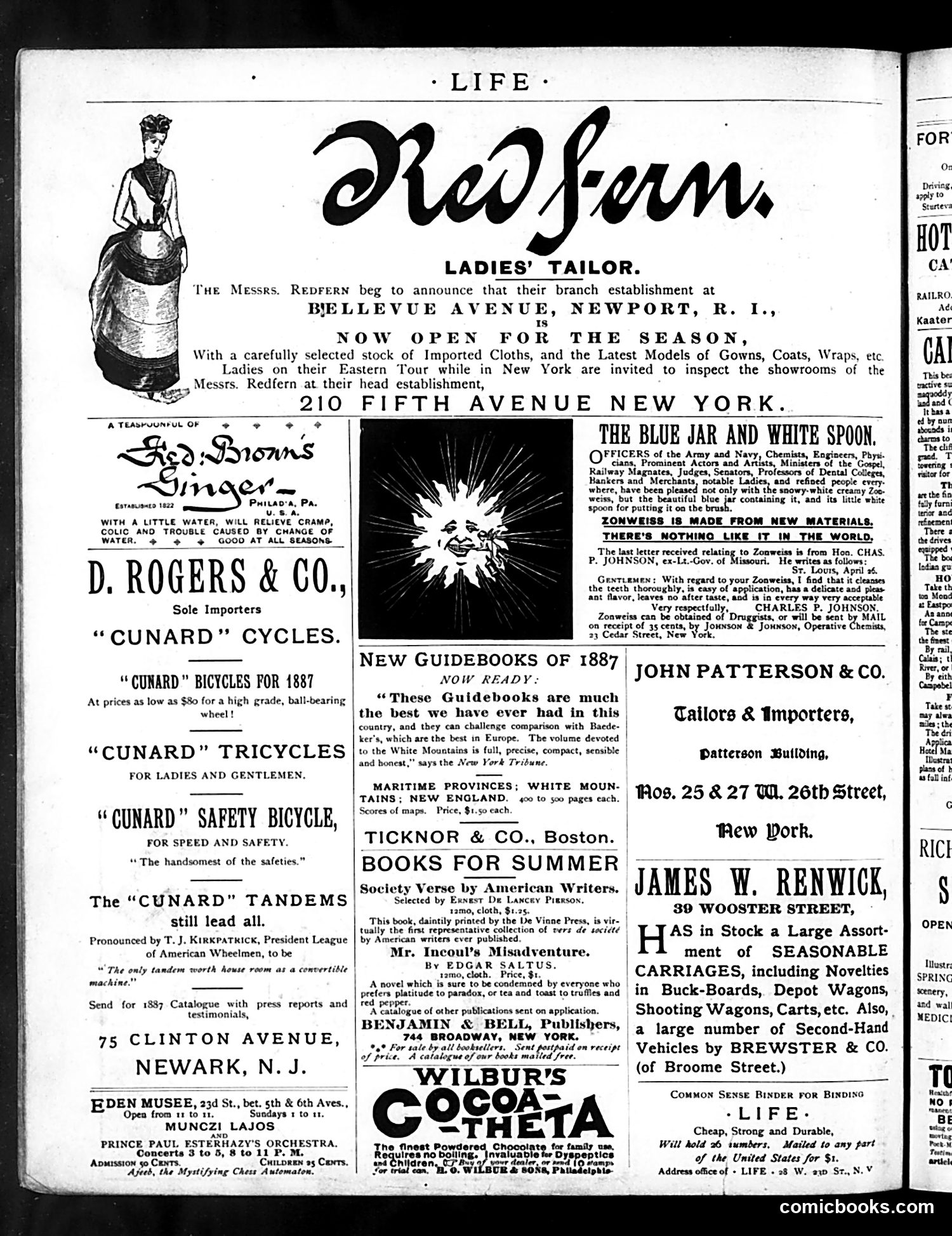
This page is primarily **advertising**, not political satire. The central image is a testimonial advertisement for "Zonweiss," a tooth-cleaning product sold in a distinctive blue jar with a white spoon. The cartoon shows a radiant sun-like face—likely representing the product's promised brightness or cleanliness benefits. The advertisement claims endorsements from prominent figures: Army and Navy officers, judges, senators, bankers, and "refined people everywhere." **The satire lies in the exaggerated testimonials**: The ad lists high-status professionals (including a former Missouri Lieutenant Governor) praising this dental product in grandiose terms. This reflects a common 19th-century advertising practice of using celebrity endorsements and inflated claims to sell patent medicines and consumer goods—often with dubious actual efficacy. The humor for contemporary *Life* readers would be recognizing this as typical snake-oil marketing dressed in respectability, mocking both the product's claims and the gullibility of consumers who trusted such endorsements.
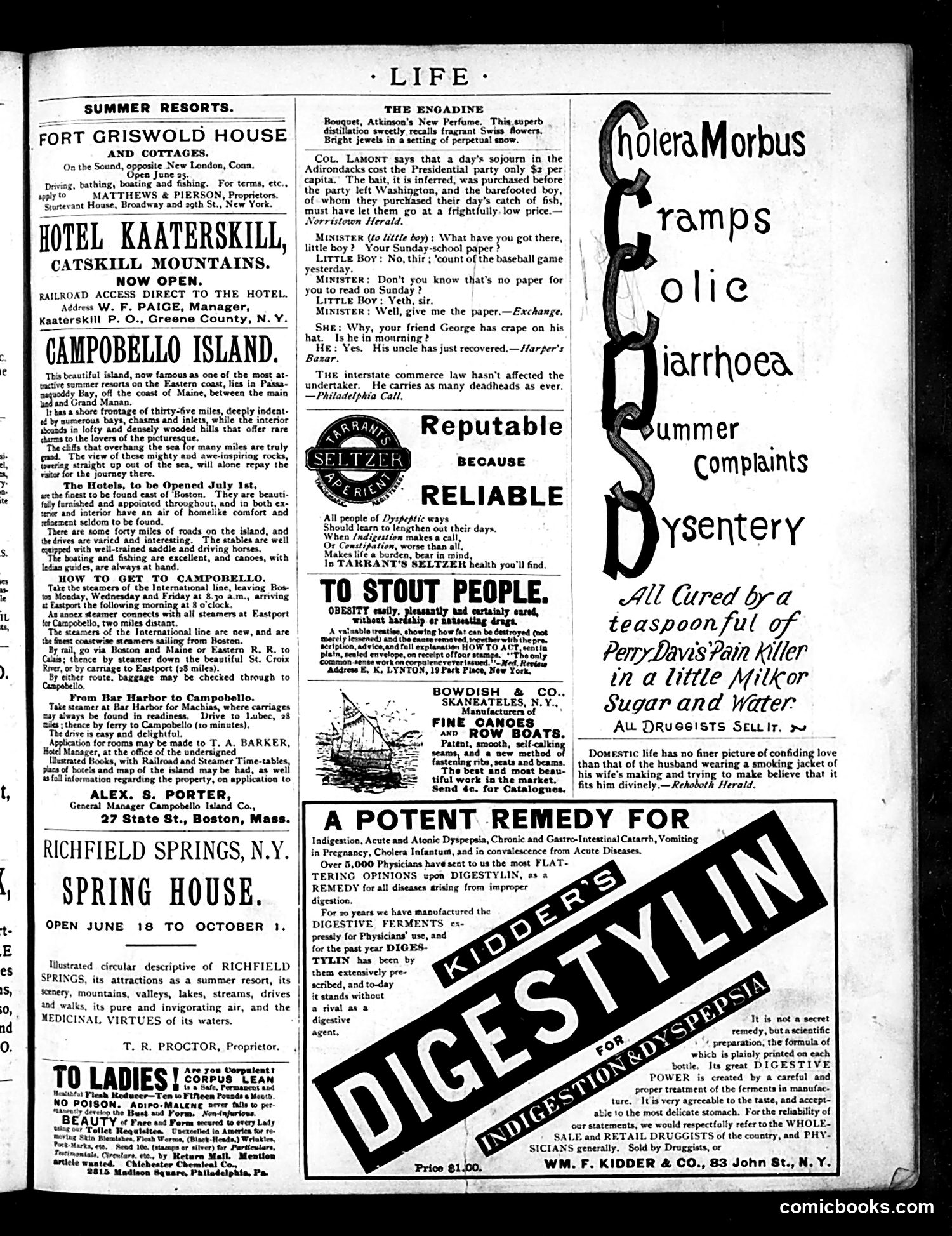
This page is primarily **advertising for summer resorts and patent medicines** from what appears to be a late 19th-century issue of *Life* magazine. There are no significant political cartoons or satirical commentary. The ads promote vacation destinations (Fort Griswold House, Hotel Kaaterskill, Campobello Island, Richfield Springs) and various commercial products including perfume, beauty treatments, and digestive remedies. The largest advertisement features "Kidder's Digestive Syrup," a patent medicine claiming to cure indigestion and related ailments—typical snake-oil marketing of the era. A small humorous exchange labeled "Minister" and "Little Boy" appears as filler content: a child claims ignorance about a baseball game because there's "no paper for you to read on Sunday," mocking both religious observance and newspaper dependency. The page serves primarily as a revenue-generating advertising vehicle rather than as a platform for satire or political commentary.
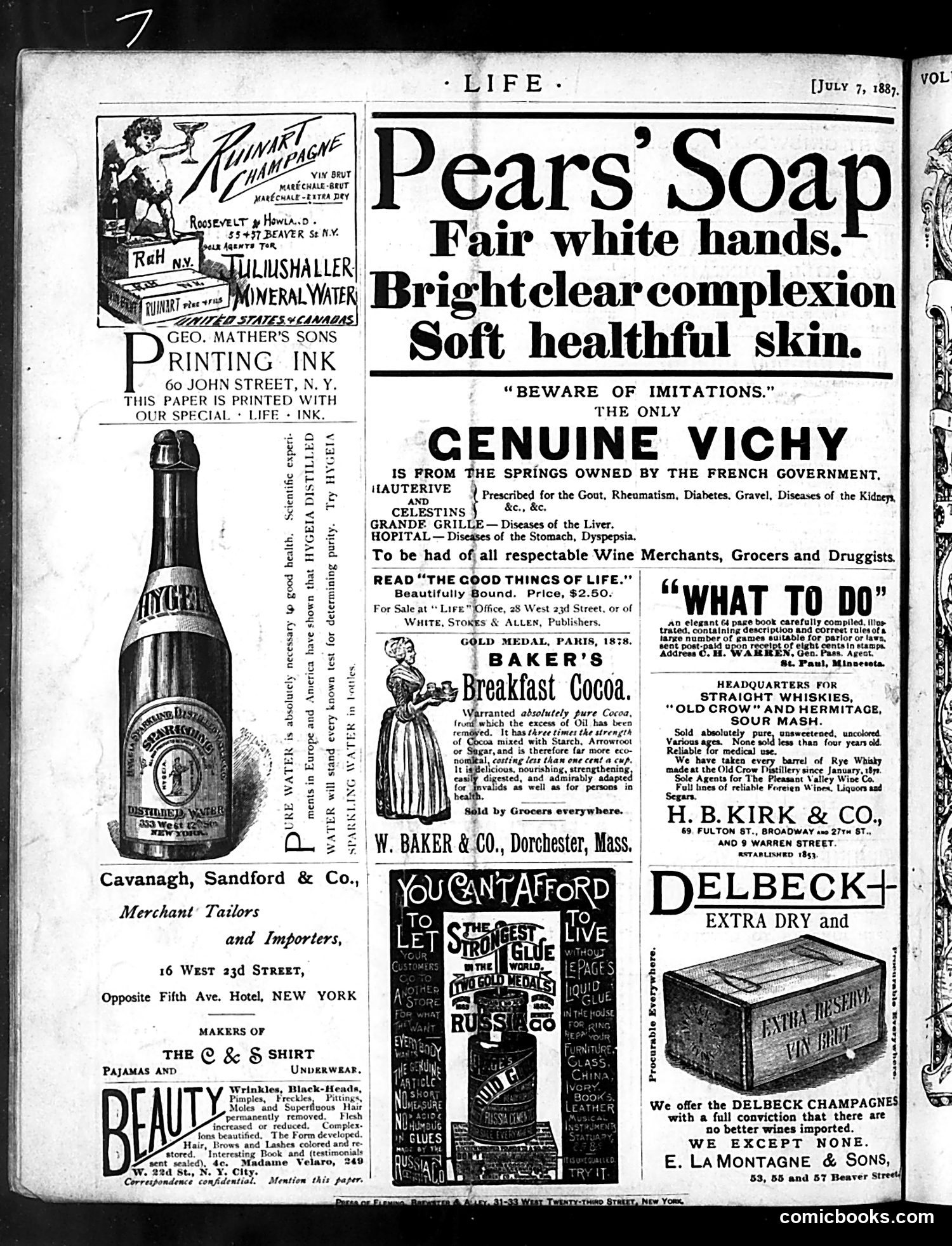
This is primarily an **advertising page** with no political cartoons or satirical content visible. The page consists entirely of commercial advertisements typical of late 19th-century magazines. Notable ads include: - **Pears' Soap**: Emphasizes "fair white hands" and "bright clear complexion"—reflecting Victorian beauty standards that equated pale skin with health and class status - **Baker's Breakfast Cocoa**: Claims superior strength and purity - **Genuine Vichy water**: French mineral water marketed for medical conditions (gout, rheumatism, diabetes) - **Whiskey and champagne ads**: Premium alcohol brands The page reflects 1880s consumer culture and advertising tactics: scientific claims (often unsubstantiated), appeals to refinement and status, and emphasis on purity/authenticity ("beware of imitations"). No satirical commentary is evident—this appears to be a straightforward revenue page for the magazine.