
Life, 1887-07-07 · page 4 of 16
Life — July 7, 1887 — page 4: what you’re looking at
What you’re looking at
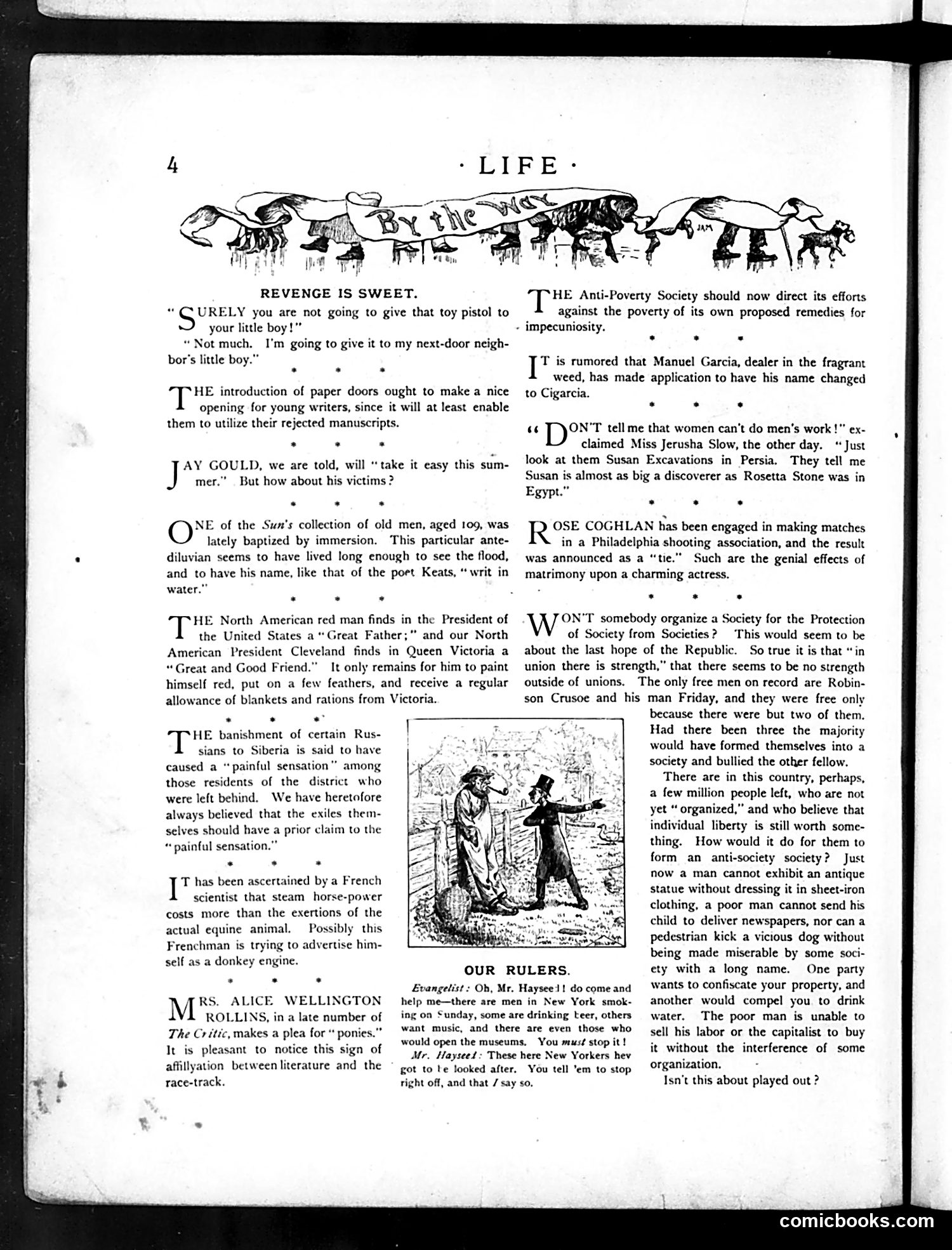
This satirical page contains several brief social commentaries typical of Life magazine's format. The main cartoon, titled "OUR RULERS," depicts an interaction between what appears to be a well-dressed man and a working-class figure, likely satirizing class divisions and social hypocrisy. The surrounding text items mock various contemporary issues: the Anti-Poverty Society's ineffective remedies, women's capabilities (referencing Susan Excavations and Rosetta Stone), Rose Coghlan's engagement in shooting sports, and labor organization. The concluding commentary critiques proposed restrictions on poor people's freedoms—preventing them from selling labor independently or engaging in basic activities without organizational permission. The satire targets what the author sees as excessive social regulation disguised as reform. The page's tone is characteristically acerbic and class-conscious.
📄 Transcribed text from this page (OCR, searchable)
Machine-transcribed from the original scan — historical spelling and the odd misread are preserved.
REVENGE IS SWEET. “ CURELY you are not going to give that toy pistol to your little boy!” “Not much. I’m going to give it to my next-door neigh- bor’s little boy.” . . . HE introduction of paper doors ought to make a nice opening for young writers, since it will at least enable them to utilize their rejected manuscripts. . . . AY GOULD, we are told, will "take it easy this sum- mer.” But how about his victims ? NE of the Sun's collection of old men, aged 109, was lately baptized by immersion. This particular ante- diluvian seems to have lived long enough to see the flood, and to have his name, like that of the poet Keats, “writ in water.” . . . HE North American red man finds in the President of the United States a “Great Father;" and our North American President Cleveland finds in Queen Victoria a “Great and Good Friend.” It only remains for him to paint himself red, put on a few feathers, and receive a regular allowance of blankets and rations from Victoria. HE Anti-Poverty Society should now direct its efforts against the poverty of its own proposed remedies for - impecuniosity. . . T’ is rumored that Manuel Garcia, dealer in the fragrant weed, has made application to have his name changed to Cigarcia. . . . “ N’T tell me that women can’t do men’s work!" ex- claimed Miss Jerusha Slow, the other day. “Just look at them Susan Excavations in Persia. They tell me Susan is almost as big a discoverer as Rosetta Stone was in Egypt.” . . . OSE COGHLAN has been engaged in making matches in a Philadelphia shooting association, and the result was announced as a “tie.” Such are the genial effects of matrimony upon a charming actress. . * . ON'T somebody organize a Society for the Protection of Society from Societies? This would seem to be about the last hope of the Republic. So true it is that “in union there is strength,” that there seems to be no strength outside of unions. The only free men on record are Robin- son Crusoe and his man Friday, and they were free only because there were but two of them. . . . HE banishment of certain Rus- sians to Siberia is said to have caused a “painful sensation” among those residents of the district. who were left behind. We have heretofore always believed that the exiles them- selves should have a prior claim to the “painful sensation.” . . . T has been ascertained by a French scientist that steam horse-power costs more than the exertions of the actual equine animal. Possibly this Frenchman is trying to advertise him- . . . OUR RULERS. Had there been three the majority would have formed themselves into a society and bullied the other fellow. There are in this country, perhaps, a few million people left, who are not yet “ organized,” and who believe that individual liberty is still worth some- thing. How would it do for them to form an anti-society society? Just now a man cannot exhibit an antique statue without dressing it in sheet-iron clothing, a poor man cannot send his child to deliver newspapers, nor can a pedestrian kick a vicious dog without being made miserable by some soci- ety with a long name. One party self as a donkey engine. M RS. ALICE WELLINGTON ROLLINS, in a late number of The Critic, makes a plea for “ ponies.” It is pleasant to notice this sign of affillyation between literature and the race-track. Evangelist : Ob, Mr. Haysee1! do come and help me—there are men in New York smok- ing on Sunday, some are drinking teer, others want music, and there are even those who would open the museums. You must stop it ! Mr. Hayseel: These here New Yorkers hev got to te looked after, You tell em to stop right off, and that / say so. wants to confiscate your property, and another would compel you to drink water. The poor man is unable to sell his labor or the capitalist to buy it without the interference of some organization, Isn't this about played out ? comicbooks.com