
Life, 1887-07-07 · page 10 of 16
Life — July 7, 1887 — page 10: what you’re looking at
What you’re looking at
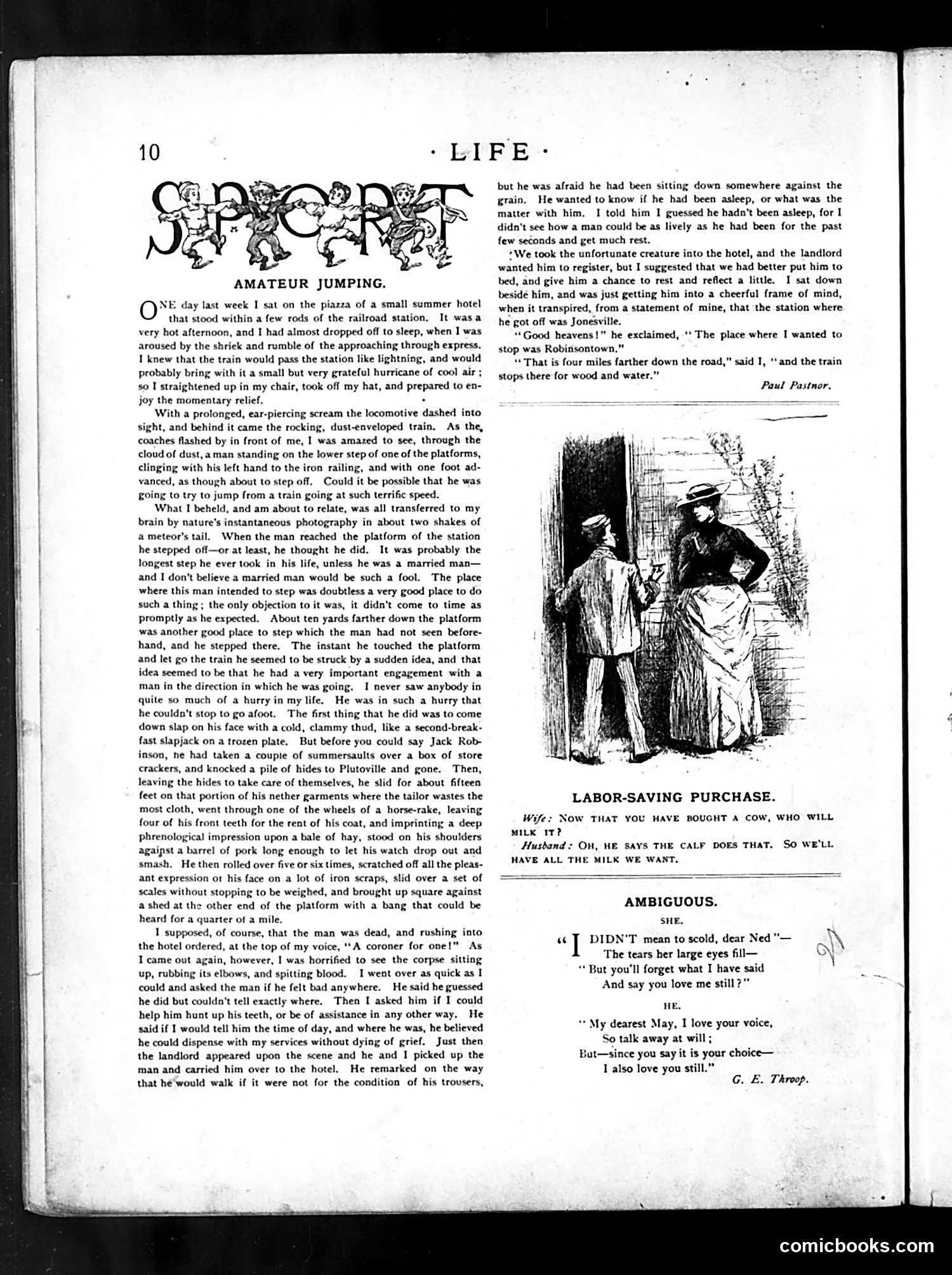
This page contains three separate humor pieces rather than political cartoons: 1. **"Amateur Jumping"** - A narrative anecdote about witnessing a man leap from a moving train near a railroad station, apparently in distress or haste. The humor derives from the narrator's bewilderment at the man's reckless behavior and subsequent discovery that the passenger had urgent business elsewhere. 2. **"Labor-Saving Purchase"** - A brief domestic joke about a husband buying a cow, with the wife assuming it will reduce their workload, only to learn the calf will produce all the milk they need anyway—inverting her expectation. 3. **"Ambiguous"** - A sentimental poem about romantic ambiguity, where a woman questions whether a man's affection is genuine. These are general-audience humor pieces without specific political references.
📄 Transcribed text from this page (OCR, searchable)
Machine-transcribed from the original scan — historical spelling and the odd misread are preserved.
- LIFE: AMATEUR JUMPING. ODE say last week I sat on the piazza of a small summer hotel that stood within a few rods of the railroad station, It was a very hot afternoon, and I had almost dropped off to sleep, when I was aroused by the shriek and rumble of the approaching through express. I knew that the train would pass the station like lightning, and would probably bring with it a small but very grateful hurricane of cool air ; so I straightened up in my chair, took off my hat, and prepared to en- joy the momentary relief. : With a prolonged, ear-piercing scream the locomotive dashed into sight, and behind it came the rocking, dust-enveloped train. As the, coaches flashed by in front of me, I was amazed to see, through the cloud of dust, aman standing on the lower step of one of the platforms, clinging with his left hand to the iron railing, and with one foot ad- vanced, as though about to step off, Could it be possible that he was going to try to jump from a train going at such terrific speed. What I beheld, and am about to relate, was all transferred to my brain by nature's instantaneous photography in about two shakes of a meteor’s tail. When the man reached the platform of the station he stepped off—or at least, he thought he did. It was probably the longest step he ever took in his life, unless he was a married man— and I don’t believe a married man would be such a fool. The place where this man intended to step was doubtless a very good place to do such a thing; the only objection to it was, it didn’t come to time as promptly as he expected. About ten yards farther down the platform was another good place to step which the man had not seen before- hand, and he stepped there. The instant he touched the platform and let go the train he seemed to be struck by a sudden idea, and that idea seemed to be that he had a very important engagement with a man in the direction in which he was going. I never saw anybody in quite so much of a hurry in my life. He was in such a hurry that he couldn't stop to go afoot. The first thing that he did was to come down slap on his face with a cold, clammy thud, like a second-break- fast slapjack on a trozen plate. But before you could say Jack Rob- inson, ne had taken a coupie of summersaults over a box of store crackers, and knocked a pile of hides to Plutoville and gone. Then, leaving the hides to take care of themselves, he slid for about fifteen feet on that portion of his nether garments where the tailor wastes the most cloth, went through one of the wheels of a horse-rake, leaving four of his front teeth for the rent of his coat, and imprinting a deep phrenological impression upon a bale of hay, stood on his shoulders agaipst a barrel of pork long enough to let his watch drop out and smash. He then rolled over five or six times, scratched off all the pleas- ant expression ot his face on a lot of iron scraps, slid over a set of scales without stopping to be weighed, and brought up square against a shed at the other end of the platform with a bang that could be heard for a quarter of a mile. 1 supposed, of course, that the man was dead, and rushing into the hotel ordered, at the top of my voice, ‘A coroner for one!” As I came out again, however, I was horrified to see the corpse sitting up, rubbing its elbows, and spitting blood. I went over as quick as I could and asked the man if he felt bad anywhere. He said he guessed he did but couldn't tell exactly where. Then I asked him if I could help him hunt up his teeth, or be of assistance in any other way. He said if I would tell him the time of day, and where he was, he believed he could dispense with my services without dying of grief, Just then the landlord appeared upon the scene and he and I picked up the man and carried him over to the hotel, He remarked on the way that he'would walk if it were not for the condition of his trousers, but he was afraid he had been sitting down somewhere against the grain, He wanted to know if he had been asleep, or what was the matter with him. I told him I guessed he hadn't been asleep, for 1 didn’t see how a man could be as lively as he had been for the past few seconds and get much rest. + We took the unfortunate creature into the hotel, and the landlord wanted him to register, but I suggested that we had better put him to bed, and give him a chance to rest and reflect a little, I sat down besidé him, and was just getting him into a cheerful frame of mind, when it transpired, from a statement of mine, that the station where he got off was Jonesville. ‘Good heavens!” he exclaimed, ‘‘ The place where I wanted to stop was Robirisontown,” “That is four miles farther down the road,” said I, ‘and the train stops there for wood and water.” Paul Pastnor, LABOR-SAVING PURCHASE. Wife: Now THAT YOU HAVE BOUGHT A COW, WHO WILL MILK IT? Husband: OW, WE SAYS THE CALF DOES THAT. HAVE ALL THE MILK WE WANT, So WE'LL AMBIGUOUS. SHE, “ DIDN'T mean to scold, dear Ned "— ‘The tears her large eyes fill— “* But you'll forget what I have said And say you love me still?” HE, “+ My dearest May, I love your voice, So talk away at will; But—since you say it is your choice— 1 also love you still.” G. E. Throop. comicbooks.com