
Life, 1887-07-07 · page 2 of 16
Life — July 7, 1887 — page 2: what you’re looking at
What you’re looking at
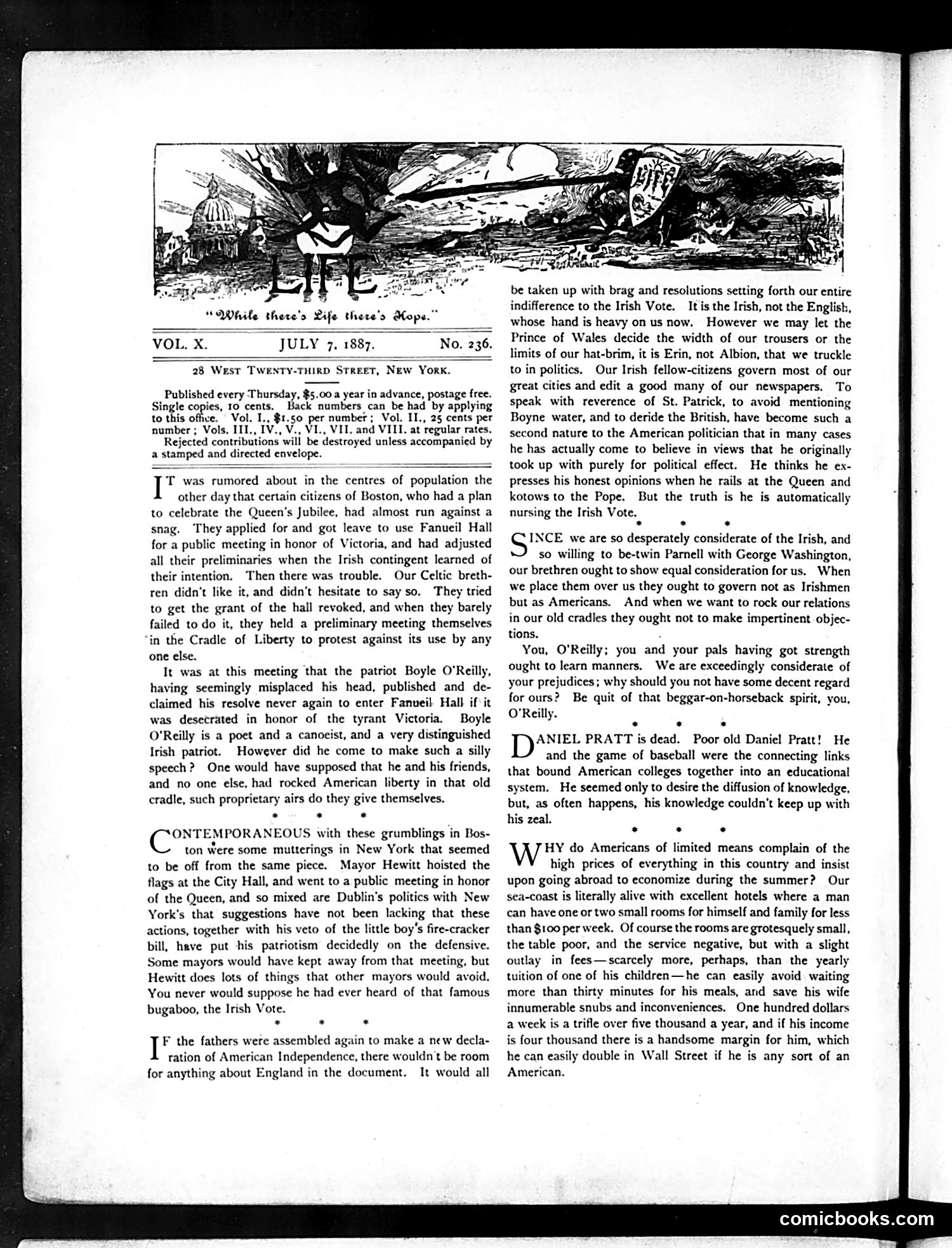
The masthead cartoon "While there's Life there's Hope" depicts a chaotic scene with references to Irish-American political tensions of the era. The text discusses Boyle O'Reilly, an Irish patriot and poet, and criticizes Irish-American leaders for prioritizing political agendas over American interests. The satire targets Irish-Americans who, the author argues, govern American cities while maintaining divided loyalties to Ireland and the Catholic Church rather than embracing full American citizenship. The piece mocks their perceived arrogance—"beggar-on-horseback spirit"—and advocates for assimilation over ethnic political identity. The page also includes brief commentary on Daniel Pratt's death and summer travel economics for middle-class Americans, reflecting Life's typical mix of political and social satire.
📄 Transcribed text from this page (OCR, searchable)
Machine-transcribed from the original scan — historical spelling and the odd misread are preserved.
“While there's Life there's Hope.” JULY 7, 1887. No. 236. 28 West Twenty-THIRD STREET, NEW York. Published every ‘Thursday, $5.00 a year in advance, postage free. Single copies, 10 cents. Back numbers can be had by applying to this office.” Vol. I., $1.50 per number; Vol. II., 25 cents per number ; Vols. III., IV., V., VI., VII. and VIII. at regular rates. Rejected contributions will be destroyed unless accompanied by a stamped and directed envelope. T was rumored about in the centres of population the other day that certain citizens of Boston, who had a plan to celebrate the Queen's Jubilee, had almost run against a snag. They applied for and got leave to use Fanucil Hall for a public meeting in honor of Victoria, and had adjusted all their preliminaries when the Irish contingent learned of their intention. Then there was trouble. Our Celtic breth- ren didn’t like it, and didn’t hesitate to say so. They tried to get the grant of the hall revoked, and when they barely failed to do it, they held a preliminary meeting themselves in the Cradle of Liberty to protest against its use by any one else. It was at this meeting that the patriot Boyle O'Reilly, having seemingly misplaced his head, published and de- claimed his resolve never again to enter Fanueil Hall if it was desecrated in honor of the tyrant Victoria. Boyle O'Reilly is a poet and a canoeist, and a very distinguished Irish patriot. However did he come to make such a silly speech ? One would have supposed that he and his friends, and no one else, had rocked American liberty in that old cradle, such proprietary airs do they give themselves. . . . ONTEMPORANEOUS with these grumblings in Bos- ton Were some mutterings in New York that seemed to be off from the same piece. Mayor Hewitt hoisted the flags at the City Hall, and went to a public meeting in honor of the Queen, and so mixed are Dublin's politics with New York's that suggestions have not been lacking that these actions, together with his veto of the little boy's fire-cracker bill, have put his patriotism decidedly on the defensive. Some mayors would have kept away from that meeting, but Hewitt does lots of things that other mayors would avoid. You never would suppose he had ever heard of that famous bugaboo, the Irish Vote. . . . F the fathers were assembled again to make a new decla- ration of American Independence, there wouldn't be room for anything about England in the document, It would all be taken up with brag and resolutions setting forth our entire indifference to the Irish Vote. It is the Irish, not the English, whose hand is heavy on us now. However we may let the Prince of Wales decide the width of our trousers or the limits of our hat-brim, it is Erin, not Albion, that we truckle to in politics. Our Irish fellow-citizens govern most of our great cities and edit a good many of our newspapers. To speak with reverence of St. Patrick, to avoid mentioning Boyne water, and to deride the British, have become such a second nature to the American politician that in many cases he has actually come to believe in views that he originally took up with purely for political effect. He thinks he ex- presses his honest opinions when he rails at the Queen and kotows to the Pope, But the truth is he is automatically nursing the Irish Vote. * > . INCE we are so desperately considerate of the Irish, and so willing to be-twin Parnell with George Washington, our brethren ought to show equal consideration for us. When we place them over us they ought to govern not as Irishmen but as Americans. And when we want to rock our relations in our old cradles they ought not to make impertinent objec- tions. ‘ You, O'Reilly; you and your pals having got strength ought to learn manners. We are exceedingly considerate of your prejudices; why should you not have some decent regard for ours? Be quit of that beggar-on-horseback spirit, you, O'Reilly. . . . ANIEL PRATT is dead. Poor old Daniel Pratt! He and the game of baseball were the connecting links that bound American colleges together into an educational system. He seemed only to desire the diffusion of knowledge, but, as often happens, his knowledge couldn't keep up with his zeal. . . . HY do Americans of limited means complain of the high prices of everything in this country and insist upon going abroad to economize during the summer? Our sea-coast is literally alive with excellent hotels where a man can have one or two small rooms for himself and family for less than $100 per week. Of course the rooms are grotesquely small, the table poor, and the service negative, but with a slight outlay in fees—scarcely more, perhaps, than the yearly tuition of one of his children—he can easily avoid waiting more than thirty minutes for his meals, and save his wife innumerable snubs and inconveniences. One hundred dollars a week is a trifle over five thousand a year, and if his income is four thousand there is a handsome margin for him, which he can easily double in Wall Street if he is any sort of an American. comicbooks.com