
Life, 1887-07-07 · page 6 of 16
Life — July 7, 1887 — page 6: what you’re looking at
What you’re looking at
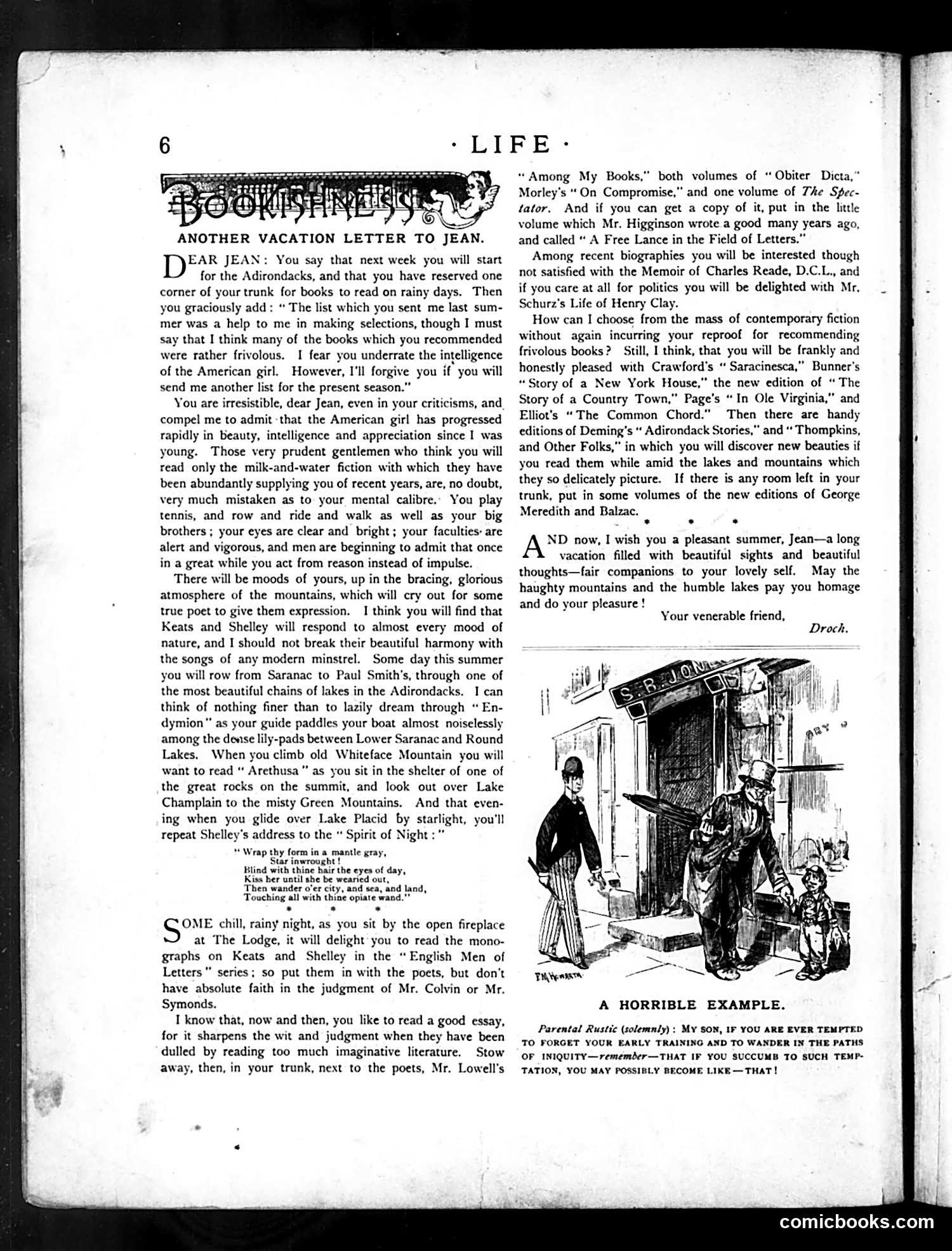
This illustration depicts a cautionary scene about parental discipline and child-rearing. A well-dressed man stands at a doorway while a woman (likely his wife) gestures toward unruly children inside a home. The caption, addressed to parents, warns that neglecting a child's early training and allowing them to "wander in the paths of iniquity" may result in the child becoming "like that!" — pointing to the chaotic scene within. The satire targets permissive parenting practices of the era. Rather than political commentary, this is social satire about Victorian moral education, using exaggerated domestic disorder to warn middle-class readers about the consequences of insufficient parental authority and discipline over children.
📄 Transcribed text from this page (OCR, searchable)
Machine-transcribed from the original scan — historical spelling and the odd misread are preserved.
* LIFE: ANOTHER VACATION LETTER TO JEAN. EAR JEAN: You say that next week you will start for the Adirondacks, and that you have reserved one corner of your trunk for books to read on rainy days. Then you graciously add: “ The list which you sent me last sum- mer was a help to me in making selections, though I must say that I think many of the books which you recommended were rather frivolous. I fear you underrate the intelligence of the American girl. However, I'll forgive you if you will send me another list for the present season.” You are irresistible, dear Jean, even in your criticisms, and. compel me to admit ‘that the American girl has progressed rapidly in beauty, intelligence and appreciation since I was young. Those very prudent gentlemen who think you will read only the milk-and-water fiction with which they have been abundantly supplying you of recent years, are, no doubt, very much mistaken as to your mental calibre.. You play tennis, and row and ride and walk as well as your big brothers ; your eyes are clear and bright; your faculties: are alert and vigorous, and men are beginning to admit that once in a great while you act from reason instead of impulse. There will be moods of yours, up in the bracing, glorious atmosphere of the mountains, which will cry out for some true poet to give them expression. I think you will find that Keats and Shelley will respond to almost every mood of nature, and I should not break their beautiful harmony with the songs of any modern minstrel. Some day this summer you will row from Saranac to Paul Smith’s, through one of the most beautiful chains of lakes in the Adirondacks. I can think of nothing finer than to lazily dream through “ En- dymion” as your guide paddles your boat almost noiselessly among the douse lily-pads between Lower Saranac and Round Lakes, When you climb old Whiteface Mountain you will want to read “ Arethusa” as you sit in the shelter of one of the great rocks on the summit, and look out over Lake Champlain to the misty Green Mountains. And that even- ing when you glide over Lake Placid by starlight, you'll repeat Shelley's address to the “ Spirit of Night :" “ Wrap thy form in a mantle gray, Star inwrought! Blind with thine hair the eyes of day, Kiss her until she be wearied out, Then wander o'er city, and sea, Touching all with thine opiate * . * OME chill, rainy night, as you sit by the open fireplace at The Lodge, it will delight you to read the mono- graphs on Keats and Shelley in the “English Men of Letters” series; so put them in with the poets, but don't have absolute faith in the judgment of Mr. Colvin or Mr. Symonds, I know that, now and then, you like to read a good essay, for it sharpens the wit and judgment when they have been dulled by reading too much imaginative literature. Stow away, then, in your trunk, next to the poets, Mr. Lowell's “Among My Books,” both volumes of “ Obiter Dicta,” Morley’s “On Compromise,” and one volume of The Spec- tator. And if you can get a copy of it, put in the little volume which Mr. Higginson wrote a good many years ago, and called “ A Free Lance in the Field of Letters.” Among recent biographies you will be interested though not satisfied with the Memoir of Charles Reade, D.C.L., and if you care at all for politics you will be delighted with Mr, Schurz’s Life of Henry Clay. How can I choose from the mass of contemporary fiction without again incurring your reproof for recommending frivolous books? Still, I think, that you will be frankly and honestly pleased with Crawford's “ Saracinesca,” Bunner's “Story of a New York House,” the new edition of “ The Story of a Country Town,” Page’s “In Ole Virginia,” and Elliot's “The Common Chord.” Then there are handy editions of Deming’s “ Adirondack Stories,” and “ Thompkins, and Other Folks,” in which you will discover new beauties if you read them while amid the lakes and mountains which they so delicately picture. If there is any room left in your trunk, put in some volumes of the new editions of George Meredith and Balzac. . . . ND now, I wish you a pleasant summer, Jean—a long vacation filled with beautiful sights and beautiful thoughts—fair companions to your lovely self. May the haughty mountains and the humble lakes pay you homage and do your pleasure ! Your venerable friend, Droch. TAYE A HORRIBLE EXAMPLE. Parental Rustic (solemnly): MY SON, IF YOU ARE EVER TEMPTED TO FORGET YOUR EARLY TRAINING AND TO WANDER IN THE PATHS OF INIQUITY—remember—THAT IF YOU SUCCUMB TO SUCH TEMP- TATION, YOU MAY POSSIBLY BECOME LIKE—THAT! comicbooks.com