
A complete issue · 16 pages · 1887
Life — June 23, 1887
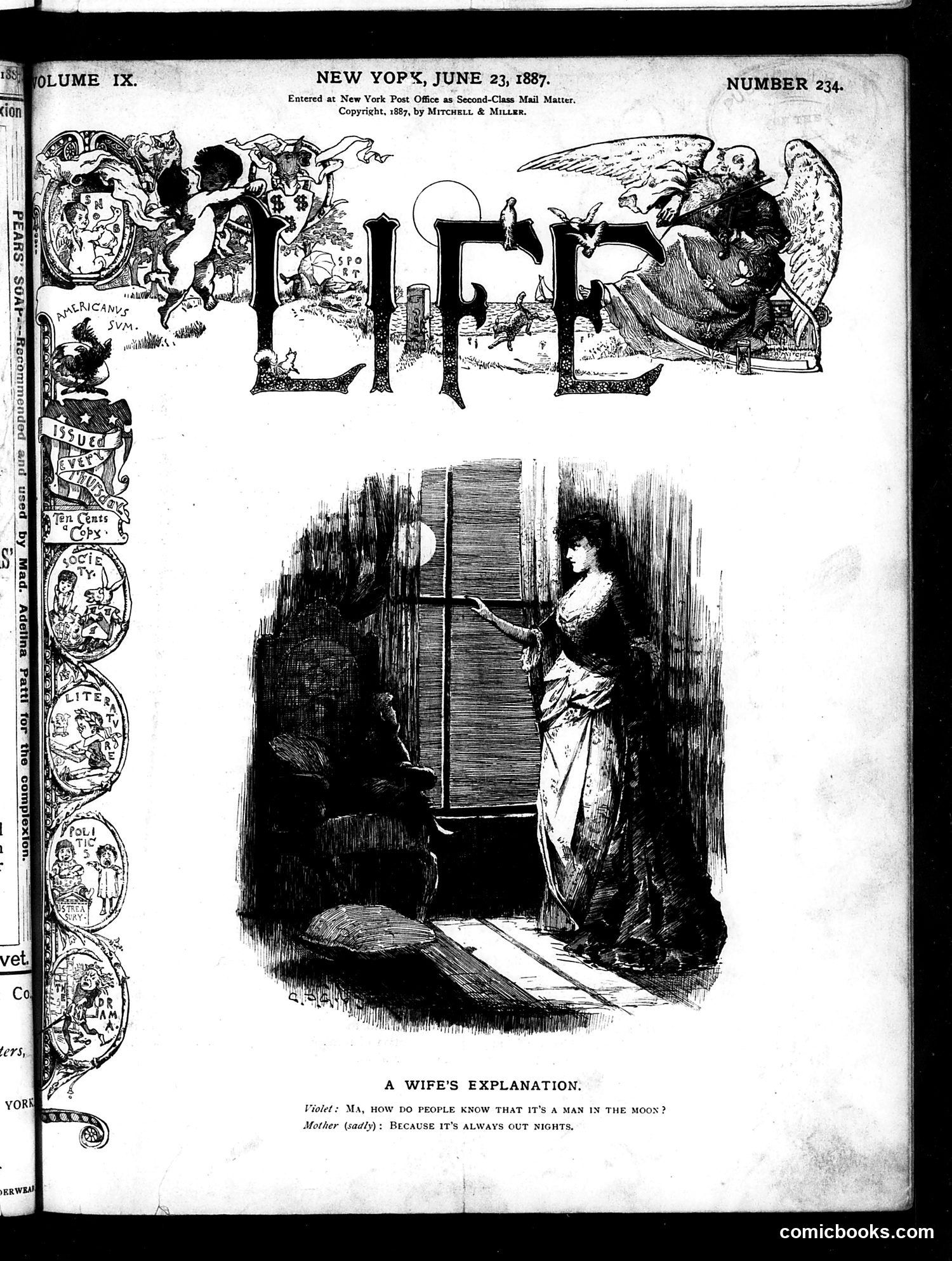
This page from Life magazine (June 23, 1887) features a domestic humor cartoon. The illustration shows a woman speaking to a child while a man sits in shadow. The caption reads: **Violet:** "Ma, how do people know that it's a man in the moon?" **Mother (sadly):** "Because it's always out nights." The joke is a criticism of husbands who stay out late—a common Victorian-era domestic complaint. The "man in the moon" becomes a metaphor for absent husbands. The mother's weary response suggests marital frustration with a spouse who regularly disappears at night, likely for drinking, socializing, or other entertainment. The humor relies on the audience recognizing this as a relatable domestic complaint rather than literal astronomy.
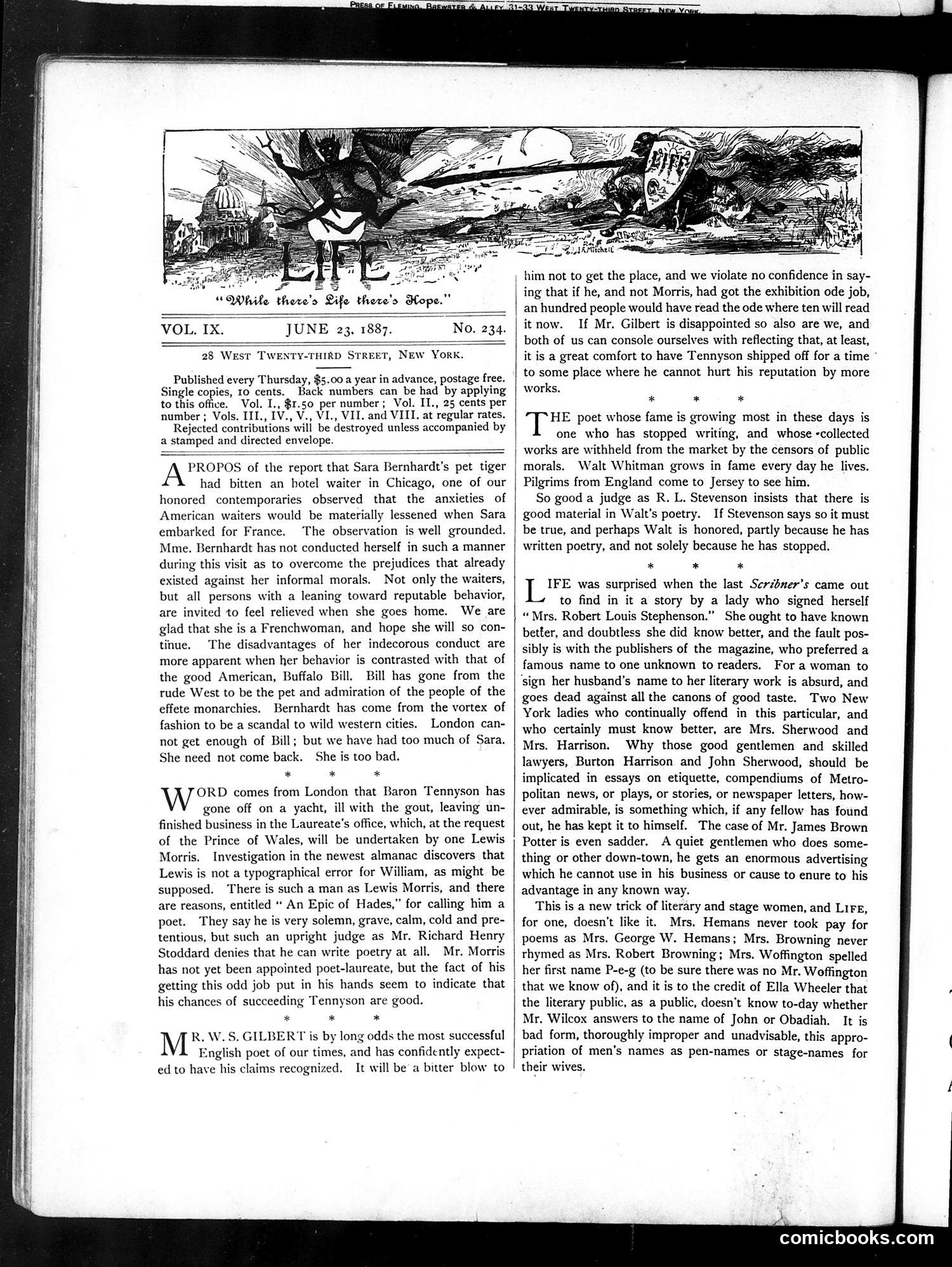
The page contains literary and cultural commentary rather than political cartoons. The small illustration at top shows a desolate landscape with the caption "While there's Life there's Hope." The main articles discuss: 1. **Sara Bernhardt's conduct**: Critics argue the French actress's behavior (notably her pet tiger biting a Chicago waiter) undermines American waiters' dignity and reputation. 2. **Censorship of literature**: The piece criticizes how public morality censors suppress Walt Whitman's poetry while he gains fame abroad. 3. **Women using pen names**: The commentary mocks women authors (like "Mrs. Robert Louis Stevenson") adopting famous husbands' names instead of their own, calling it poor literary taste. 4. **R.W.S. Gilbert**: Notes the successful English poet faces difficulty getting public recognition despite his talents.
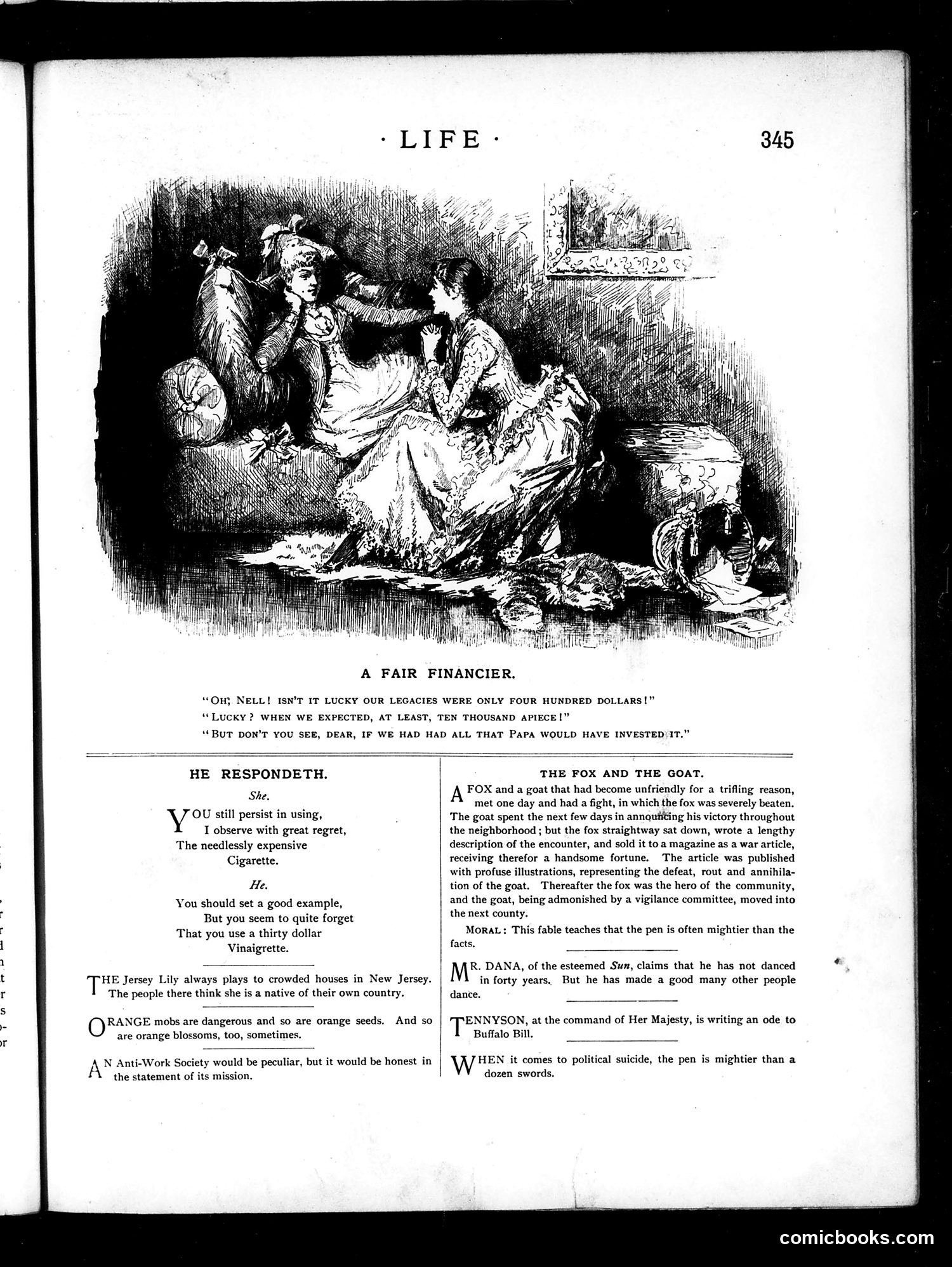
**"A Fair Financier"** (top cartoon): This satirizes wealthy individuals and inheritance. The dialogue references legacies of "four hundred dollars" versus expected "ten thousand" and suggests a father figure ("Papa") would have invested it all away. The humor targets the financial irresponsibility or poor investment decisions of the rich. **"He Respondeth"** (left column): A verse-based joke mocking wasteful spending—specifically cigarettes at "a thirty dollar" cost, contrasted with setting "a good example." **"The Fox and the Goat"**: A fable retelling where a fox and goat fight, then the fox sells their conflict story to a magazine for profit. The moral: "the pen is mightier than the facts"—satirizing sensationalist journalism and monetization of conflict. The remaining items are brief satirical quips on various social topics.
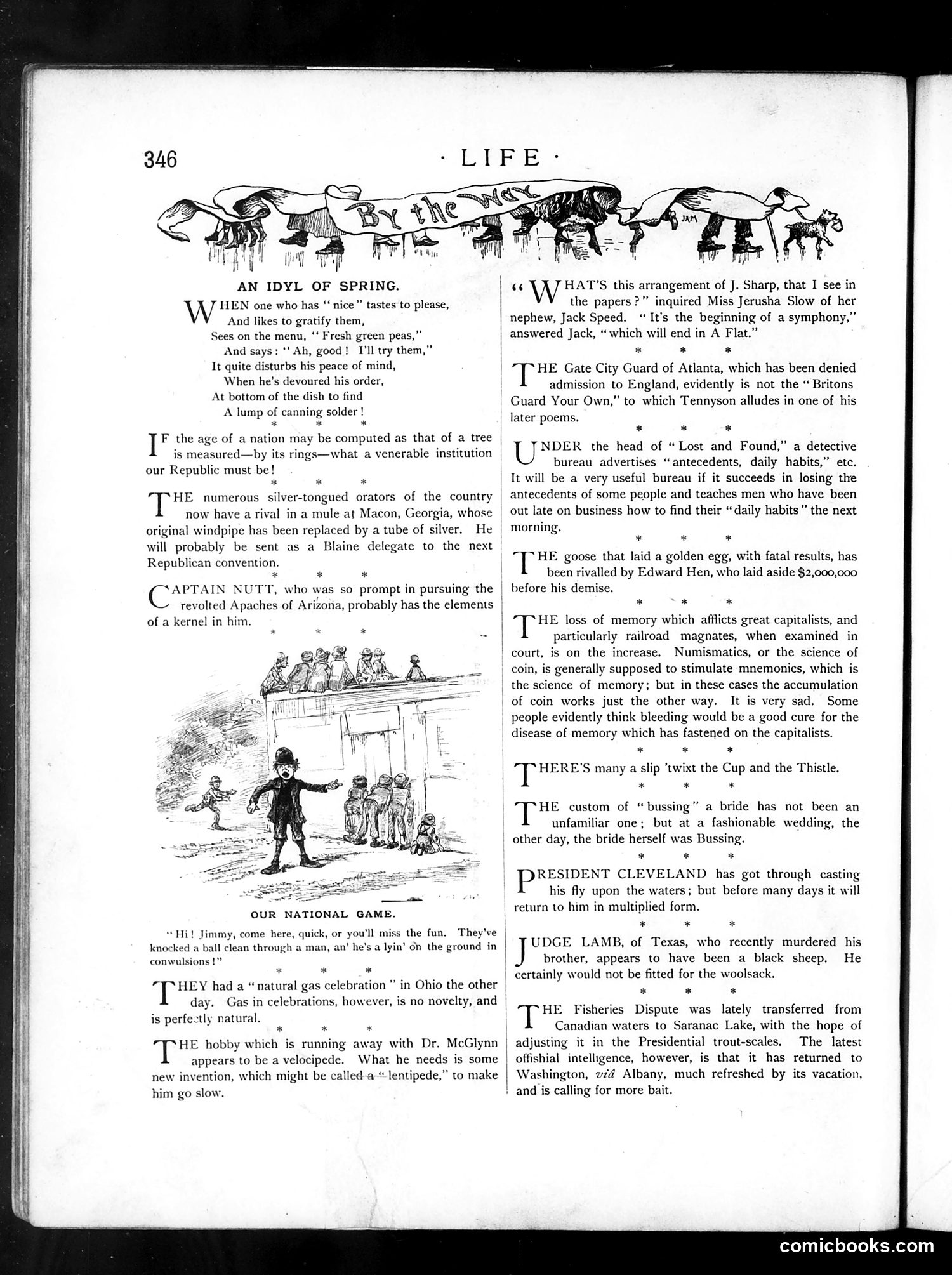
The page contains miscellaneous satirical items rather than a single cohesive cartoon. "Our National Game" depicts a man directing children, with text joking that they'll "all clean through a man, an' he's a kin' on the ground in convulsions!"—likely satirizing baseball as violent or chaotic. Other brief items mock contemporary figures and events: President Cleveland's fishing hobby, Judge Lamb of Texas (who murdered his brother), and the Fisheries Dispute between American and Canadian waters. The column titled "An Idyl of Spring" satirizes someone with refined tastes who enjoys simple pleasures like "fresh green peas," suggesting pretension or affectation. These are typical of Life's format: short, topical jokes targeting politicians, social trends, and current news rather than sustained narrative satire.
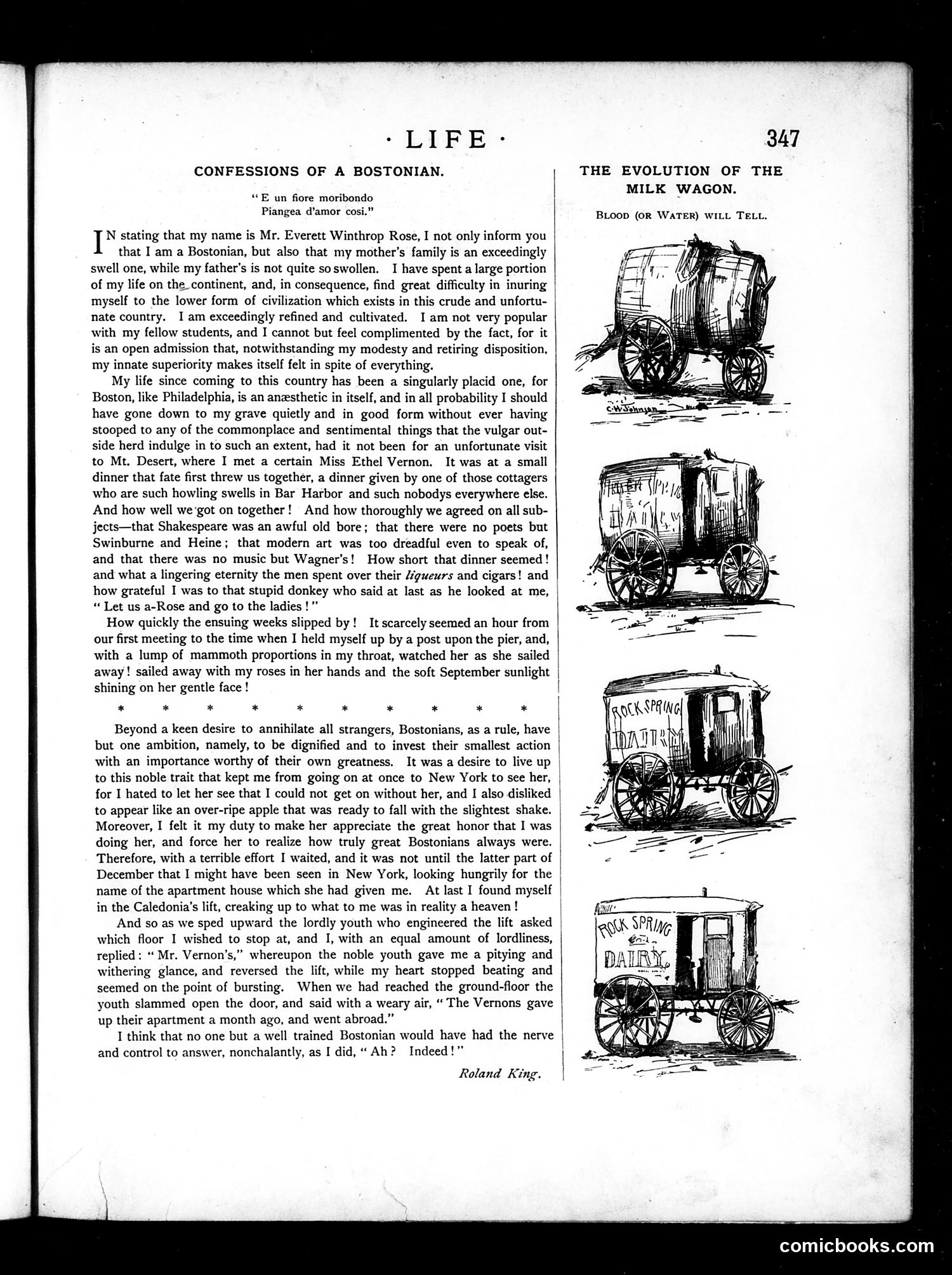
The right side of this page shows four illustrated stages of milk delivery wagons, progressing from basic to more elaborate designs. Each wagon is progressively larger and more decorated, with the final two featuring "Rock Spring" and "Rock Spring Dairy" branding. This appears to be a humorous commentary on commercial competition and advertising excess in the dairy industry. The sequence suggests how milk vendors increasingly embellished their wagons with larger signs and more prominent branding to attract customers—transforming simple delivery vehicles into mobile advertisements. The title "Blood (or Water) Will Tell" implies satirical skepticism about such marketing claims, questioning whether fancy presentation actually reflects product quality.
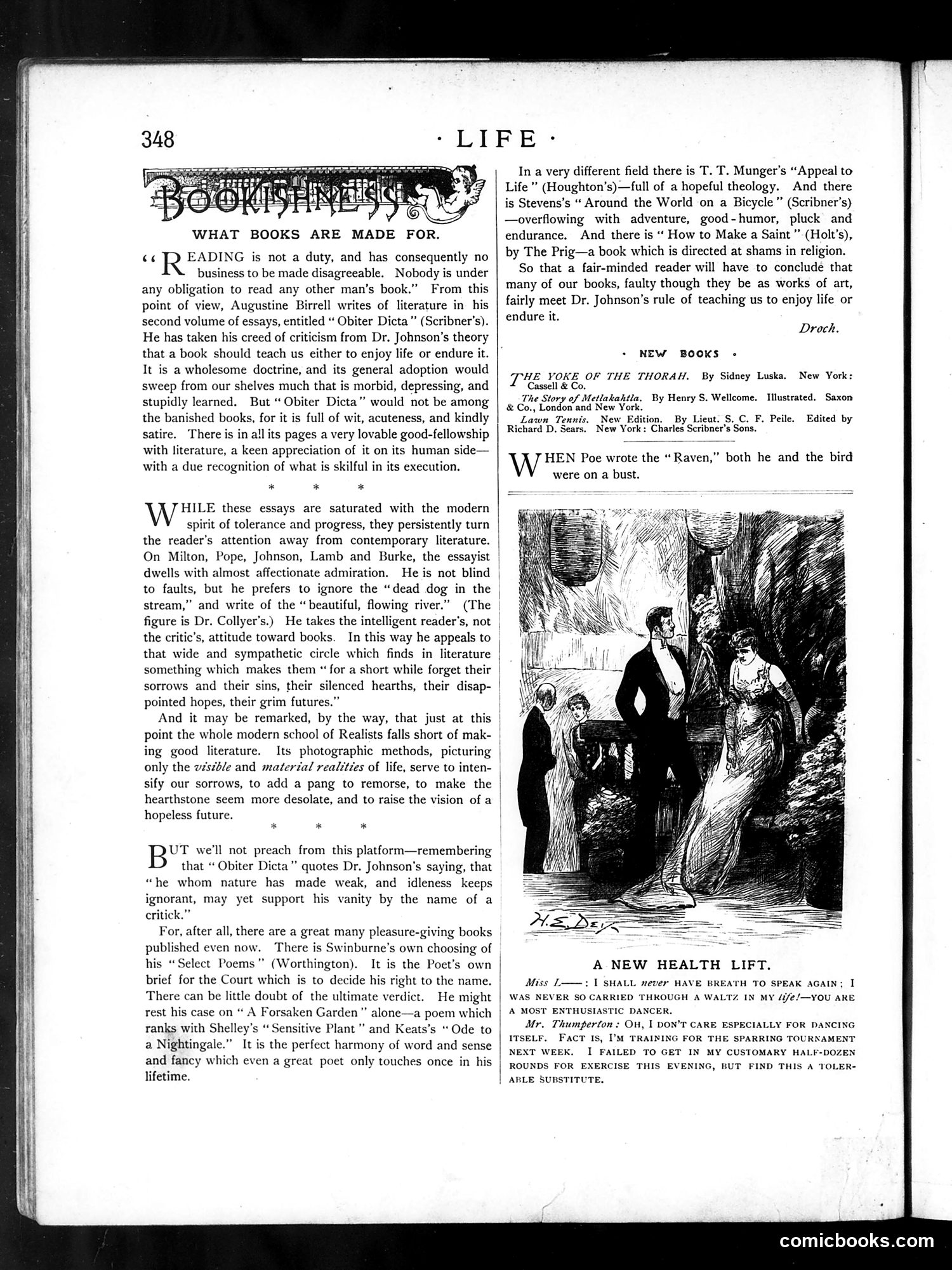
This page from *Life* magazine contains a literary essay titled "What Books Are Made For" alongside a section on new books. The main illustration, captioned "A New Health Lift," depicts a social scene with elegantly dressed figures in what appears to be an outdoor setting with dramatic tree roots or natural formations. Below the illustration is a brief comedic dialogue between "Miss L—" and "Mr. Thrumperton" about dancing and exercise. The humor appears gentle and domestic—Miss L— mentions never speaking again after an enthusiastic waltz, while Mr. Thrumperton boasts about training for a sparring tournament but substituting dancing as an exercise alternative. The satire targets Victorian-era social pretensions around health, fitness, and courtship conventions among the upper classes, suggesting that even vigorous activities like dancing could serve as socially acceptable exercise.
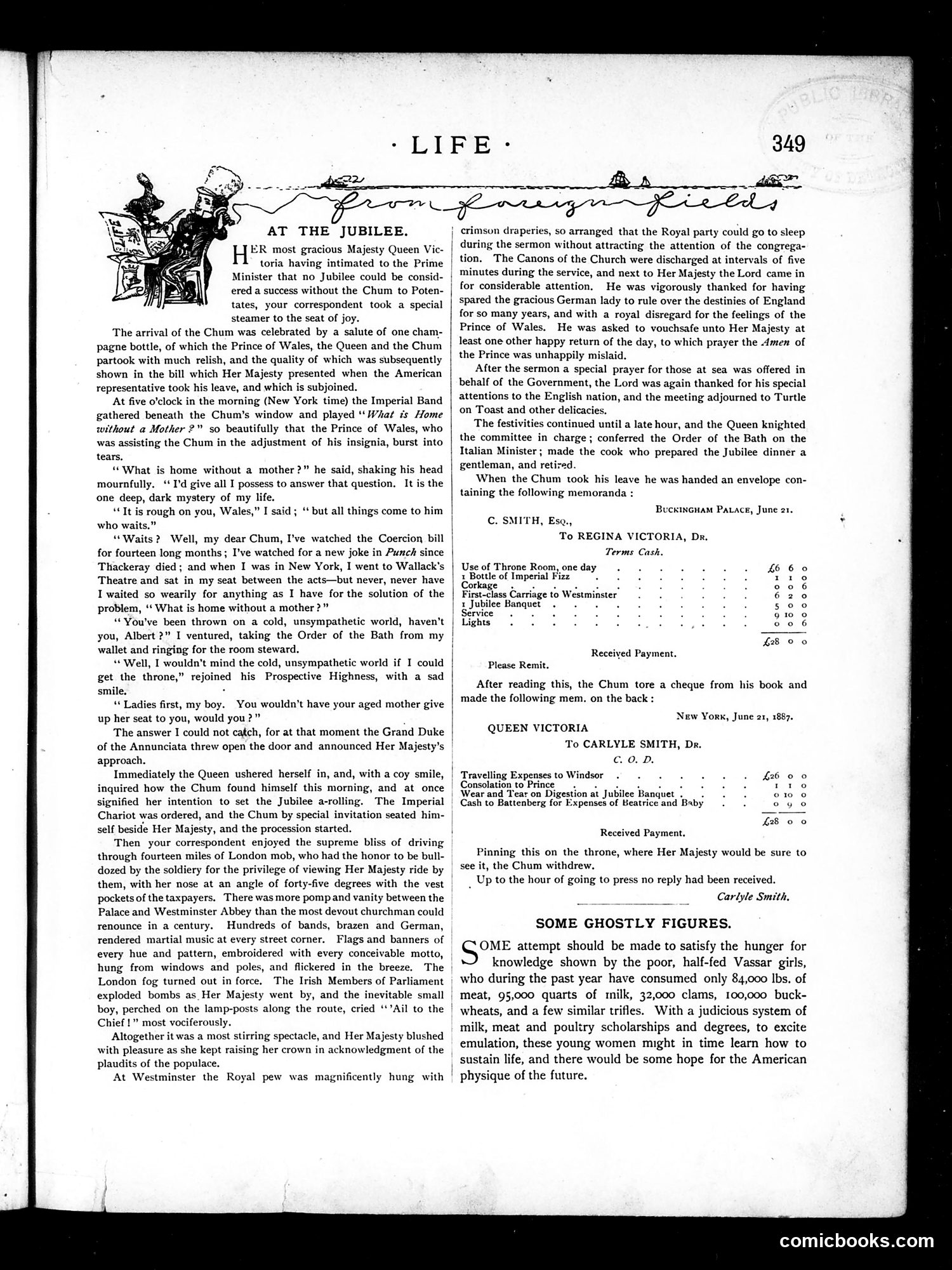
This page contains a satirical narrative titled "From Foreign Fields" describing a royal visit, likely by the Prince of Wales, to a Jubilee celebration. The cartoon illustration shows two figures in period dress engaged in dialogue. The satire mocks the Prince's emotional response to hearing "What is Home without a Mother?" played by the Imperial Band. The Chum character portrays the Prince as sentimentally affected, tearing up at the song—a jab at his perceived sensitivity or theatricality. The subsequent humor involves financial bills and expenses from the royal visit, with the Queen and various officials presented as calculating costs for throne room use, carriages, and banquets. The satire targets the contradiction between royal pageantry and mercenary practicality—suggesting the monarchy's supposedly dignified occasion was really about extracting payment.
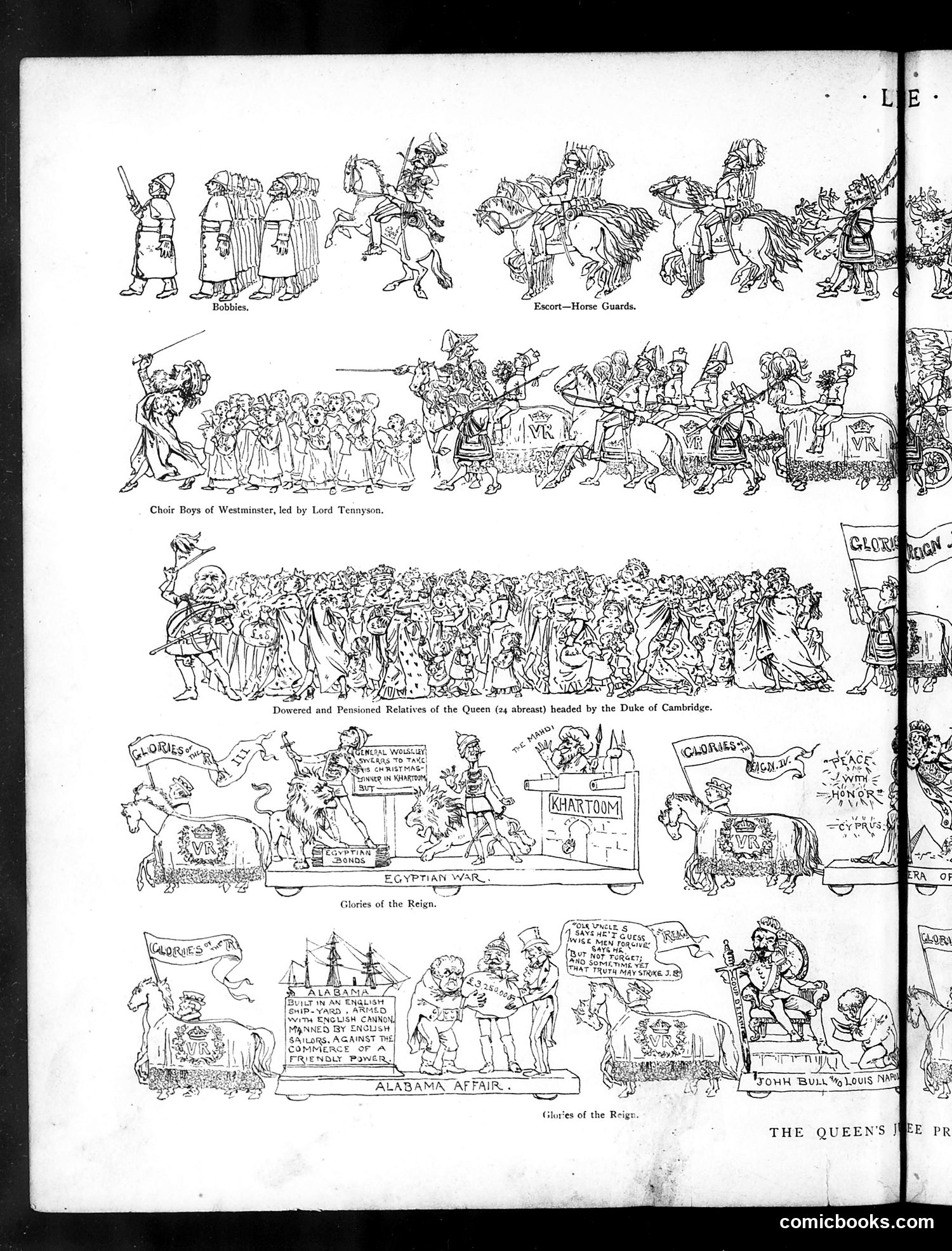
This page depicts Queen Victoria's jubilee celebration through satirical illustrations. The top section shows ceremonial elements: babies (likely representing innocence or the nation's youth), mounted escort guards, Westminster choir boys led by Lord Tennyson, and dowered relatives of the Queen headed by the Duke of Cambridge. Below are satirical "Glories of the Reign" — cartoons mocking major events: the Egyptian War, the Alabama Affair (a Civil War-era British-American dispute), and what appears to be naval/military conflicts. These "glories" use irony to critique imperial ventures and diplomatic controversies during Victoria's reign, contrasting the grand ceremonial procession above with the messy political realities below.
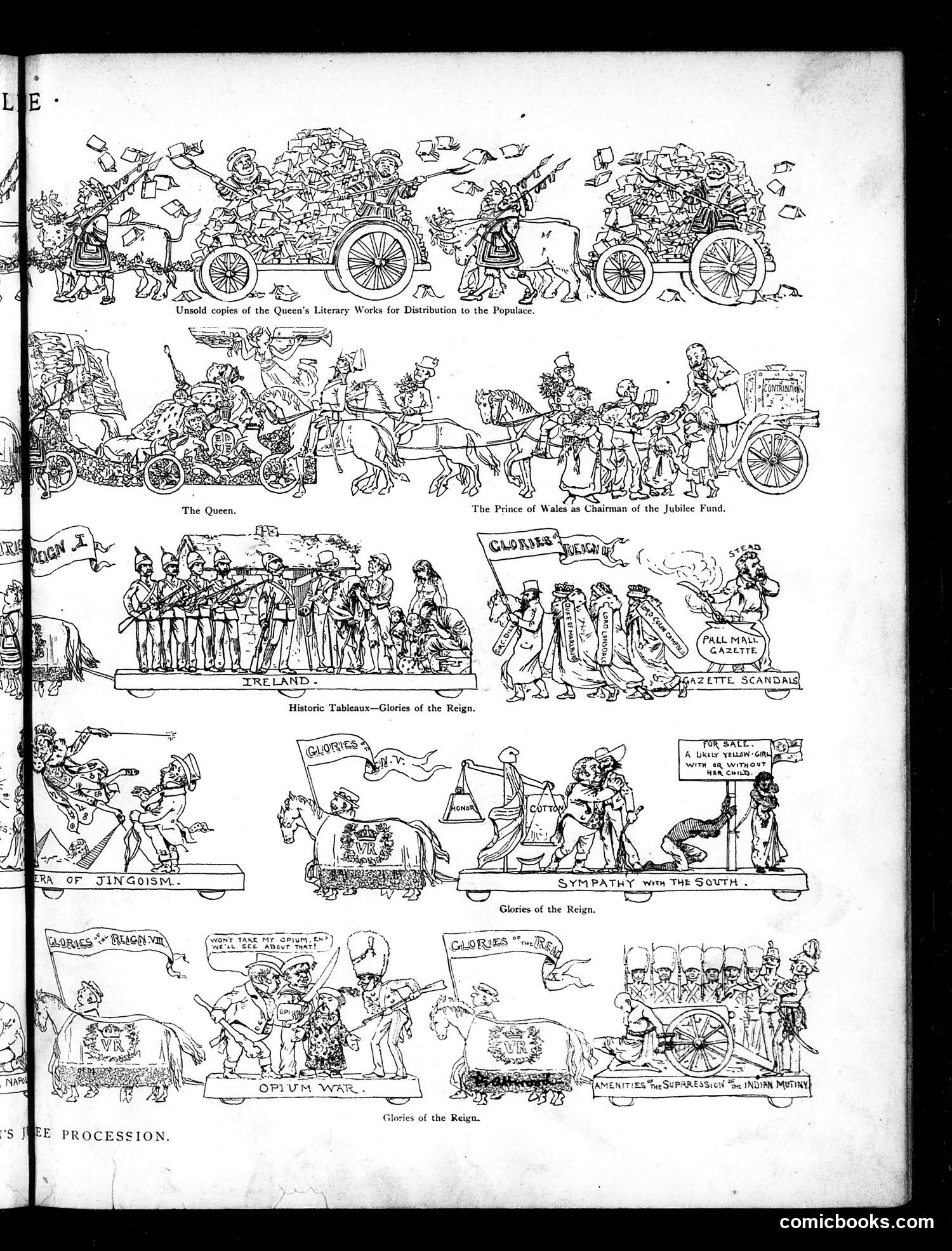
This page depicts Queen Victoria's Diamond Jubilee (likely 1897) through satirical "tableaux" or procession floats. The top shows carts distributing the Queen's literary works to common people—mocking the idea of mass distribution of royal propaganda. Below are various allegorical floats labeled "Glories of the Reign," satirizing British imperial achievements: Ireland, jingoism, "Sympathy with the South" (American Civil War support), opium wars, and "Old Roses" (unclear reference). Each tableau mockingly celebrates controversial policies—colonialism, drug trafficking, Irish subjugation—as national "glories." The satire suggests *Life* magazine was criticizing the jingoistic celebration of Britain's imperial record, exposing uncomfortable historical realities behind patriotic pageantry. The humor relies on readers recognizing these policies as shameful rather than glorious.
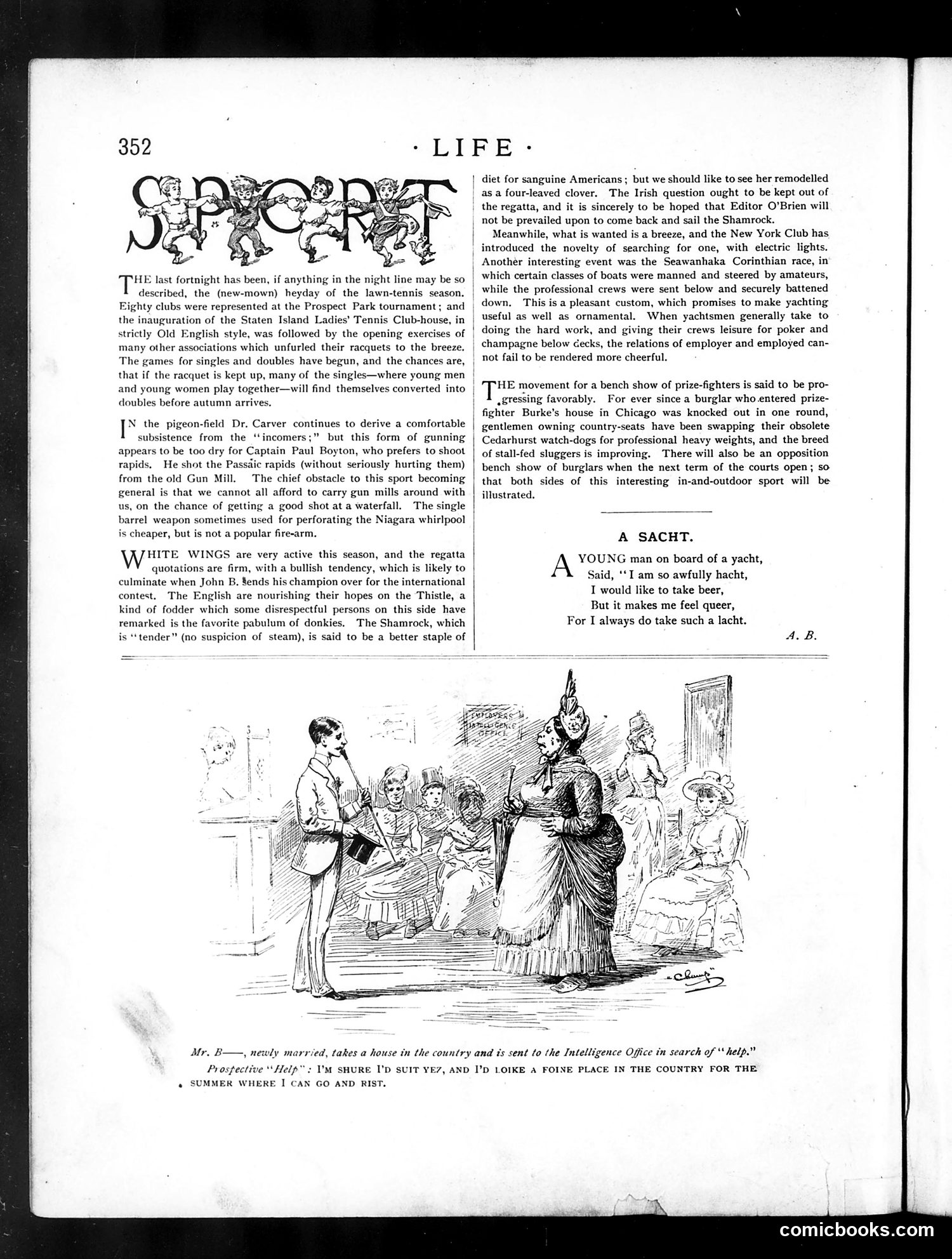
This page contains two distinct items: **Upper text:** Commentary on the tennis season, pigeon-shooting sports, and yacht racing—activities of wealthy Americans. It discusses hopes for various boats (Thistle, Shamrock) competing in international contests. **Lower cartoon:** Titled "A Sacht" (likely "A Yacht"), it depicts a newly married man seeking lodging at an Intelligence Office, claiming to want a country house for the summer. The joke's caption suggests he's actually fleeing his new marriage—he wants a place to "hist" (hide). The woman in the illustration appears to be his wife, whom he's already trying to escape. The satire mocks newlywed men who regret marriage almost immediately, presenting domestic life as something to evade rather than enjoy.
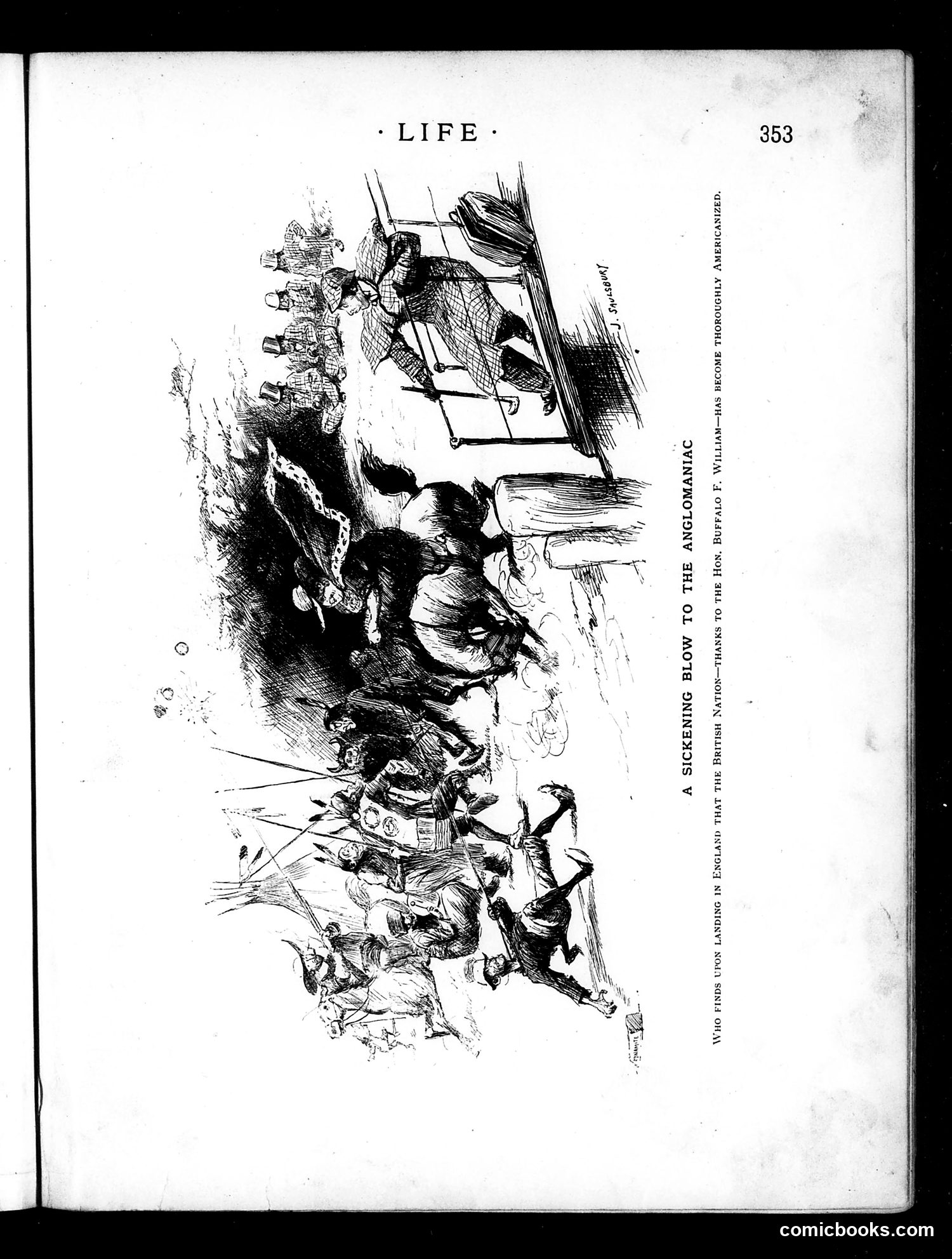
I cannot reliably interpret this cartoon. The OCR text is heavily corrupted and unreadable, making it impossible to identify the specific political or social references intended. While the image shows a sketch-style illustration with multiple figures in what appears to be a satirical scene—possibly depicting a chaotic or comedic situation with period clothing and details—without legible text or clear context, I cannot accurately explain the satire, identify specific figures being caricatured, or determine the historical event or social commentary being referenced. To properly analyze this Life magazine page, a clearer text source or additional context would be needed.
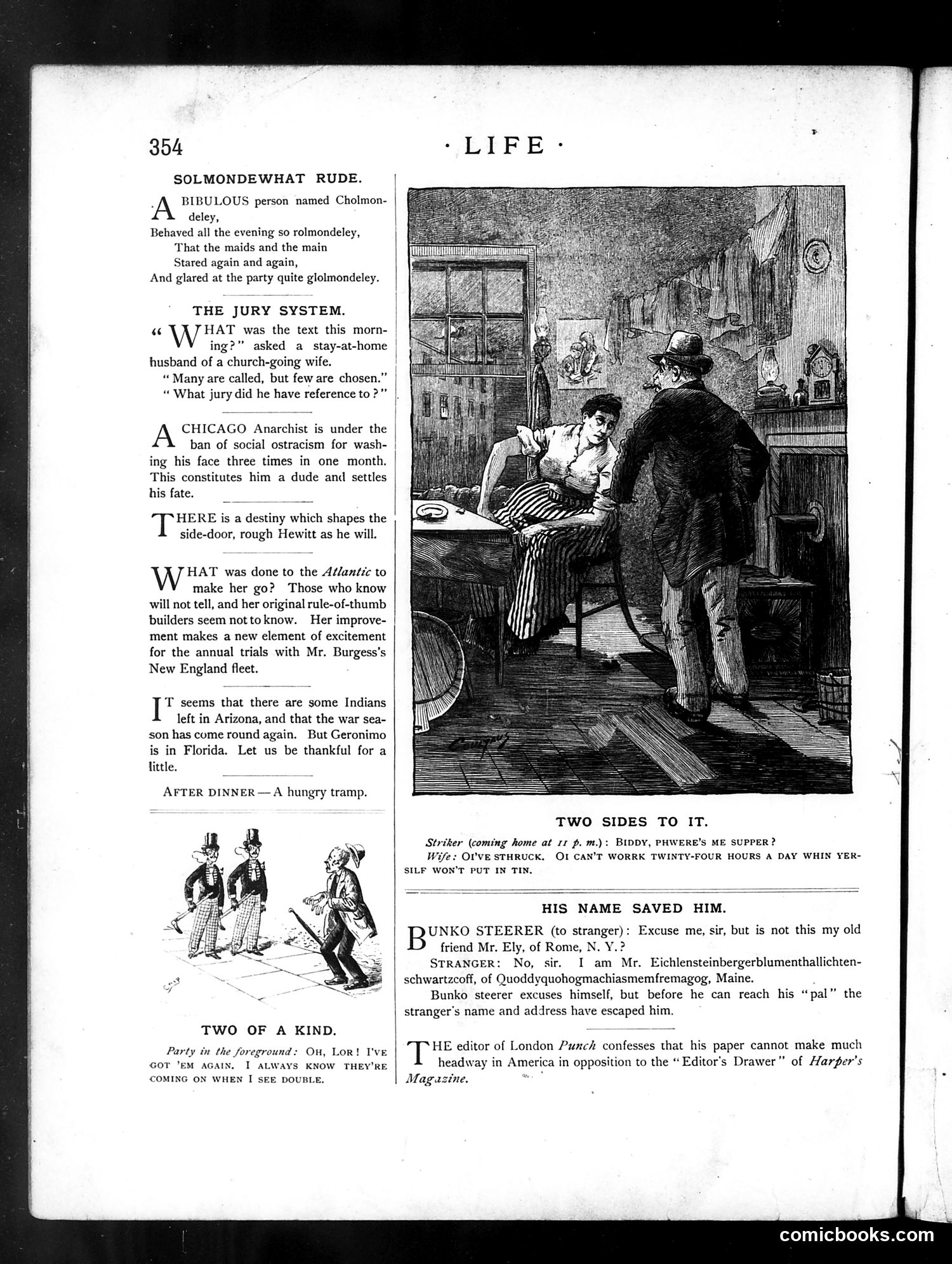
This page from *Life* contains several brief satirical pieces mocking contemporary American society: **"Solmondewhat Rude"** ridicules an drunk guest whose behavior disrupts a party—a commentary on poor etiquette among the bibulous classes. **"The Jury System"** jokes that jurors are "called" but "few are chosen" (biblical language), implying jury selection is arbitrary or flawed. **Chicago Anarchist** satirizes both anarchists and excessive propriety by claiming a radical faces social ostracism for *washing* his face—absurdist humor attacking both extremes. The illustrated cartoons show working-class life: a striker's wife refusing to cook because she won't work 24-hour days while her husband contributes nothing; and a "bunko steerer" (con artist) unable to remember an obviously fake name given by a stranger. The final item has *Life* boasting it competes better than *Harper's Magazine*'s "Editor's Drawer" column—self-promotional trade commentary between rival publications. Overall: sharp, quick social satire targeting drunks, poor civics, labor disputes, and con artists.
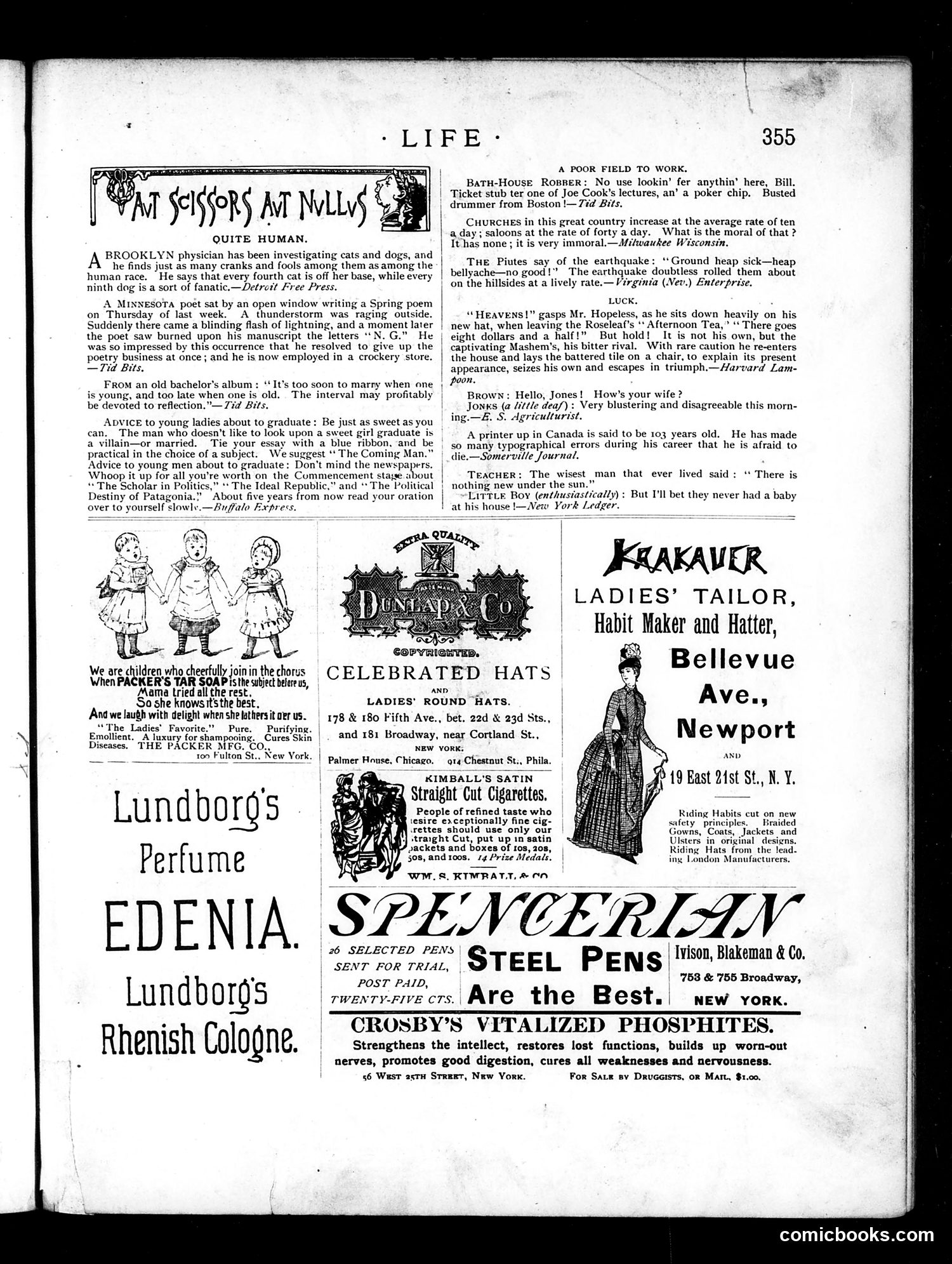
This page is primarily **advertisements and humorous short items** rather than political cartoons. The content consists of: **Humorous Anecdotes:** Brief satirical jokes about contemporary American life—a Brooklyn doctor finding cats and dogs as foolish as humans; a Minnesota poet struck by lightning while writing; advice to graduates; observations about church growth versus saloon expansion; and domestic situations involving mistaken hats and miscommunication. **One Illustrated Advertisement:** A children's chorus promoting Packer's Tar Soap, showing young girls cheerfully endorsing the product—typical Victorian-era advertising rhetoric targeting mothers. **Product Advertisements:** Multiple ads for Lundborg's perfume, Krakauer's ladies' tailoring, Spencerian steel pens, Crosby's phosphites, and Kimball's cigars—standard period commercial content. The page reflects **turn-of-the-century American sensibilities**: domestic humor, commercialism, and gentle social observation. There is no significant political satire or caricature requiring historical context beyond understanding period advertising conventions.
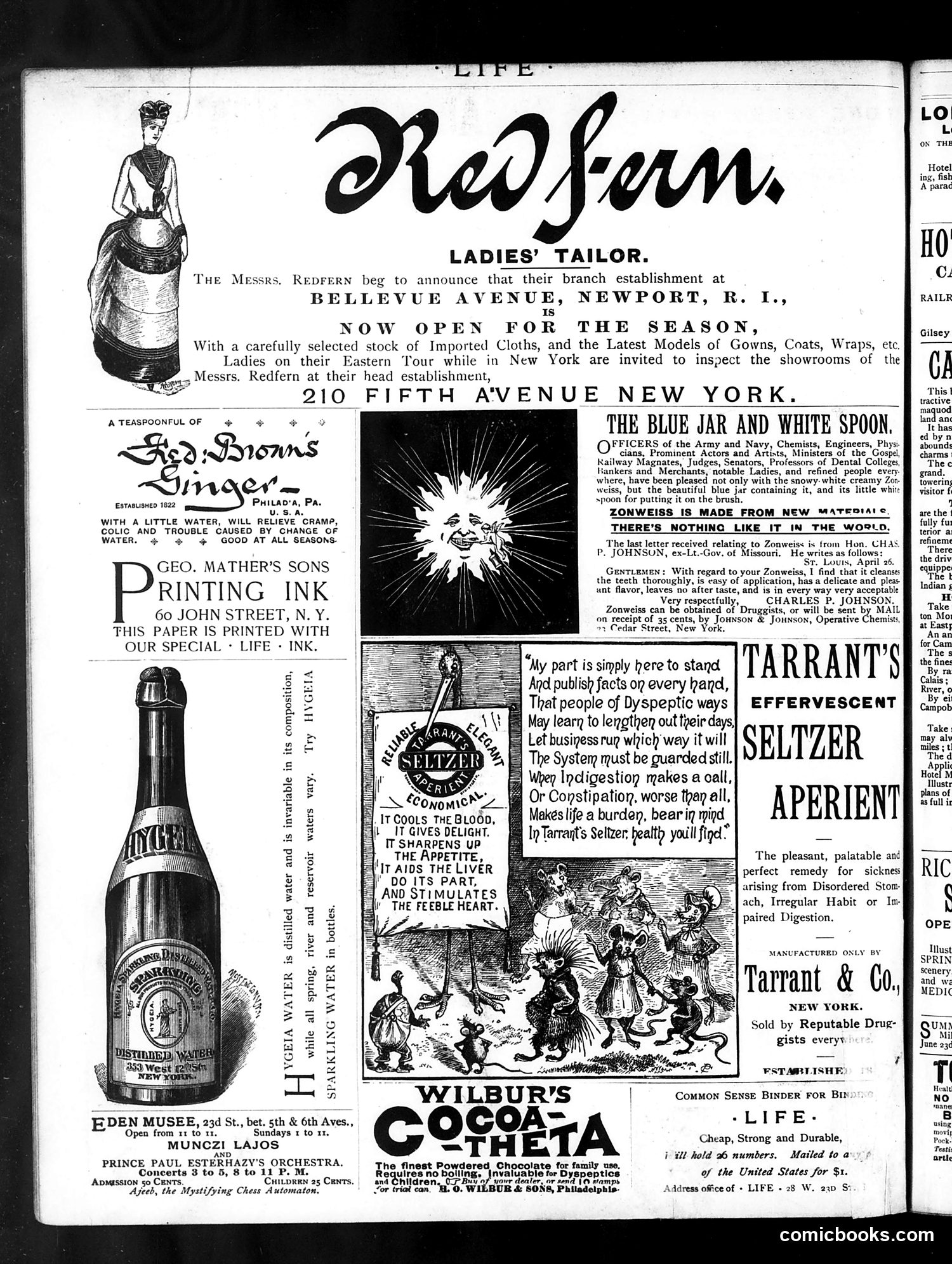
This is primarily a **advertisements page** from *Life* magazine, not a political cartoon. The page contains Victorian-era commercial ads for luxury goods and services targeting wealthy Americans. **Key content:** - **Redfern** (top): A high-end ladies' tailor announcing a Newport, Rhode Island branch opening - **Zonweiss** (center): A tooth-cleaning product endorsed by prominent figures (military officers, actors, senators, judges) - **Tarrant's Seltzer** (right): A digestive remedy with a small illustrated scene showing people discussing dyspepsia - Other ads: printing ink, cocoa, music performances, and a chess automaton The Tarrant's ad includes the only satirical element—a verse poking mild fun at businessmen and digestive troubles, but this is **product advertising humor**, not political satire. The page reflects late 19th-century consumer culture targeting the affluent.
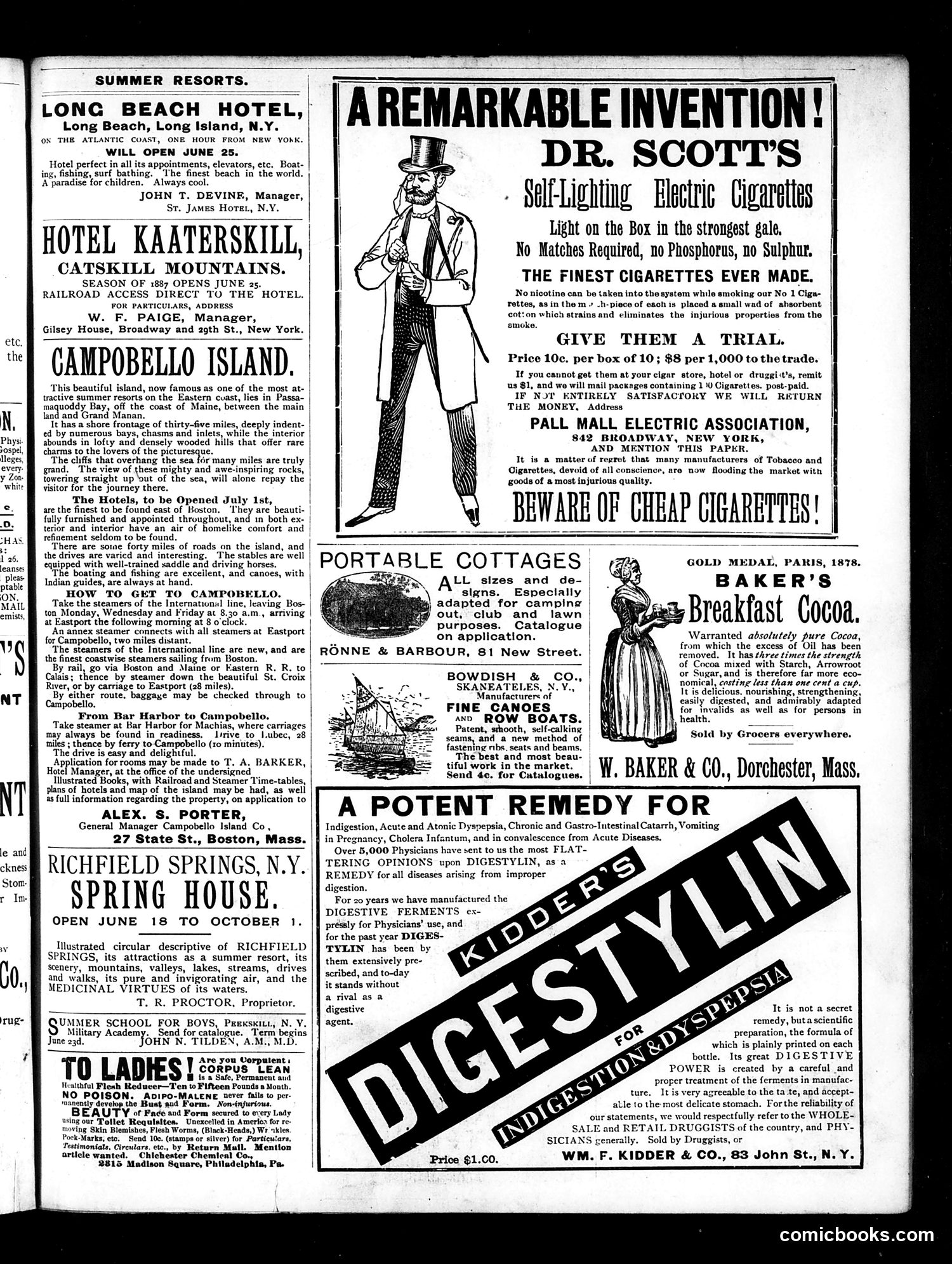
This page is primarily **advertising rather than political satire**. It features vacation destinations (Long Beach Hotel, Hotel Kaaterskill, Campobello Island) and commercial products. The dominant illustration is a well-dressed gentleman promoting **Dr. Scott's Self-Lighting Electric Cigarettes**—a fraudulent health product typical of the late 1800s. The "remarkable invention" claims cigarettes with an absorbent cotton filter eliminate nicotine's harmful properties. This reflects the era's widespread medical quackery and pre-regulation patent medicine industry, before the FDA restricted false health claims. Below appears **Kidder's Digestive Ferments**, another dubious remedy claiming to cure numerous ailments through "indigestion." These advertisements exemplify how 19th-century publications profited from dangerous medical misinformation, targeting readers with pseudo-scientific promises. The page reveals how consumers lacked consumer protection and were vulnerable to exploitation through exaggerated or invented medical claims.
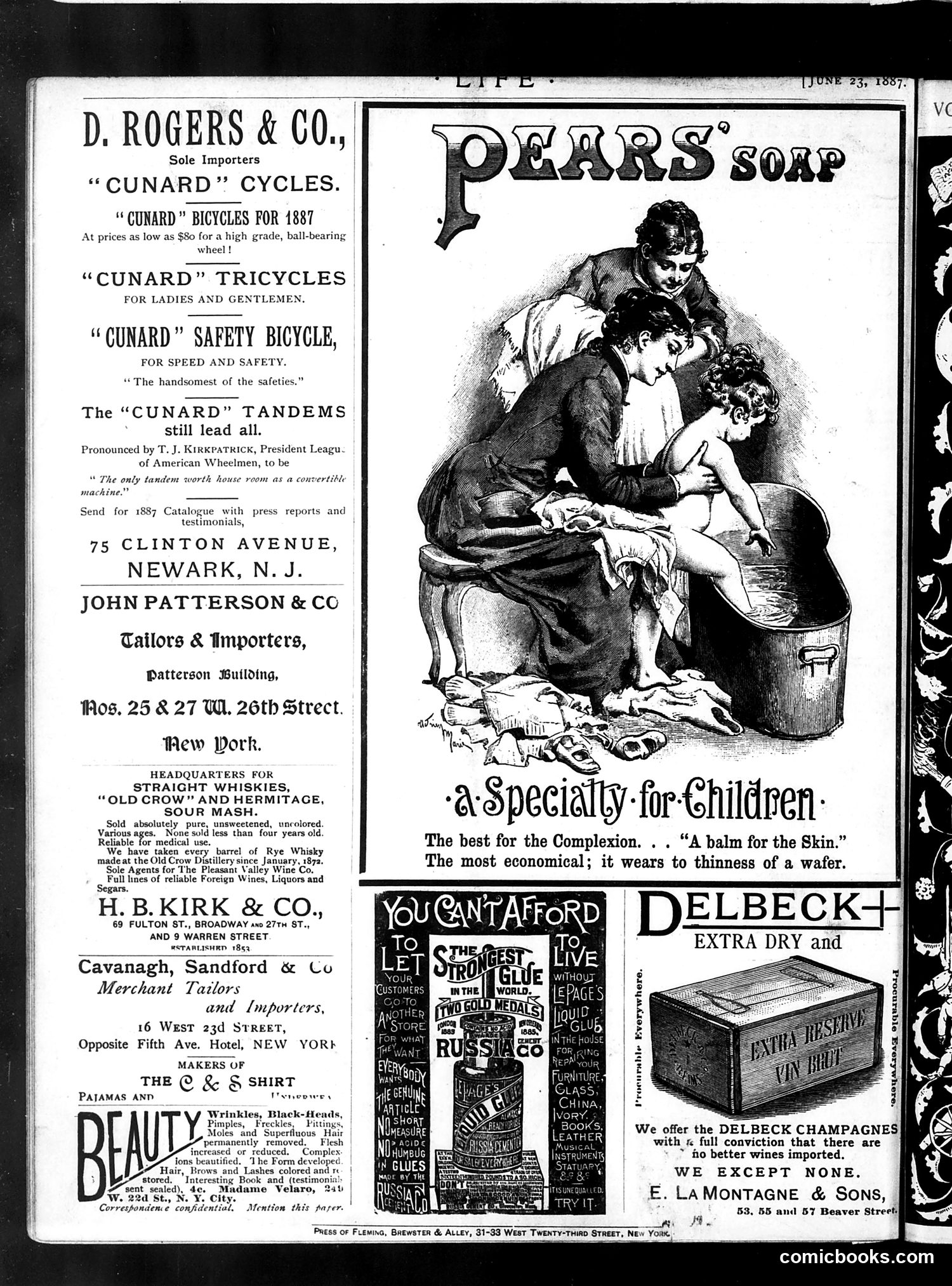
This page is primarily **advertisements** from an 1887 *Life* magazine issue. The dominant visual is a **Pears' Soap ad** featuring a sentimental Victorian-era illustration of a woman bathing a child, with accompanying text marketing the product as "a Specialty for Children" — "The best for the Complexion" and "a balm for the Skin." The imagery appeals to contemporary middle-class values of domestic virtue and child care. The ad's emotional tone (protective motherhood, cleanliness as moral goodness) was typical of late-19th-century advertising rhetoric. Other ads on the page promote bicycles (Cunard brand), tailoring, whiskey, champagne, and beauty treatments — products targeting affluent urban consumers. **There is no political cartoon visible here.** The page consists almost entirely of commercial advertisements, which constituted significant revenue for *Life* magazine during this period.