
Life, 1887-06-23 · page 5 of 16
Life — June 23, 1887 — page 5: what you’re looking at
What you’re looking at
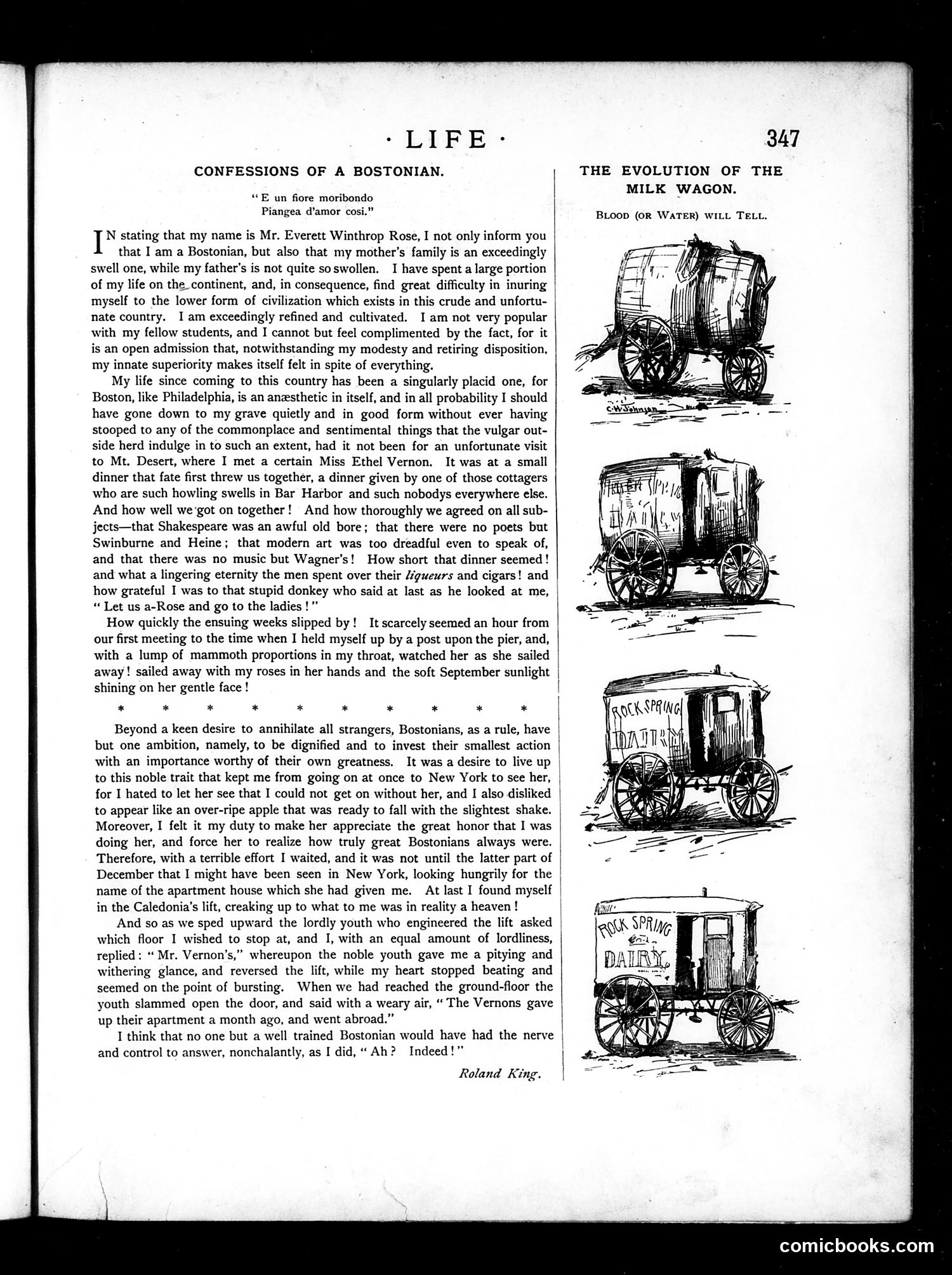
The right side of this page shows four illustrated stages of milk delivery wagons, progressing from basic to more elaborate designs. Each wagon is progressively larger and more decorated, with the final two featuring "Rock Spring" and "Rock Spring Dairy" branding. This appears to be a humorous commentary on commercial competition and advertising excess in the dairy industry. The sequence suggests how milk vendors increasingly embellished their wagons with larger signs and more prominent branding to attract customers—transforming simple delivery vehicles into mobile advertisements. The title "Blood (or Water) Will Tell" implies satirical skepticism about such marketing claims, questioning whether fancy presentation actually reflects product quality.
📄 Transcribed text from this page (OCR, searchable)
Machine-transcribed from the original scan — historical spelling and the odd misread are preserved.
- LIFE: CONFESSIONS OF A BOSTONIAN. “E un fiore moribondo Piangea d’amor cosi.” N stating that my name is Mr. Everett Winthrop Rose, I not only inform you | that I am a Bostonian, but also that my mother’s family is an exceedingly swell one, while my father’s is not quite soswollen. I have spent a large portion of my life on the_continent, and, in consequence, find great difficulty in inuring myself to the lower form of civilization which exists in this crude and unfortu- nate country. I am exceedingly refined and cultivated. I am not very popular with my fellow students, and I cannot but feel complimented by the fact, for it is an open admission that, notwithstanding my modesty and retiring disposition, my innate superiority makes itself felt in spite of everything. My life since coming to this country has been a singularly placid one, for Boston, like Philadelphia, is an anesthetic in itself, and in all probability I should have gone down to my grave quietly and in good form without ever having stooped to any of the commonplace and sentimental things that the vulgar out- side herd indulge in to such an extent, had it not been for an unfortunate visit to Mt. Desert, where I met a certain Miss Ethel Vernon. It was at a small dinner that fate first threw us together, a dinner given by one of those cottagers who are such howling swells in Bar Harbor and such nobodys everywhere else. And how well we'got on together! And how thoroughly we agreed on all sub- jects—that Shakespeare was an awful old bore; that there were no poets but Swinburne and Heine; that modern art was too dreadful even to speak of, and that there was no music but Wagner’s! How short that dinner seemed ! and what a lingering eternity the men spent over their /4gueurs and cigars! and how grateful I was to that stupid donkey who said at last as he looked at me, « Let us a-Rose and go to the ladies !”” How quickly the ensuing weeks slipped by! It scarcely seemed an hour from our first meeting to the time when I held myself up by a post upon the pier, and, with a lump of mammoth proportions in my throat, watched her as she sailed away ! sailed away with my roses in her hands and the soft September sunlight shining on her gentle face ! * * * * * * * * * * Beyond a keen desire to annihilate all strangers, Bostonians, as a rule, have but one ambition, namely, to be dignified and to invest their smallest action | with an importance worthy of their own greatness. It was a desire to live up to this noble trait that kept me from going on at once to New York to see her, | for I hated to let her see that I could not get on without her, and I also disliked to appear like an over-ripe apple that was ready to fall with the slightest shake. | Moreover, I felt it my duty to make her appreciate the great honor that I was doing her, and force her to realize how truly great Bostonians always were. | Therefore, with a terrible effort I waited, and it was not until the latter part of | December that I might have been seen in New York, looking hungrily for the | name of the apartment house which she had given me. At last I found myself | in the Caledonia’s lift, creaking up to what to me was in reality a heaven ! And so as we sped upward the lordly youth who engineered the lift asked | which floor I wished to stop at, and I, with an equal amount of lordliness, replied: “ Mr. Vernon's,” whereupon the noble youth gave me a pitying and withering glance, and reversed the lift, while my heart stopped beating and seemed on the point of bursting. When we had reached the ground-floor the youth slammed open the door, and said with a weary air, “ The Vernons gave up their apartment a month ago, and went abroad.” I think that no one but a well trained Bostonian would have had the nerve | and control to answer, nonchalantly, as I did, “Ah? Indeed!” Roland King. 347 THE EVOLUTION OF THE MILK WAGON. BLoop (oR WaTER) WILL TELL. comicbooks.com