
Life, 1887-06-23 · page 6 of 16
Life — June 23, 1887 — page 6: what you’re looking at
What you’re looking at
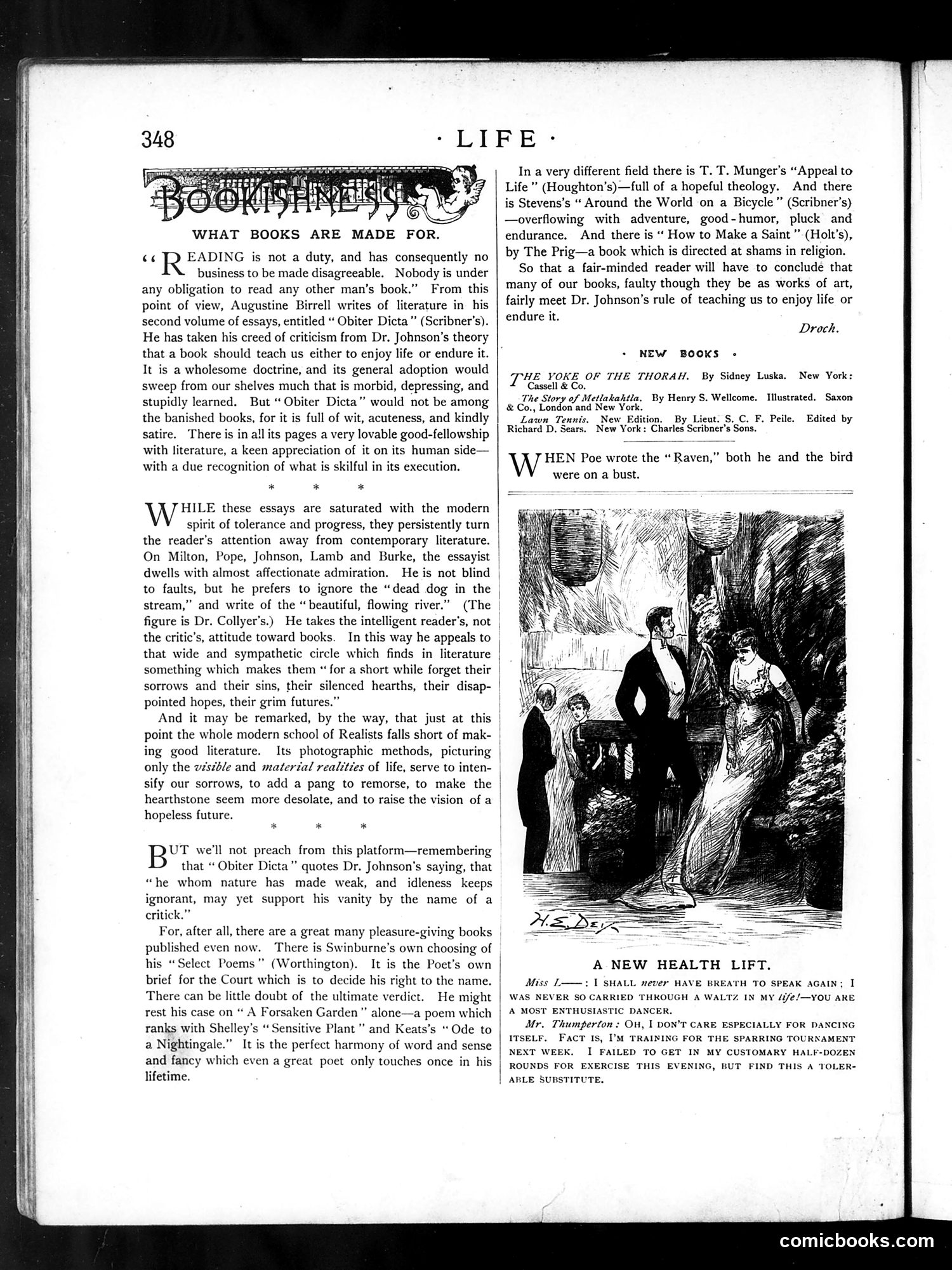
This page from *Life* magazine contains a literary essay titled "What Books Are Made For" alongside a section on new books. The main illustration, captioned "A New Health Lift," depicts a social scene with elegantly dressed figures in what appears to be an outdoor setting with dramatic tree roots or natural formations. Below the illustration is a brief comedic dialogue between "Miss L—" and "Mr. Thrumperton" about dancing and exercise. The humor appears gentle and domestic—Miss L— mentions never speaking again after an enthusiastic waltz, while Mr. Thrumperton boasts about training for a sparring tournament but substituting dancing as an exercise alternative. The satire targets Victorian-era social pretensions around health, fitness, and courtship conventions among the upper classes, suggesting that even vigorous activities like dancing could serve as socially acceptable exercise.
📄 Transcribed text from this page (OCR, searchable)
Machine-transcribed from the original scan — historical spelling and the odd misread are preserved.
WHAT BOOKS ARE MADE FOR. 66 <ADING is not a duty, and has consequently no business to be made disagreeable. Nobody is under any obligation to read any other man’s book.” From this point of view, Augustine Birrell writes of literature in his second volume of essays, entitled “ Obiter Dicta” (Scribner's). He has taken his creed of criticism from Dr. Johnson’s theory that a book should teach us either to enjoy life or endure it. It is a wholesome doctrine, and its general adoption would sweep from our shelves much that is morbid, depressing, and stupidly learned. But “ Obiter Dicta” would not be among the banished books, for it is full of wit, acuteness, and kindly satire. There is in a!l its pages a very lovable good-fellowship with literature, a keen appreciation of it on its human side— with a due recognition of what is skilful in its execution. * * * HILE these essays are saturated with the modern spirit of tolerance and progress, they persistently turn the reader’s attention away from contemporary literature. | On Milton, Pope, Johnson, Lamb and Burke, the essayist dwells with almost affectionate admiration. to faults, but he prefers to ignore the “dead dog in the stream,” and write of the “beautiful, flowing river.” (The figure is Dr. Collyer’s.) He takes the intelligent reader's, not the critic’s, attitude toward books. In this way he appeals to that wide and sympathetic circle which finds in literature | something which makes them “for a short while forget their | sorrows and their sins, their silenced hearths, their disap- pointed hopes, their grim futures.” And it may be remarked, by the way, that just at this point the whole modern school of Realists falls short of mak- ing good literature. Its photographic methods, picturing only the v¢szb/e and matertal realttzes of life, serve to inten- sify our sorrows, to add a pang to remorse, to make the hearthstone seem more desolate, and to raise the vision of a hopeless future. * * * UT we'll not preach from this platform—remembering that “ Obiter Dicta”’ quotes Dr. Johnson's saying, that “he whom nature has made weak, and idleness keeps ignorant, may yet support his vanity by the name of a critick.”” For, after all, there are a great many pleasure-giving books published even now. There is Swinburne’s own choosing of his “Select Poems” (Worthington). brief for the Court which is to decide his right to the name. There can be little doubt of the ultimate verdict. rest his case on “ He might Forsaken Garden” alone—a poem which ranks with Shelley's “ Sensitive Plant” and Keats’s “Ode to | a Nightingale.” It is the perfect harmony of word and sense and fancy which even a great poet only touches once in his lifetime. He is not blind | It is the Poet's own | In a very different field there is T. T. Munger’s “Appeal to Life ” (Houghton’s)—full of a hopeful theology. And there is Stevens’s “ Around the World on a Bicycle” (Scribner’s) —overflowing with adventure, good-humor, pluck and endurance. And there is ‘“‘ How to Make a Saint ” (Holt’s), by The Prig—a book which is directed at shams in religion. So that a fair-minded reader will have to conclude that many of our books, faulty though they be as works of art, fairly meet Dr. Johnson’s rule of teaching us to enjoy life or endure it. Droch. + NEW BOOKS - THE VOKE OF THE THORAH. By Sidney Luska. New York: Cassell & Co, The Story of Metlakahtla. & Co,, London and New York. Lawn Tennis. New Edi By Henry S. Wellcome. Illustrated. Saxon By Lieut. S.C. F. Peile. Edited by lition. Richard D, Sears. New York: Charles Scribner's Sons. HEN Poe wrote the “Raven,” both he and the bird were on a bust. A NEW HEALTH LIFT. Miss L—:1 SHALL never HAVE BREA’ WAS NEVER SO CARRIED THROUGH A WALT: A MOST ENTHUSIASTIC DANCER. Mr. Thumperton: Ou, | DON’T CARE ESPECIALLY FOR DANCING ITSELF. Fact Is, I'M TRAINING FOR THE SPARRING TOURNAMENT NEXT WEEK. I FAILED TO GET IN MY CUSTOMARY HALF-DOZEN ROUNDS FOR EXERCISE THIS EVENING, BUT FIND THIS A TOLER- TO SPEAK AGAIN; I IN MY 4/e/—YOU ARE | ABLE SUBSTITUTE. comicbooks.com