
Life, 1887-06-23 · page 2 of 16
Life — June 23, 1887 — page 2: what you’re looking at
What you’re looking at
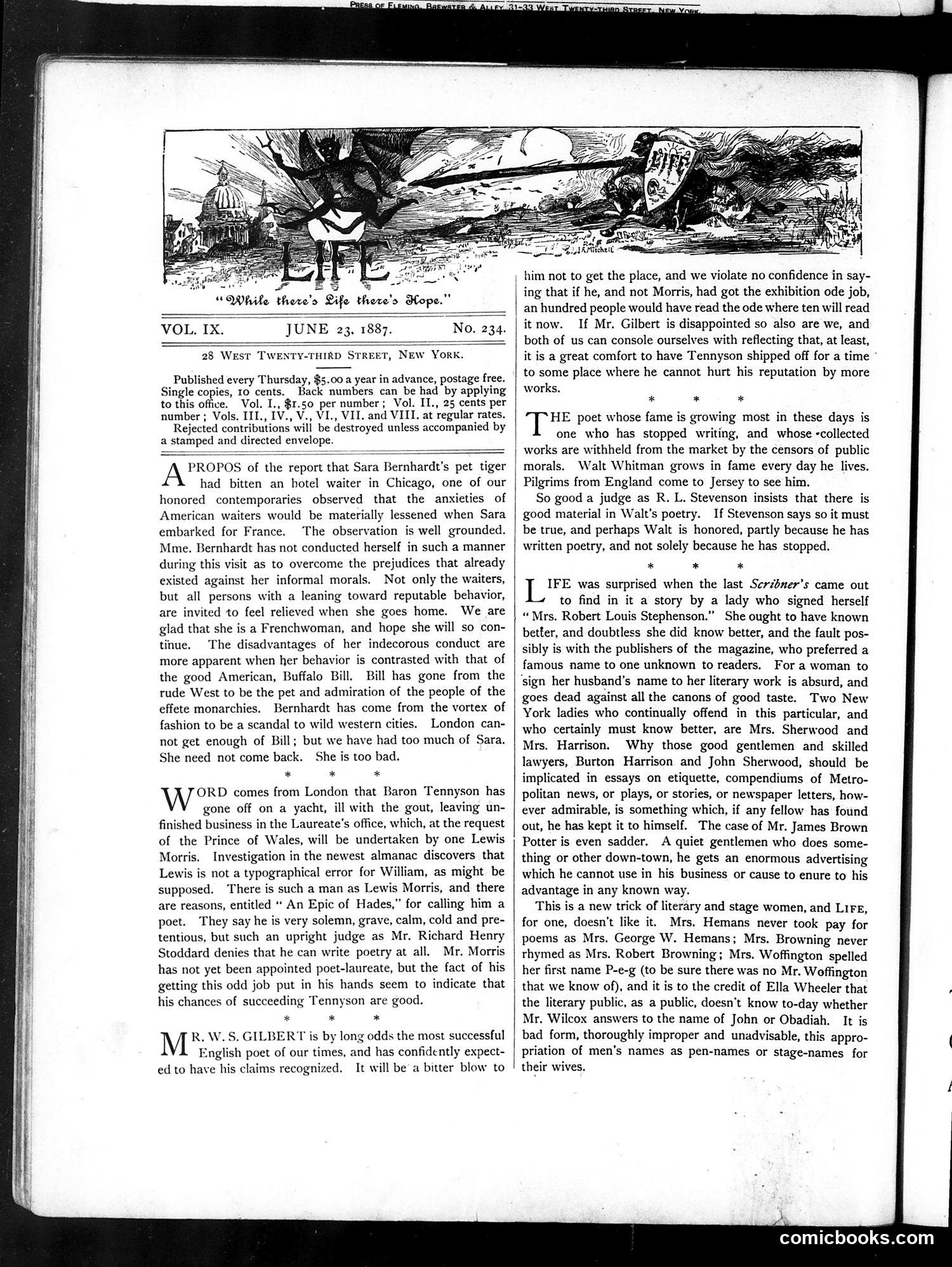
The page contains literary and cultural commentary rather than political cartoons. The small illustration at top shows a desolate landscape with the caption "While there's Life there's Hope." The main articles discuss: 1. **Sara Bernhardt's conduct**: Critics argue the French actress's behavior (notably her pet tiger biting a Chicago waiter) undermines American waiters' dignity and reputation. 2. **Censorship of literature**: The piece criticizes how public morality censors suppress Walt Whitman's poetry while he gains fame abroad. 3. **Women using pen names**: The commentary mocks women authors (like "Mrs. Robert Louis Stevenson") adopting famous husbands' names instead of their own, calling it poor literary taste. 4. **R.W.S. Gilbert**: Notes the successful English poet faces difficulty getting public recognition despite his talents.
📄 Transcribed text from this page (OCR, searchable)
Machine-transcribed from the original scan — historical spelling and the odd misread are preserved.
“OWMhile there's Life there's Hope. No. 234. ‘JUNE 23, 1887. VOL. IX. 28 West TWENTY-THIRD STREET, NEW York. Published every Thursday, $5.00 a year in advance, postage free. Single copies, 10 cents. Back numbers can be had by applying to this office. Vol. I., $1.50 per number; Vol. II., 25 cents per number ; Vols. III., IV., V., VI., VIL. and VIII. at regular rates. Rejected contributions will be destroyed unless accompanied by a stamped and directed envelope. A Bernhardt’s pet tiger had bitten an hotel waiter in Chicago, one of our honored contemporaries observed that the anxieties of American waiters would be materially lessened when Sara embarked for France. The observation is well grounded. Mme. Bernhardt has not conducted herself in such a manner during this visit as to overcome the prejudices that already existed against her informal morals. Not only the waiters, but all persons with a leaning toward reputable behavior, are invited to feel relieved when she goes home. We are glad that she is a Frenchwoman, and hope she will so con- tinue. The disadvantages of her indecorous conduct are more apparent when her behavior is contrasted with that of the good American, Buffalo Bill. Bill has gone from the rude West to be the pet and admiration of the people of the effete monarchies. Bernhardt has come from the vortex of fashion to be a scandal to wild western cities. London can- not get enough of Bill; but we have had too much of Sara. She need not come back. She is too bad. * * * ORD comes from London that Baron Tennyson has gone off on a yacht, ill with the gout, leaving un- finished business in the Laureate’s office, which, at the request of the Prince of Wales, will be undertaken by one Lewis Morris. Investigation in the newest almanac discovers that Lewis is not a typographical error for William, as might be supposed. There is such a man as Lewis Morris, and there are reasons, entitled “ An Epic of Hades,” for calling him a poet. They say he is very solemn, grave, calm, cold and pre- tentious, but such an upright judge as Mr. Richard Henry Stoddard denies that he can write poetry at all. Mr. Morris has not yet been appointed poet-laureate, but the fact of his getting this odd job put in his hands seem to indicate that his chances of succeeding Tennyson are good. * * * R. W. S. GILBERT is by long odds the most successful English poet of our times, and has confidently expect- ed to have his claims recognized. It will be a bitter blow to him not to get the place, and we violate no confidence in say- | ing that if he, and not Morris, had got the exhibition ode job, an hundred people would have read the ode where ten will read itnow. If Mr. Gilbert is disappointed so also are we, and both of us can console ourselves with reflecting that, at least, it is a great comfort to have Tennyson shipped off for a time to some place where he cannot hurt his reputation by more works. * * * HE poet whose fame is growing most in these days is one who has stopped writing, and whose collected works are withheld from the market by the censors of public morals. Walt Whitman grows in fame every day he lives. Pilgrims from England come to Jersey to see him, So good a judge as R. L. Stevenson insists that there is good material in Walt’s poetry. If Stevenson says so it must be true, and perhaps Walt is honored, partly because he has written poetry, and not solely because he has stopped. * * * IFE was surprised when the last Scr¢bner’s came out to find in it a story by a lady who signed herself “Mrs. Robert Louis Stephenson.” She ought to have known better, and doubtless she did know better, and the fault pos- sibly is with the publishers of the magazine, who preferred a famous name to one unknown to readers. For a woman to sign her husband’s name to her literary work is absurd, and goes dead against all the canons of good taste. Two New York ladies who continually offend in this particular, and who certainly must know better, are Mrs. Sherwood and Mrs. Harrison. Why those good gentlemen and skilled lawyers, Burton Harrison and John Sherwood, should be implicated in essays on etiquette, compendiums of Metro- politan news, or plays, or stories, or newspaper letters, how- ever admirable, is something which, if any fellow has found out, he has kept it to himself. The case of Mr. James Brown Potter is even sadder. A quiet gentlemen who does some- thing or other down-town, he gets an enormous advertising which he cannot use in his business or cause to enure to his advantage in any known way. This is a new trick of literary and stage women, and LIFE, for one, doesn’t like it. Mrs. Hemans never took pay for poems as Mrs. George W. Hemans; Mrs. Browning never rhymed as Mrs. Robert Browning; Mrs. Woffington spelled her first name P-e-g (to be sure there was no Mr. Woffington that we know of), and it is to the credit of Ella Wheeler that the literary public, as a public, doesn’t know to-day whether Mr. Wilcox answers to the name of John or Obadiah. It is bad form, thoroughly improper and unadvisable, this appro- priation of men’s names as pen-names or stage-names for their wives. comicbooks.com