
A complete issue · 16 pages · 1887
Life — March 17, 1887
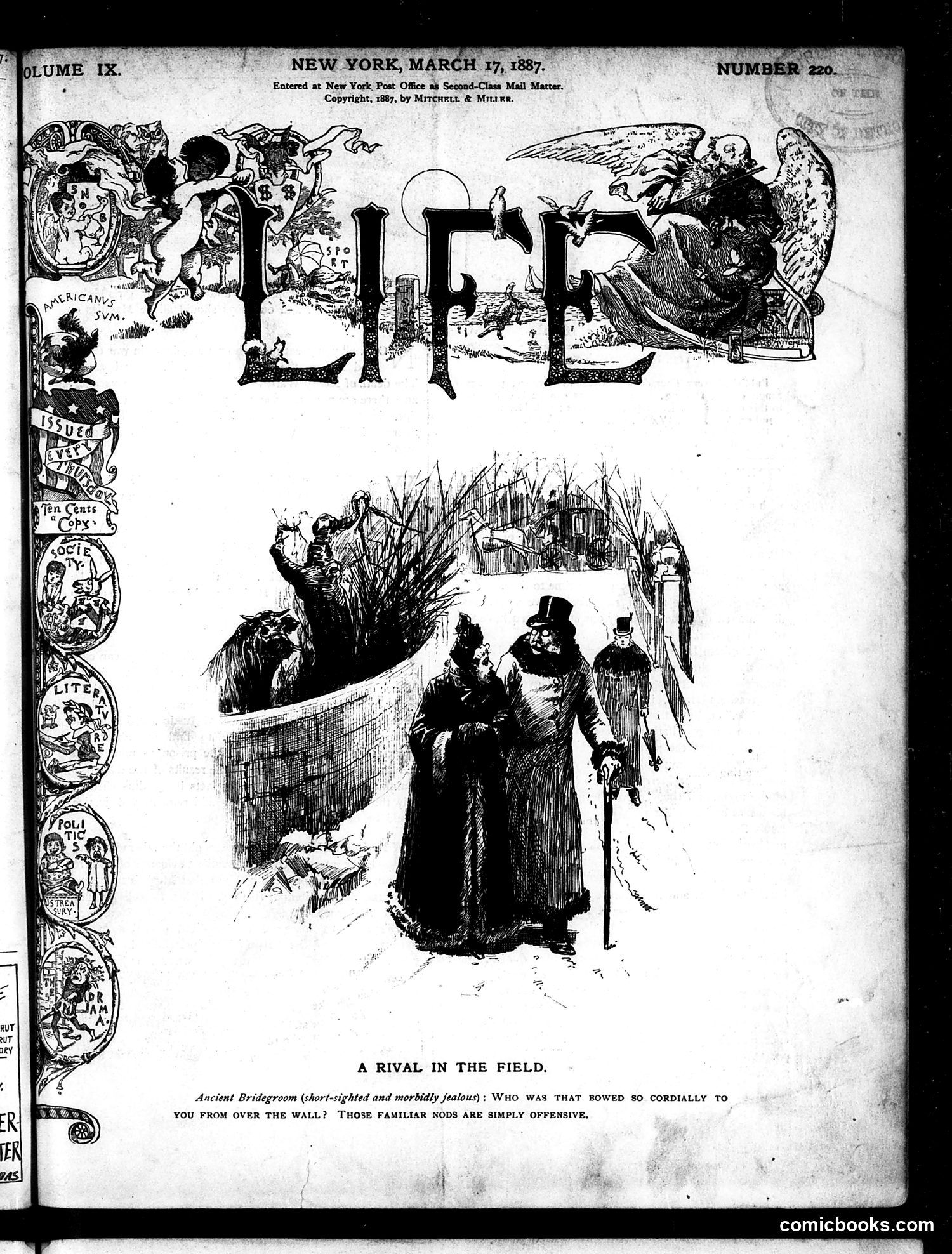
**The Cartoon: "A Rival in the Field"** This satirical illustration depicts what appears to be a romantic rivalry scenario. The caption references "Ancient Bridegroom (short-sighted and morbidly jealous)" and mocks his concern about someone bowing cordially over a wall, dismissing the familiar nods as "simply offensive." The humor plays on jealousy and insecurity—the bridegroom apparently misinterprets innocent social courtesies as romantic threats. The snowy winter setting and period clothing (top hats, long coats) situate this in contemporary 1880s society. Without additional context, the specific individuals referenced remain unclear, though the satire clearly targets masculine jealousy and the absurdity of misconstruing polite gestures as infidelity.
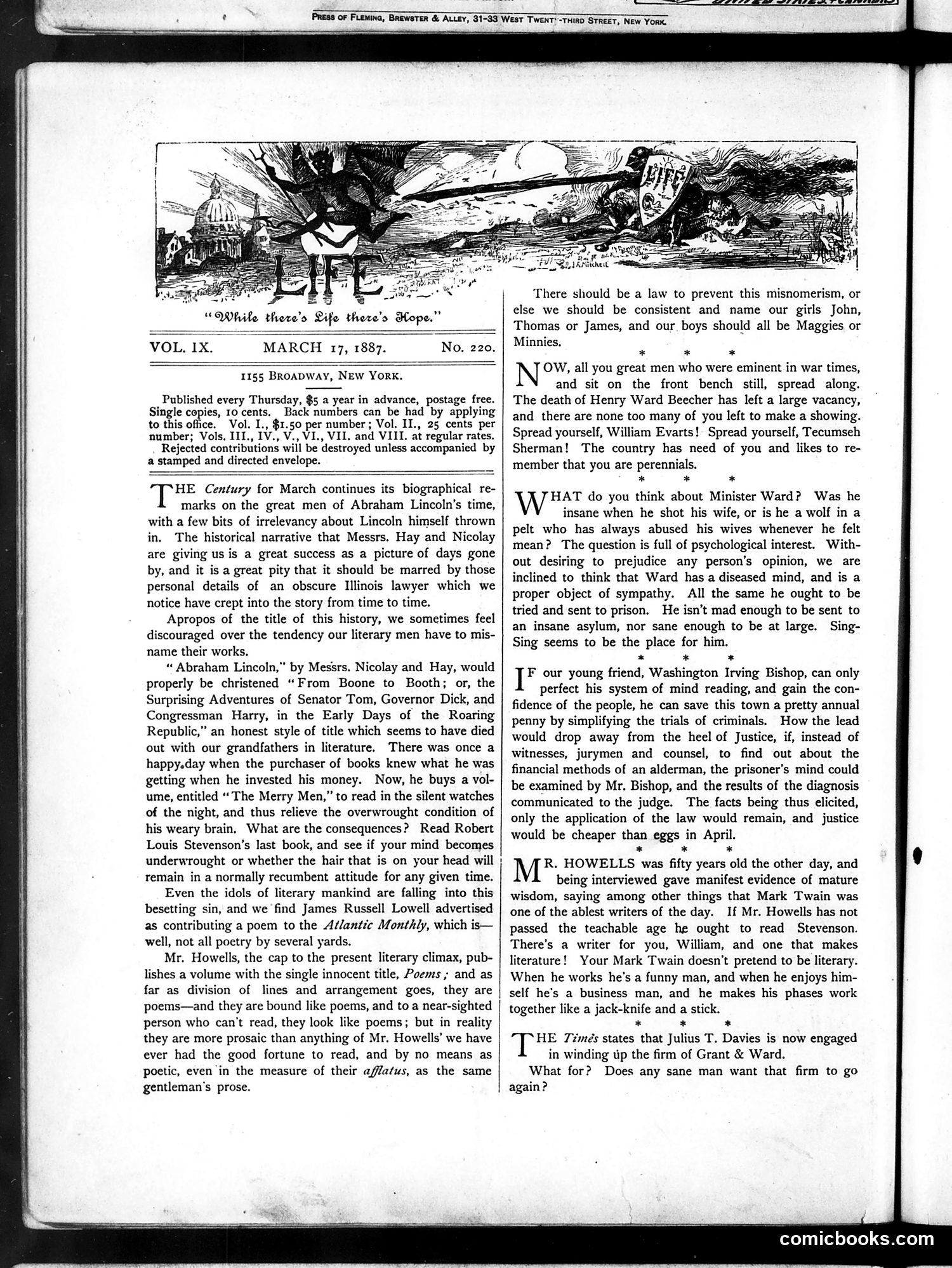
The masthead illustration depicts **"Life"** with the motto **"While there's Life there's Hope."** The allegorical figure appears to be a classical personification of Life itself. The page consists primarily of **editorial commentary and book reviews** rather than political cartoons. The text discusses: - A complaint about authors misusing the word "life" in book titles - Commentary on **Henry Ward Beecher's death** and calls for prominent men to step forward - Criticism of **Minister Ward** (likely the same Beecher) regarding his treatment of his wives - A favorable review of **Mark Twain's** literary abilities - A note about **Julius T. Davies** and the firm **Grant & Ward** This appears to be satirical social commentary rather than visual political cartooning.
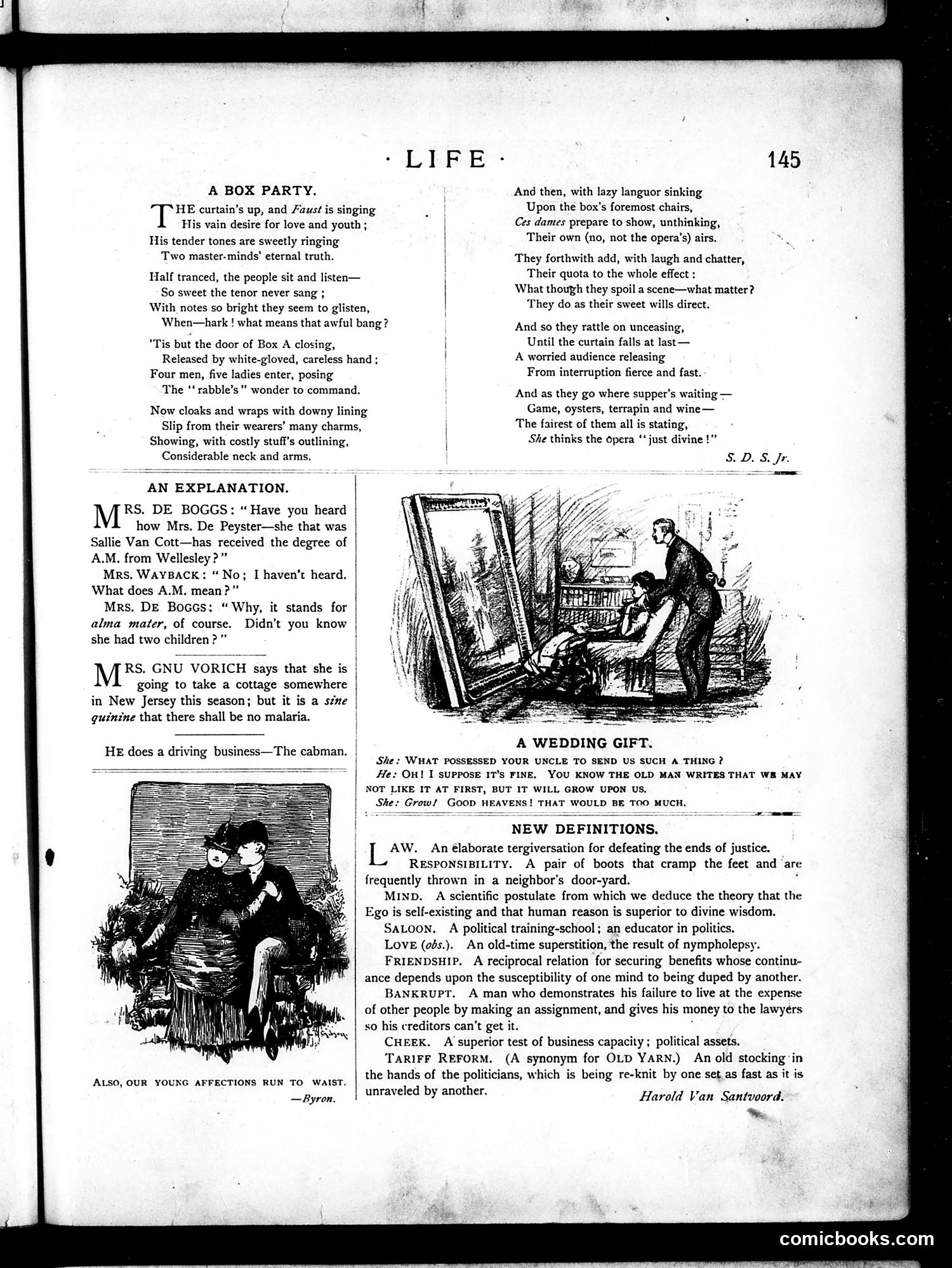
**"A Box Party"** (poem): Satirizes operagoers more interested in socializing than the performance. The satire targets the shallow behavior of wealthy box-seat patrons—their "vain desire for love and youth," gossiping during music, and treating the opera as a social venue rather than an art form. The final line mocks a woman thinking the opera "just divine" while clearly not paying attention. **"An Explanation"** (dialogue): Humorous exchange about academic degrees, with Mrs. De Boggs explaining "A.M." means *alma mater*. The satire criticizes either pretentious name-dropping or misunderstanding of educational credentials among society women. **"A Wedding Gift"** (cartoon): Shows a couple receiving an unwanted large mirror, joking that unpleasant gifts improve with time—gentle satire on social obligation and poor taste in gift-giving.
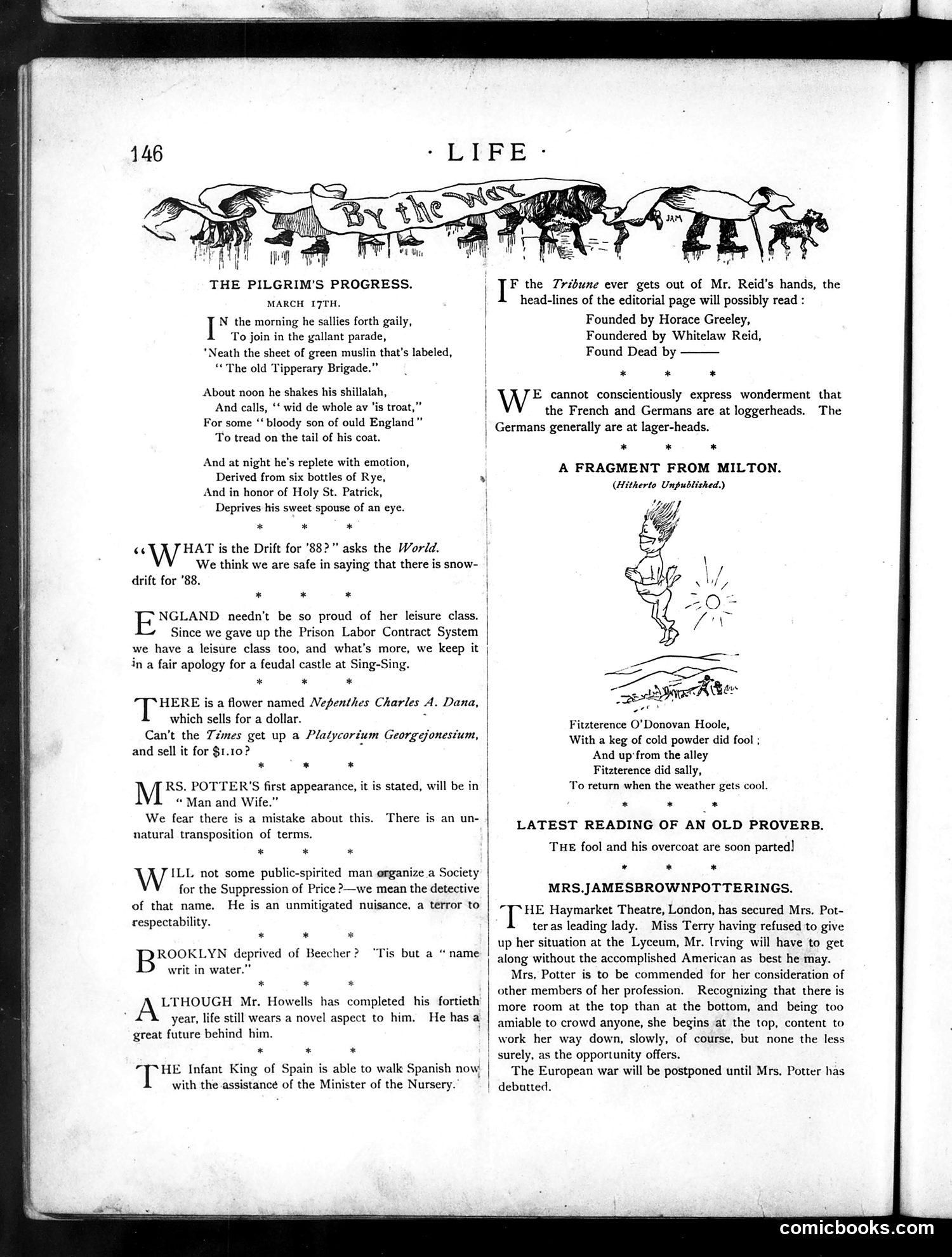
This page contains satirical commentary rather than political cartoons. The visible illustration, "A Fragment from Milton (Hitherto Unpublished)," shows a caricatured figure labeled "Fitterence O'Donovan Hoole" - apparently a humorous invented character depicted as thin and exaggerated. The accompanying verse mocks this fictional person fleeing with stolen gunpowder. The text items address various contemporary topics: criticism of French and German stereotypes as "loggerheads," commentary on England's leisure class and prison labor, and remarks about theater. One section discusses Mrs. Potter's engagement at the Haymarket Theatre in London, suggesting this is a late 19th or early 20th-century issue. The overall page is miscellaneous satire and gossip typical of Life magazine's style, mixing social commentary with invented humor.
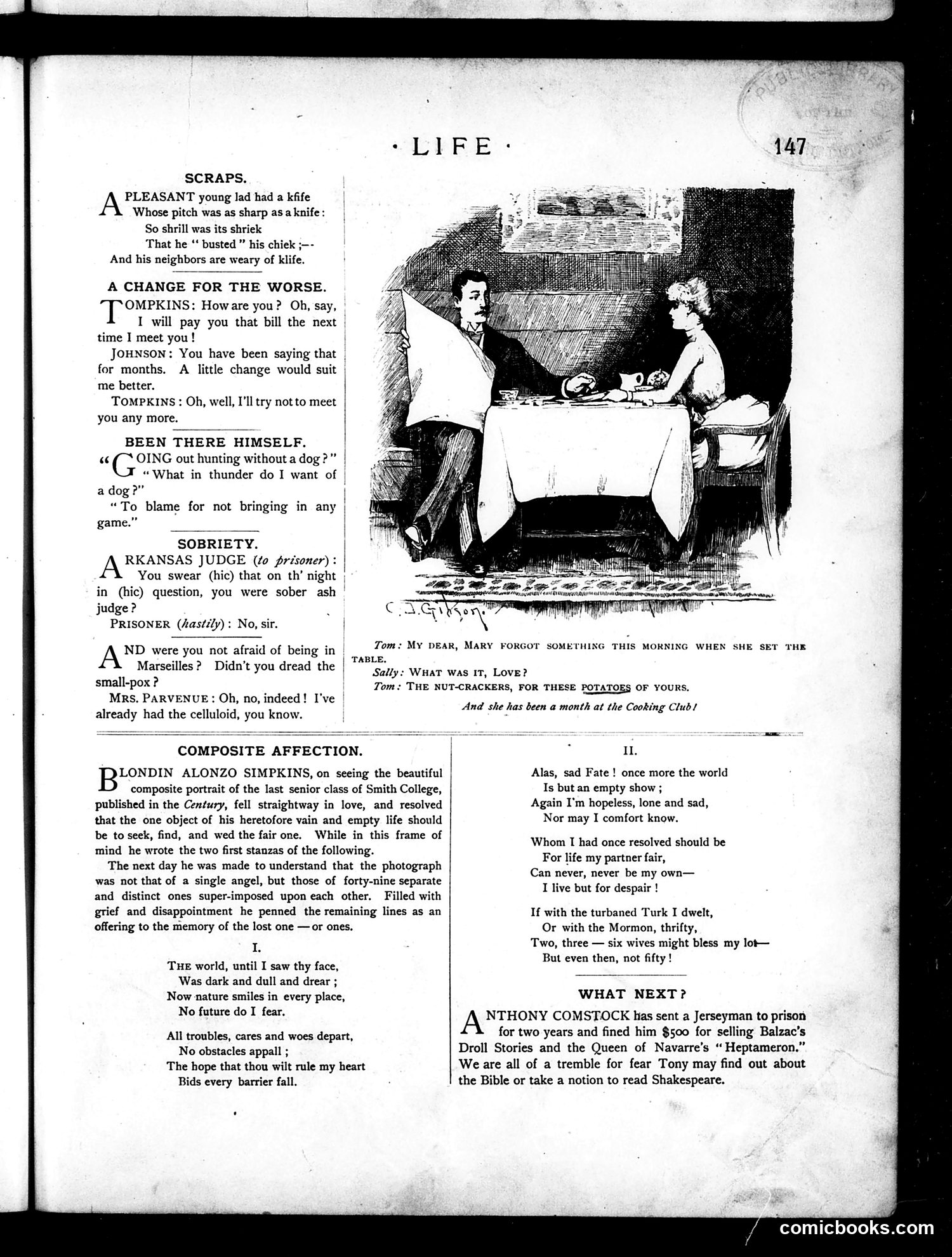
This page from *Life* magazine contains several brief satirical pieces and a sketch. The main illustration shows two men and a woman at a dining table—likely depicting a domestic or social scene of marital discord. The caption references "Mary" forgetting something about the table setting, with the man (Tom) complaining about "nut-crackers" and potatoes, and mentioning "she has been a month at the Cooking Club." The satire targets wives attending cooking classes while neglecting household duties—a common complaint in early 20th-century humor. The surrounding text pieces mock minor social annoyances: a loud knife, changing one's mind, hunting excuses, and small-pox fears. These represent typical *Life* magazine humor: light social criticism targeting everyday domestic frustrations rather than serious political matters.
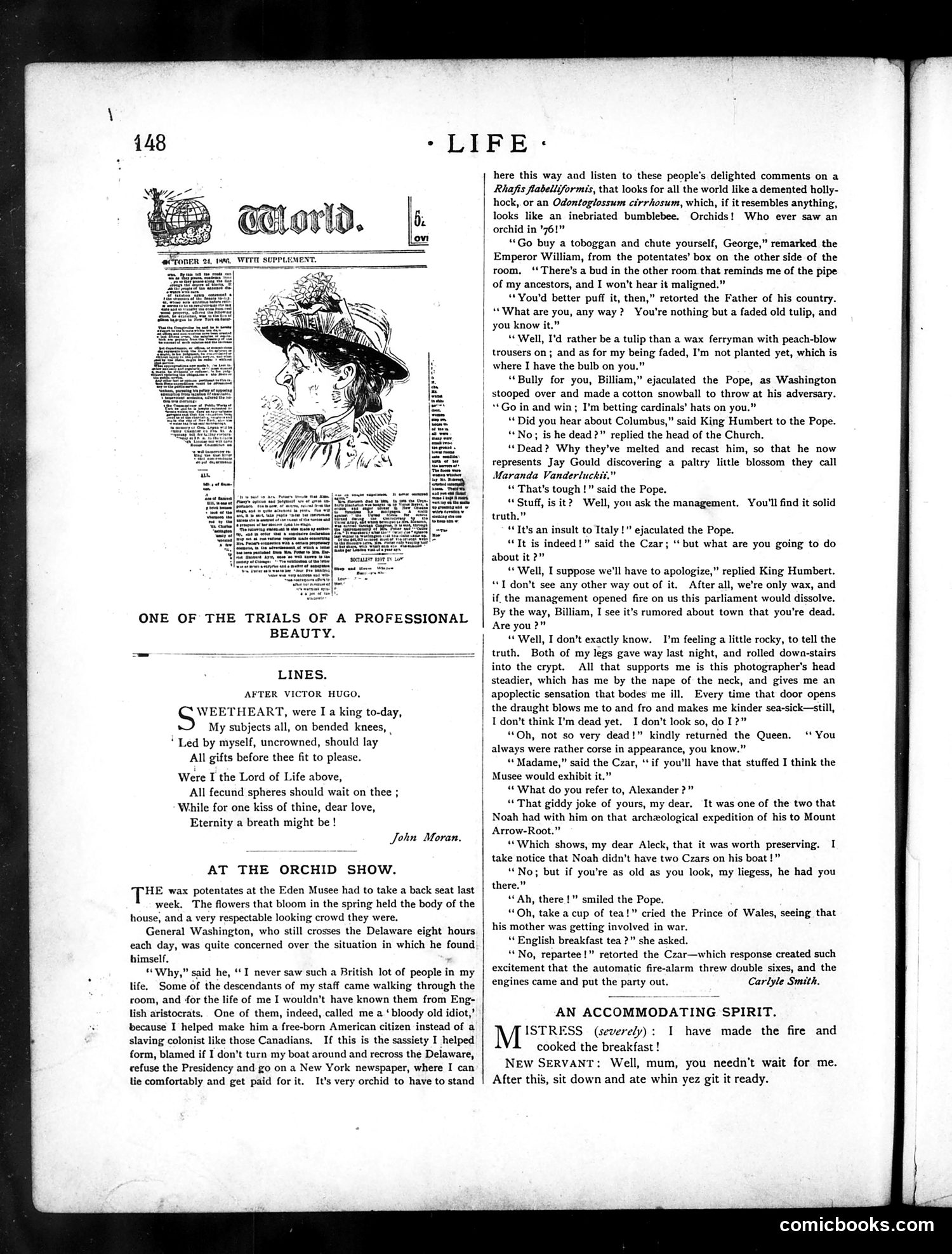
The main cartoon, "One of the Trials of a Professional Beauty," depicts a fashionably dressed woman whose elaborate hat dominates the composition. The accompanying text suggests this satirizes the absurdities of high society beauty standards and women's fashion, particularly the impractical oversized hats fashionable in the early 20th century. The page includes several literary pieces and anecdotes mocking various subjects: a poem "At the Orchid Show" about British aristocrats visiting America; dialogue poking fun at the Pope and historical figures like Columbus and Jay Gould; and exchanges ridiculing Queen Victoria and the Czar. The satire targets both aristocratic pretension and social hierarchy, using wit to critique class distinctions and fashionable excess. The specific historical figures referenced suggest this is from the early 1900s.
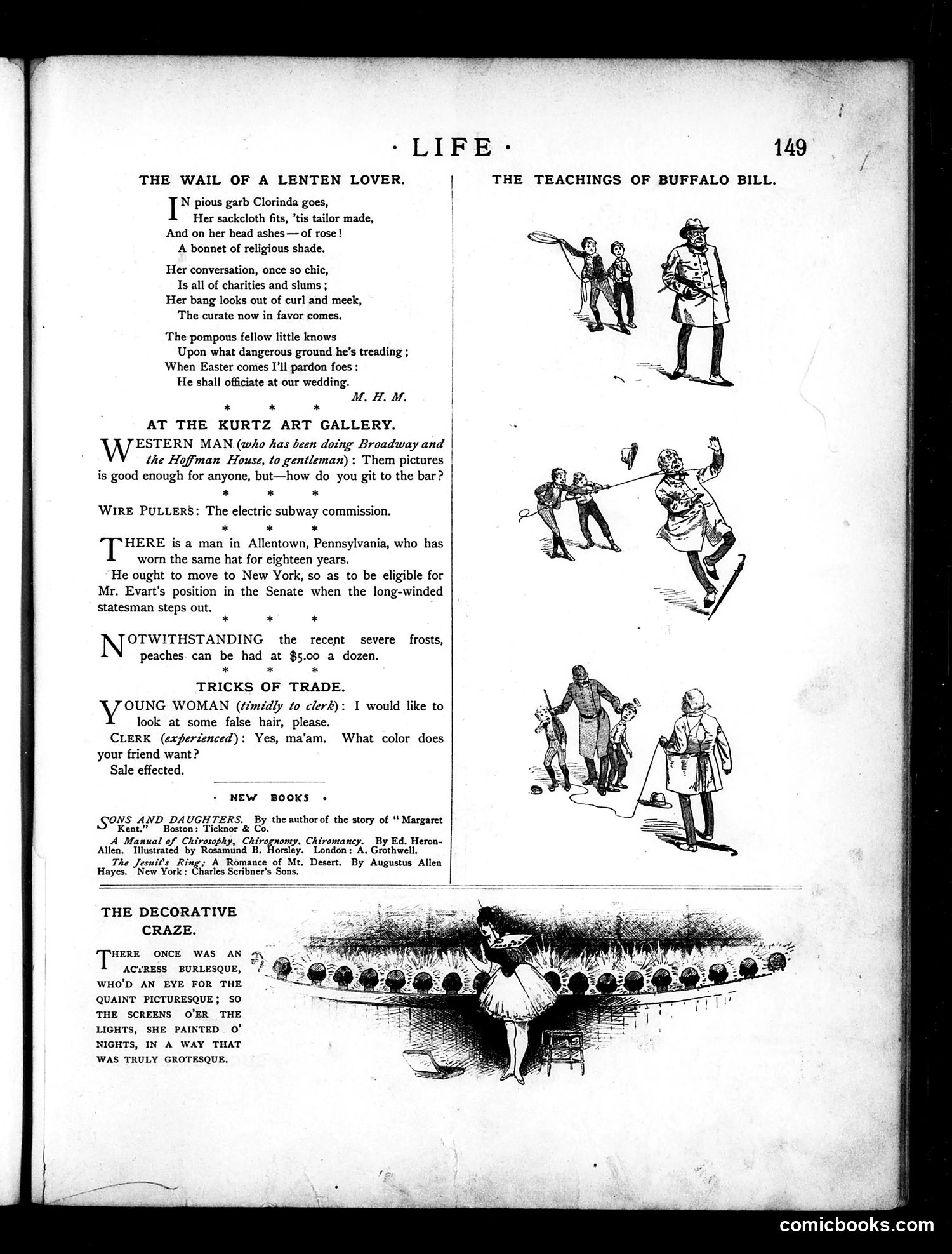
This page contains several satirical sections typical of Life's format: **"The Wail of a Lenten Lover"** mocks a man's complaint about his girlfriend's religious observance during Lent, suggesting she's become pious and less available. **"The Teachings of Buffalo Bill"** presents illustrations of what appears to be Wild West-style lessons or demonstrations, likely satirizing Buffalo Bill's Wild West show and frontier mythology popular at the time. **"Tricks of Trade"** depicts a humorous exchange between a young woman seeking false hair and an experienced clerk, satirizing both consumer vanity and sales techniques. **"The Decorative Craze"** criticizes excessive theatrical ornamentation, showing an actress painting decorative elements so elaborately that it becomes grotesque—mocking the era's trend toward overwrought stage design. The humor relies on social observation rather than specific political figures.
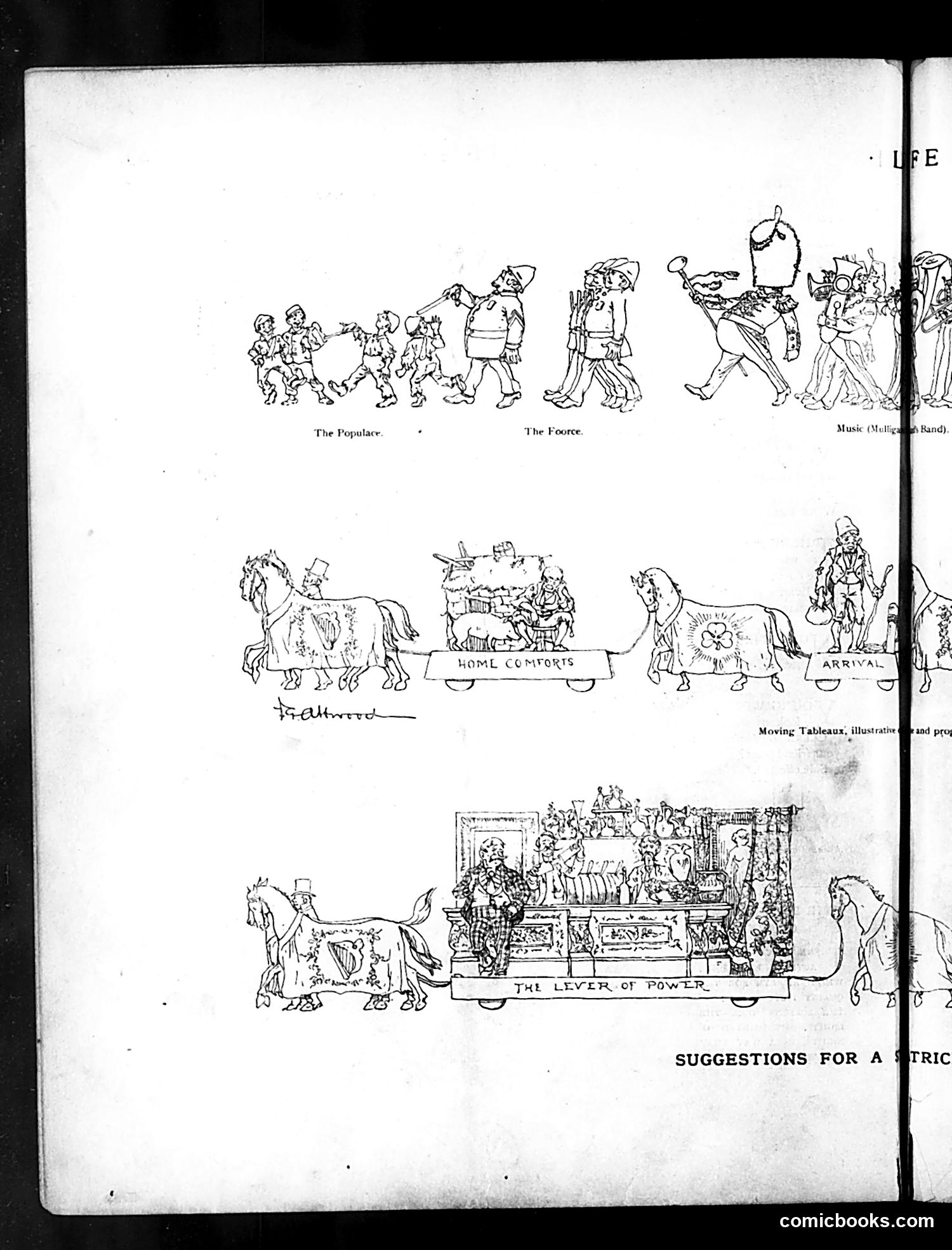
This page shows "Suggestions for a Stric[t]" (incomplete title) depicting a historical parade or procession with moving tableaux. The illustrations progress from left to right, showing: 1. **The Populace** — common people walking 2. **The Force** — what appears to be police or military personnel 3. **Music (Municipal Band)** — uniformed musicians 4. **Moving Tableaux** — elaborate horse-drawn floats depicting different scenes, including "Home Comforts" and "The Lever of Power" The final tableau shows "The Lever of Power" as an ornate, heavily populated float, likely satirizing political control or governance. The sketch suggests these were design proposals for a civic pageant, parade, or celebration. The satire appears to mock how power is theatrically displayed and controlled in public demonstrations, with the increasingly elaborate final float emphasizing how authority is concentrated and showcased.
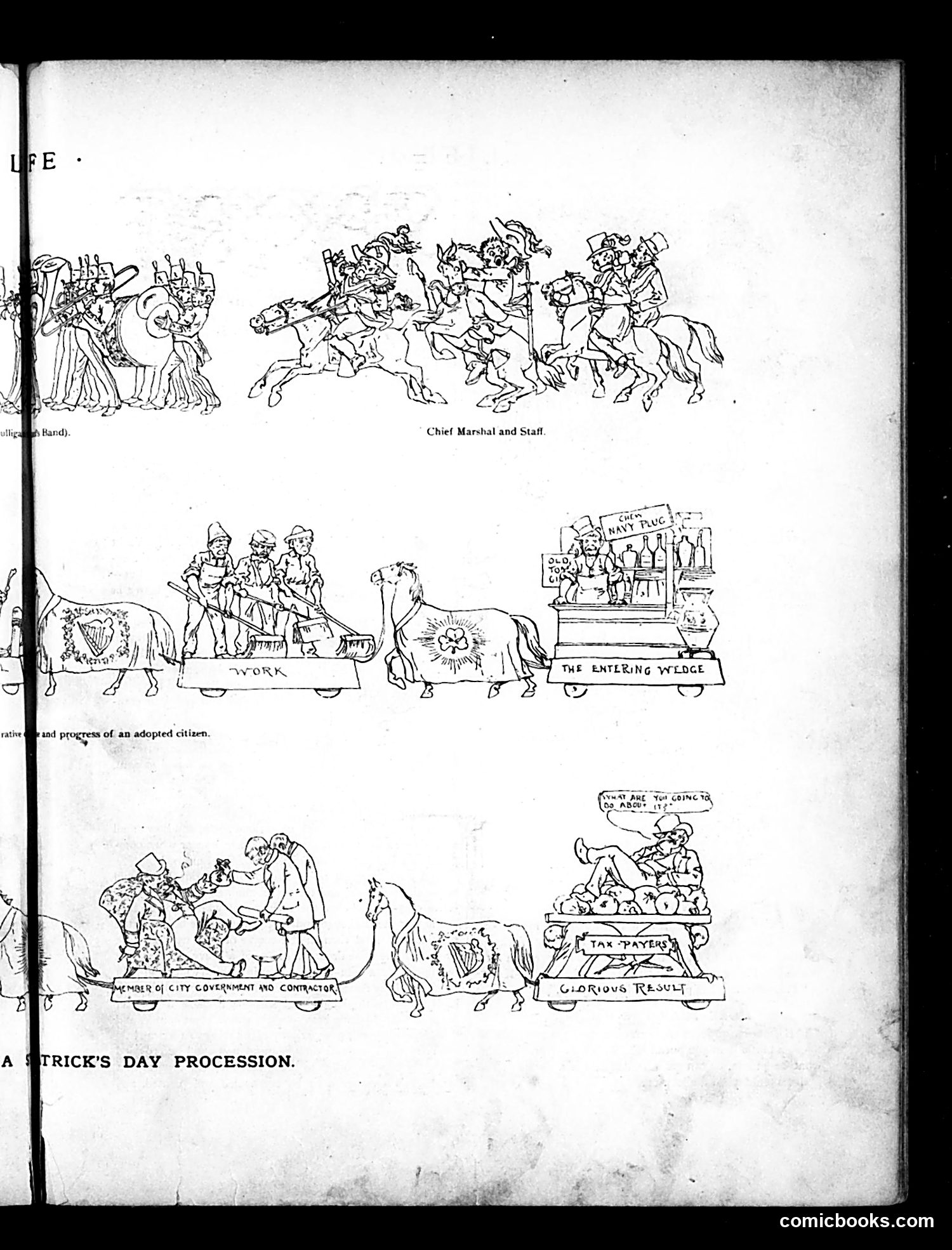
This satirical cartoon depicts a St. Patrick's Day parade as a series of wagons drawn by oxen, each representing different aspects of city governance and public life. The procession includes: - **Chief Marshal and Staff** (top) - the parade leadership on horseback - **"Work"** - laborers and construction - **"The Entering Wedge"** - what appears to be a saloon or tavern - **"Members of City Government and Contractor"** - officials and business interests - **"Glorious Result"** - tax payers depicted as burdened The satire suggests that St. Patrick's Day celebrations mask corruption and mismanagement, with city officials and contractors enriching themselves while ordinary taxpayers bear the costs. It's a critique of urban political corruption and cronyism embedded within ethnic community celebration.
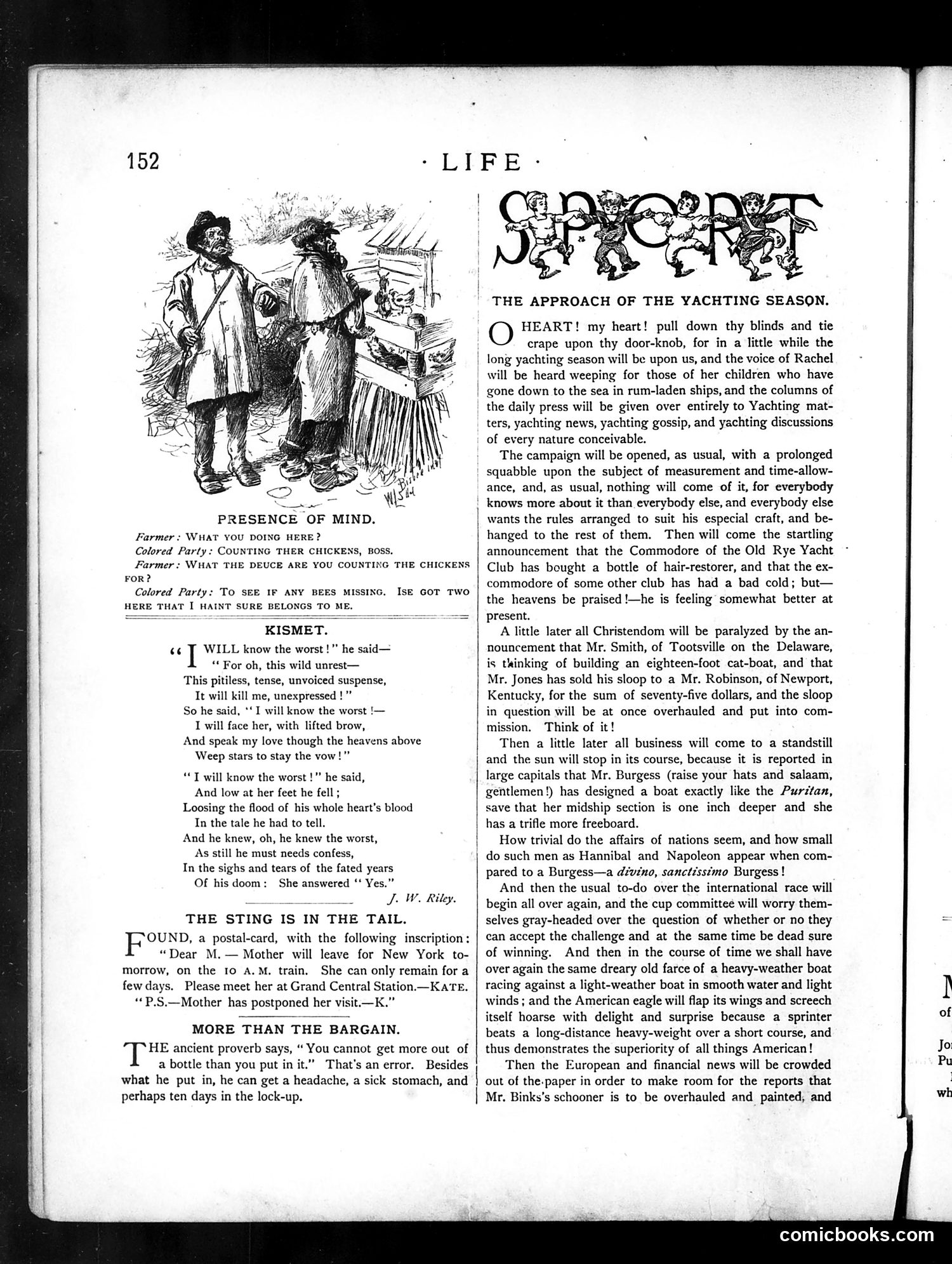
**The Cartoon:** The illustration titled "Presence of Mind" depicts a farmer confronting a colored party (a guest) caught examining his chickens. The farmer demands explanation; the guest claims to be checking for missing bees. This is absurdist humor—the excuse makes no logical sense, creating the joke's comedy through the guest's attempted deception. **The Articles:** "Support" discusses the approaching yachting season with satirical commentary on wealthy society's obsession with yacht racing, boat measurements, and maritime gossip. References to specific gentlemen like Mr. Smith, Mr. Jones, and "Burgess" suggest these were recognizable wealthy figures to contemporary readers. The other pieces ("Kismet," "The Sting in the Tail," "More Than the Bargain") appear to be brief humorous anecdotes typical of Life's satirical format.
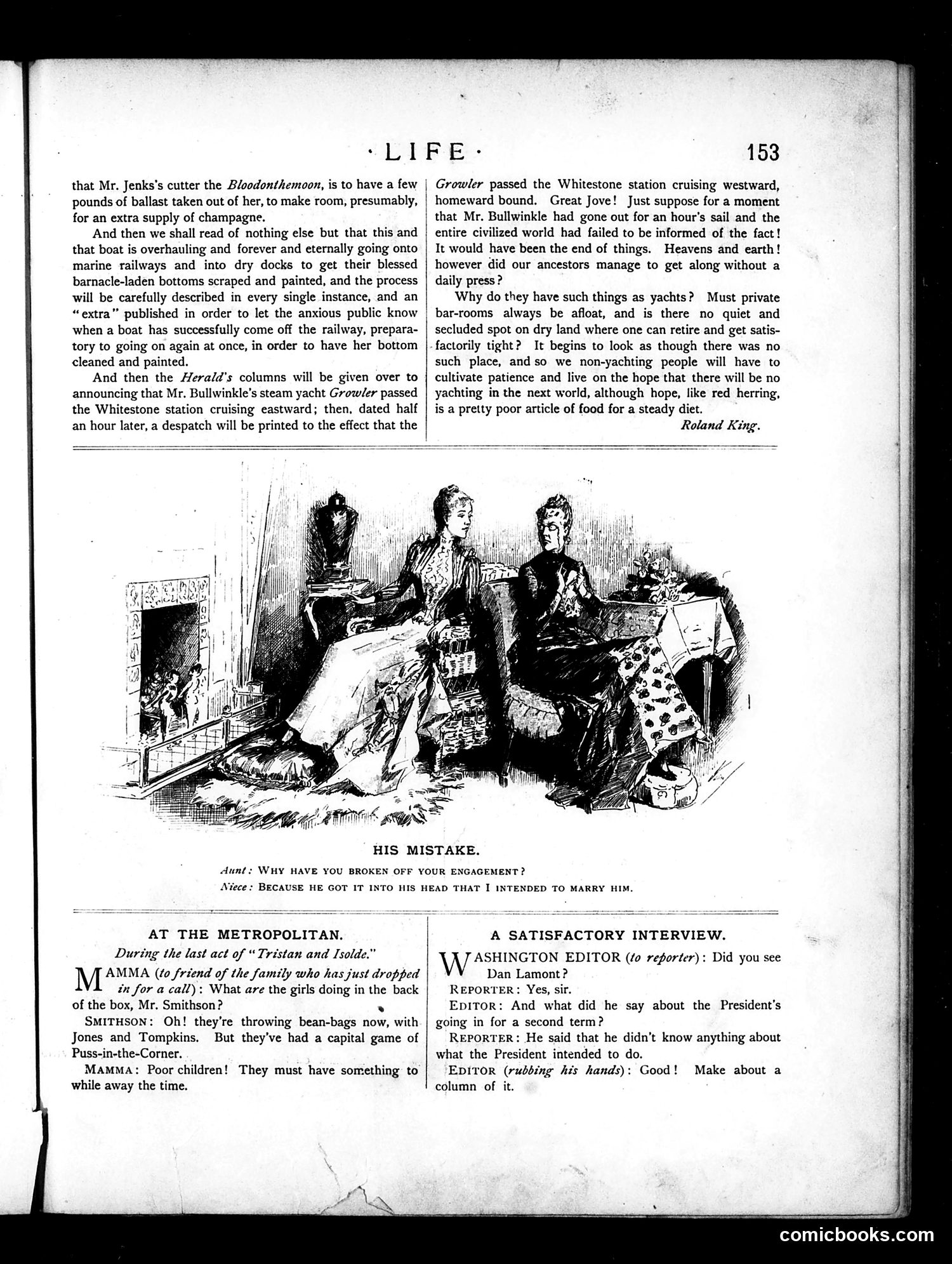
This page contains three separate satirical pieces mocking American society circa the 1890s: **Top section** ("His Mistake"): A cartoon about wealthy yachtsmen like Bullwinkle and Jenks, satirizing the obsessive newspaper coverage of their leisure activities—boats passing stations, being repainted, docked. The satire criticizes both the frivolous wealthy (who use yachts as floating bars) and sensationalist press that treats trivial yacht movements as major news. **"At the Metropolitan"**: Mocks upper-class parents' indifference to culture. Children attending Wagner's *Tristan and Isolde*—high art—instead listen, playing bean-bag games in theater boxes. The humor lies in the children's boredom and parents' obliviousness to this disrespect. **"A Satisfactory Interview"**: Political satire on journalism and government evasion. A Washington editor instructs his reporter to write a full column based on Dan Lamont's non-answer about the President's second term. It mocks how newspapers fabricate substance from official non-statements—creating "news" from nothing.
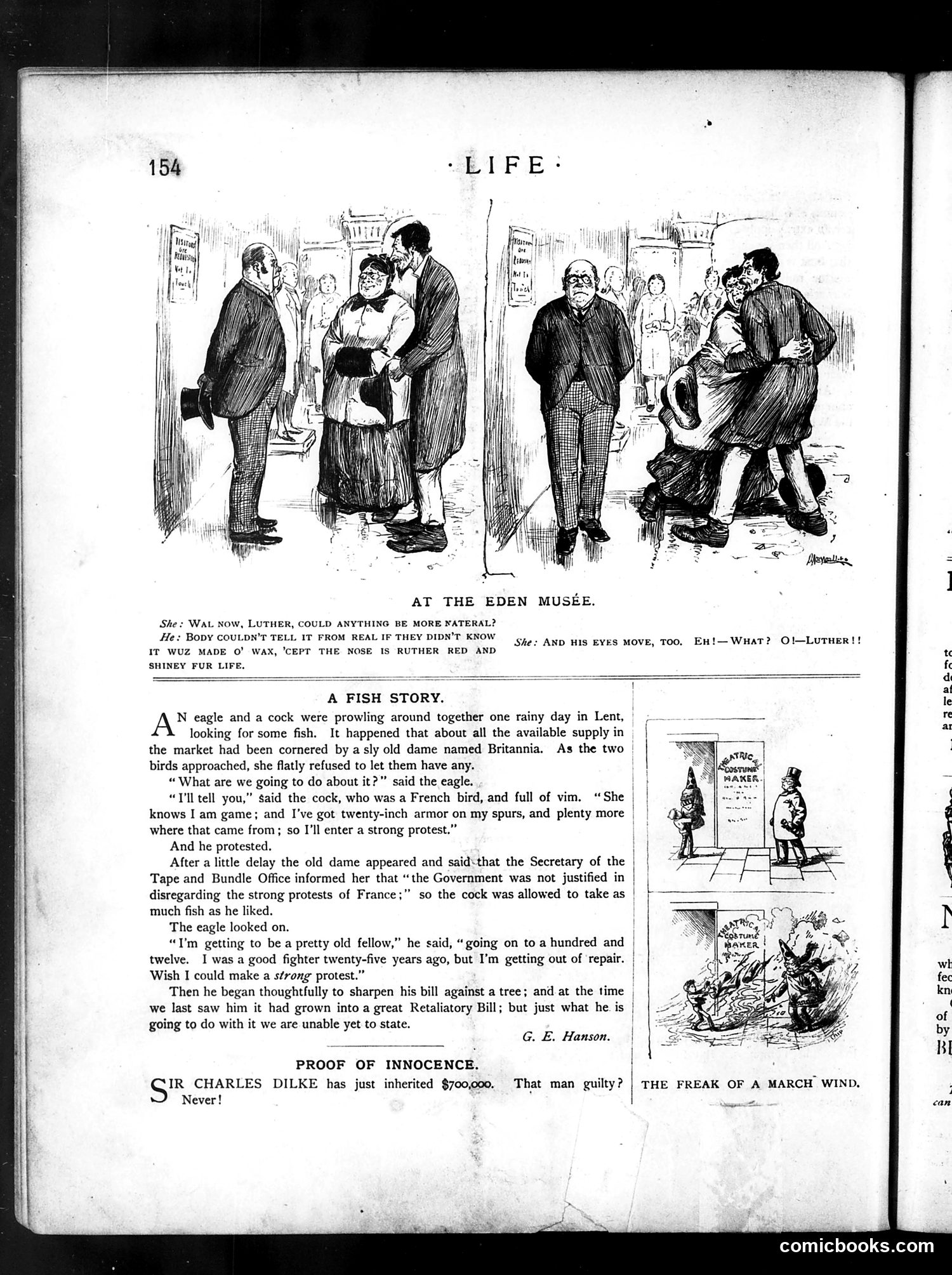
**Top Cartoon:** A couple visits a wax museum (Eden Musée was a real NYC attraction). The joke turns on the husband's crude observation that a wax figure is indistinguishable from a real person—except its nose is unnaturally red and shiny. The wife's shocked reaction ("O!—LUTHER!!") suggests he's made an embarrassing or inappropriate comment, likely comparing the figure to a real woman they know. **"A Fish Story":** Political allegory about trade disputes. "Britannia" (Britain) monopolizes fish supplies. A French "cock" protests loudly and wins concessions from the government's bureaucratic "Tape and Bundle Office," while an American "eagle" watches helplessly. The eagle, old and tired, contemplates building a "Retaliatory Bill" but remains uncertain—satirizing American reluctance to challenge British economic dominance through protective tariffs.
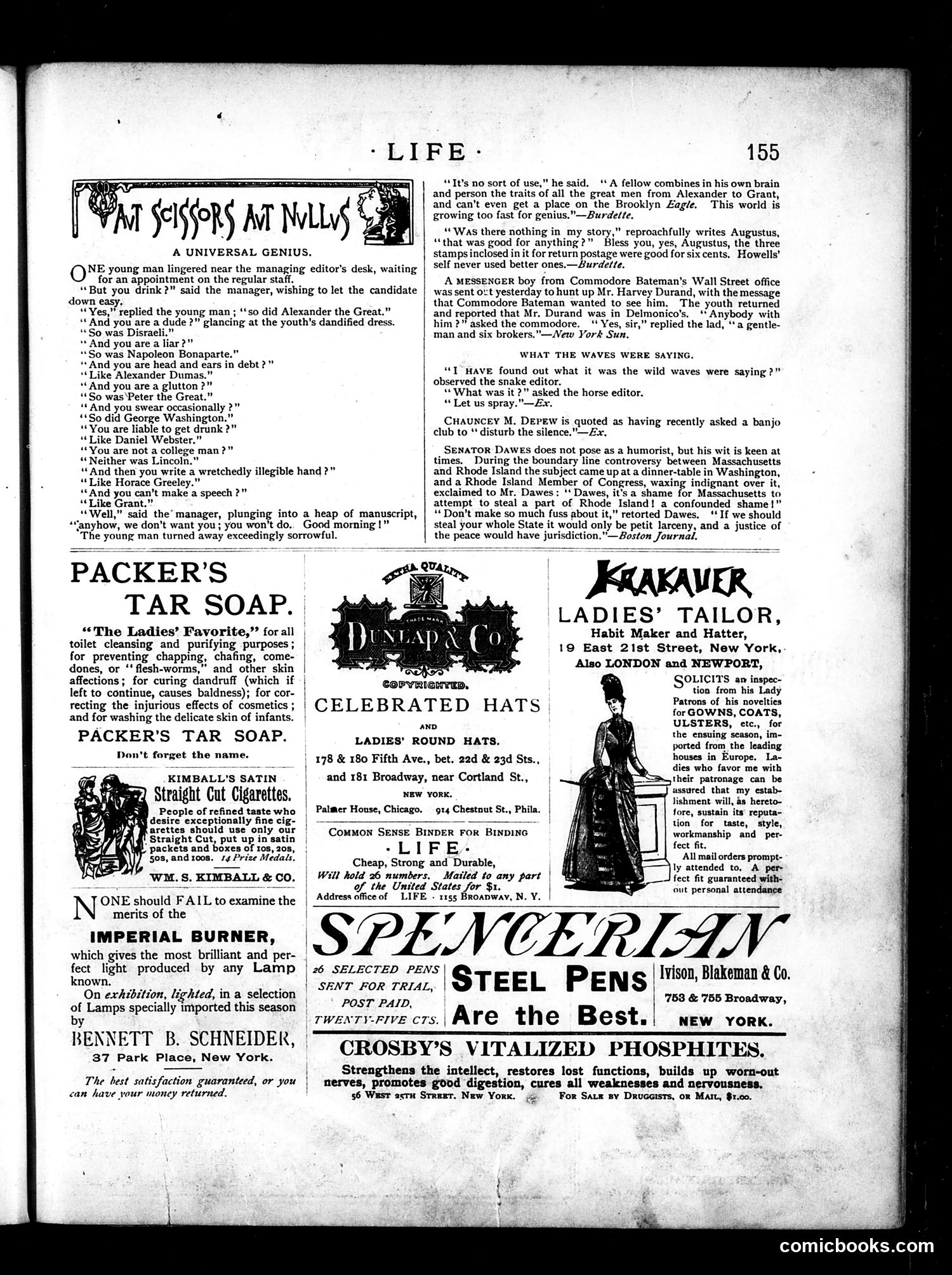
This cartoon satirizes the tension between a job applicant's self-importance and his actual employability. A young man seeking a newspaper position responds to each of the editor's criticisms (drinking, lying, being in debt, poor handwriting) by comparing himself to famous historical figures—Alexander the Great, Disraeli, Napoleon, etc. The joke is that possessing the character flaws of genius doesn't make one a genius; it just makes one unemployable. The editor, unmoved by these comparisons, ultimately rejects him anyway, concluding "we don't want you; you won't do." The satire mocks both the applicant's delusional self-assessment and the broader conceit that mediocre people can excuse their failures by invoking great men's similar vices. The final line—"This world is growing too fast for genius"—is ironic commentary on the young man's inflated self-regard.
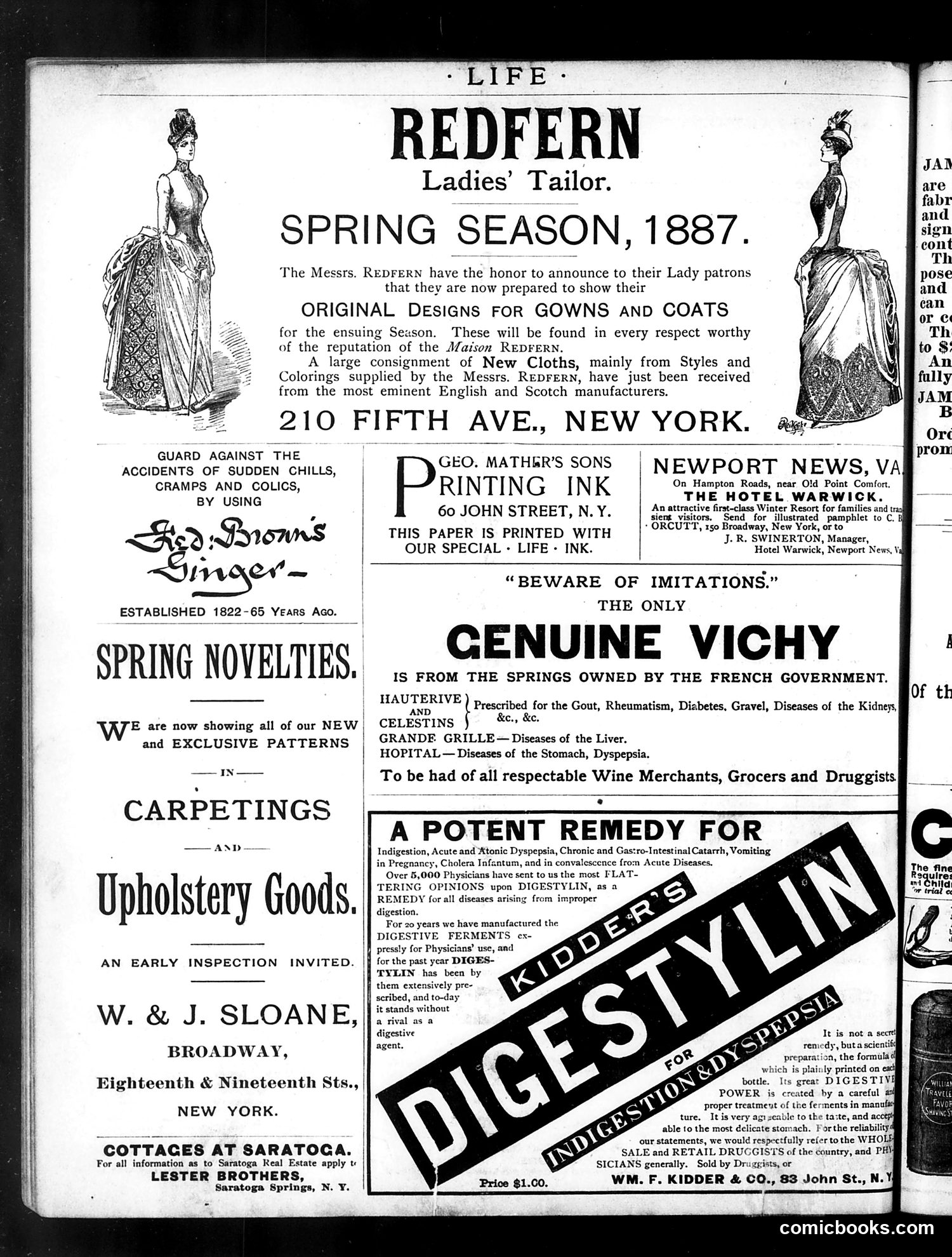
This is not a satirical cartoon page but rather a advertisements section from *Life* magazine's Spring 1887 issue. The page contains no political satire or comics—instead, it features period advertisements for: - **Redfern Ladies' Tailor** (high-end fashion) - **W. & J. Sloane** (carpets and upholstery) - **Printing ink and paper suppliers** - **Patent medicines**: Vichy water (a French mineral spring product marketed for gout, rheumatism, and kidney disease) and "Digestylin" (a digestive enzyme remedy endorsed by over 5,000 physicians) - **Hotels and real estate** in Newport News and Saratoga Springs The ads reflect late-19th-century consumer culture: luxury goods, "scientific" remedies with exaggerated health claims, and resort destinations. The page documents what contemporary readers considered newsworthy advertising rather than satirical content.
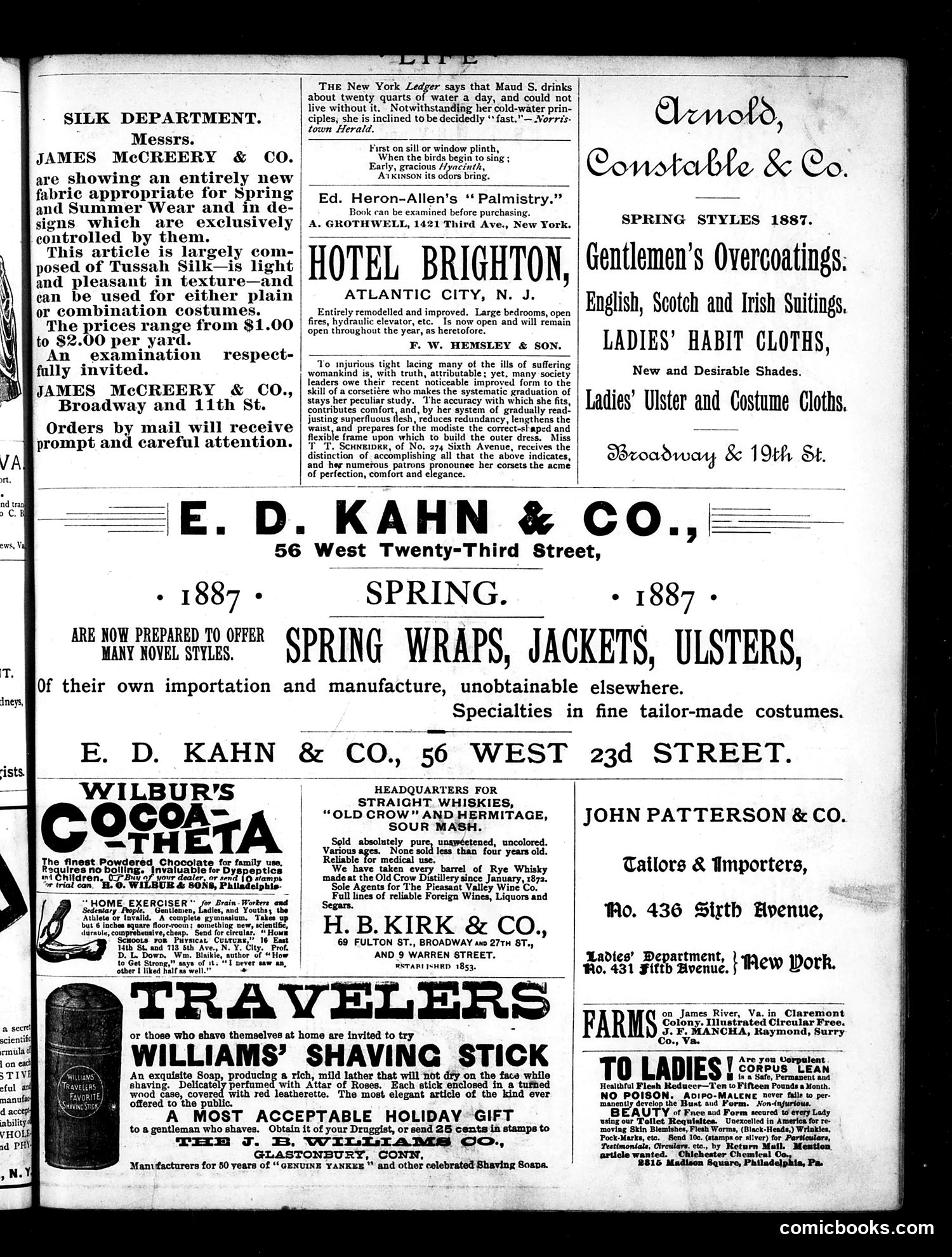
This page is primarily **advertising**, not satire or political commentary. It features commercial notices for spring 1887 fashions and luxury goods targeted at wealthy New York consumers. The one brief **satirical note** appears in the upper left: a jab at Maud S. (likely the famous racehorse Maud S.), claiming she drinks 20 quarts of water daily yet is "decidedly 'fast'"—a play on words contrasting her supposedly pure water-drinking habits with morally questionable behavior. The rest comprises upscale department store ads (James McCreery & Co., Arnold Constable & Co.), clothing merchants (E.D. Kahn & Co.), whiskey dealers, corset makers, and beauty products. These ads reflect Gilded Age consumer culture and contemporary women's fashion concerns: tight lacing, tailored costumes, and specialized garments like "habit cloths" (riding wear). No major political figures or events are referenced.
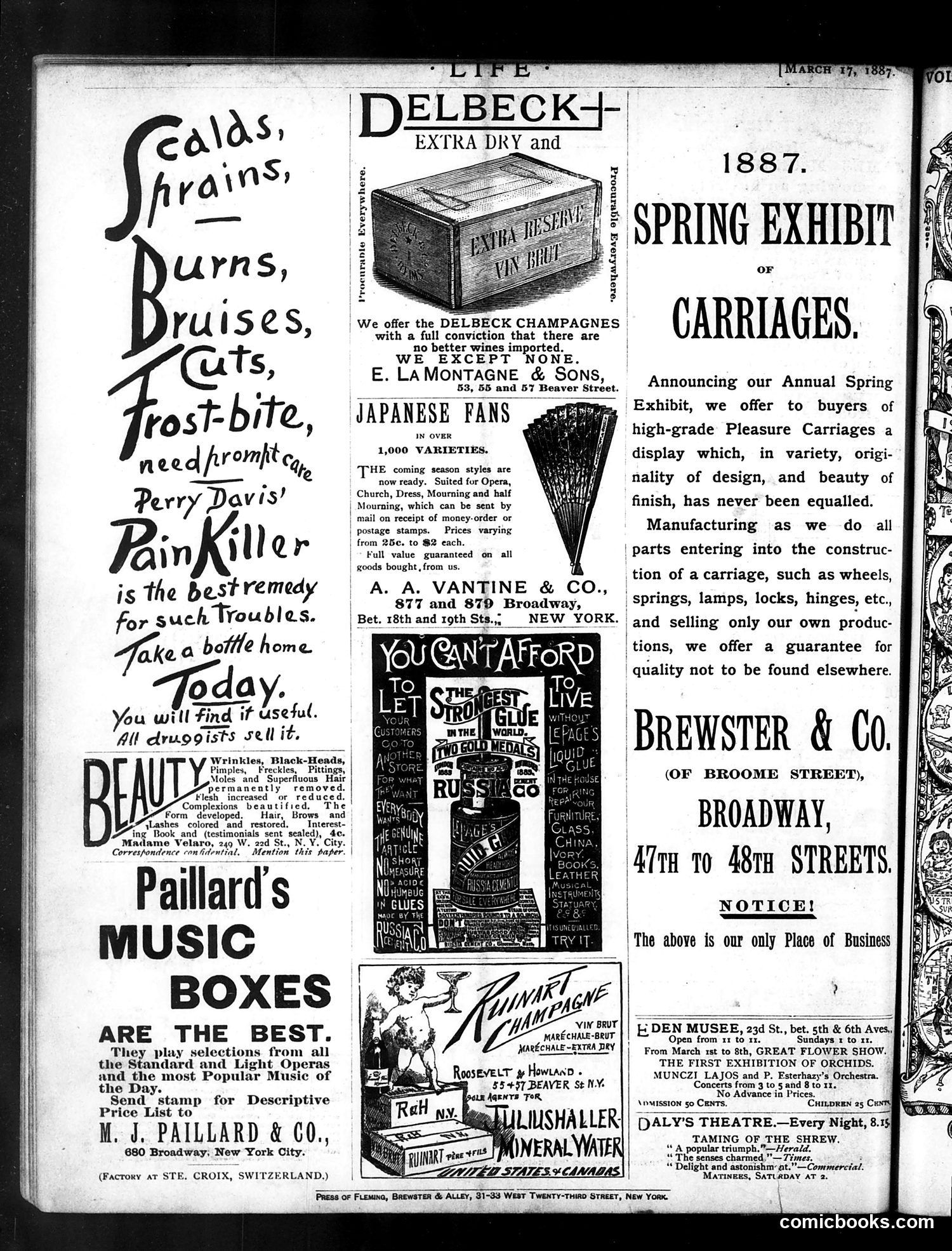
This is primarily an **advertising page** rather than a satirical cartoon page. The content consists of commercial advertisements typical of 1880s periodicals: **Notable ads include:** - Perry Davis' Pain Killer (a patent medicine for various ailments) - Madame Velaro's beauty treatments (wrinkle removal, skin care) - Paillard's music boxes - Delbeck champagne - Japanese fans - Brewster & Co. carriages (spring exhibit announcement) - Eden Musee (wax museum with flower show) - Daly's Theatre production of "Taming of the Shrew" **The one notable graphic element** is a small illustration for "Russian Glue" by Russin & Co., advertising it as "the best strong glue" for various materials—a straightforward product advertisement. The page reflects **late 19th-century consumer culture**: patent medicines, luxury goods, entertainment venues, and cosmetic services targeting middle and upper-class readers. There is no discernible political satire or commentary on this particular page.