
Life, 1887-03-17 · page 2 of 16
Life — March 17, 1887 — page 2: what you’re looking at
What you’re looking at
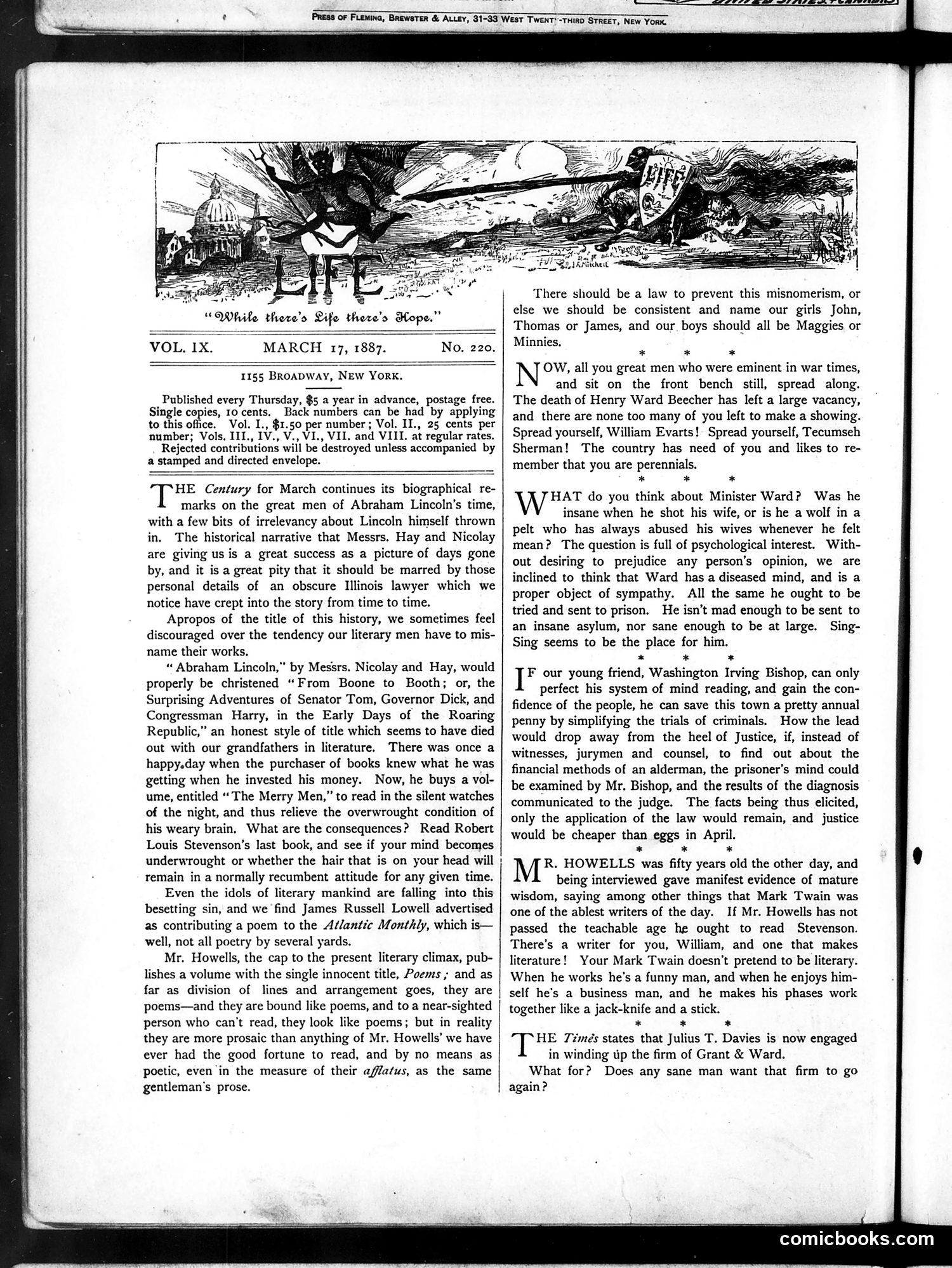
The masthead illustration depicts **"Life"** with the motto **"While there's Life there's Hope."** The allegorical figure appears to be a classical personification of Life itself. The page consists primarily of **editorial commentary and book reviews** rather than political cartoons. The text discusses: - A complaint about authors misusing the word "life" in book titles - Commentary on **Henry Ward Beecher's death** and calls for prominent men to step forward - Criticism of **Minister Ward** (likely the same Beecher) regarding his treatment of his wives - A favorable review of **Mark Twain's** literary abilities - A note about **Julius T. Davies** and the firm **Grant & Ward** This appears to be satirical social commentary rather than visual political cartooning.
📄 Transcribed text from this page (OCR, searchable)
Machine-transcribed from the original scan — historical spelling and the odd misread are preserved.
STS RR Oe ee EE ee Press oF Fiewina, Brewster & ALiey, 31-33 West TwENT’-THinD STREET, New YOR ES “While there's Life there’s Hope.” VOL. 1X. No. 220. MARCH 17, 1887. 1155 BROADWAY, NEw YorRK. Published every Thursday, $5 a year in advance, postage free. Single copies, 10 cents. Back numbers can be had by applying to this office. Vol. I., $1.50 per number ; Vol. II., 25 cents per number; Vols, III., IV., V., VI., VII. and VIII. at regular rates, Rejected contributions will be destroyed unless accompanied by a stamped and directed envelope. HE Century for March continues its biographical re- marks on the great men of Abraham Lincoln’s time, with a few bits of irrelevancy about Lincoln himself thrown in. The historical narrative that Messrs. Hay and Nicolay are giving us is a great success as a picture of days gone by, and it is a great pity that it should be marred by those personal details of an obscure Illinois lawyer which we notice have crept into the story from time to time. Apropos of the title of this history, we sometimes feel discouraged over the tendency our literary men have to mis- name their works. “ Abraham Lincoln,” by Messrs. Nicolay and Hay, would properly be christened “From Boone to Booth; or, the Surprising Adventures of Senator Tom, Governor Dick, and Congressman Harry, in the Early Days of the Roaring Republic,” an honest style of title which seems to have died out with our grandfathers in literature. There was once a happy.day when the purchaser of books knew what he was getting when he invested his money. Now, he buys a vol- ume, entitled “The Merry Men,” to read in the silent watches of the night, and thus relieve the overwrought condition of his weary brain, What are the consequences? Read Robert Louis Stevenson’s last book, and see if your mind becomes underwrought or whether the hair that is on your head will remain in a normally recumbent attitude for any given time. Even the idols of literary mankind are falling into this besetting sin, and we find James Russell Lowell advertised as contributing a poem to the Aé/antic Monthly, which is— well, not all poetry by several yards. Mr. Howells, the cap to the present literary climax, pub- lishes a volume with the single innocent title, Poems ; and as far as division of lines and arrangement goes, they are poems—and they are bound like poems, and to a near-sighted person who can't read, they look like poems; but in reality they are more prosaic than anything of Mr. Howells’ we have ever had the good fortune to read, and by no means as poetic, even in the measure of their affatus, as the same gentleman's prose. There should be a law to prevent this misnomerism, or else we should be consistent and name our girls John, Thomas or James, and our boys should all be Maggies or Minnies. * * * OW, all you great men who were eminent in war times, and sit on the front bench still, spread along. The death of Henry Ward Beecher has left a large vacancy, and there are none too many of you left to make a showing. Spread yourself, William Evarts! Spread yourself, Tecumseh Sherman! The country has need of you and likes to re- member that you are perennials, * * * HAT do you think about Minister Ward? Was he insane when he shot his wife, or is he a wolf in a pelt who has always abused his wives whenever he felt mean? The question is full of psychological interest. With- out desiring to prejudice any person’s opinion, we are inclined to think that Ward has a diseased mind, and is a proper object of sympathy. All the same he ought to be tried and sent to prison. He isn’t mad enough to be sent to an insane asylum, nor sane enough to be at large. Sing- Sing seems to be the place for him. * * * F our young friend, Washington Irving Bishop, can only perfect his system of mind reading, and gain the con- fidence of the people, he can save this town a pretty annual penny by simplifying the trials of criminals. How the lead would drop away from the heel of Justice, if, instead of witnesses, jurymen and counsel, to find out about the financial methods of an alderman, the prisoner's mind could be examined by Mr. Bishop, and the results of the diagnosis communicated to the judge. The facts being thus elicited, only the application of the law would remain, and justice would be cheaper than eggs in April. * * * R. HOWELLS was fifty years old the other day, and being interviewed gave manifest evidence of mature wisdom, saying among other things that Mark Twain was one of the ablest writers of the day. If Mr. Howells has not passed the teachable age he ought to read Stevenson. There’s a writer for you, William, and one that makes literature! Your Mark Twain doesn’t pretend to be literary. When he works he’s a funny man, and when he enjoys him- self he’s a business man, and he makes his phases work together like a jack-knife and a stick. * * * HE 77meés states that Julius T. Davies is now engaged in winding up the firm of Grant & Ward. What for? Does any sane man want that firm to go again? comicbooks.com