
A complete issue · 16 pages · 1886
Life — November 11, 1886
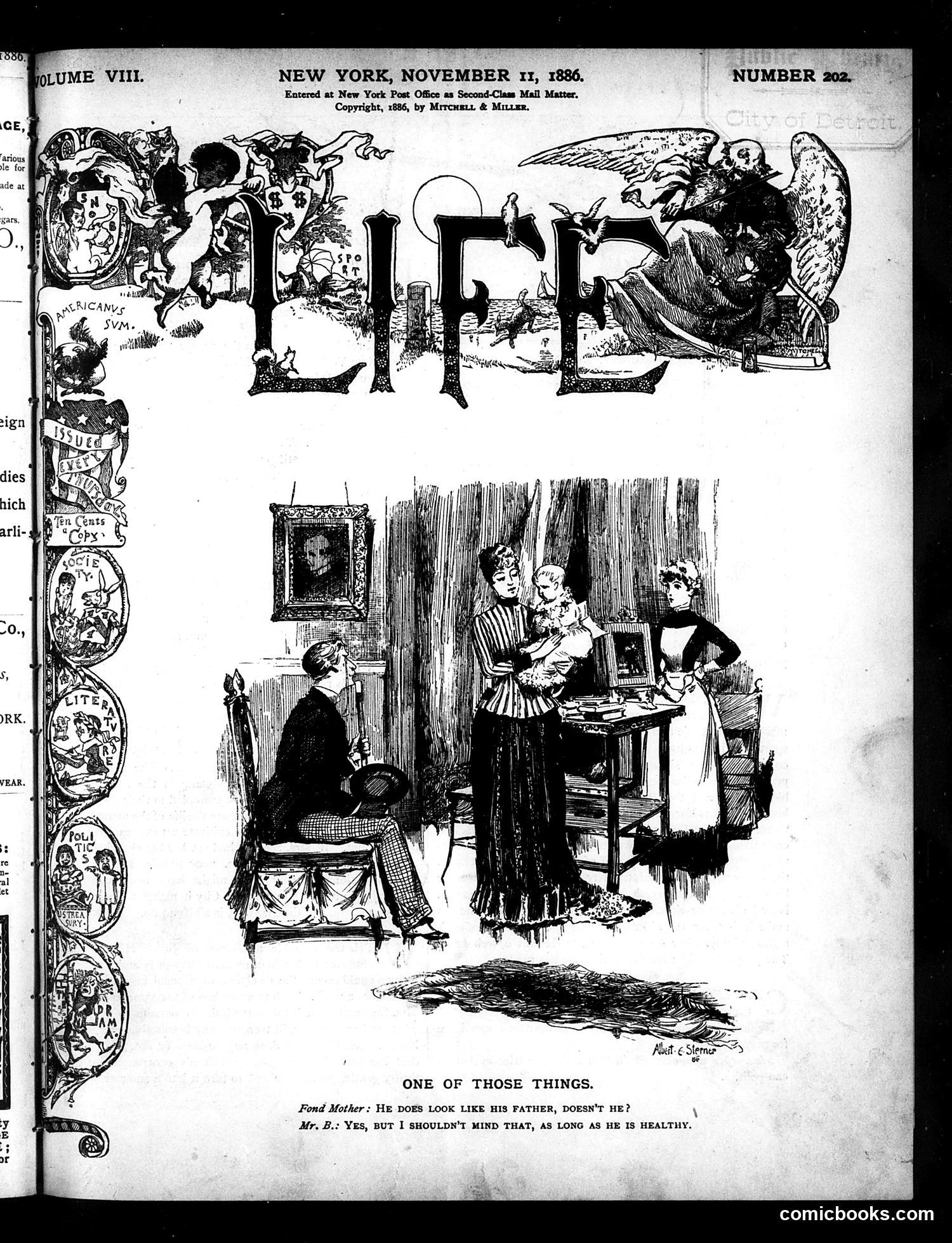
**The Main Cartoon: "One of Those Things"** The illustration depicts a domestic scene where a Fond Mother remarks that a child "does look like his father," and Mr. B. responds reassuringly that he "shouldn't mind that, as long as he is healthy." The joke plays on Victorian-era anxieties about paternity and legitimacy. The mother's concern that the child resembles the father is presented as trivial compared to health—suggesting either marital infidelity or uncertainty about parentage was a relatable social anxiety of the period. The satire mocks the priorities of bourgeois society, where appearance and legitimacy worried people more than actual welfare. The ornate decorative border and elaborate "LIFE" masthead are typical of this era's satirical publication design.
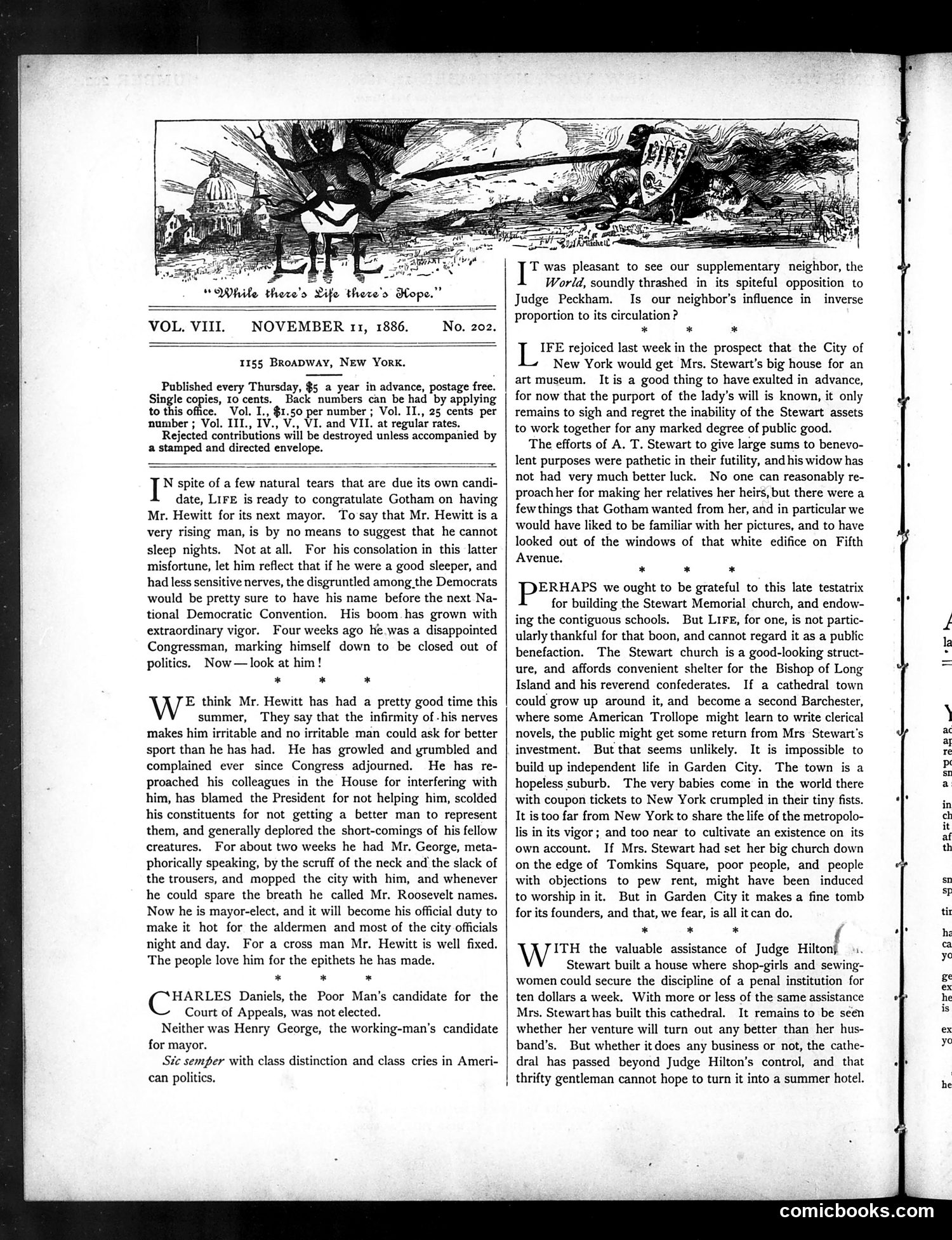
The masthead cartoon depicts "Life" as a figure wielding a scythe labeled "Life," attacking what appears to be a skeletal or death-like figure, illustrating the magazine's satirical mission to critique folly and expose hypocrisy. The text discusses New York politics, particularly Mayor Hewitt's administration. The articles criticize Democratic infighting and class-based politics. One section mocks Charles Daniels (Poor Man's candidate for Court of Appeals) and Henry George (workingman's mayoral candidate), suggesting satirical skepticism toward populist political movements that invoked class division. The overall tone suggests *Life* positioned itself as an independent voice critiquing both establishment politicians and populist demagogues exploiting class resentment for political gain.
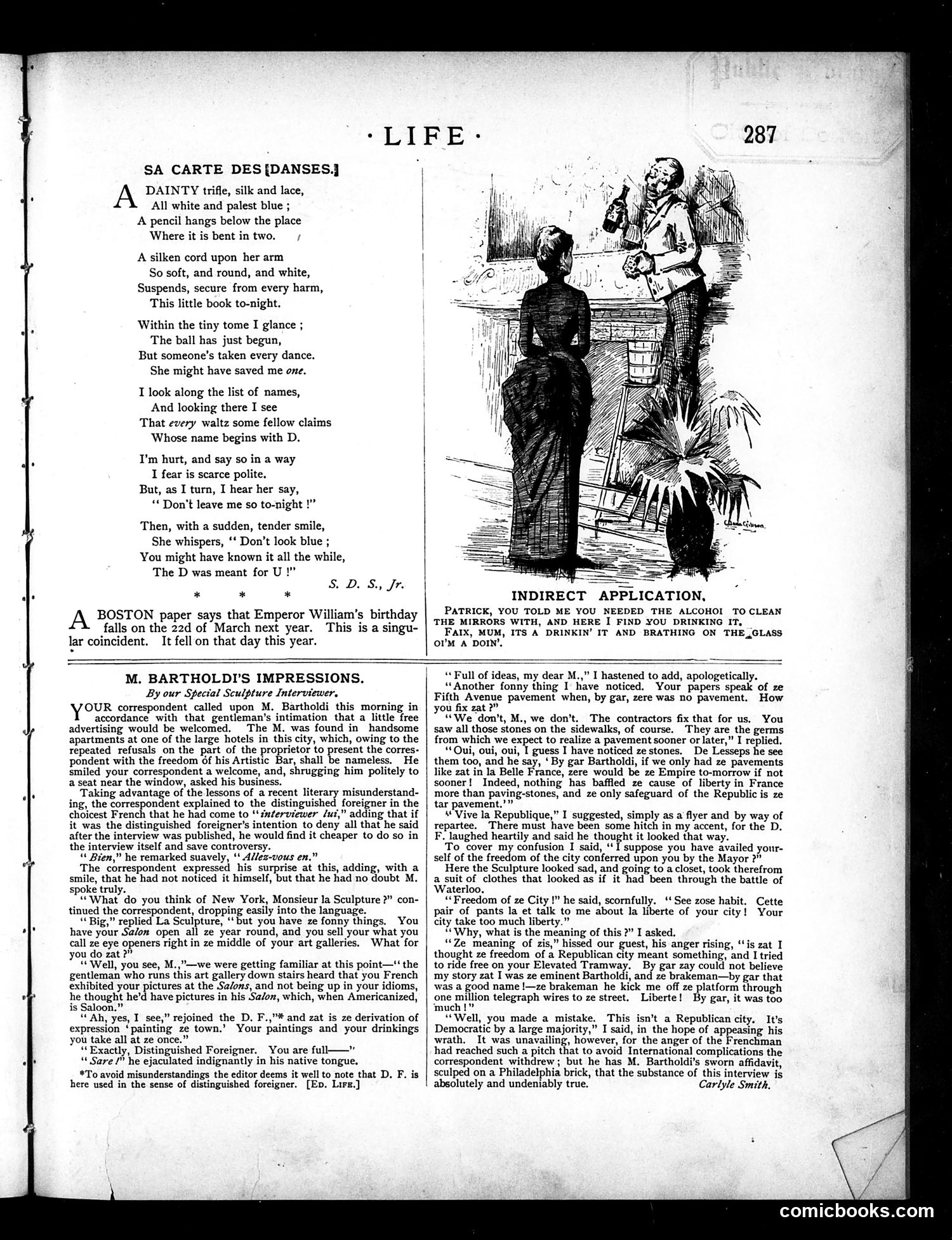
The main illustration titled "Indirect Application" depicts a woman confronting a man about drinking alcohol, referencing Prohibition-era politics. The accompanying text discusses M. Bartholdi's impressions, featuring a satirical interview about French artistic and political concepts. The central satire mocks American attempts to understand French Republican ideals and aesthetics. The correspondent questions French notions of "freedom," "civilization," and "sculpture," exposing confusion between genuine political liberty and superficial cultural pretension. The humor targets both American ignorance of French philosophy and French condescension toward American interpretation of European ideas. The Prohibition cartoon satirizes the enforcement challenges of alcohol bans—specifically how indirect methods (here, drinking from glass) circumvent direct prohibitions, mocking the impracticality of the law.
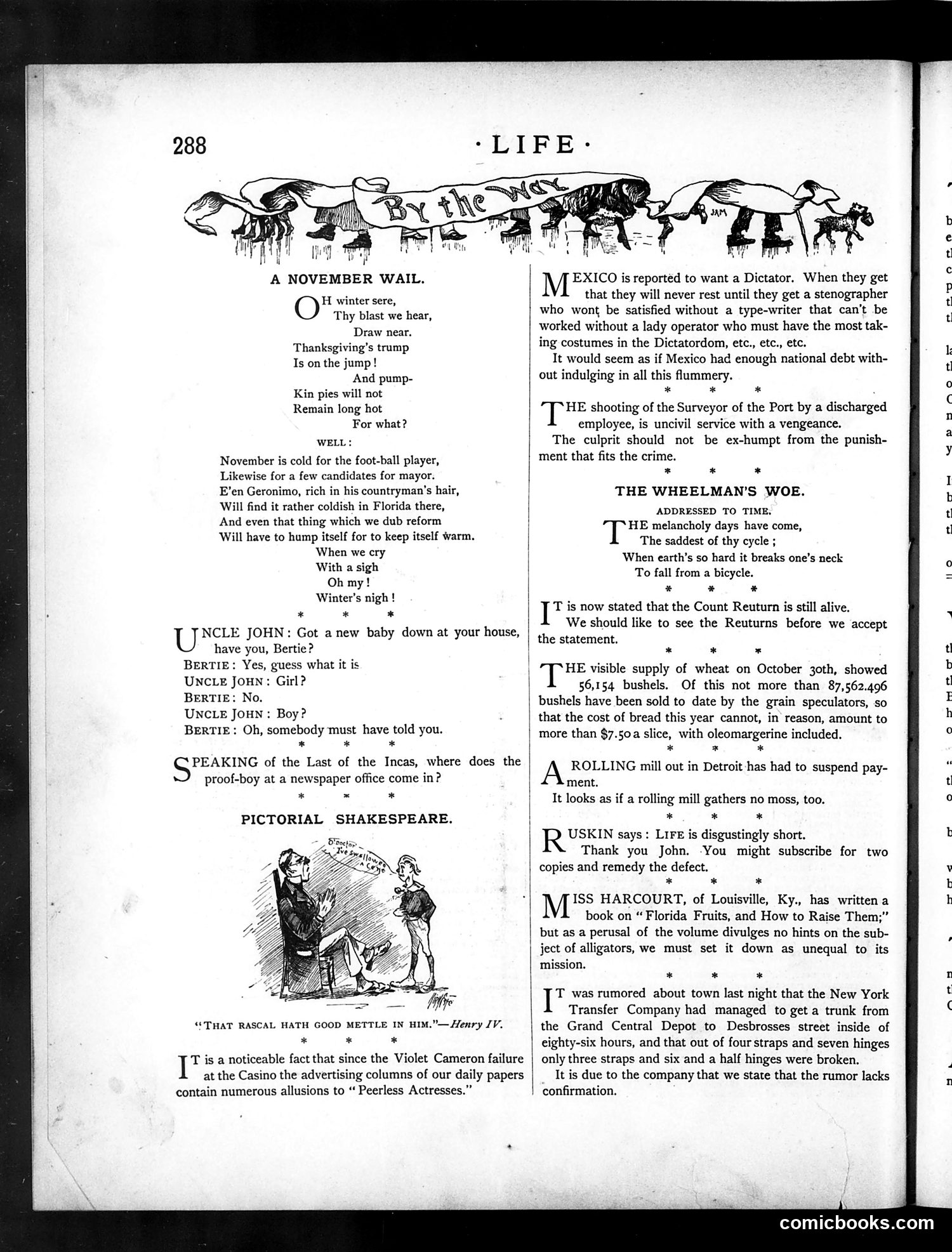
The page contains several short satirical pieces rather than a single political cartoon. **"A November Wail"** is a poem mocking political candidates and seasonal cold. **"Pictorial Shakespeare"** features a small sketch illustrating Henry IV's line "That rascal hath good mettle in him," showing what appears to be a confrontation between two figures, though their specific identities aren't clear from the image alone. The remaining content consists of brief humorous observations on contemporary topics: Mexico's political instability and bureaucratic incompetence, a Port Surveyor shooting incident, bicycle safety, wheat supply prices, a Detroit rolling mill closure, and a New York Transfer Company trunk-moving mishap. This appears to be a typical Life magazine miscellany page—brief satirical commentary on current events rather than sustained political cartooning.
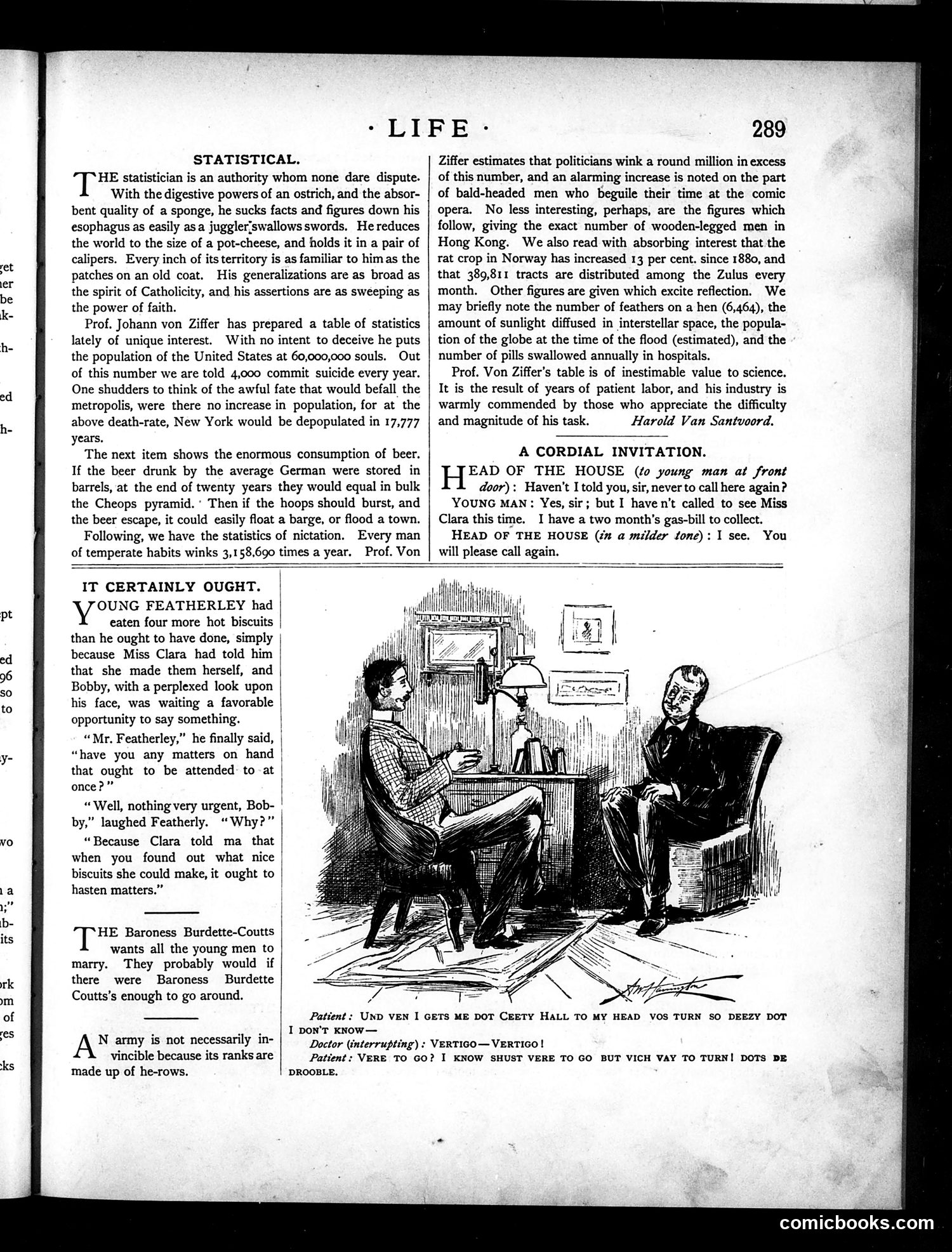
The main cartoon depicts a doctor visiting a patient at home. The patient complains of dizziness, mentioning "Certy Hall" affecting his head. The doctor responds with "Vertigo! Vertigo!" — a pun suggesting the patient's ailment is related to turning or spinning motions. The humor appears to reference a specific location or event (likely "Certy Hall," possibly a music hall or entertainment venue), though the exact contemporary reference is unclear from this image alone. The cartoon mocks hypochondria and doctors' tendency to use Latin medical terms to sound authoritative. The page also contains statistical articles about suicide rates, beer consumption, and other social observations — typical of Life's satirical commentary on American society and statistics.
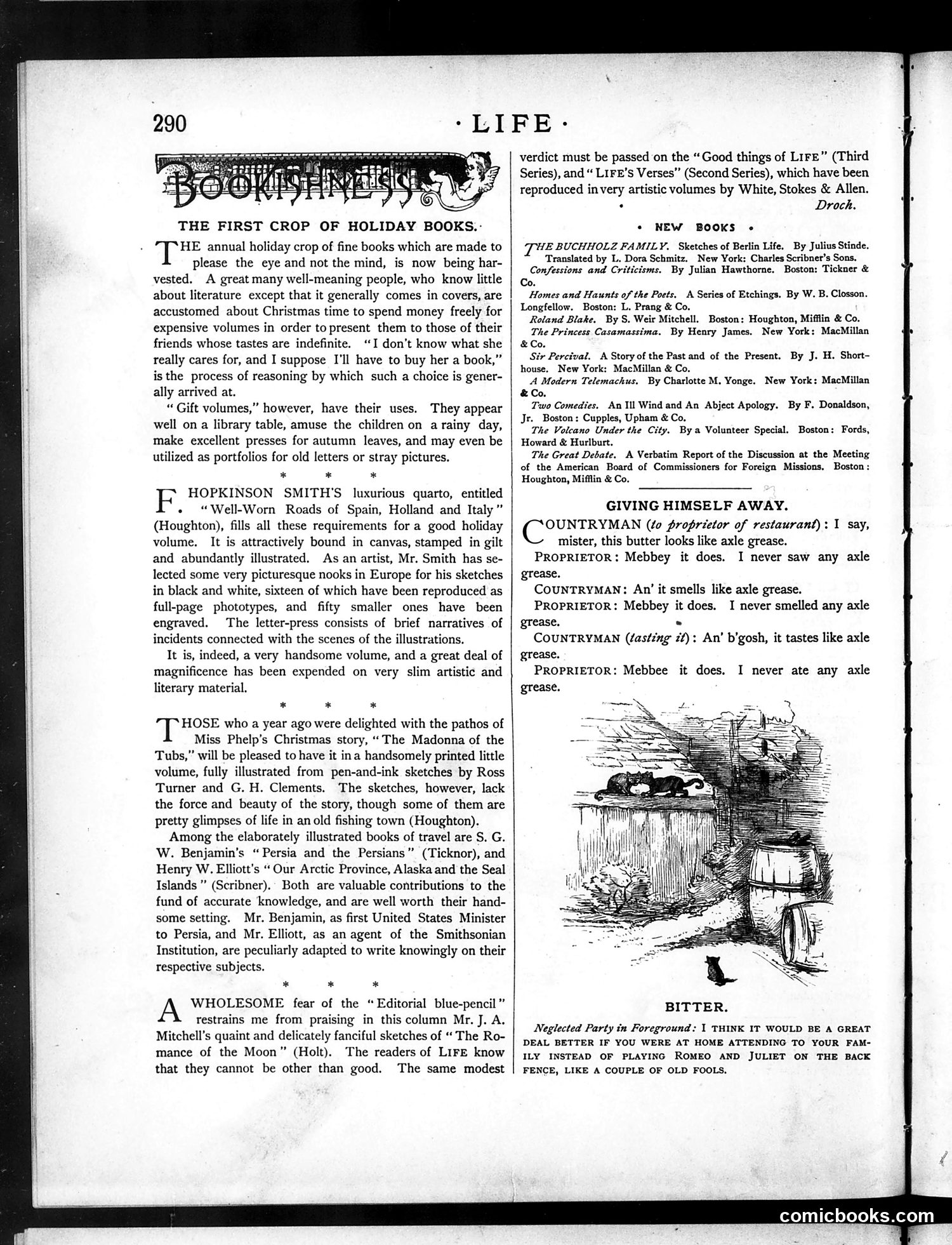
This page contains a book review section ("Bookshelf") discussing holiday gift books, followed by a small satirical dialogue titled "GIVING HIMSELF AWAY." The cartoon depicts a **proprietor and countryman** discussing butter at what appears to be a restaurant or shop. The countryman complains the butter tastes like axle grease; the proprietor denies this. When the countryman tastes it again, he agrees it does taste like axle grease—but then admits he's never actually eaten axle grease, so cannot judge. The satire mocks **gullible acceptance of authority**: the countryman reverses his complaint once contradicted by the proprietor, despite his own sensory experience. It's a comment on people's tendency to doubt their own judgment when challenged by those in positions of power or expertise.
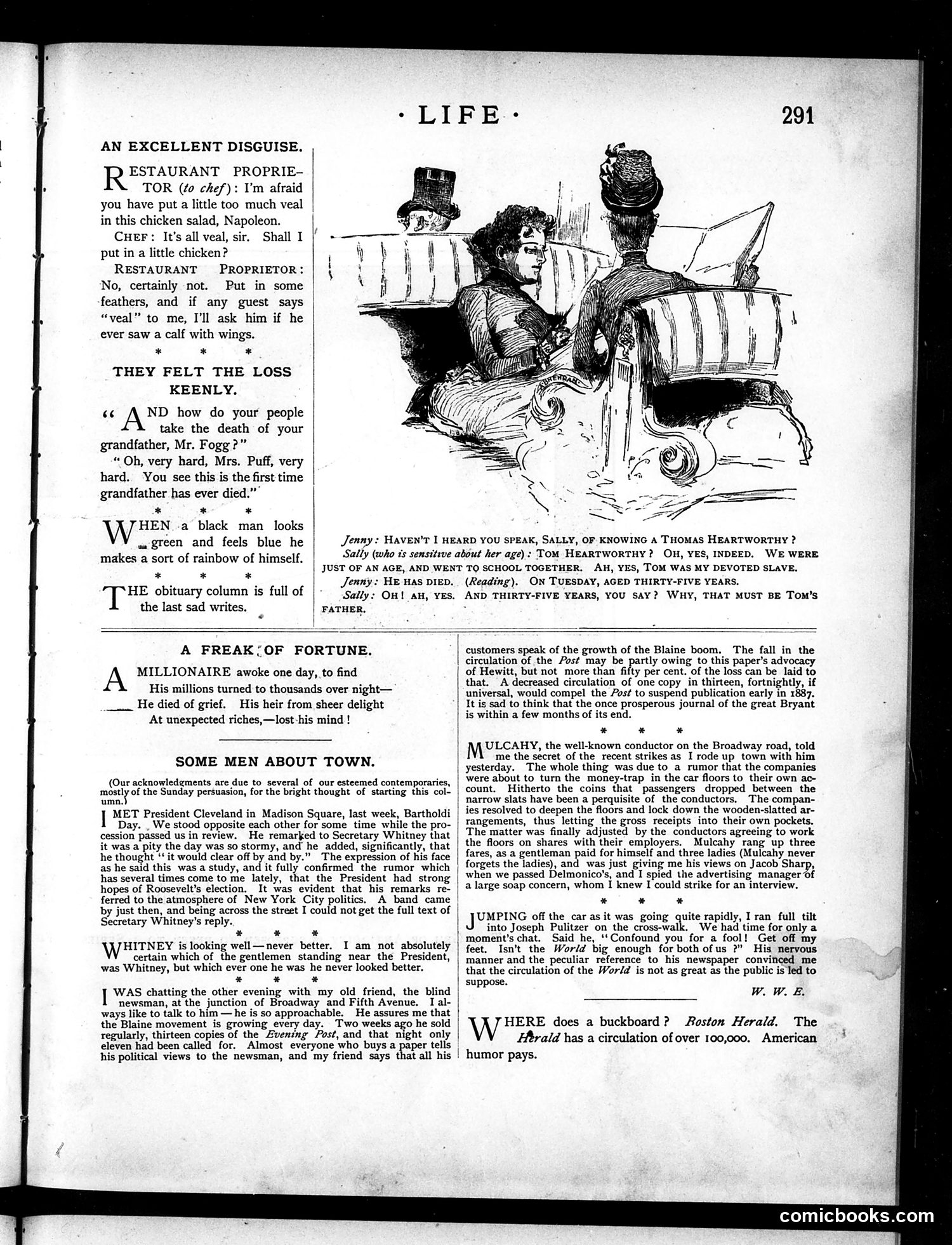
The main cartoon depicts a woman with an elaborate feathered hat riding in what appears to be a hot air balloon or fantastical flying contraption made of cushions and fabric. The accompanying text jokes about restaurant chefs disguising poor-quality veal as chicken—suggesting deception about food quality. Below are several brief anecdotes from "Some Men About Town," including observations about President Cleveland, newspaper circulation figures, and a conductor named Mulcahy discussing coin theft from passengers on a Broadway road. The page represents Life's typical satirical format: visual humor combined with gossipy social commentary about New York City life, politics, and contemporary absurdities. The specific references to Cleveland and the Blaine movement suggest this dates to the 1880s-1890s era.
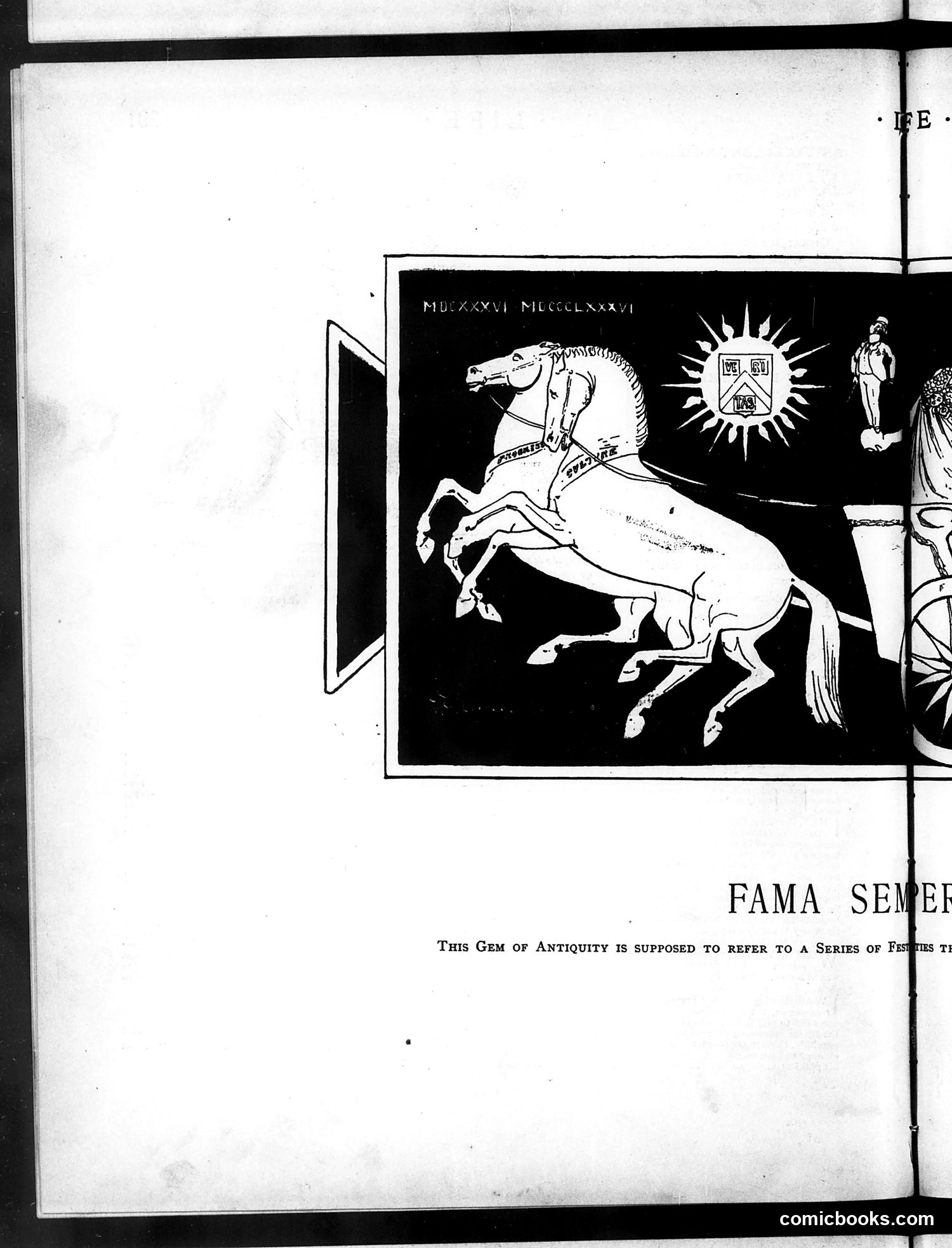
This page features a classical engraving or emblem labeled "MDCXXVI MDCCCLXXVI" (Roman numerals, likely dates). It depicts a rearing horse in ornate armor or decorative trappings, with a coat of arms featuring a sunburst design beside it. A standing figure appears on the right. The caption reads "FAMA SEME[R]" (Latin, suggesting "Fame" or "Rumor") and notes: "THIS GEM OF ANTIQUITY IS SUPPOSED TO REFER TO A SERIES OF FABLES TH[AT]..." (text cuts off). The artwork appears to be presented as an example of classical or heraldic imagery, possibly satirizing the reverence for antiquity or illustrating historical symbolism. Without the complete caption, the specific satirical point remains unclear, though the juxtaposition of grand classical imagery with the Life magazine's typically irreverent commentary suggests gentle mockery of pretension.
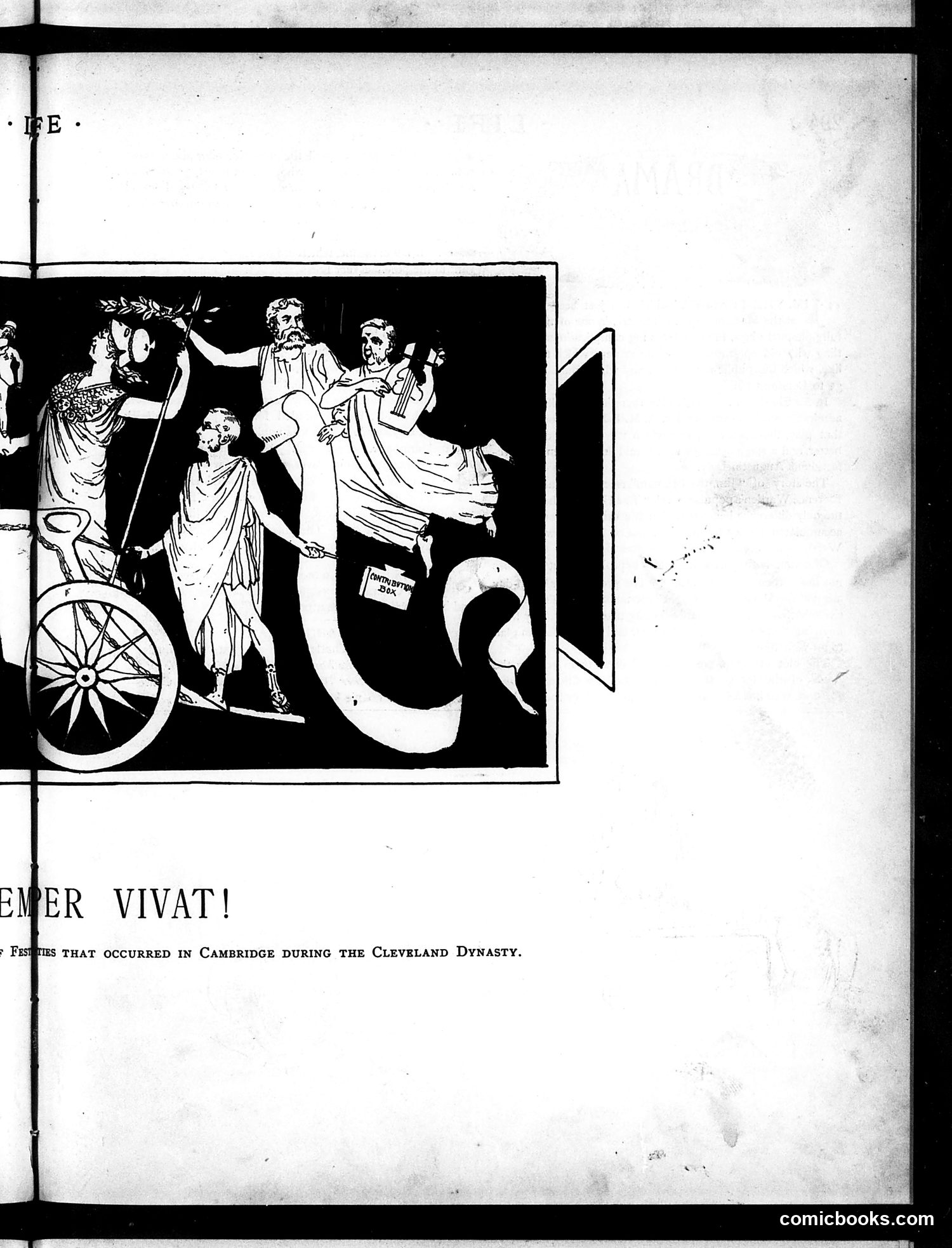
This page shows a classical scene with multiple robed figures gathered around a large cornucopia (horn of plenty). The text references "Festies that Occurred in Cambriage During the Cleveland Dynasty" and includes the Latin phrase "EMER VIVAT!" (roughly "long may he live"). The satire appears to target President Grover Cleveland's administration, depicting an abundance of festivities or celebrations in Cambridge (likely Harvard University). The classical artistic style—with toga-wearing figures and Roman imagery—creates ironic contrast, suggesting either: mockery of pretentious academic celebrations, or criticism of perceived excess/indulgence during Cleveland's presidency. The cornucopia symbolizes plenty or abundance. Without clearer identification of specific figures, the exact targets remain unclear, though the tone appears satirical toward elite celebration or institutional excess.
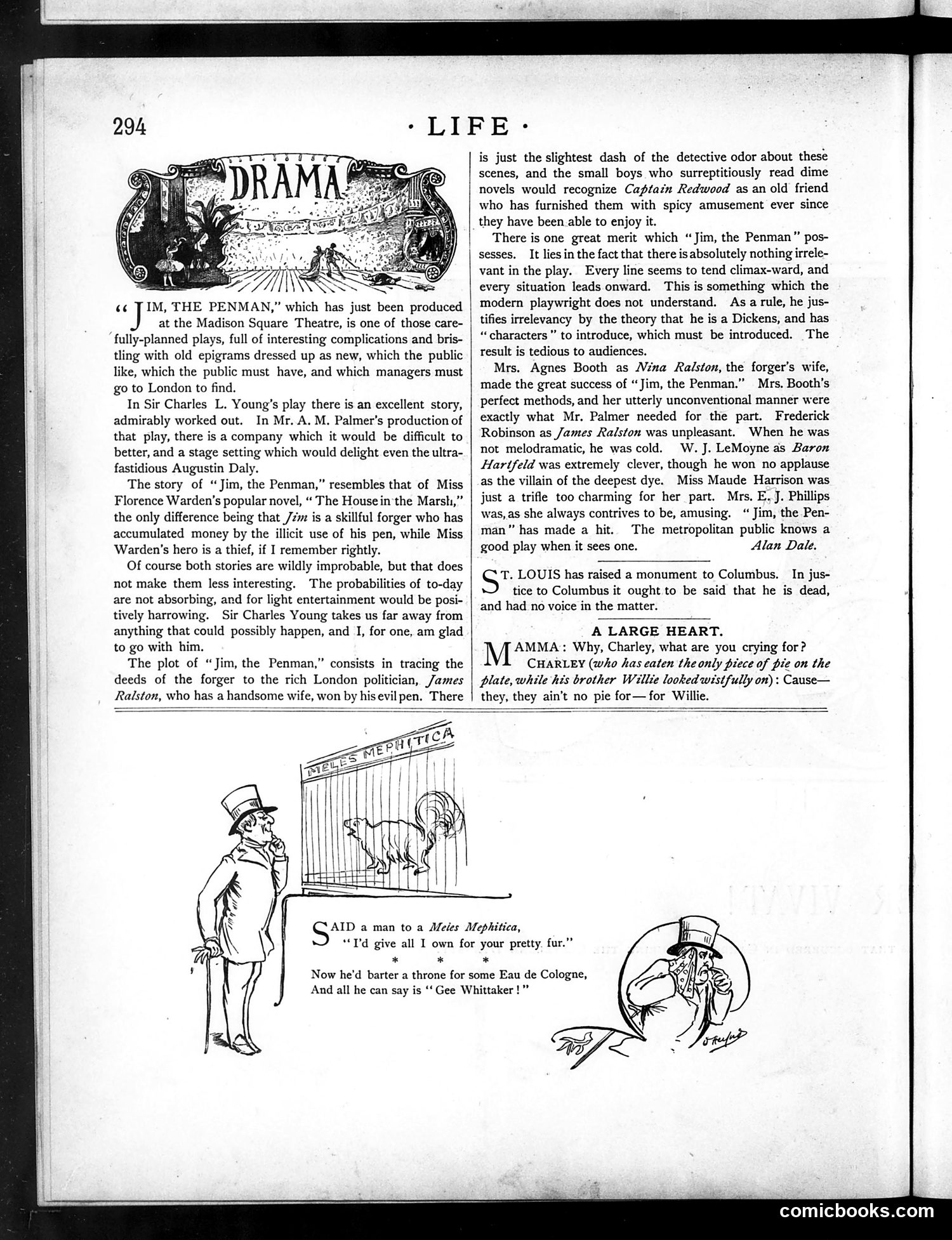
This page reviews the play "Jim, the Penman," praising its plot about a forger who seduces a rich politician to steal from him. The reviewer notes the play's relevance—forgery and fraud were apparently recognizable crimes to contemporary audiences. The two cartoons below satirize wealth and desire: 1. **Left cartoon**: A man in formal dress offers a fur coat to a "Meta Mephistica" (woman in cage), saying "I'd give all I own for your pretty fur." 2. **Right cartoon**: Shows the consequence—the man has traded his wealth, now saying only "Gee Whittaker!" (an exclamation of dismay). Together, they mock how men's desire for luxury or women leads to financial ruin—echoing the play's themes about greed and seduction.
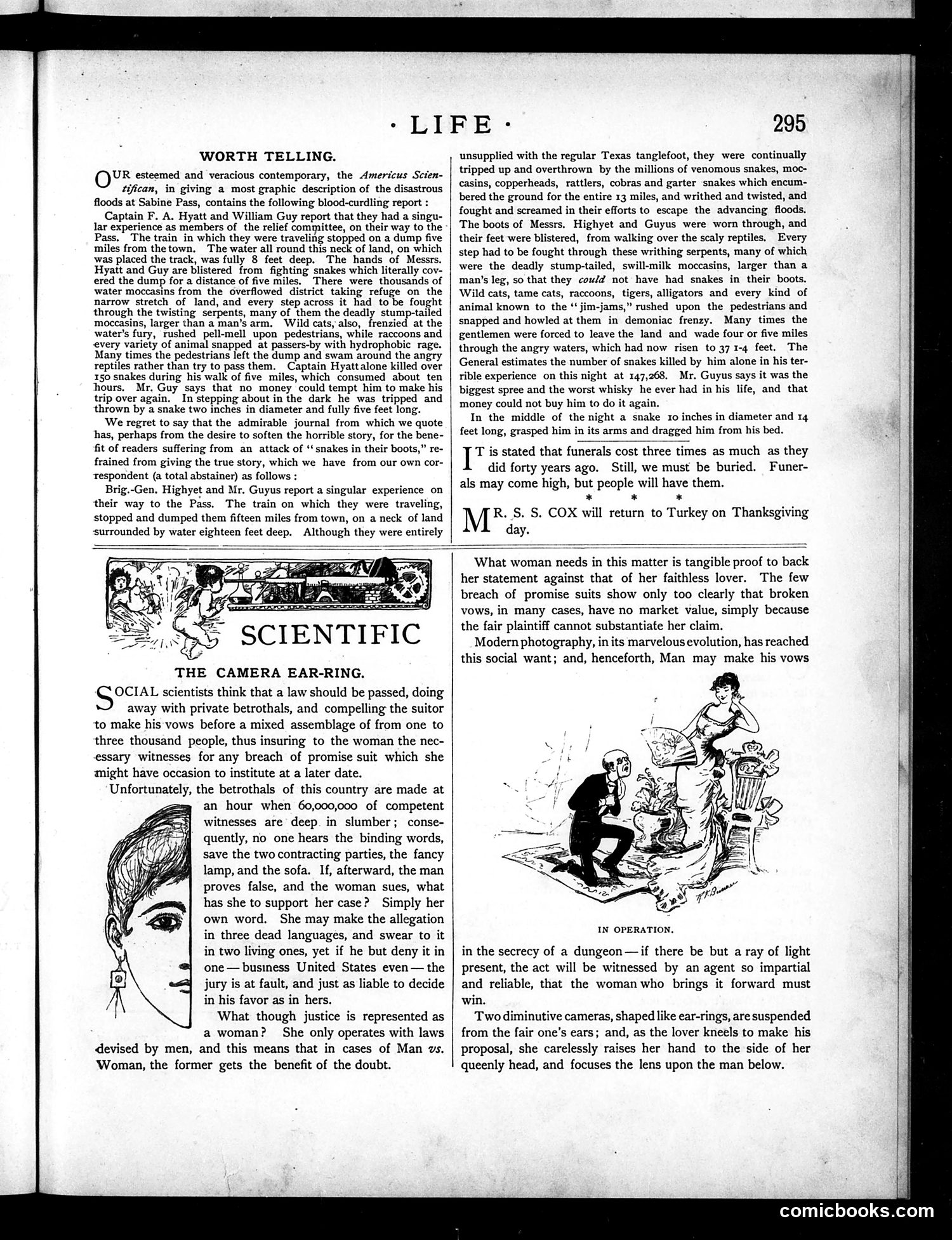
This page satirizes exaggerated newspaper reporting through a humorous hoax story about a flood at Sabine Pass, Texas. **The Setup:** Life quotes the "American Scientifican" reporting a dramatic account of relief workers battling massive snakes, wild animals, and floodwaters. The snakes are absurdly oversized (some "larger than a man's arm"), and the dangers multiply impossibly. **The Joke:** Life's "correspondent" then "reveals" the truth: the workers were actually drunk on "Texas tanglefoot" (slang for cheap whiskey). The exaggerations weren't nature's horror but drunken hallucination. The punchline reveals the fantastical details—snakes 10 inches in diameter, 147,268 snakes killed, water rising to 37¼ feet—were alcohol-induced delusions, not real events. **The Target:** This mocks sensationalist journalism that prints obviously fabricated disaster stories without verification, and criticizes newspapers for printing tall tales as fact to sell copies. The "Scientific" section header emphasizes the irony: there's nothing scientific about such credulous reporting.
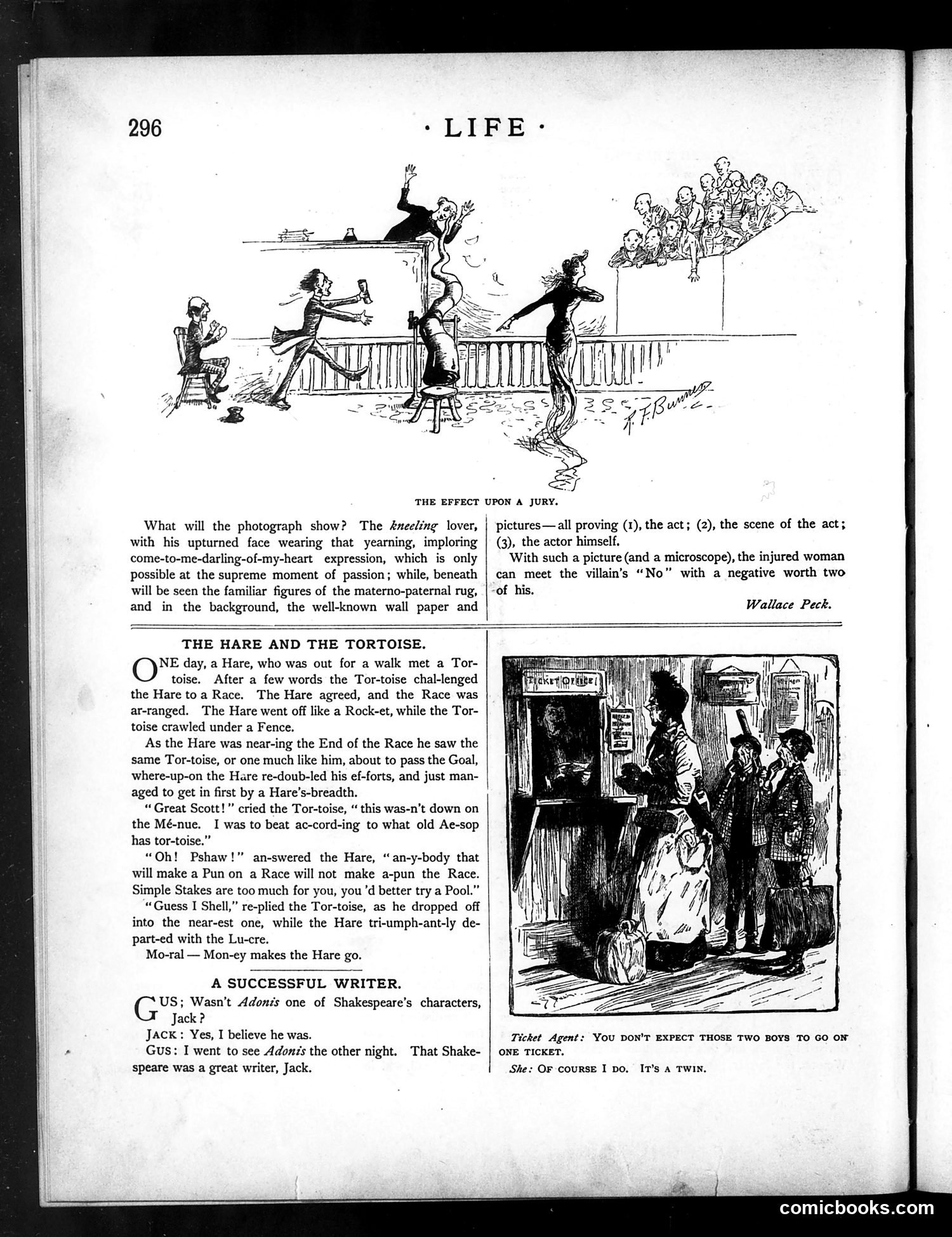
**"The Effect Upon a Jury"** (top): A cartoon mocking courtroom photography and evidence. The joke suggests that a photograph of lovers, when presented to a jury with magnified detail, would show not just the couple but incriminating background details (furniture, wallpaper)—proving the act occurred, its location, and the guilty party. It's satirizing both the supposed "objectivity" of photography as legal evidence and the absurdity of expecting juries to reach conclusions from circumstantial visual details. **"The Hare and the Tortoise"**: A fractured retelling of Aesop's fable where the Hare actually wins by a narrow margin, then the Tortoise drowns himself in a pool. The moral states: "Money makes the Hare go"—cynically suggesting that in modern life, speed and financial advantage trump slow persistence, inverting the original fable's lesson about patience. **"A Successful Writer"**: A brief dialogue where Gus confuses Shakespeare's character *Adonis* with a recent stage production titled *Adonis*, praising Shakespeare's genius for work he didn't write—mocking theatrical ignorance.
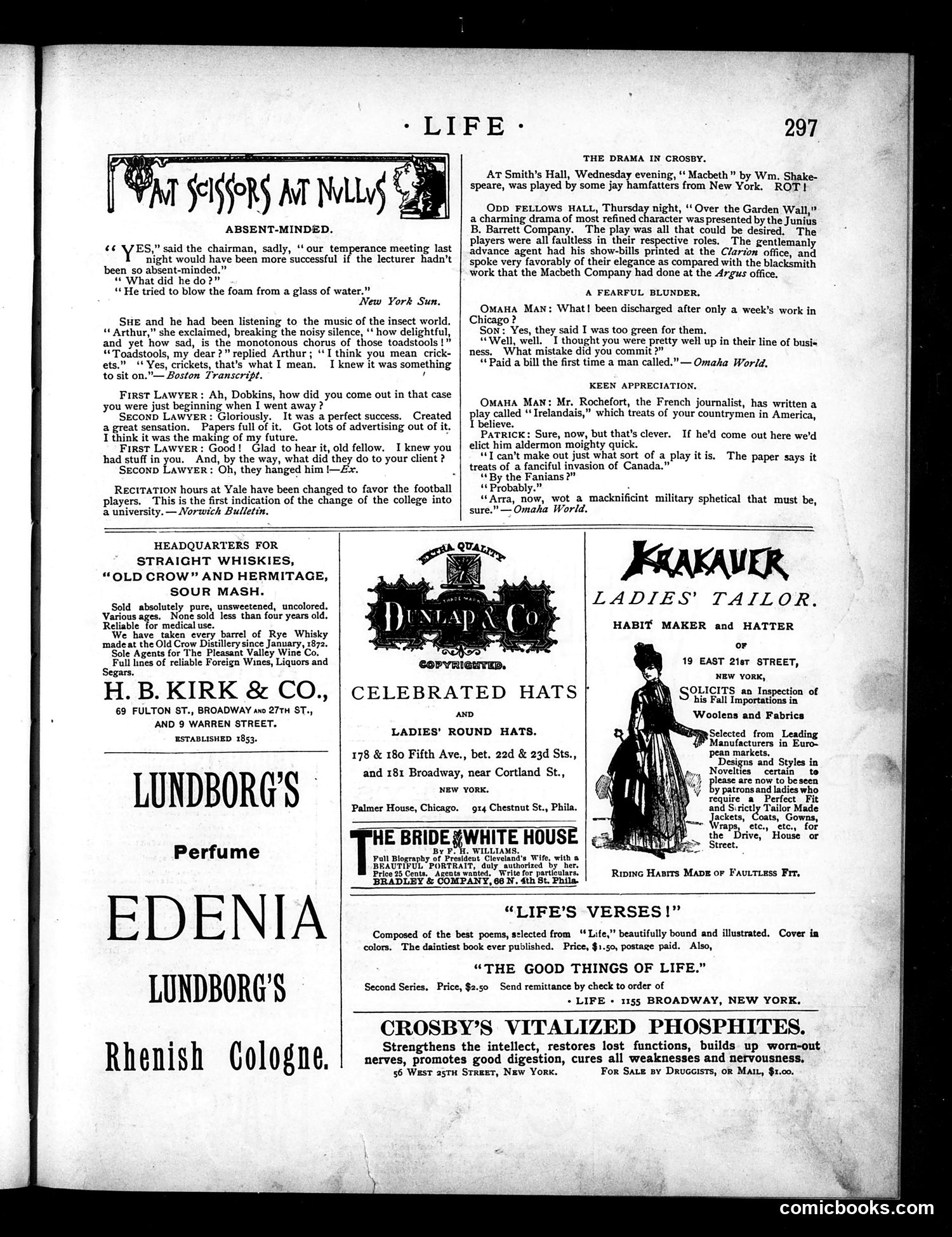
This page from *Life* magazine contains several brief comic sketches typical of 1870s-80s satirical humor. The cartoon at the top ("SCISSORS AT NULLY") depicts an "absent-minded" temperance lecturer who tries to blow foam off a water glass—the joke being the ironic contradiction between abstinence advocacy and the appearance of intoxication. The other pieces are short humorous dialogues, including jokes about lawyers pursuing cases for personal profit rather than justice, and mild ethnic humor involving Irish ("Patrick") and German characters. One sketch mocks the contrast between a poor local Shakespeare production and a superior traveling theater company. The page is largely advertisements for whiskey, perfume, hats, and patent medicines—typical commercial content from the era. The humor relies on simple observational comedy and character stereotypes rather than political satire, reflecting *Life*'s general approach as an entertainment magazine for middle-class readers.
This is primarily an **advertising page** with minimal editorial content. The dominant visual is the royal coat of arms at top left, followed by advertisements for Redfern Ladies' Tailor (210 Fifth Avenue, New York) featuring fashionable hat designs. The page contains **commercial advertisements** rather than political satire: printing ink, a tailor shop, theaters (Eden Musee, Daly's Theatre), roses, cocoa, beauty treatments, and binding services. One curiosity is the Eden Musee's advertised display of "The Chicago Anarchists" — likely a realistic wax group depicting the infamous Haymarket anarchists (executed 1887), a contemporary sensational attraction. The "Thoughts" section advertises a book of Russian aphorisms by Ivan Panin, with favorable reviews from Boston publications. **No significant political cartoon or satire appears on this page.** It functions as a commercial venue for upscale New York businesses and entertainments of the 1880s.
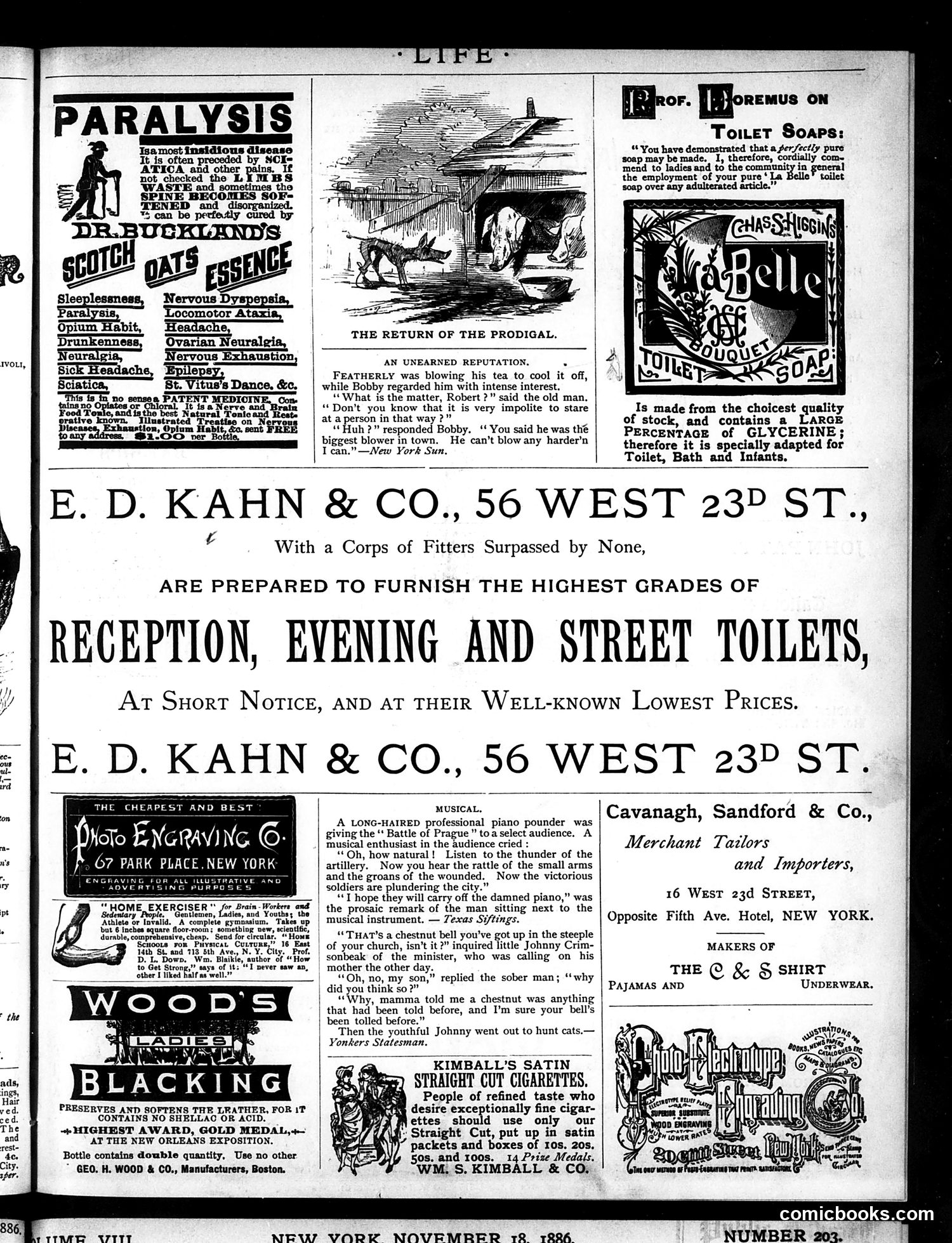
This brief comic anecdote satirizes pretension and empty boasting. An old man named Featherly is trying to cool his tea by blowing on it, when young Bobby stares at him intently. When Featherly scolds the boy for staring, Bobby responds that Featherly claimed to be "the biggest blower in town"—yet the child can blow just as hard. The joke deflates Featherly's reputation: his supposedly impressive "blowing" ability is revealed as ordinary and unremarkable when put to actual test. The humor lies in the collision between reputation and reality—what Featherly is known for proves utterly unimpressive in practice. It's a gentle mockery of small-town gossip and exaggerated local fame. The page is primarily advertisements for patent medicines, soaps, clothing, and piano services typical of 1886 *Life* magazine.
This page is primarily **advertising**, typical of 1880s magazines. However, it includes one satirical element: **The Train Conductor Joke** (center): A brief comic anecdote mocking working-class rudeness. A passenger complains about frequent stops; the conductor dismissively tells him to walk if he doesn't like it. The passenger accepts this absurd response meekly. The satire targets the conductor's hostility and the passenger's powerlessness—reflecting contemporary frustrations with poor service from workers in transportation industries. **The Advertisements** promote distinctly 1880s products: Waterbury watches (emphasizing American mechanical innovation), Williams' shaving cream, Baker's cocoa, Vichy mineral water (a luxury import), and fur retailers. These ads reflect both industrial-age pride and genteel consumer culture of the Gilded Age. The page contains **no political cartoons**—it's a mix of commercial pitches and light humor typical of Life's advertising-heavy format during this era.