
Life, 1886-11-11 · page 3 of 16
Life — November 11, 1886 — page 3: what you’re looking at
What you’re looking at
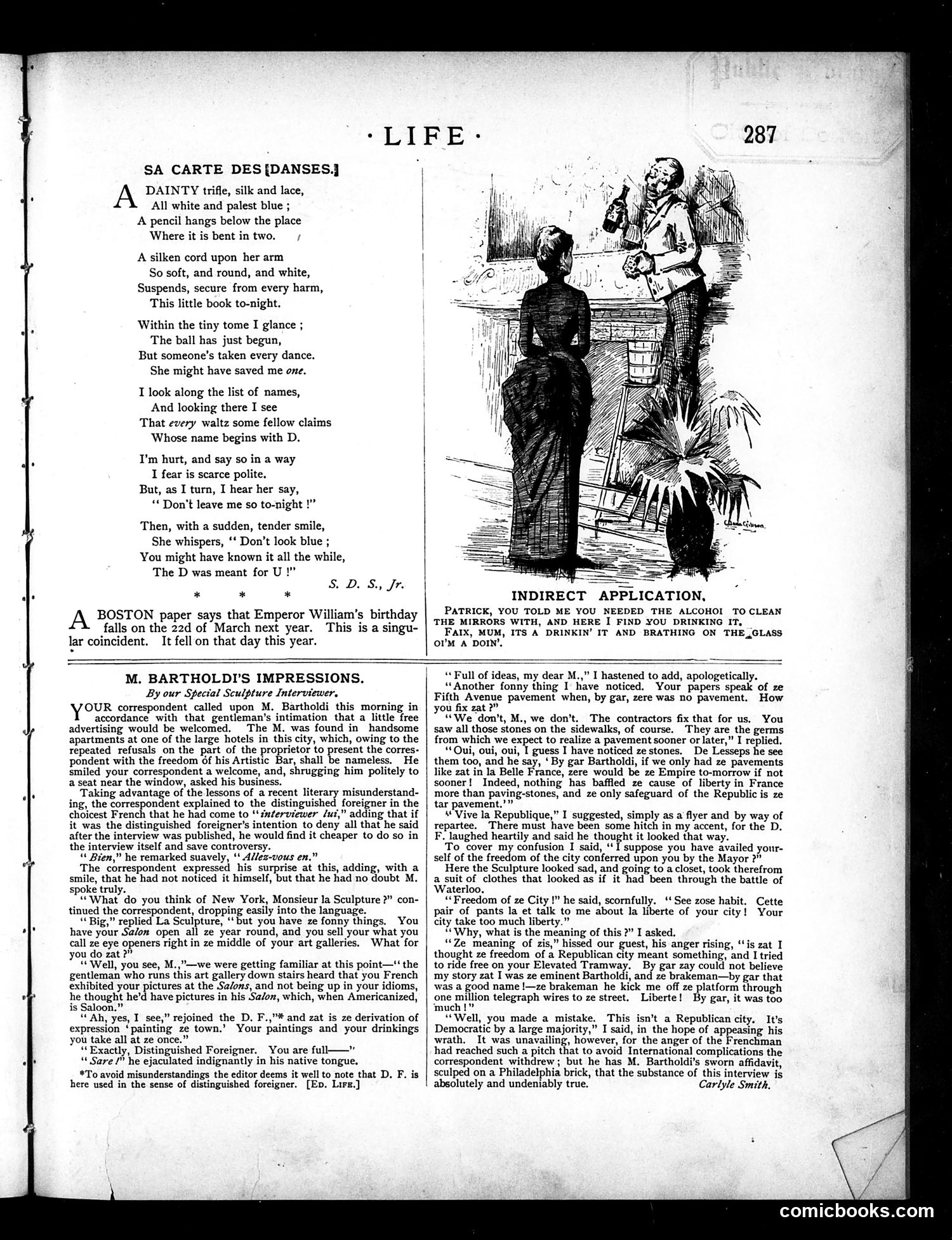
The main illustration titled "Indirect Application" depicts a woman confronting a man about drinking alcohol, referencing Prohibition-era politics. The accompanying text discusses M. Bartholdi's impressions, featuring a satirical interview about French artistic and political concepts. The central satire mocks American attempts to understand French Republican ideals and aesthetics. The correspondent questions French notions of "freedom," "civilization," and "sculpture," exposing confusion between genuine political liberty and superficial cultural pretension. The humor targets both American ignorance of French philosophy and French condescension toward American interpretation of European ideas. The Prohibition cartoon satirizes the enforcement challenges of alcohol bans—specifically how indirect methods (here, drinking from glass) circumvent direct prohibitions, mocking the impracticality of the law.
📄 Transcribed text from this page (OCR, searchable)
Machine-transcribed from the original scan — historical spelling and the odd misread are preserved.
SA CARTE DES [{DANSES,] DAINTY trifle, silk and lace, All white and palest blue ; A pencil hangs below the place Where it is bent intwo. = A silken cord upon her arm So soft, and round, and white, Suspends, secure from every harm, This little book to-night. Within the tiny tome I glance ; The ball has just begun, But someone’s taken every dance. She might have saved me one. I look along the list of names, And looking there I see That every waltz some fellow claims ‘Whose name begins with D. I'm hurt, and say so in a way I fear is scarce polite, But, as I turn, I hear her say, “* Don't leave me so to-night !” Then, with a sudden, tender smile, She whispers, ‘‘ Don’t look blue ; You might have known it all the while, The D was meant for U !” SD. S., Jr. A BOSTON paper says that Emperor William’s birthday falls on the 22d of March next year. This is a singu- lar coincident. It fell on that day this year. * * * INDIRECT APPLICATION, PATRICK, YOU TOLD ME YOU NEEDED THE ALCOHOI TO CLEAN THE MIRRORS WITH, AND HERE I FIND YOU DRINKING IT, FAIx, MUM, ITS A DRINKIN’ IT AND BRATHING ON THE {GLASS orm A DOIN’, M. BARTHOLDI’S IMPRESSIONS. By our Special Sculpture Interviewer, YOUR correspondent called upon M. Bartholdi this morning in accordance with that gentleman's intimation that a little free advertising would be welcomed. The M. was found in handsome apartments at one of the large hotels in this city, which, owing to the repeated refusals on the part of the proprietor to present the corres- pondent with the freedom of his Artistic Bar, shall be nameless. He smiled your correspondent a welcome, and, shrugging him politely to a seat near the window, asked his business. Taking advantage of the lessons of a recent literary misunderstand- ing, the correspondent explained to the distinguished foreigner in the choicest French that he had come to “'sntervtewer /ui,” adding that if it was the distinguished foreigner’s intention to deny all that he said after the interview was published, he would find it cheaper to do so in the interview itself and save controversy. “ Bien,” he remarked suavely, ‘ Al/ez-vous en.” The correspondent expressed his surprise at this, adding, with a smile, that he had not noticed it himself, but that he had no doubt M. spoke truly. ““What do you think of New York, Monsieur la Sculpture ?” con- tinued the correspondent, dropping easily into the language. “Big,” replied La Sculpture, ‘but you have ze fonny things. You have your Salon open all ze year round, and you sell your what you call ze eye openers right in ze middle of your art galleries. What for you do zat ?” “Well, you see, M.,”—we were getting familiar at this point—“ the gentleman who runs this art gallery down stairs heard that you French exhibited your pictures at the Sa/ons, and not being up in your idioms, he thought he'd have pictures in his Sa/on, which, when Americanized, is Saloon.” “Ah, yes, I see,” rejoined the D. F.,”* and zat is ze derivation of expression ‘painting ze town.’ Your paintings and your drinkings you take all at ze once.” “Exactly, Distinguished Foreigner. You are full—” “ Sare /” he ejaculated indignantly in his native tongue. *To avoid misunderstandings the editor deems it well to note that D, F. is here used in the sense of distinguished foreigner. [Ep. Lire.] “« Full of ideas, my dear M.,” I hastened to add, apologetically. “Another fonny thing I have noticed. Your papers speak of ze Fifth Avenue pavement when, by gar, zere was no pavement. How you fix zat ?” ‘‘We don’t, M., we don’t. The contractors fix that for us. You saw all those stones on the sidewalks, of course. They are the germs from which we expect to realize a pavement sooner or later,” I replied. “Qui, oui, oui, I guess I have noticed ze stones. De Lesseps he see them too, and he say, ‘ By gar Bartholdi, if we only had ze pavements like zat in la Belle France, zere would be ze Empire to-morrow if not sooner! Indeed, nothing has baffled ze cause of liberty in France more than paving-stones, and ze only safeguard of the Republic is ze tar pavement.’” «Vive la Republique,” I suggested, simply as a flyer and by way of repartee. There must have been some hitch in my accent, for the D. F. laughed heartily and said he thought it looked that way. To cover my confusion I said, “I suppose you have availed your- self of the freedom of the city conferred upon you by the Mayor 2” Here the Sculpture looked sad, and going to a closet, took therefrom a suit of clothes that looked as if it had been through the battle of Waterloo. “‘Freedom of ze City !” he said, scornfully. ‘‘ See zose habit. Cette pair of pants la et talk to me about la liberte of your city! Your city take too much liberty.” “Why, what is the meaning of this ?” I asked. “Ze meaning of zis,” hissed our guest, his anger rising, ‘is zat I thought ze freedom of a Republican city meant something, and I tried to ride free on your Elevated Tramway. By gar zay could not believe my story zat I was ze eminent Bartholdi, and ze brakeman—by gar that ‘was a good name !—ze brakeman he kick me off ze platform through ‘one ni ion telegraph wires to ze street. Liberte! By gar, it was too much !” “Well, you made a mistake. This isn’t a Republican city. It’s Democratic by a large majority,” I said, in the hope of appeasing his wrath, It was unavailing, however, for the anger of the Frenchman had reached such a pitch that to avoid International complications the correspondent withdrew; but he has M. Bartholdi’s sworn affidavit, sculped on a Philadelphia brick, that the substance of this interview is | absolutely and undeniably true. Carlyle Smith, comicbooks.com