
Life, 1886-11-11 · page 2 of 16
Life — November 11, 1886 — page 2: what you’re looking at
What you’re looking at
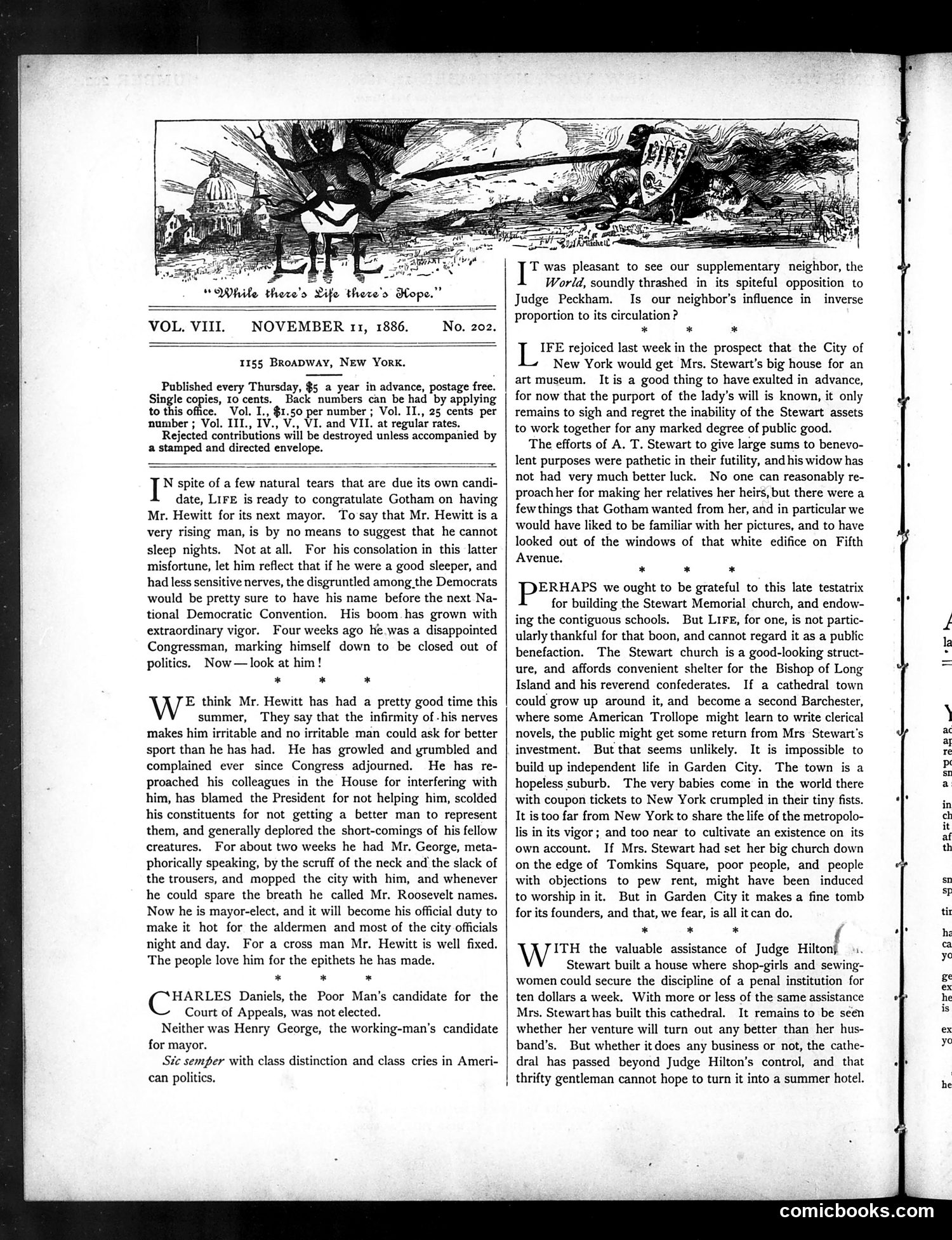
The masthead cartoon depicts "Life" as a figure wielding a scythe labeled "Life," attacking what appears to be a skeletal or death-like figure, illustrating the magazine's satirical mission to critique folly and expose hypocrisy. The text discusses New York politics, particularly Mayor Hewitt's administration. The articles criticize Democratic infighting and class-based politics. One section mocks Charles Daniels (Poor Man's candidate for Court of Appeals) and Henry George (workingman's mayoral candidate), suggesting satirical skepticism toward populist political movements that invoked class division. The overall tone suggests *Life* positioned itself as an independent voice critiquing both establishment politicians and populist demagogues exploiting class resentment for political gain.
📄 Transcribed text from this page (OCR, searchable)
Machine-transcribed from the original scan — historical spelling and the odd misread are preserved.
vy 5 aK “While there's Life there's Hope.” VOL. VIII. NOVEMBER 11, 1886. No. 202. 1155 Broapway, NEw York. Published every Thursday, $5 a year in advance, postage free. Single copies, 10 cents. Back numbers can be had by applying to this o ice. Vol. I., $1.50 per number ; Vol. II., 25 cents per number ; Vol. III., IV., V., VI. and VII. at regular rates. Rejected contributions will be destroyed unless accompanied by a stamped and directed envelope. N spite of a few natural tears that are due its own candi- date, LIFE is ready to congratulate Gotham on having Mr. Hewitt for its next mayor. To'say that Mr. Hewitt isa very rising man, is by no means to suggest that he cannot sleep nights. Not at all. For his consolation in this latter misfortune, let him reflect that if he were a good sleeper, and had less sensitive nerves, the disgruntled among the Democrats would be pretty sure to have his name before the next Na- tional Democratic Convention. His boom has grown with extraordinary vigor. Four weeks ago he.was a disappointed Congressman, marking himself down to be closed out of politics. Now—look at him! * * * E think Mr. Hewitt has had a pretty good time this summer, They say that the infirmity of -his nerves makes him irritable and no irritable man could ask for better sport than he has had. He has growled and grumbled and complained ever since Congress adjourned. He has re- proached his colleagues in the House for interfering with him, has blamed the President for not helping him, scolded his constituents for not getting a better man to represent them, and generally deplored the short-comings of his fellow creatures. For about two weeks he had Mr. George, meta- phorically speaking, by the scruff of the neck and the slack of the trousers, and mopped the city with him, and whenever he could spare the breath he called Mr. Roosevelt names. Now he is mayor-elect, and it will become his official duty to make it hot for the aldermen and most of the city officials night and day. For a cross man Mr. Hewitt is well fixed. The people love him for the epithets he has made. * * * HARLES Daniels, the Poor Man's candidate for the Court of Appeals, was not elected. Neither was Henry George, the working-man’s candidate for mayor. Sic semper with class distinction and class cries in Ameri- can politics. T was pleasant to see our supplementary neighbor, the World, soundly thrashed in its spiteful opposition to Judge Peckham. Is our neighbor's influence in inverse proportion to its circulation ? * * * IFE rejoiced last week in the prospect that the City of New York would get Mrs. Stewart’s big house for an art museum. It is a good thing to have exulted in advance, for now that the purport of the lady’s will is known, it only remains to sigh and regret the inability of the Stewart assets to work together for any marked degree of public good. The efforts of A. T. Stewart to give large sums to benevo- lent purposes were pathetic in their futility, and his widow has not had very much better luck. No one can reasonably re- proach her for making her relatives her heirs, but there were a few things that Gotham wanted from her, and in particular we would have liked to be familiar with her pictures, and to have looked out of the windows of that white edifice on Fifth Avenue. * * * EERHAPS we ought to be grateful to this late testatrix for building the Stewart Memorial church, and endow- ing the contiguous schools. But LIFE, for one, is not partic- ularly thankful for that boon, and cannot regard it as a public benefaction. The Stewart church is a good-looking struct- ure, and affords convenient shelter for the Bishop of Long Island and his reverend confederates. If a cathedral town could grow up around it, and become a second Barchester, where some American Trollope might learn to write clerical novels, the public might get some return from Mrs Stewart's investment. But that seems unlikely. It is impossible to build up independent life in Garden City. The town is a hopeless suburb. The very babies come in the world there with coupon tickets to New York crumpled in their tiny fists. It is too far from New York to share the life of the metropolo- lis in its vigor ; and too near to cultivate an existence on its own account. If Mrs. Stewart had set her big church down on the edge of Tomkins Square, poor people, and people with objections to pew rent, might have been induced to worship in it. But in Garden City it makes a fine tomb for its founders, and that, we fear, is all itcan do. * * * ITH the valuable assistance of Judge Hilton} . Stewart built a house where shop-girls and sewing- women could secure the discipline of a penal institution for ten dollars a week. With more or less of the same assistance Mrs. Stewarthas built this cathedral. It remains to be seen whether her venture will turn out any better than her hus- band’s. But whether it does any business or not, the cathe- dral has passed beyond Judge Hilton’s control, and that | thrifty gentleman cannot hope to turn it into a summer hotel. comicbooks.com he