
Life, 1886-11-11 · page 10 of 16
Life — November 11, 1886 — page 10: what you’re looking at
What you’re looking at
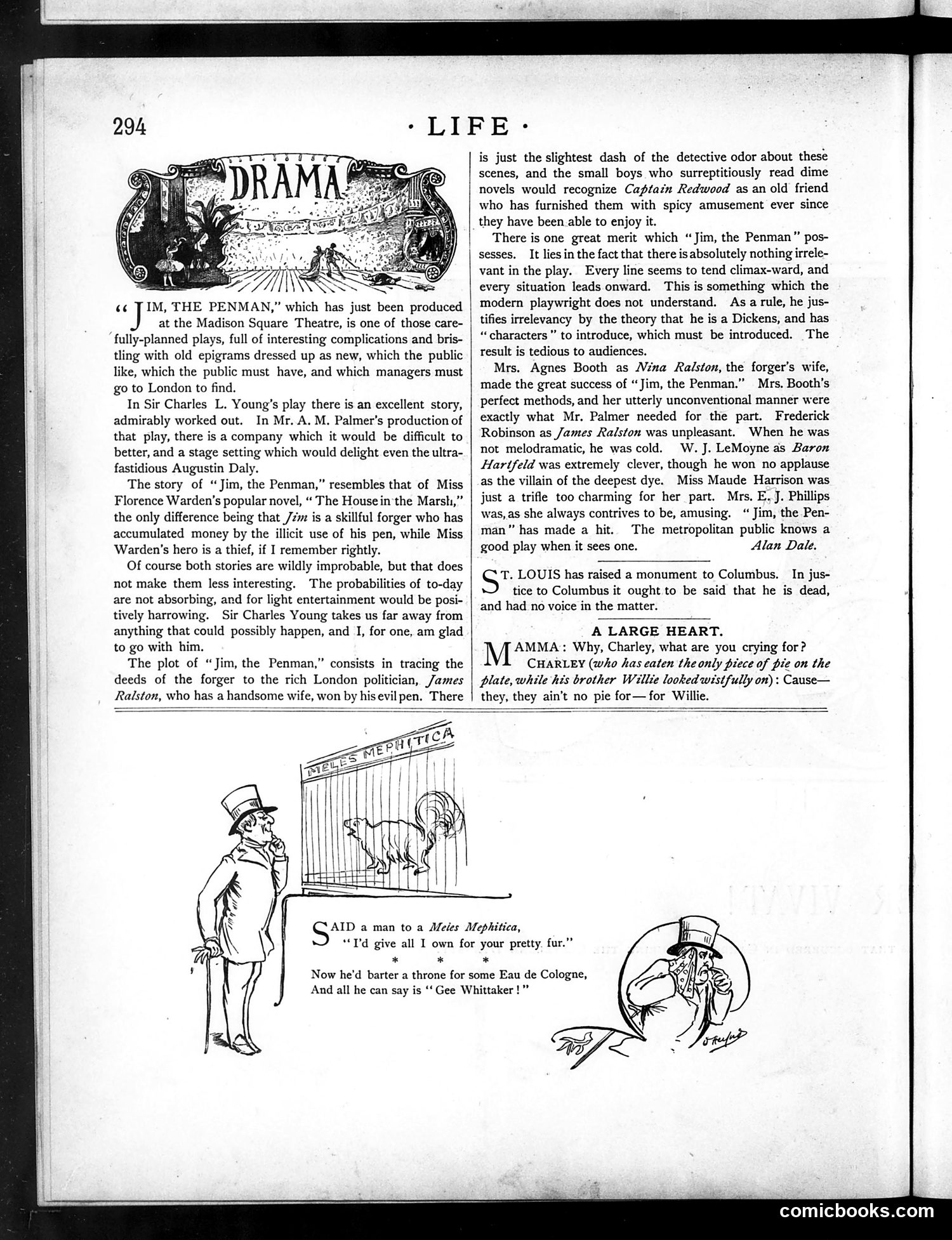
This page reviews the play "Jim, the Penman," praising its plot about a forger who seduces a rich politician to steal from him. The reviewer notes the play's relevance—forgery and fraud were apparently recognizable crimes to contemporary audiences. The two cartoons below satirize wealth and desire: 1. **Left cartoon**: A man in formal dress offers a fur coat to a "Meta Mephistica" (woman in cage), saying "I'd give all I own for your pretty fur." 2. **Right cartoon**: Shows the consequence—the man has traded his wealth, now saying only "Gee Whittaker!" (an exclamation of dismay). Together, they mock how men's desire for luxury or women leads to financial ruin—echoing the play's themes about greed and seduction.
📄 Transcribed text from this page (OCR, searchable)
Machine-transcribed from the original scan — historical spelling and the odd misread are preserved.
ET «6¢ TIM, THE PENMAN,” which has just been produced J at the Madison Square Theatre, is one of those care- fully-planned plays, full of interesting complications and bris- tling with old epigrams dressed up as new, which the public like, which the public must have, and which managers must go to London to find. In Sir Charles L. Young’s play there is an excellent story, admirably worked out. In Mr. A. M. Palmer’s production of that play, there is a company which it would be difficult to better, and a stage setting which would delight even the ultra- fastidious Augustin Daly. The story of “Jim, the Penman,” resembles that of Miss Florence Warden’s popular novel, “ The House inthe Marsh,” the only difference being that 72 is a skillful forger who has accumulated money by the illicit use of his pen, while Miss Warden's hero is a thief, if I remember rightly. Of course both stories are wildly improbable, but that does not make them less interesting. The probabilities of to-day are not absorbing, and for light entertainment would be posi- tively harrowing. Sir Charles Young takes us far away from anything that could possibly happen, and I, for one, am glad to go with him. The plot of “Jim, the Penman,” consists in tracing the deeds of the forger to the rich London politician, James FE- is just the slightest dash of the detective odor about these scenes, and the small boys who surreptitiously read dime novels would recognize Captain Redwood as an old friend who has furnished them with spicy amusement ever since they have been.able to enjoy it. There is one great merit which “Jim, the Penman” pos- sesses. It lies in the fact that there is absolutely nothing irrele- vant in the play. Every line seems to tend climax-ward, and every situation leads onward. This is something which the modern playwright does not understand. As a rule, he jus- | tifies irrelevancy by the theory that he is a Dickens, and has “characters ” to introduce, which must be introduced. The result is tedious to audiences. Mrs. Agnes Booth as ina Ralston, the forger’s wife, made the great success of “Jim, the Penman.” Mrs. Booth’s perfect methods, and her utterly unconventional manner were exactly what Mr. Palmer needed for the part. Frederick Robinson as James Ralston was unpleasant. When he was not melodramatic, he was cold. W. J. LeMoyne as Baron Harifeld was extremely clever, though he won no applause as the villain of the deepest dye. Miss Maude Harrison was just a trifle too charming for her part. Mrs. E, J. Phillips was, as she always contrives to be, amusing. “ Jim, the Pen- man” has made a hit. The metropolitan public knows a good play when it sees one. Alan Dale. T. LOUIS has raised a monument to Columbus. In jus- tice to Columbus it ought to be said that he is dead, and had no voice in the matter. A LARGE HEART. AMMA: Why, Charley, what are you crying for? CHARLEY (who has eaten the only piece of pie on the plate, while his brother Willie looked wistfully on): Cause— Ralston, who has a handsome wife, won by his evil pen. There they, they ain’t no pie for— for Willie. AID a man to a Meles Mephitica, “I'd give all I own for your pretty. fur." * Now he'd barter a throne for * * some Eau de Cologne, And all he can say is ‘‘Gee Whittaker!” comicbooks.com