
A complete issue · 16 pages · 1886
Life — October 21, 1886
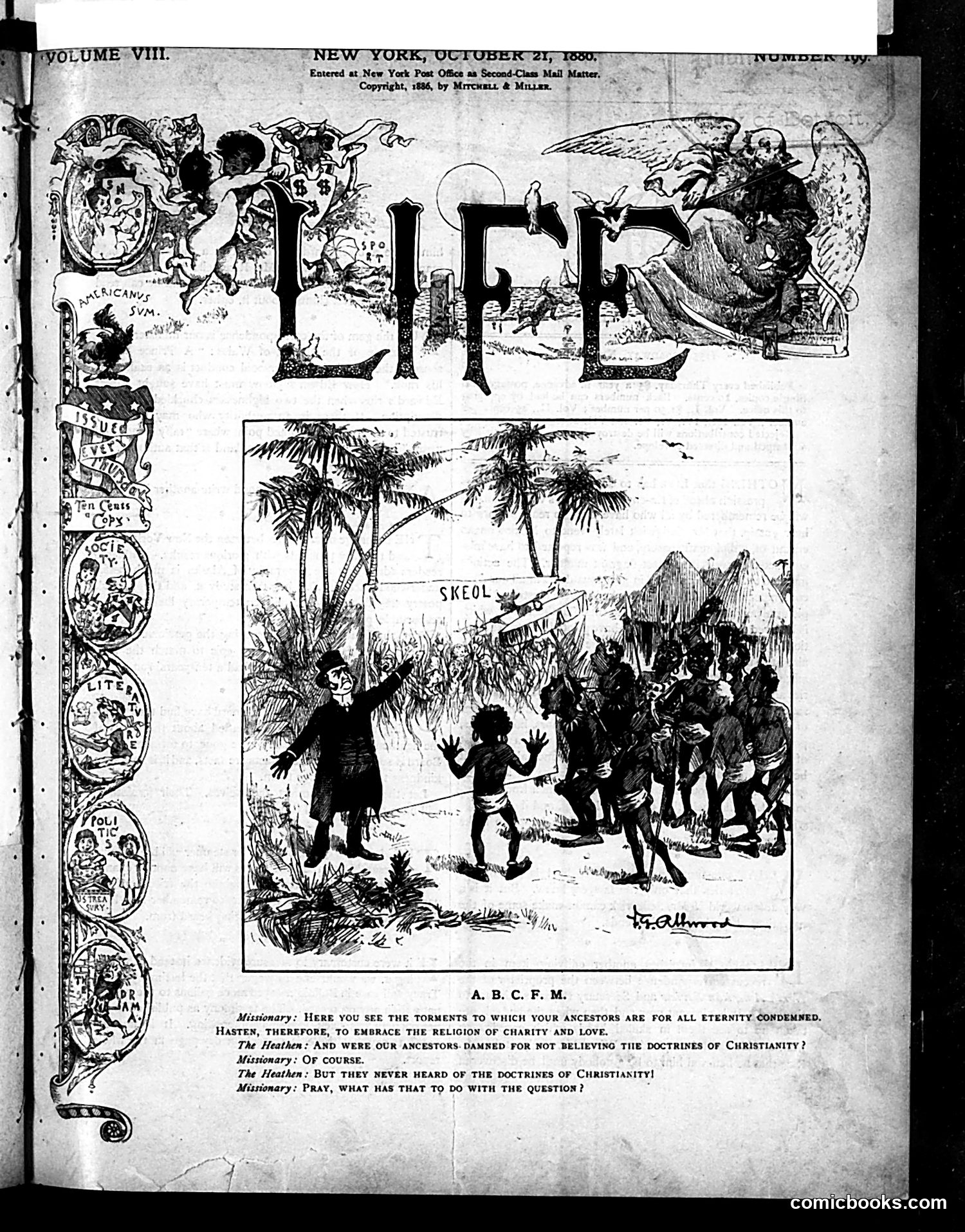
This page satirizes religious missionary work and Christian doctrine through a colonial-era scene. The main illustration depicts what appears to be a missionary (in Western dress, left) encountering indigenous peoples in a tropical setting. The dialogue below mocks the contradiction between Christian teaching and historical practice: a missionary claims ancestors are "condemned" for not embracing Christianity, while a heathen challenges this, noting ancestors "never heard" Christian doctrine. The missionary cannot answer, exposing the logical flaw. The satire targets Christian missionaries' moral certainty about condemning non-believers who had no opportunity to convert. It questions whether condemning people for ignorance aligns with Christian values of "charity and love." The cartoon critiques both missionary arrogance and theological inconsistency.
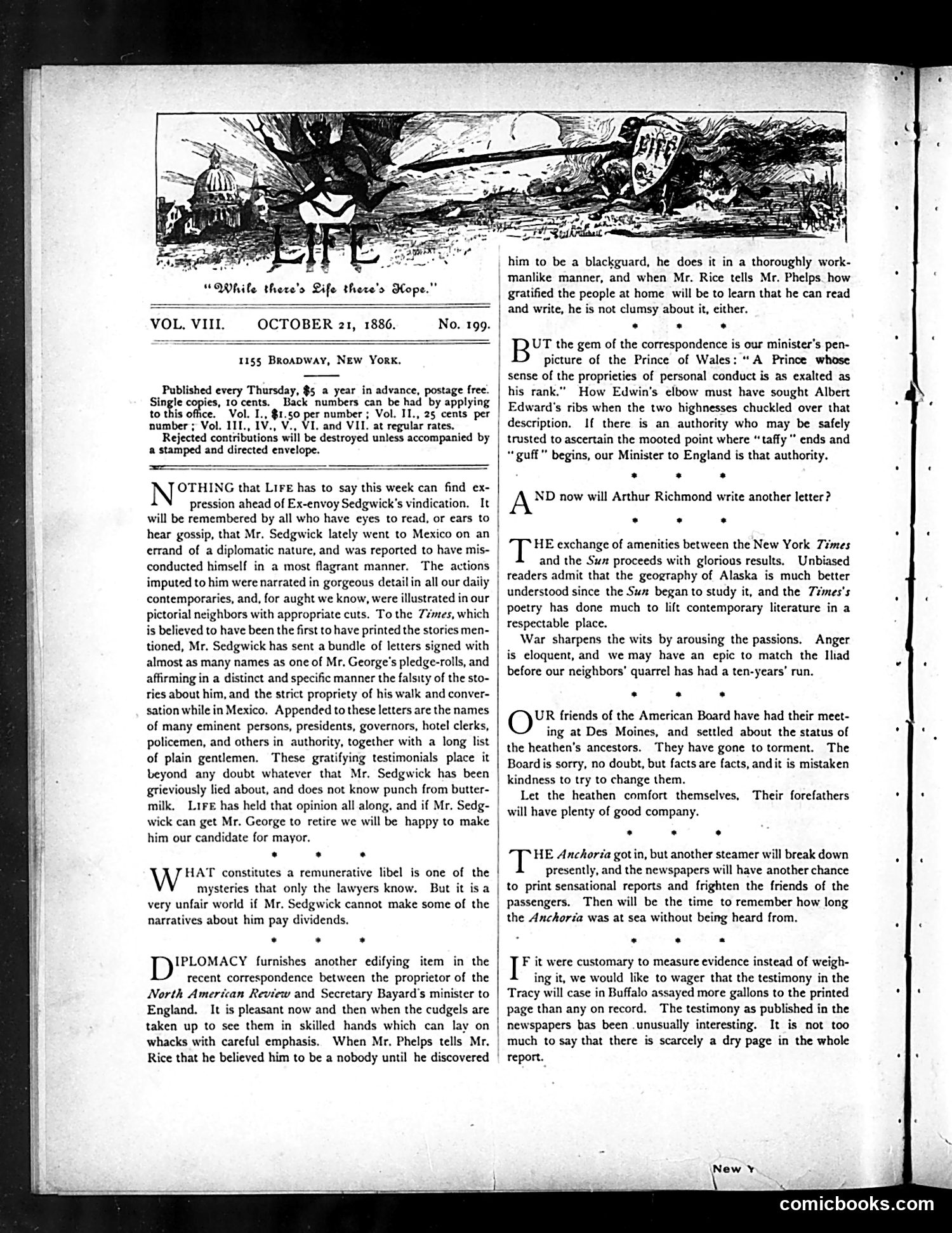
The masthead cartoon shows a bare tree beside classical architecture, illustrating the magazine's title. The page contains editorial commentary rather than political cartoons. The text discusses Ex-envoy Sedgwick's vindication following his conduct in Mexico, praising his dignified behavior. It also covers a dispute between the *New York Times* and the *San Francisco Sun* regarding literary precedent, with the editors suggesting this rivalry could inspire noteworthy writing comparable to classical epics. Additional items address the American Board's status of heathen ancestors (apparently a theological debate) and anticipate future newspaper sensationalism surrounding the steamship *Anchoria*. The final section questions the reliability of testimony in the Tracy case, noting the unusual amount of published evidence. The content reflects 1880s American journalism, diplomatic concerns, and religious controversy.
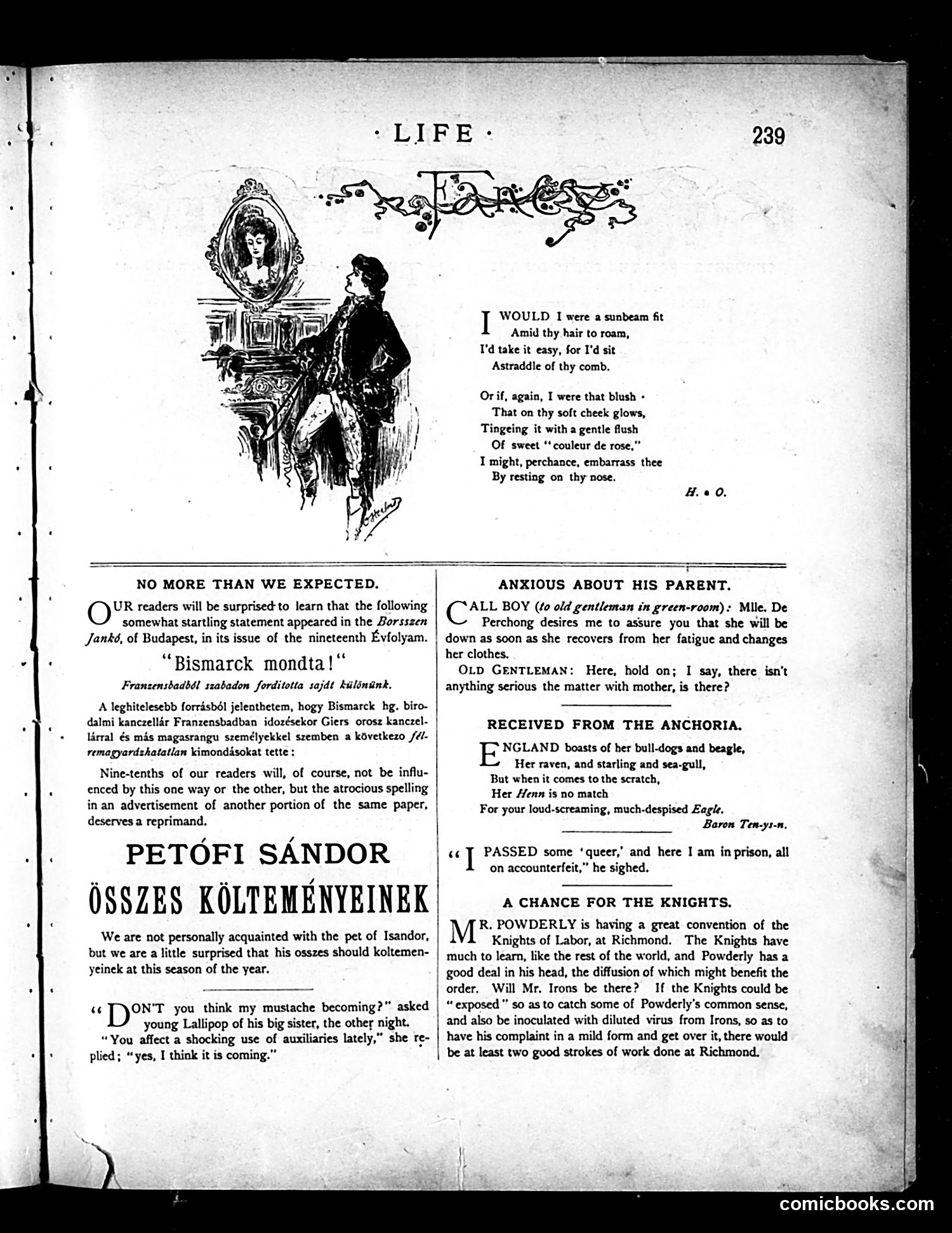
The main cartoon depicts a man admiring himself in a mirror, accompanied by romantic verse wishing to be "a sunbeam" to caress a woman's hair or "that blush" on her cheek. This appears to be satirizing male vanity and self-absorbed romanticism. Below are brief humor items: "Bismarck mondta!" references the German chancellor (likely a Hungarian-language joke); "Petőfi Sándor összes költeményeinek" discusses Hungarian poet Petőfi's works; and other short comedic anecdotes about mustaches, social pretensions, and romantic misadventures. The page is primarily **satirical humor** targeting male narcissism, affected romantic behavior, and social pretension rather than direct political commentary, though historical figures like Bismarck appear as reference points for jokes.
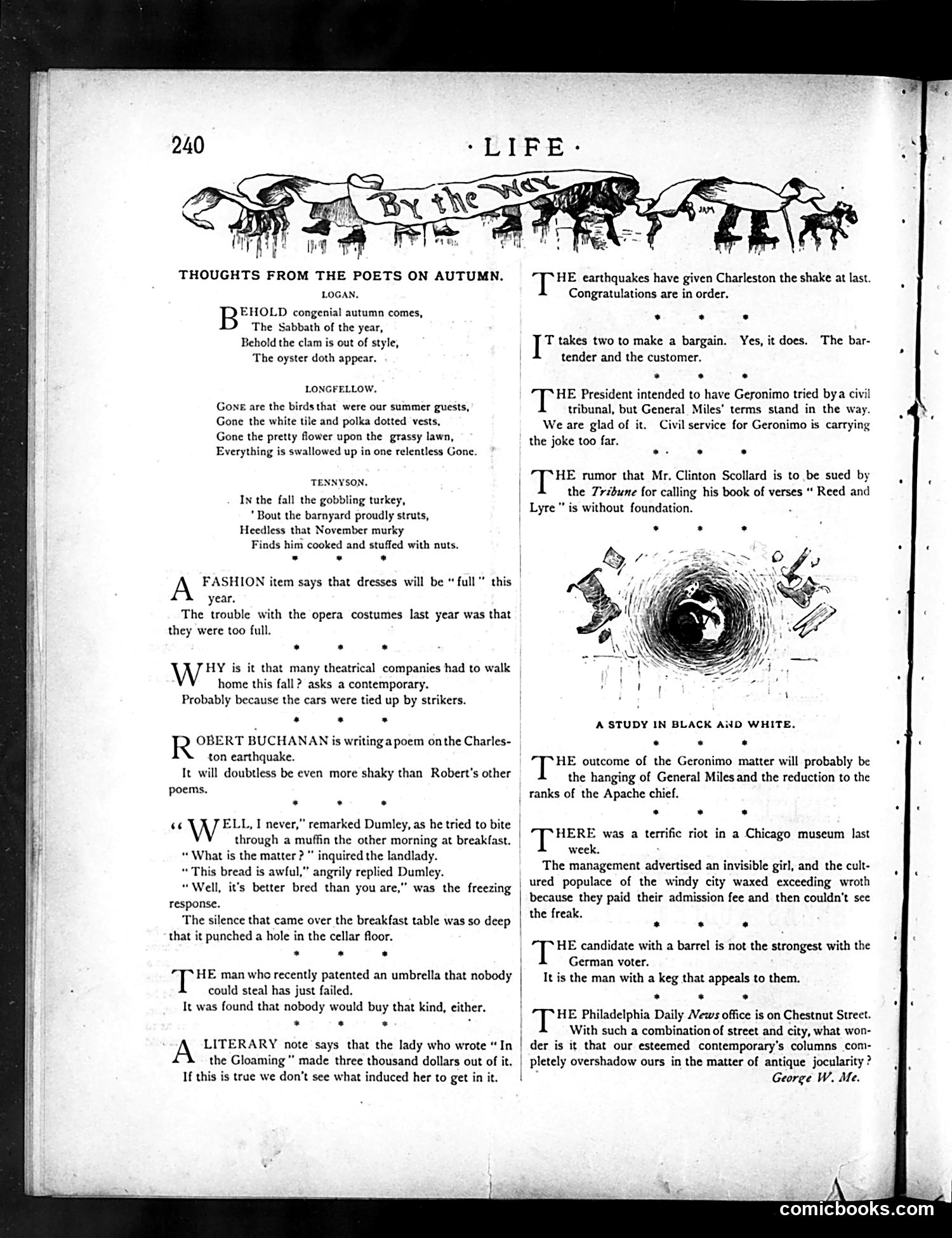
This page contains satirical commentary and humorous anecdotes rather than political cartoons. Key references include: **Charleston Earthquake**: A congratulatory joke about Charleston receiving "the shake at last," likely referencing the 1886 Charleston earthquake. **General Miles/Geronimo**: Multiple items mock President's plan to try Apache chief Geronimo in civil court rather than military tribunal, with commentary suggesting Civil Service is "carrying the joke too far." **Chicago Museum Scandal**: A brief mentions a museum advertising an "invisible girl" exhibit—a scam where patrons paid admission, saw nothing, then couldn't complain without admitting they were fooled. **Fashion & Social Commentary**: Items discuss women's fashion trends and humorous anecdotes about everyday mishaps (umbrella theft, muffin disputes at breakfast). The page exemplifies Life's satirical approach to current events and social absurdities of the era.
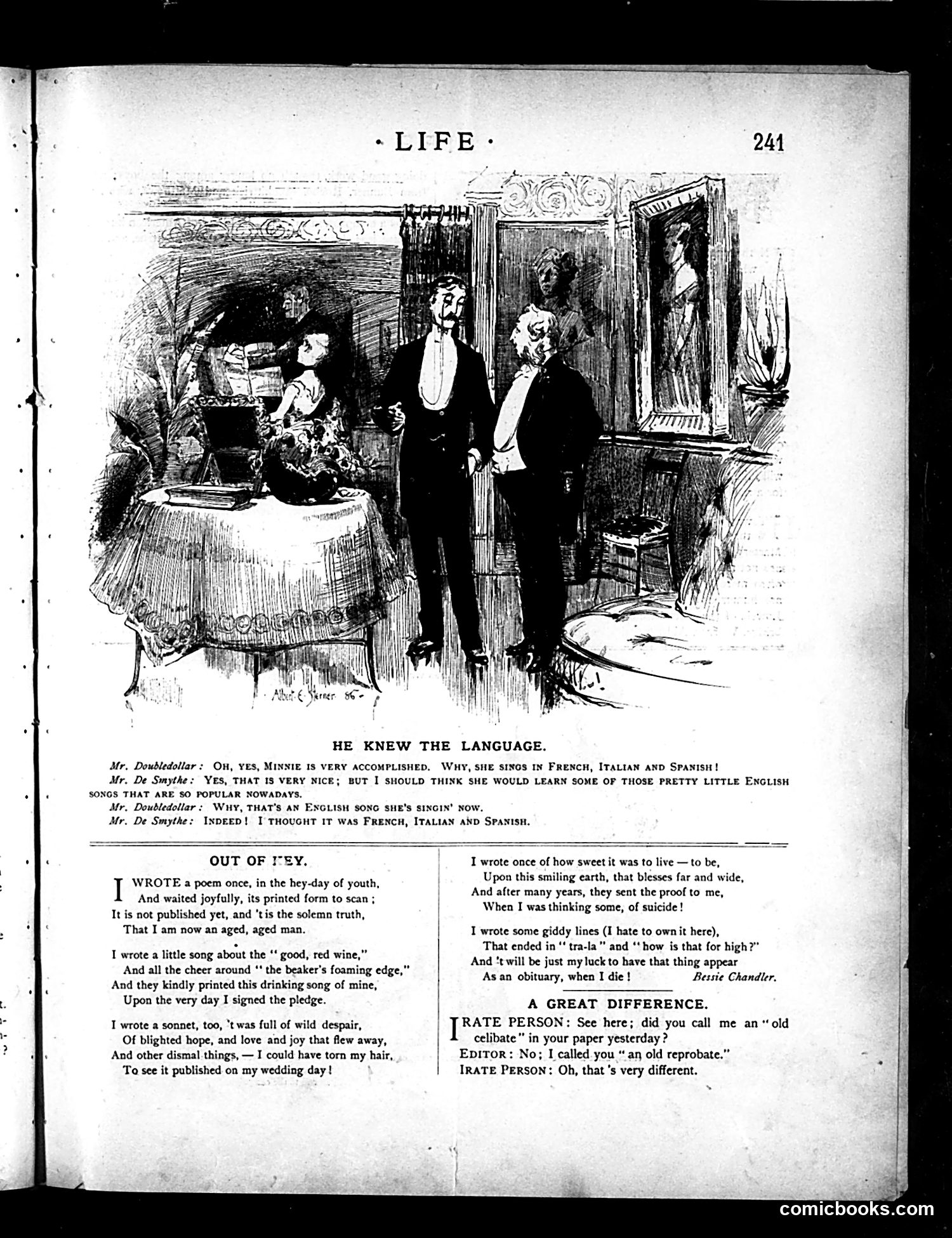
**"He Knew the Language"** depicts a social comedy about linguistic pretension. A man in formal attire stands among well-dressed people in what appears to be a parlor. The dialogue reveals the joke: Mr. Doddlebillar praises a woman named Minnie for singing in French, Italian, and Spanish, suggesting she should learn "pretty little English songs." Mr. De Smythe responds that he thought those *were* French, Italian, and Spanish—implying Minnie was actually singing English songs but doing so with such a poor accent they were unrecognizable. The humor targets both affected musical performers who pretend to sophistication and listeners who lack genuine cultural knowledge to distinguish between languages. It's gentle satire on social pretension and linguistic incompetence among the well-to-do.
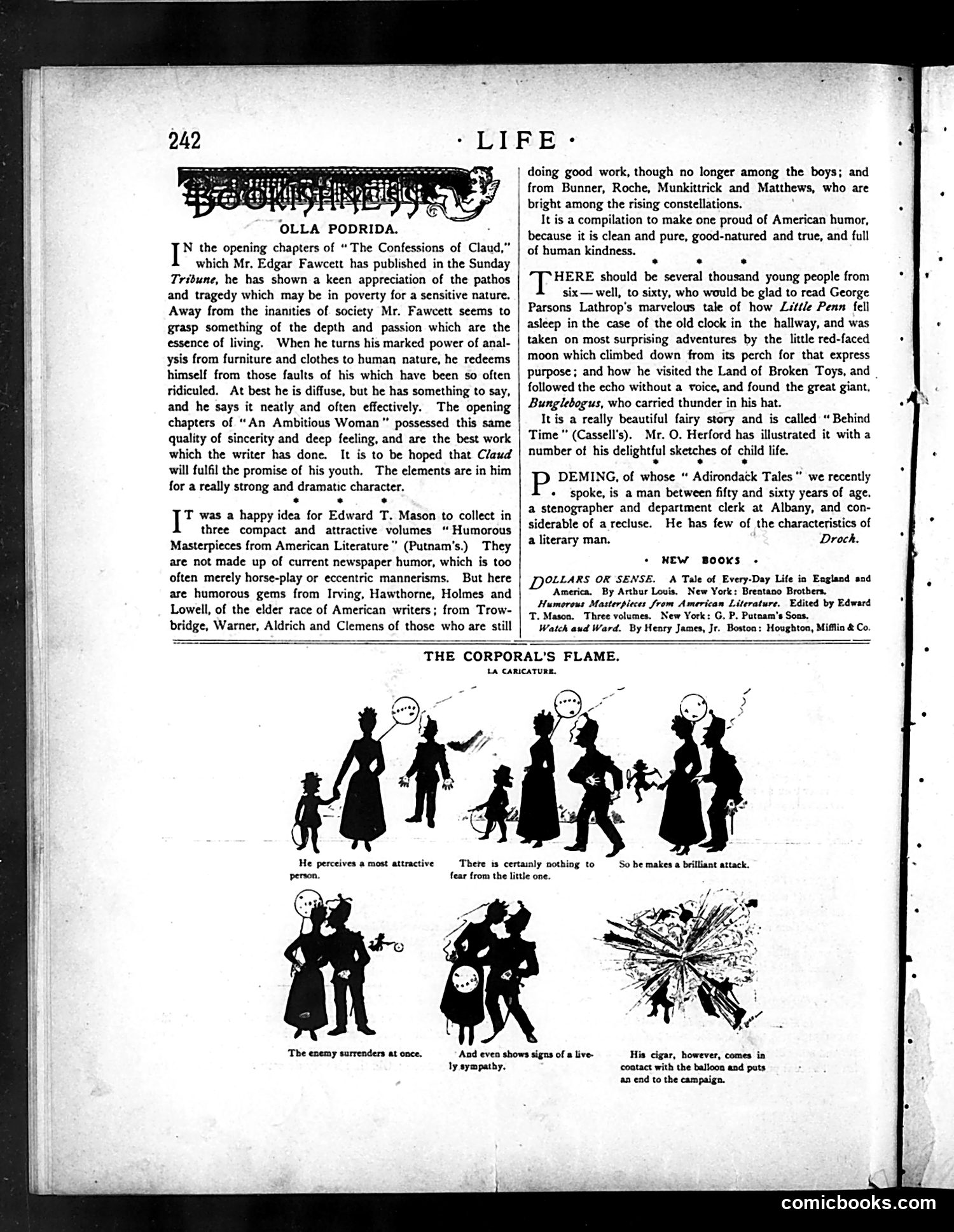
This political cartoon satirizes a military officer's romantic entanglement during wartime. The sequential panels show a uniformed corporal attempting to maintain composure while his romantic interest creates chaos around him—soldiers panic, balloons pop, and his cigar explodes in contact with surrounding objects. The satire appears to mock the distraction of romance during serious military duty. The caption "His cigar, however, comes in contact with the balloon and puts an end to the campaign" suggests the officer's romantic "campaign" fails spectacularly. This reflects early 20th-century concerns about soldiers' focus during wartime, using physical comedy and romantic mishap as social commentary on military discipline versus personal desires.
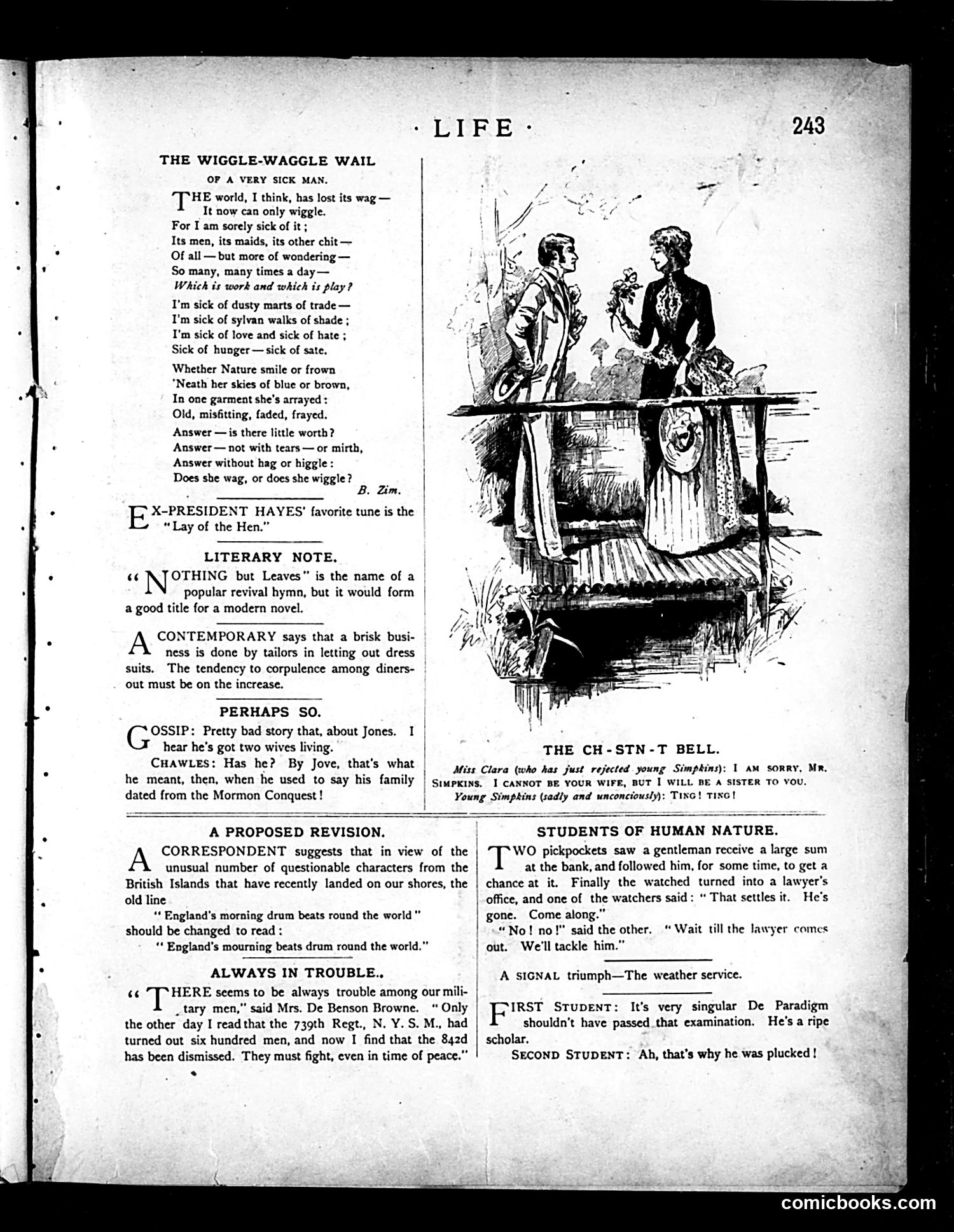
This poem expresses existential exhaustion—the speaker is sick of life's contradictions: "work and play," love and hate, natural fortune and misfortune. The refrain "Which is work and which is play?" and "Does she wag, or does she wiggle?" suggest confusion about meaning and authenticity in modern life. The accompanying illustration shows two figures at a fence, likely depicting casual social interaction—perhaps representing the "sham" relationships the poem critiques. The page contains multiple brief satirical items typical of *Life* magazine: literary commentary, gossip snippets, and humorous observations about contemporary society. "The Chisn't Bell" appears to be a joke about rejecting a marriage proposal. Overall, the content reflects early-20th-century American satirical humor targeting social pretense and modern alienation.
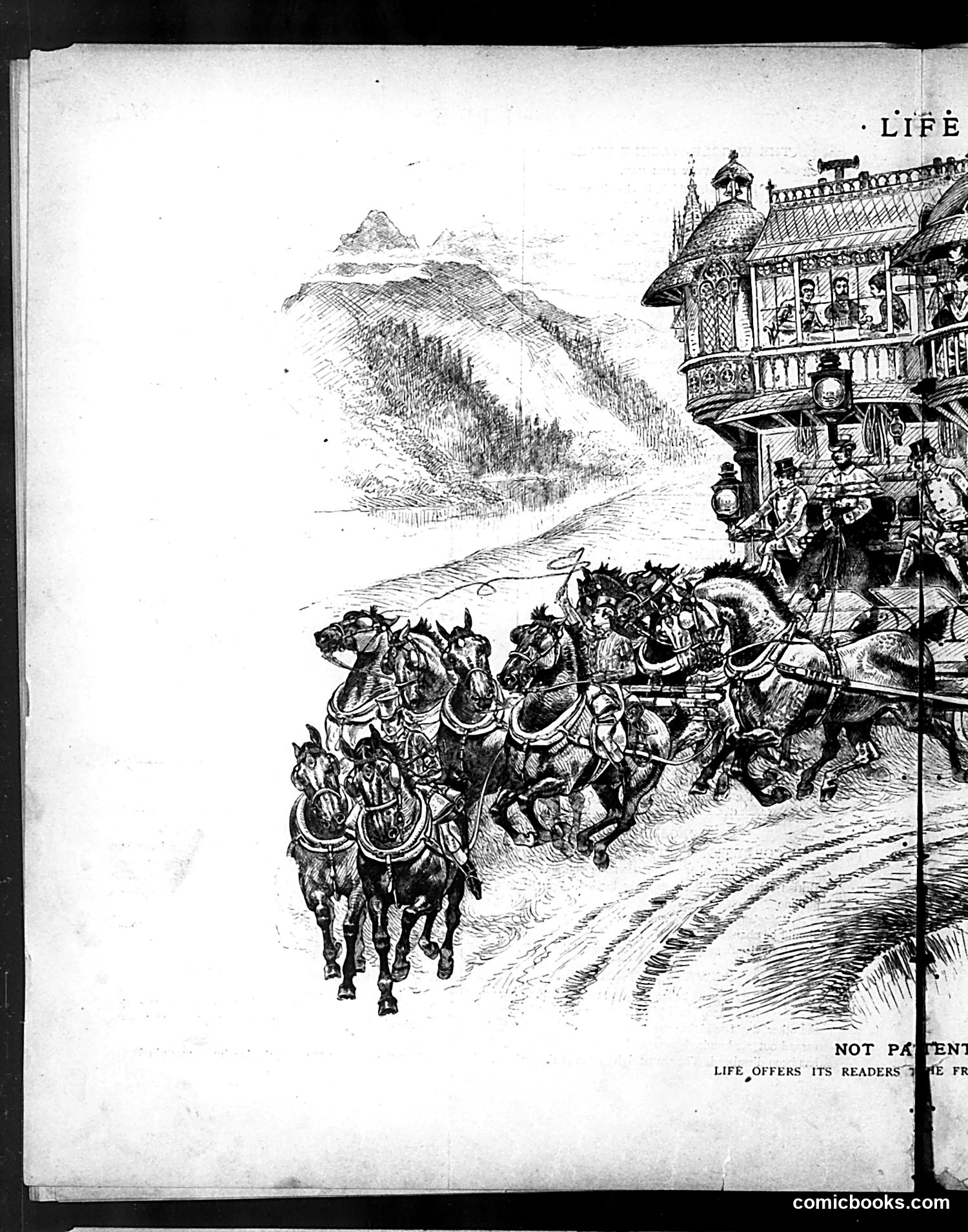
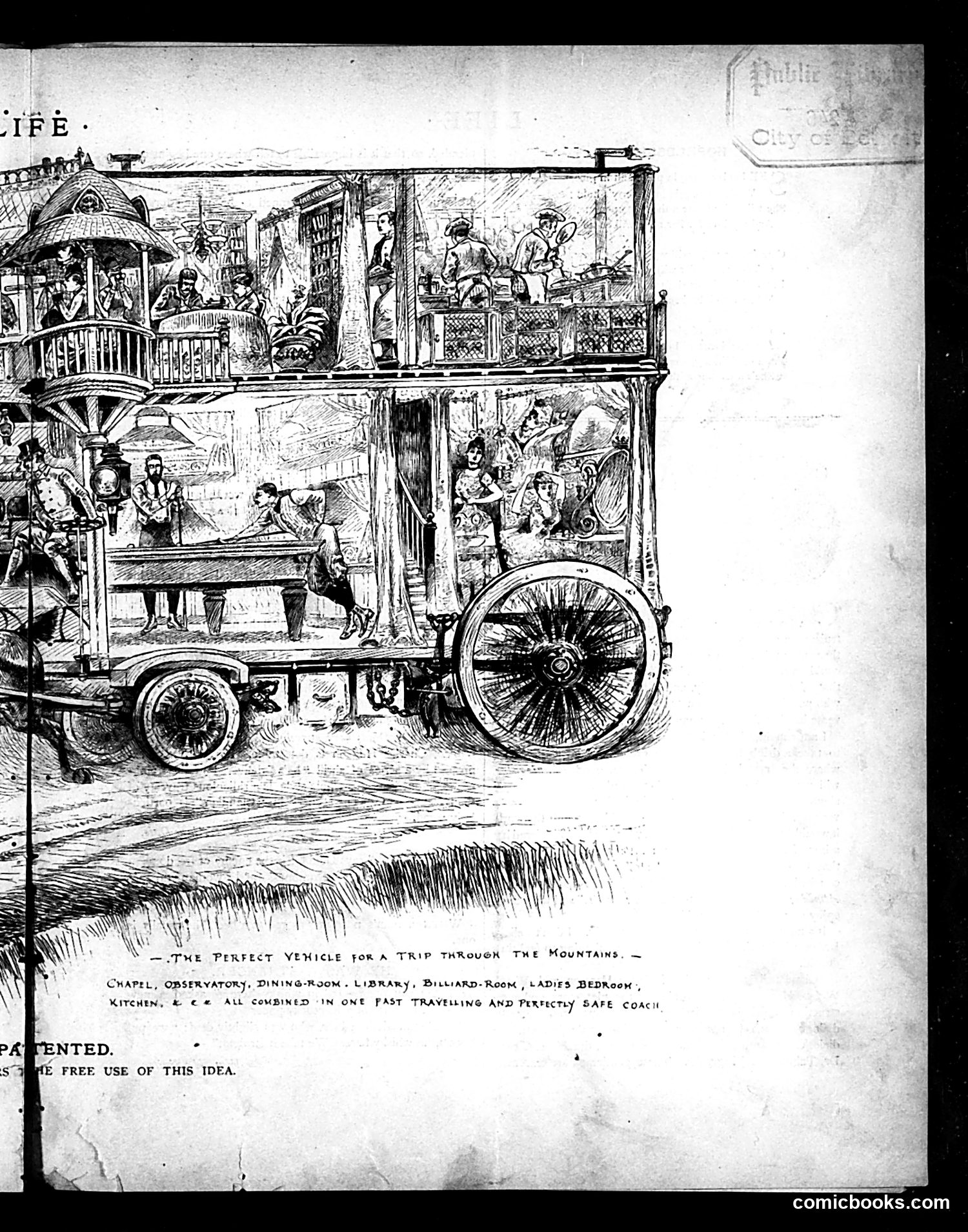
This is a satirical illustration titled "The Perfect Vehicle for a Trip Through the Mountains," depicting an absurdly overcrowded multi-story mobile coach. The vehicle appears to be a wheeled carriage with multiple levels containing various rooms and amenities. The caption lists the included features: "Chapel, Observatory, Dining-Room, Library, Billiard-Room, Ladies' Bedroom, Kitchen, &c &c—All Combined in One Fast Travelling and Perfectly Safe Coach." The satire mocks Victorian-era aspirations for luxury travel and the period's tendency toward grandiose over-engineering. It ridicules the idea of cramming an entire mansion's worth of rooms into a traveling vehicle while maintaining safety and practicality. The joke targets both the excess of wealthy travelers' expectations and the absurd inventions marketed during this era. The notation "PATENTED" at bottom further emphasizes the satire of dubious patent-era schemes.
This page contains literary criticism and humor rather than political cartoons. The main content discusses Henry Herman and W.G. Wills' play "Claudian," praising its dialogue and structure while critiquing the plot as tragic and uninteresting. The page includes a decorative "DRAMA" header and three separate humorous anecdotes at the bottom: 1. A joke about Ouida's quote on women and freedom 2. A quip about a man's red nose 3. A brief exchange between a newspaper reporter and editor about whether whiskey contains an 'e' These short pieces appear designed to provide light entertainment alongside the dramatic criticism. The layout suggests this is a typical late 19th-century "Life" magazine blend of serious cultural commentary mixed with witty filler content.
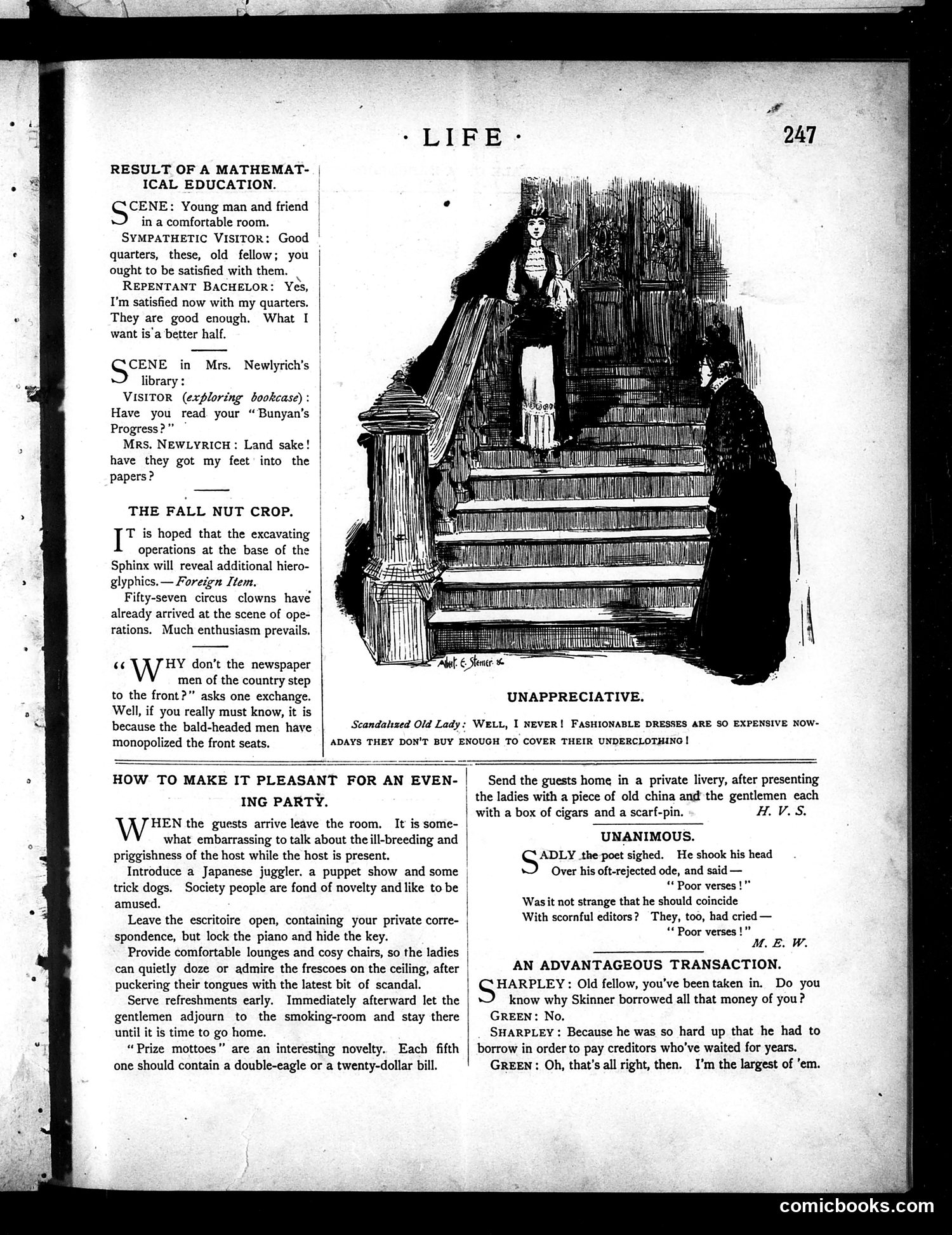
This page from *Life* magazine contains several short satirical pieces mocking American society and manners: **"Result of a Mathematical Education"** jokes about a bachelor satisfied with his living quarters but wanting "a better half" (a wife)—a pun on mathematical fractions. **"Mrs. Newlyrich's Library"** mocks newly wealthy people's pretension: a social climber is embarrassed that visitors might discover she owns *Bunyan's Progress* (likely *Pilgrim's Progress*), implying she purchased books for appearance rather than genuine literacy. **"Unappreciative"** satirizes modern fashion's impracticality—an elderly woman scandalized that expensive dresses provide so little fabric they fail to adequately cover undergarments. **"How to Make It Pleasant for an Evening Party"** offers tongue-in-cheek advice on hosting: entertain guests elaborately to avoid awkward conversation, snoop by leaving correspondence visible, bore ladies with décor-gazing, segregate genders, and ensure refreshments end early—essentially instructions for thoroughly bad hospitality disguised as etiquette. The cartoon depicts a woman ascending ornate stairs—likely illustrating social climbing, a frequent *Life* target.
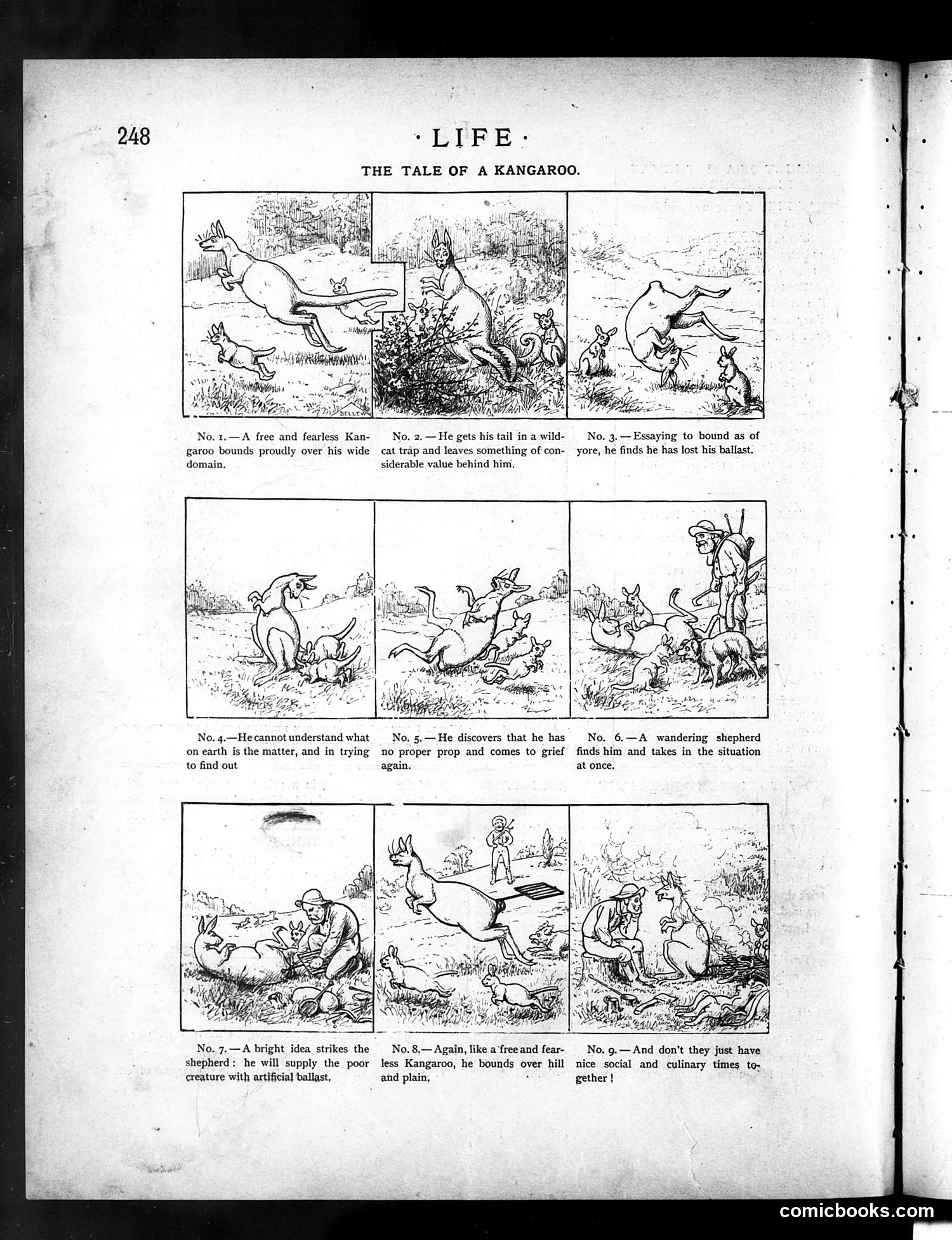
This is a nine-panel satirical comic strip about a kangaroo that loses its tail in a wildcat trap. The tail, being essential to the kangaroo's balance and locomotion ("ballast"), causes the animal to become helpless and confused—it cannot bound properly without this counterweight. A shepherd discovers the distressed kangaroo and has a "bright idea": he fashions an artificial replacement tail/ballast from materials at hand. Once equipped, the kangaroo returns to its natural, joyful state, bounding freely across the landscape. The satire appears to mock human dependency and desperation. The joke's final panel suggests the kangaroo and shepherd now enjoy companionship and meals together—implying that necessity and shared problem-solving create social bonds. The humor lies in treating the kangaroo's plight as analogous to human predicaments where a practical solution restores dignity and happiness.
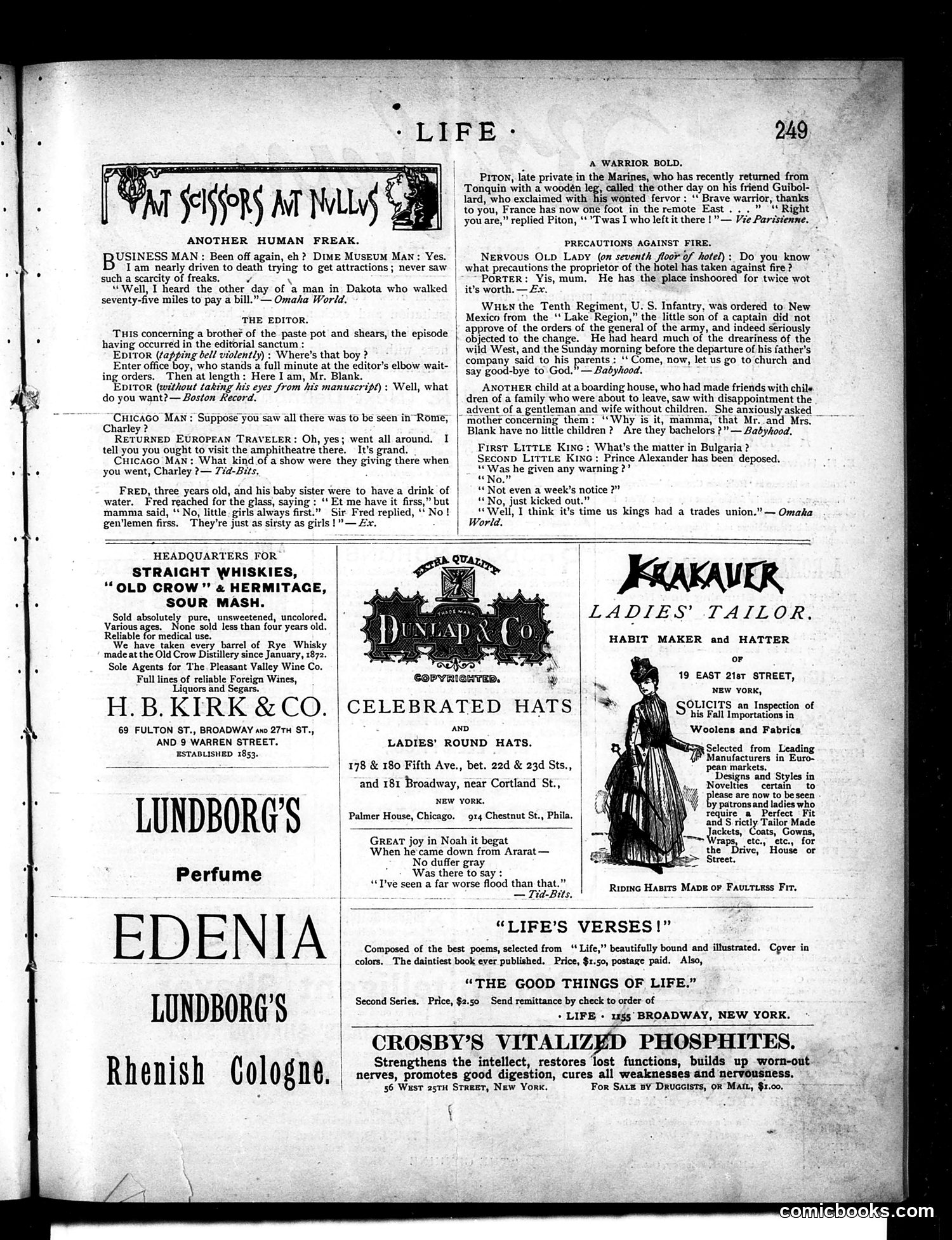
This page is primarily **advertisements and short humor pieces** typical of Life magazine's format. Key satirical content includes: **"Another Human Freak"**: A museum curator complains about finding attractions, then marvels that a Dakota man walked 75 miles to *pay a bill*—suggesting this is so unusual it qualifies as a "freak." The satire mocks both the rarity of financial responsibility and the absurdity of dime museum standards. **"Precautions Against Fire"**: Dark humor about a hotel owner insuring property for *twice* its value against fire—implying insurance fraud or that he actually *wants* a fire. **"Trades Union for Kings"**: Two child monarchs discuss Prince Alexander of Bulgaria's recent deposition. One jokes they need a "trades union" for job protection. This references contemporary labor organizing while satirizing monarchs as ordinary workers deserving workplace protections. The remaining pieces are brief observational humor about children, editors, and travelers. The bulk of the page consists of period advertisements for whiskey, hats, and cologne.
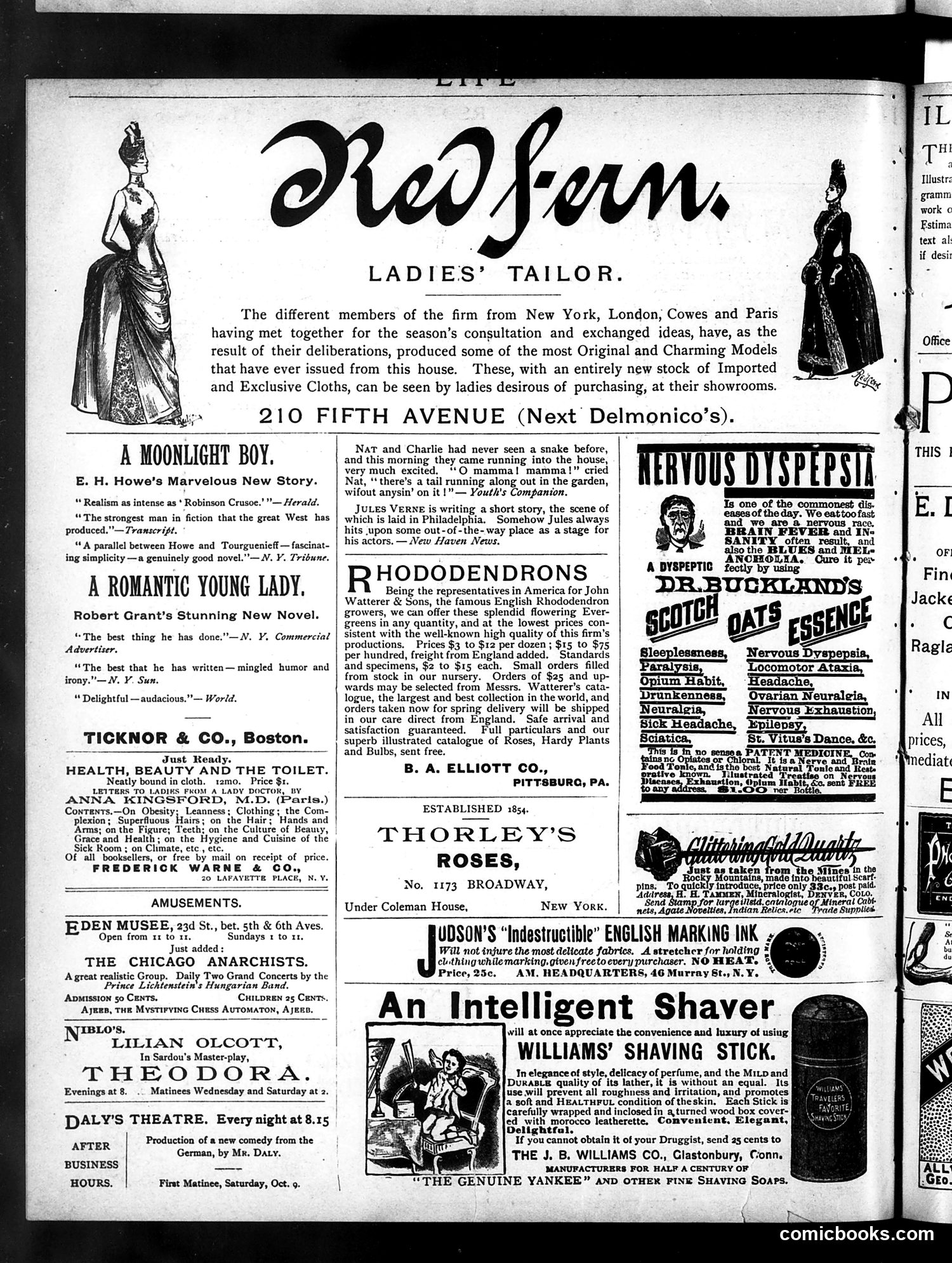
This page is primarily **advertisements and literary notices** with minimal editorial content. The layout includes: **Main Advertisements:** - Red Fern Ladies' Tailor (top) advertising fashionable clothing from international designers - Book publishers (Ticknor & Co., Frederick Warne & Co.) promoting new novels - Health/beauty book by a lady doctor - Flower nurseries (rhododendrons, roses) - Theater notices for various productions **Amusement Section** lists performances including "The Chicago Anarchists"—a wax museum exhibit at Eden Musee, reflecting contemporary public fascination with the recent Haymarket affair (1886), when anarchist violence was a major national concern. **Minor Content:** Small anecdotes about Jules Verne and children encountering a snake (from Youth's Companion) appear as filler. The page reflects **Gilded Age consumer culture**: luxury goods, imported fashions, intellectual pursuits (novels), and theatrical entertainment targeting educated, affluent readers. There is no political cartoon present.
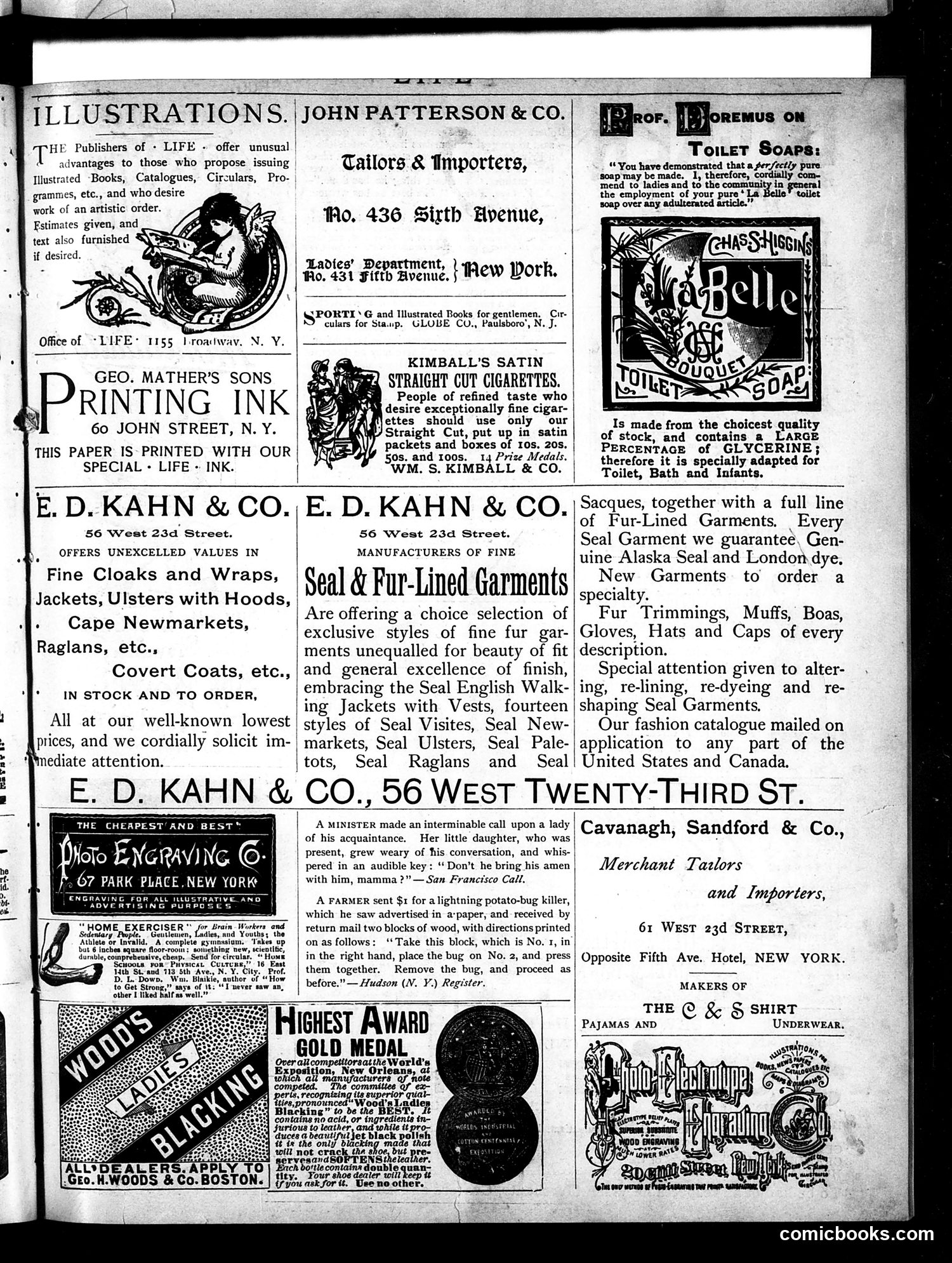
This is primarily an advertising page from Life magazine, with brief humorous anecdotes at the bottom rather than political cartoons. The two short jokes illustrate common turn-of-the-century concerns: one mocks a minister's tediously long social call (a familiar annoyance to families), and the other satirizes mail-order advertising fraud. The "lightning potato-bug killer" scam—where a farmer pays for an advertised product but receives only two wooden blocks with useless instructions—represents the period's widespread problem of fraudulent patent medicines and dubious mail-order gadgets that preyed on rural consumers. These anecdotes served as social commentary on both religious excess and consumer gullibility. The page is dominated by advertisements for tailors, fur garments, printing services, and specialty items like satin cigarettes and toilet soap, reflecting late 19th-century consumer culture.
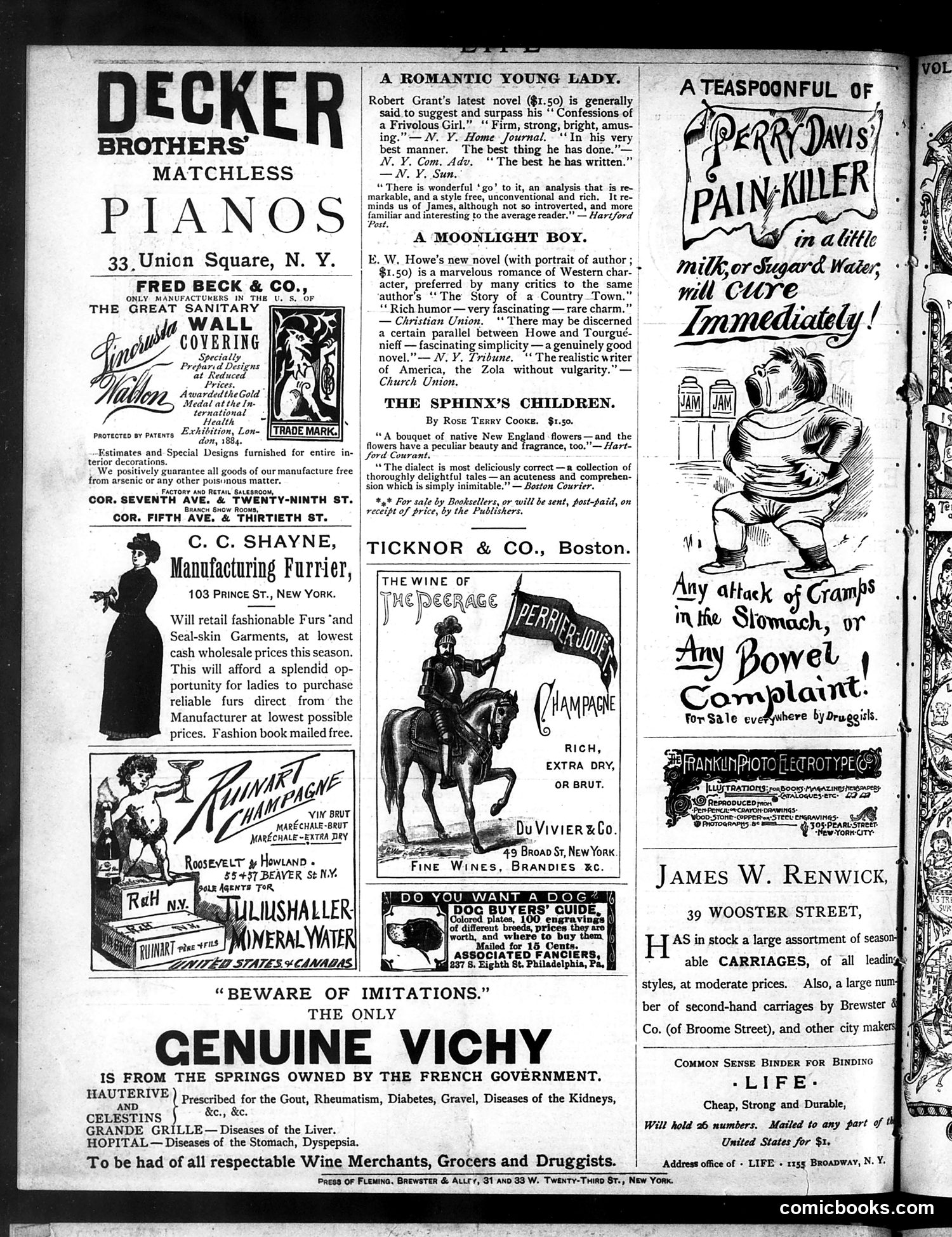
This is primarily an advertising page from *Life* magazine, with no significant political cartoons or satire. The page consists almost entirely of commercial advertisements typical of the late 19th century. The main content includes ads for: - Decker Brothers pianos - Fred Beck & Co.'s "sanitary wall covering" (notably advertised as arsenic-free—a health concern of the era) - C.C. Shayne's fur business - Book reviews promoting novels by Robert Grant, E.W. Howe, and Rose Terry Cooke - Wine and champagne merchants - Perry Davis Pain-Killer (a patent medicine) - James W. Renwick's carriage business - Vichy water (mineral water for health ailments) The only visual humor appears in the Perry Davis ad featuring an illustrated baby, which uses exaggerated imagery typical of patent medicine advertising. The page reflects consumer culture and health anxieties of the Gilded Age rather than political satire.