
Life, 1886-10-21 · page 7 of 16
Life — October 21, 1886 — page 7: what you’re looking at
What you’re looking at
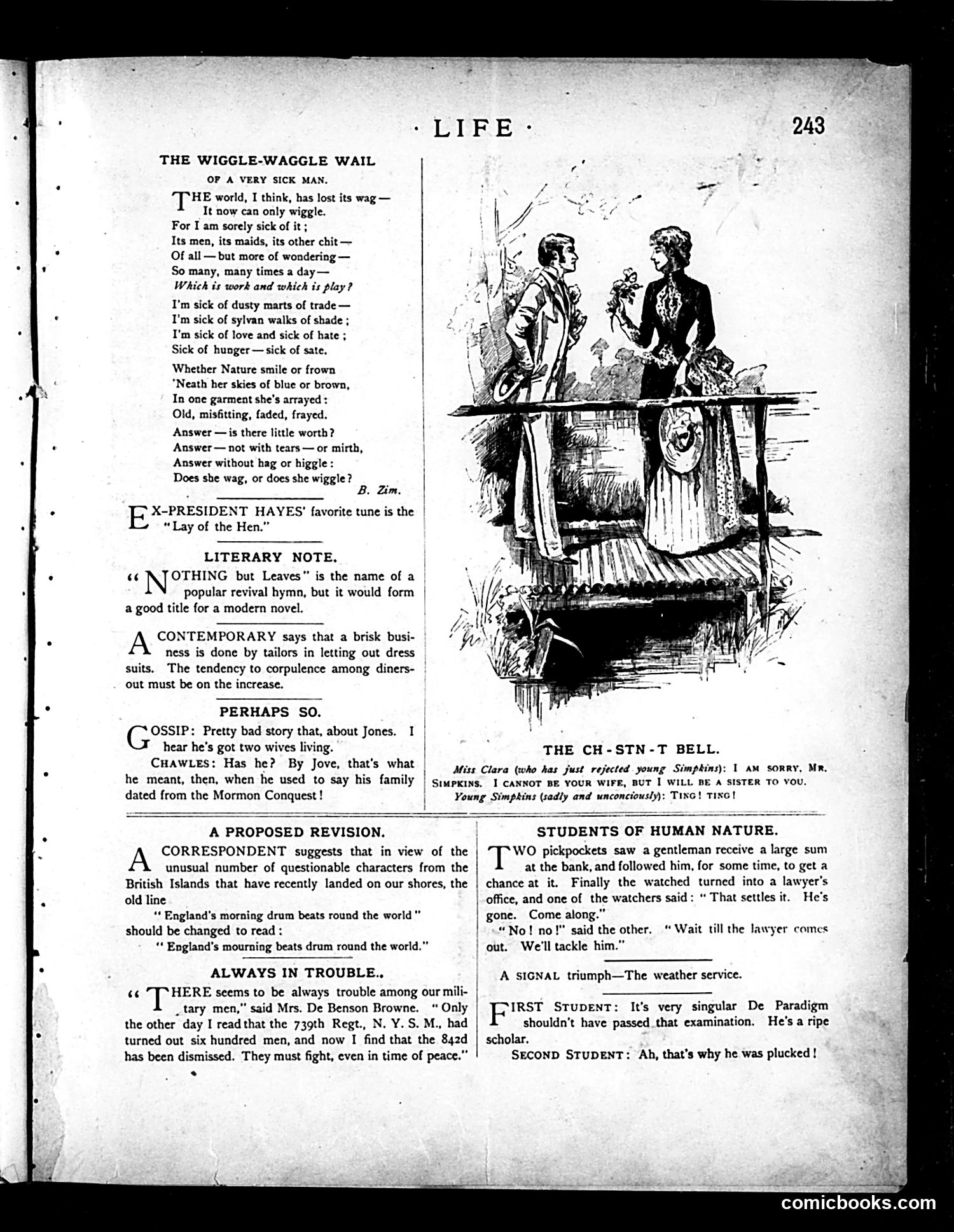
This poem expresses existential exhaustion—the speaker is sick of life's contradictions: "work and play," love and hate, natural fortune and misfortune. The refrain "Which is work and which is play?" and "Does she wag, or does she wiggle?" suggest confusion about meaning and authenticity in modern life. The accompanying illustration shows two figures at a fence, likely depicting casual social interaction—perhaps representing the "sham" relationships the poem critiques. The page contains multiple brief satirical items typical of *Life* magazine: literary commentary, gossip snippets, and humorous observations about contemporary society. "The Chisn't Bell" appears to be a joke about rejecting a marriage proposal. Overall, the content reflects early-20th-century American satirical humor targeting social pretense and modern alienation.
📄 Transcribed text from this page (OCR, searchable)
Machine-transcribed from the original scan — historical spelling and the odd misread are preserved.
THE WIGGLE-WAGGLE WAIL OF A VERY SICK MAN. THE world, I think, has lost its wag — It now can only wiggle. For I am sorely sick of it; Its men, its maids, its other chit — Of all — but more of wondering — So many, many times a day— Which is work and which is play? I'm sick of dusty marts of trade — I'm sick of sylvan walks of shade ; I'm sick of love and sick of hate ; Sick of hunger — sick of sate, Whether Nature smile or frown "Neath her skies of blue or brown, In one garment she's arrayed : Old, misfitting, faded, frayed. Answer — is there little worth? Answer — not with tears — or mirth, Answer without hag or higgle: Does she wag, or does she wiggle? . B. Zim. X-PRESIDENT HAYES’ favorite tune is the | “ Lay of the Hen.” LITERARY NOTE, 6“ OTHING but Leaves” is the name of a popular revival hymn, but it would form a good title for a modern novel. CONTEMPORARY says that a brisk busi- ness is done by tailors in letting out dress suits. The tendency to corpulence among diners- out must be on the increase. PERHAPS SO. OSSIP: Pretty bad story that, about Jones. I | hear he's got two wives living. CHAWLES: Has he? By Jove, that's what | he meant, then, when he used to say his family | dated from the Mormon Conquest ! THE CH-STN-T BELL. Miss Clara (who has just rejected young Simpkins): 1 am sorry, Mr. StMPKINS, Young Simpkins (sadly and unconctously): TING! TIN! I CANNOT BE YOUR WIFE, BUT I WILL BE A SISTER TO YOU. A PROPOSED REVISION. CORRESPONDENT suggests that in view of the unusual number of questionable characters from the British Islands that have recently landed on our shores, the old line ‘* England's morning drum beats round the world" should be changed to read: “* England's mourning beats drum round the world.” ALWAYS IN TROUBLE.. “cc HERE seems to be always trouble among our mili- | _ tary men,” said Mrs. De Benson Browne. “ Only the other day I readthat the 739th Regt., N. Y. S. M., had turned out six hundred men, and now I find that the 842d has been dismissed. They must fight, even in time of peace.” . 1 STUDENTS OF HUMAN NATURE. i) RE pickpockets saw a gentleman receive a large sum at the bank, and followed him, for some time, to get a | chance at it. Finally the watched turned into a lawyer's | office, and one of the watchers said: “ That settles it. He's | gone. Come along.” “No! no!” said the other. | out. We'll tackle him.” “Wait till the lawyer comes A SIGNAL triumph—The weather service. IRST STUDENT: It’s very singular De Paradigm shouldn't have passed that examination. He's a ripe scholar. SECOND STUDENT: Ah, that’s why he was plucked ! comicbooks.com