
Life, 1886-10-21 · page 10 of 16
Life — October 21, 1886 — page 10: what you’re looking at
What you’re looking at
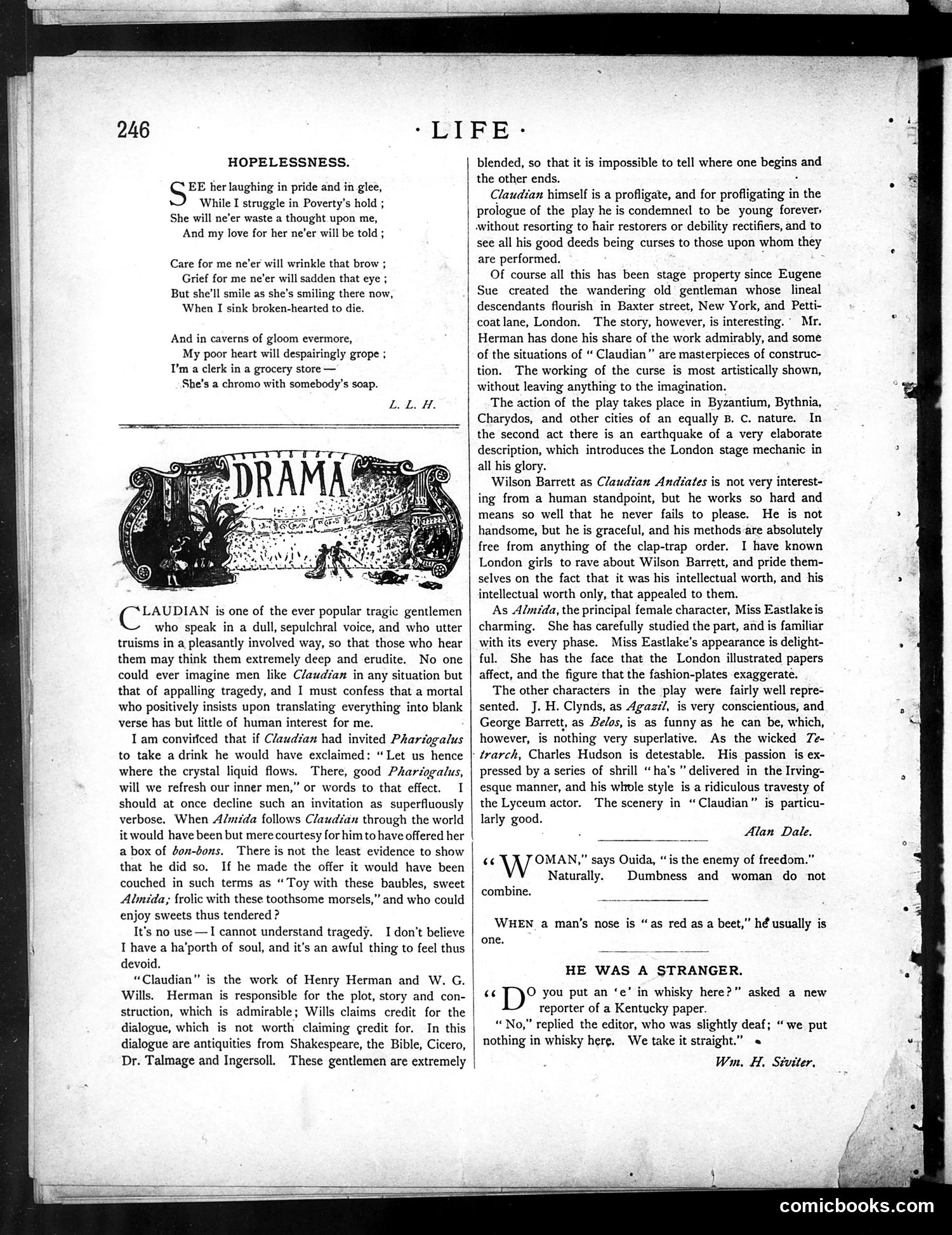
This page contains literary criticism and humor rather than political cartoons. The main content discusses Henry Herman and W.G. Wills' play "Claudian," praising its dialogue and structure while critiquing the plot as tragic and uninteresting. The page includes a decorative "DRAMA" header and three separate humorous anecdotes at the bottom: 1. A joke about Ouida's quote on women and freedom 2. A quip about a man's red nose 3. A brief exchange between a newspaper reporter and editor about whether whiskey contains an 'e' These short pieces appear designed to provide light entertainment alongside the dramatic criticism. The layout suggests this is a typical late 19th-century "Life" magazine blend of serious cultural commentary mixed with witty filler content.
📄 Transcribed text from this page (OCR, searchable)
Machine-transcribed from the original scan — historical spelling and the odd misread are preserved.
-LIFE- HOPELESSNESS. EE her laughing in pride and in glee, While I struggle in Poverty’s hold ; She will ne’er waste a thought upon me, And my love for her ne’er will be told ; Care for me ne’er will wrinkle that brow ; Grief for me ne’er will sadden that eye ; But she'll smile as she’s smiling there now, When I sink broken-hearted to die. And in caverns of gloom evermore, My poor heart will despairingly grope ; I'm a clerk in a grocery store — She's a chromo with somebody's soap. LAUDIAN is one of the ever popular tragic gentlemen who speak in a dull, sepulchral voice, and who utter truisms in a pleasantly involved way, so that those who hear them may think them extremely deep and erudite. No one could ever imagine men like C/audan in any situation but that of appalling tragedy, and I must confess that a mortal who positively insists upon translating everything into blank verse has but little of human interest for me. I am convirlced that if C/audzan had invited Phartogalus to take adrink he would have exclaimed: “Let us hence where the crystal liquid flows. There, good Phartogalus, will we refresh our inner men,” or words to that effect. I should at once decline such an invitation as superfluously verbose. When A/mzda follows Claudian through the world it would have been but mere courtesy for him to have offered her a box of don-dons. There is not the least evidence to show that he did so. If he made the offer it would have been couched in such terms as “Toy with these baubles, sweet Almida; frolic with these toothsome morsels,” and who could enjoy sweets thus tendered ? It's no use —I cannot understand tragedy. I don't believe I have a ha’porth of soul, and it’s an awful thing to feel thus devoid. “Claudian” is the work of Henry Herman and W. G. Wills. Herman is responsible for the plot, story and con- struction, which is admirable; Wills claims credit for the dialogue, which is not worth claiming ¢redit for. In this dialogue are antiquities from Shakespeare, the Bible, Cicero, Dr. Talmage and Ingersoll. These gentlemen are extremely blended, so that it is impossible to tell where one begins and the other ends. ¢ Claudian himself is a profligate, and for profligating in the prologue of the play he is condemned to be young forever: | without resorting to hair restorers or debility rectifiers, and to see all his good deeds being curses to those upon whom they are performed. 3 Of course all this has been stage property since Eugene Sue created the wandering old gentleman whose lineal descendants flourish in Baxter street, New York, and Petti- coat lane, London. The story, however, is interesting. Mr. Herman has done his share of the work admirably, and some of the situations of “ Claudian” are masterpieces of construc- tion. The working of the curse is most artistically shown, without leaving anything to the imagination. The action of the play takes place in Byzantium, Bythnia, Charydos, and other cities of an equally B. C. nature. In the second act there is an earthquake of a very elaborate description, which introduces the London stage mechanic in all his glory. Wilson Barrett as Claudian Andiates is not very interest- ing from a human standpoint, but he works so hard and means so well that he never fails to please. He is not handsome, but he is graceful, and his methods are absolutely free from anything of the clap-trap order. I have known London girls to rave about Wilson Barrett, and pride them- selves on the fact that it was his intellectual worth, and his intellectual worth only, that appealed to them. As Almida, the principal female character, Miss Eastlake is charming. She has carefully studied the part, and is familiar with its every phase. Miss Eastlake’s appearance is delight- ful. She has the face that the London illustrated papers affect, and the figure that the fashion-plates exaggerate. The other characters in the play were fairly well repre- sented. J. H. Clynds, as Agazz?, is very conscientious, and George Barrett, as Be/os, is as funny as he can be, which, however, is nothing very superlative. As the wicked Ze- trarch, Charles Hudson is detestable. His passion is ex- pressed by a series of shrill “ha’s ” delivered in the Irving- esque manner, and his whole style is a ridiculous travesty of the Lyceum actor. The scenery in “Claudian” is particu- larly good. Alan Dale. 6c OMAN,” says Ouida, “is the enemy of freedom.” Naturally. © Dumbness and woman do not combine. WHEN a man’s nose is “as red as a beet,” hé usually is one. HE WAS A STRANGER. 73 O you put an ‘e’ in whisky here?” asked a new reporter of a Kentucky paper. “No,” replied the editor, who was slightly deaf; “we put nothing in whisky here. We take it straight.” « Wm. H, Siviter, comicbooks.com