
Life, 1886-10-21 · page 2 of 16
Life — October 21, 1886 — page 2: what you’re looking at
What you’re looking at
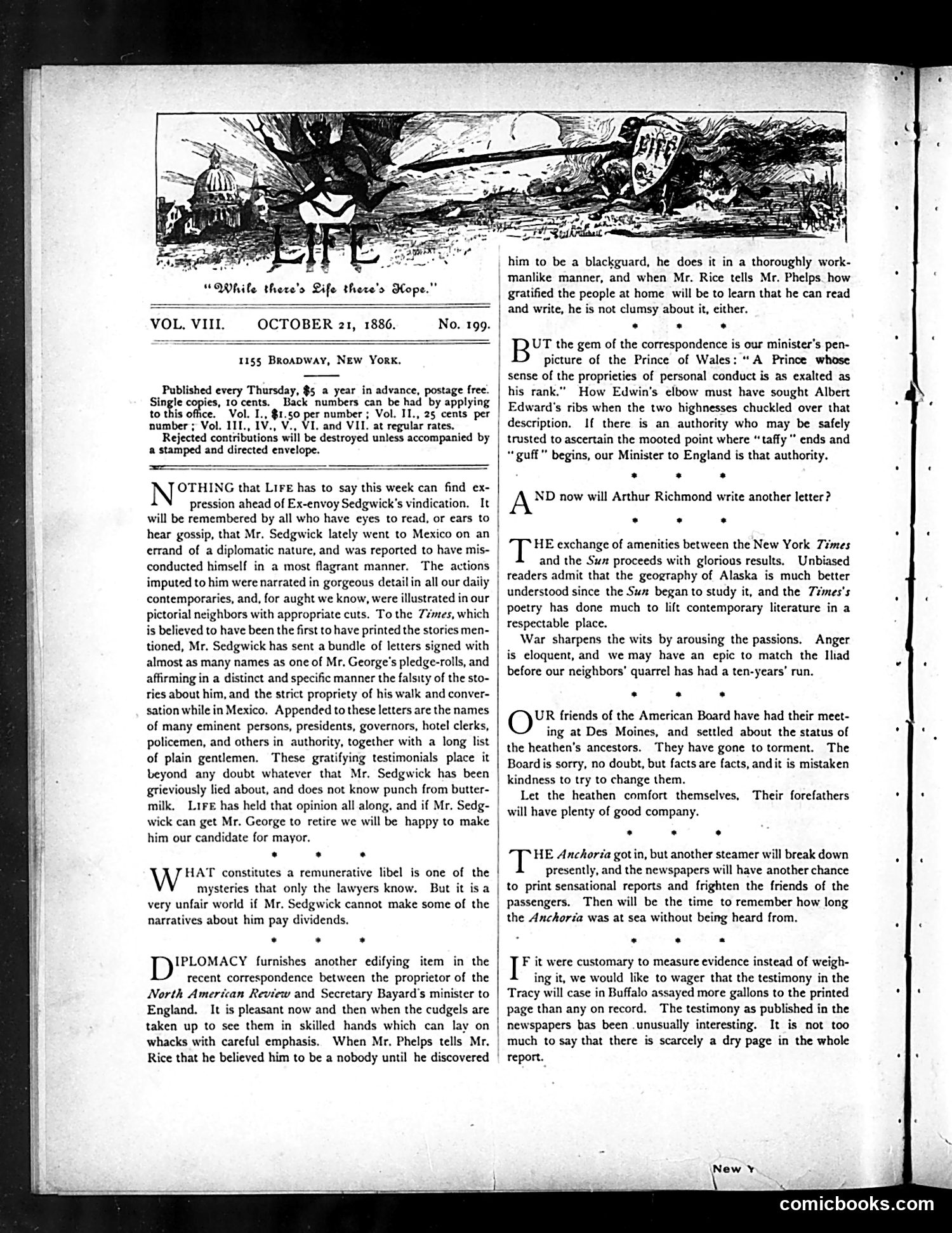
The masthead cartoon shows a bare tree beside classical architecture, illustrating the magazine's title. The page contains editorial commentary rather than political cartoons. The text discusses Ex-envoy Sedgwick's vindication following his conduct in Mexico, praising his dignified behavior. It also covers a dispute between the *New York Times* and the *San Francisco Sun* regarding literary precedent, with the editors suggesting this rivalry could inspire noteworthy writing comparable to classical epics. Additional items address the American Board's status of heathen ancestors (apparently a theological debate) and anticipate future newspaper sensationalism surrounding the steamship *Anchoria*. The final section questions the reliability of testimony in the Tracy case, noting the unusual amount of published evidence. The content reflects 1880s American journalism, diplomatic concerns, and religious controversy.
📄 Transcribed text from this page (OCR, searchable)
Machine-transcribed from the original scan — historical spelling and the odd misread are preserved.
“While there's Life there's Hope.” VOL. VIII. OCTOBER 21, 1886. No. 199. 1155 BroaDway, New York. Published every Thursday, $5 a year in advance, postage free. Single copies, 10 cents. Back numbers can be had by applying to this ofhce. Vol. I., $1.50 per number ; Vol. II., 25 cents per number ; Vol. III., IV., V., VI. and VII. at regular rates. Rejected contributions will be destroyed unless accompanied by a stamped and directed envelope. =—— =< = OTHING that Lire has to say this week can find ex- pression ahead of Ex-envoy Sedgwick's vindication, It | will be remembered by all who have eyes to read, or ears to | hear gossip, that Mr. Sedgwick lately went to Mexico on an | errand of a diplomatic nature, and was reported to have mis- conducted himself in a most flagrant manner. The actions | imputed to him were narrated in gorgeous detail in all our daily contemporaries, and, for aught we know, were illustrated in our pictorial neighbors with appropriate cuts. To the 7zmes, which is believed to have been the first to have printed the storics men- tioned, Mr. Sedgwick has sent a bundle of letters signed with almost as many names as one of Mr. George's pledge-rolls, and affirming in a distinct and specific manner the falsity of the sto- ries about him, and the strict propriety of his walk and conver- sation while in Mexico. Appended to these letters are the names. of many eminent persons, presidents, governors, hotel clerks, policemen, and others in authority, together with a long list of plain gentlemen. These gratifying testimonials place it Ueyond any doubt whatever that Mr. Sedgwick has been grieviously lied about, and does not know punch from butter- milk, Lire has held that opinion all along. and if Mr. Sedg- wick can get Mr. George to retire we will be happy to make him our candidate for mayor. . . . HAT constitutes a remunerative libel is one of the mysteries that only the lawyers know. But it is a very unfair world if Mr. Sedgwick cannot make some of the narratives about him pay dividends. . . * IPLOMACY furnishes another edifying item in the recent correspondence between the proprietor of the North American Review and Secretary Bayard’s minister to England. It is pleasant now and then when the cudgels are taken up to see them in skilled hands which can lay on whacks with careful emphasis. When Mr. Phelps tells Mr. Rice that he believed him to be a nobody until he discovered him to be a blackguard, he does it in a thoroughly work- manlike manner, and when Mr. Rice tells Mr. Phelps. how gratified the people at home will be to learn that he can read and write, he is not clumsy about it, either. . . . UT the gem of the correspondence is our minister's pen- picture of the Prince of Wales: “A Prince whose sense of the proprieties of personal conduct is as exalted as his rank.” How Edwin’s elbow must have sought Albert Edward's ribs when the two highnesses chuckled over that description. If there is an authority who may be safely trusted to ascertain the mooted point where “taffy " ends and “ guff” begins, our Minister to England is that authority. * * * A’ now will Arthur Richmond write another letter? . . . HE exchange of amenities between the New York 7imes and the Sux proceeds with glorious results. Unbiased readers admit that the geography of Alaska is much better understood since the Suz began to study it, and the 7imes's poetry has done much to lift contemporary literature in a respectable place. War sharpens the wits by arousing the passions. Anger is eloquent, and we may have an epic to match the Iliad before our neighbors’ quarrel has had a ten-years’ run. . . . UR friends of the American Board have had their meet- ing at Des Moines, and settled about the status of the heathen’s ancestors. They have gone to torment. The Board is sorry, no doubt, but facts are facts, andit is mistaken kindness to try to change them. Let the heathen comfort themselves, will have plenty of good company. Their forefathers . . . HE Anchoria gotin, but another steamer will break down presently, and the newspapers will have another chance to print sensational reports and frighten the friends of the passengers. Then will be the time to remember how long | the Anchoria was at sea without being heard from. F it were customary to measure evidence instead of weigh- ing it, we would like to wager that the testimony in the Tracy will case in Buffalo assayed more gallons to the printed page than any on record. The testimony as published in the newspapers bas been .unusually interesting. It is not too much to say that there is scarcely a dry page in the whole report. comicbooks.com