
A complete issue · 20 pages · 1886
Life — October 14, 1886
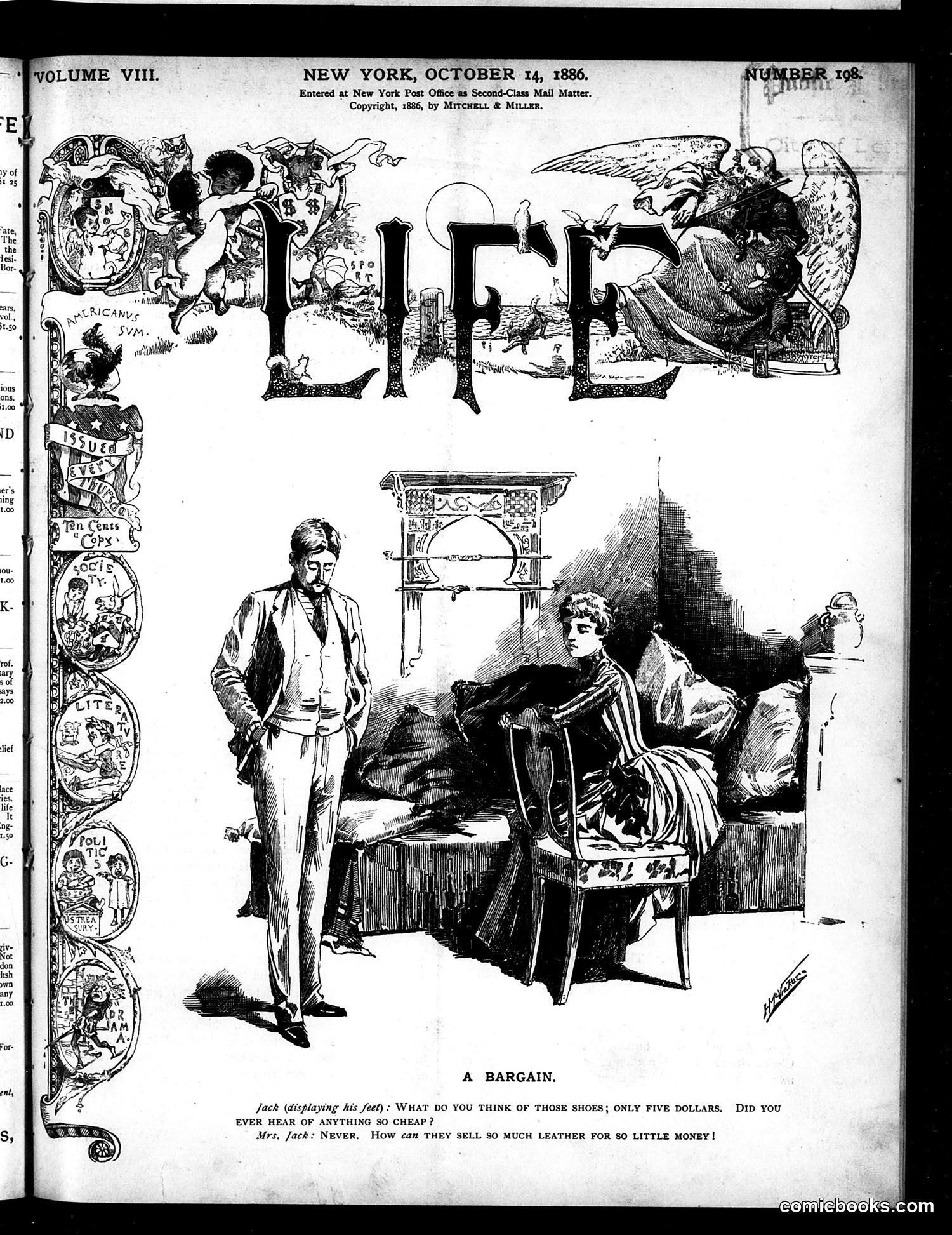
This satirical cartoon depicts a domestic negotiation about inexpensive shoes. A man (Jack) displays shoes costing only five dollars, marveling at the price. His wife responds skeptically, questioning how manufacturers could possibly sell leather goods so cheaply—implying the shoes must be of poor quality or made from inferior materials. The satire targets consumer skepticism about bargain pricing in the 1880s. The joke hinges on the tension between desire for low prices and suspicion about quality: if something seems too good to be true, it probably is. The ornate decorative border and theatrical presentation emphasize the humor of this mundane domestic disagreement, making it a commentary on emerging consumer culture and middle-class shopping anxieties of the Gilded Age.
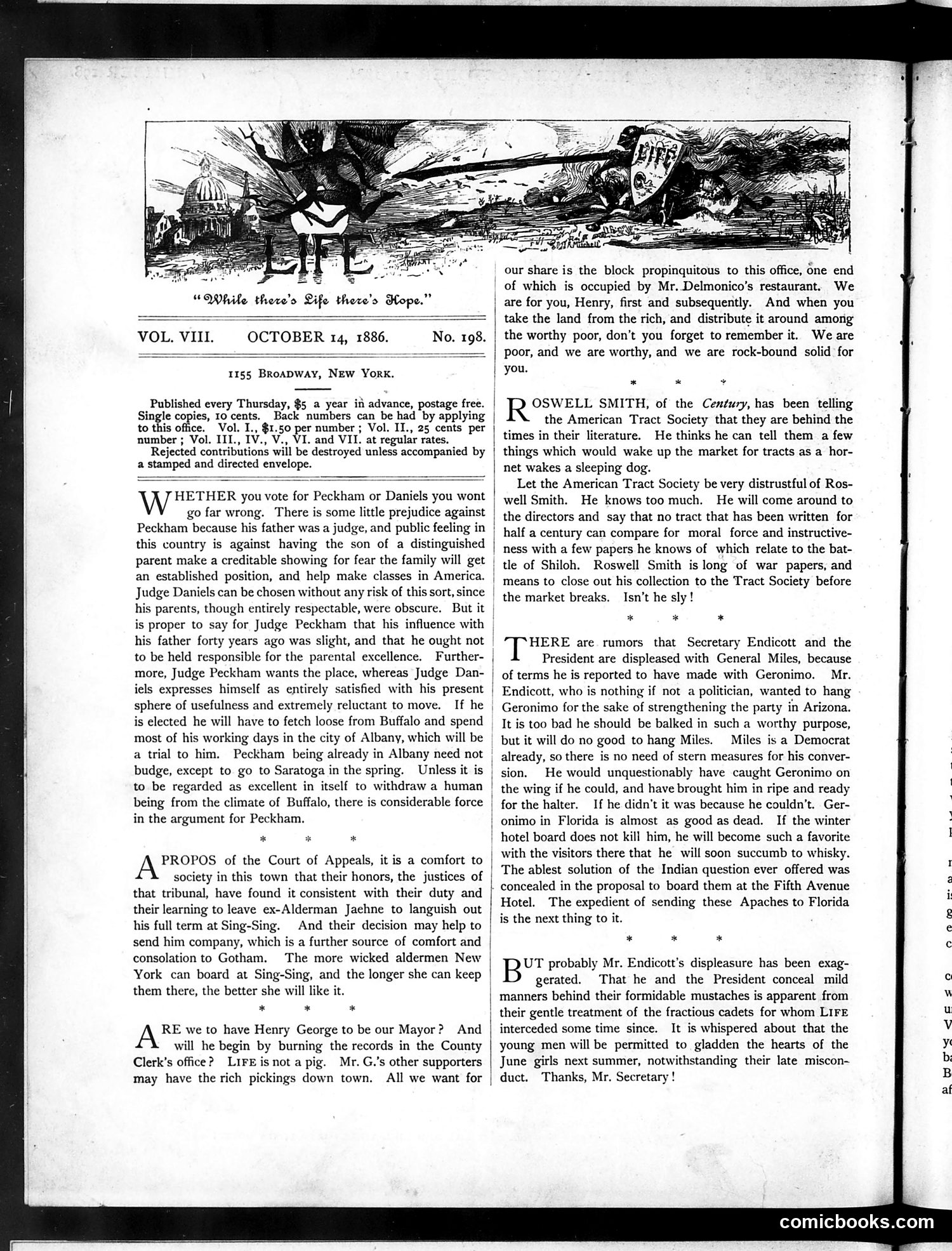
The masthead cartoon shows a classical female figure (likely representing Life or Liberty) in a dramatic landscape, illustrating the magazine's title: "While there's Life there's Hope." The page contains editorial commentary on contemporary political matters, including discussion of Judge Peckham's judicial appointment, Secretary Endicott and the President's handling of General Miles and Apache relocation to Florida, and speculation about Henry George potentially becoming Mayor of New York (with sarcastic references to burning county records). The tone is satirical and critical, targeting political figures and policies. Without clearer visual caricatures or labels identifying specific individuals in the cartoon itself, the exact subjects of ridicule remain somewhat unclear, though the text references real political controversies of 1886.
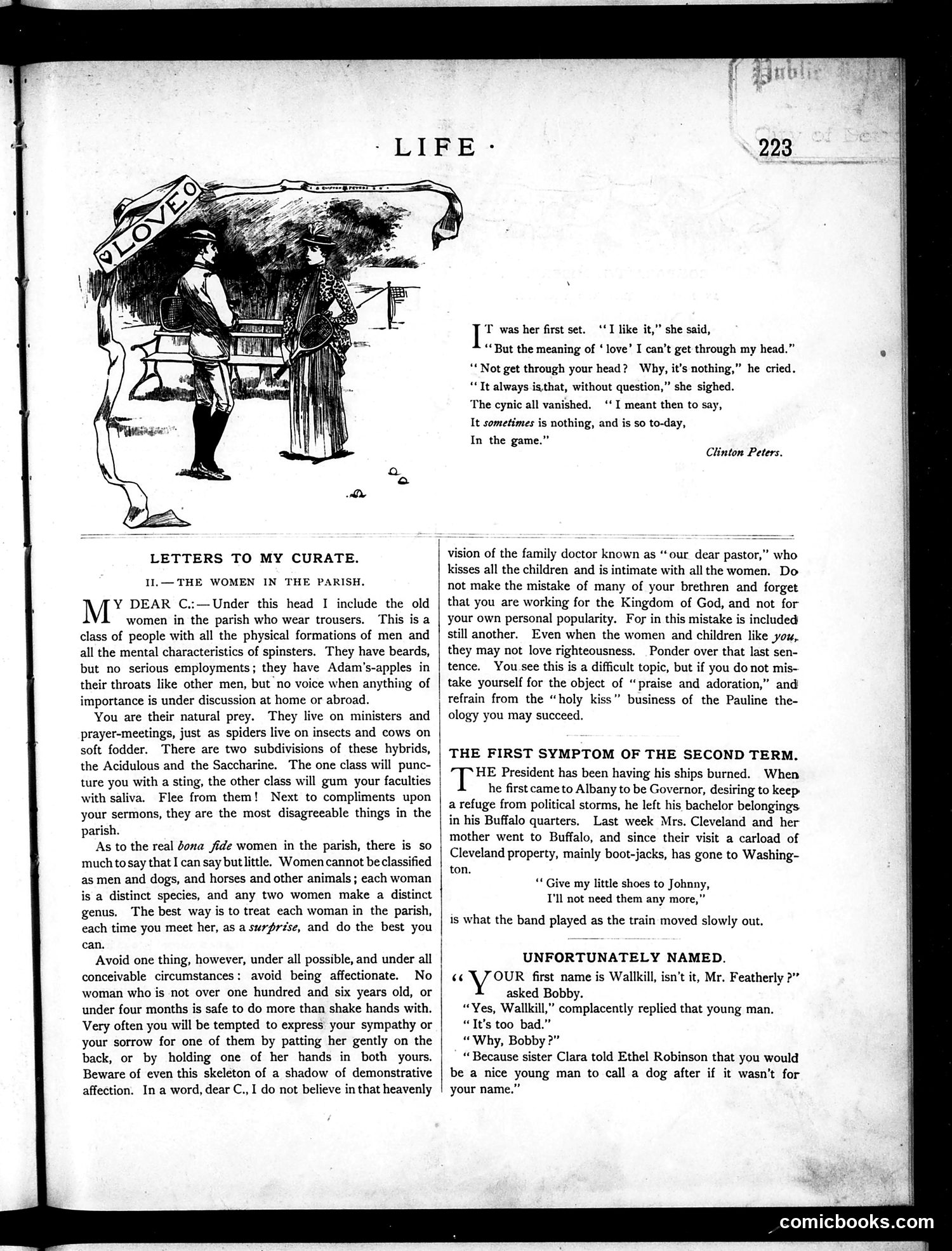
The main cartoon depicts a romantic scene between a man and woman, with accompanying dialogue about the nature of love. The woman says she "likes" love but can't understand its meaning; the man dismissively replies it's "nothing" and "so to-day, in the game." This satirizes the cynical, casual attitude toward romance prevalent in early 20th-century society—the idea that love is merely a temporary, meaningless game rather than something profound. The "Letters to My Curate" section below contains satirical commentary on parish women, describing them with animal metaphors and warning against physical affection with them. This represents period social satire about class distinctions and propriety in religious communities, mocking both the women described and the sanctimonious advice-giver.
The left side contains a satirical poem titled "Comparative Misery: An Idle Hills and Insanity" mocking politicians seeking mayoral positions. Several brief verses ridicule specific figures: Henry George (a mayoral candidate), Jeff Davis (sending "another batch of supposition"), and Sherman (criticism of military service). The text also jabs at the Philadelphia *News*'s practice of giving titles to editorials, suggesting Boston newspapers might profit similarly. The right side features "Intercepted Postal Cards"—satirical fake postcards supposedly intercepted by Life's editor. These mock various public figures including George Jones (newspaper editor), Isaac Minzesheimer, and others, using humor to critique their positions on politics, government, and social issues. The overall tone is characteristic of late-19th-century American political satire, targeting local New York personalities and public figures through humor rather than serious criticism.
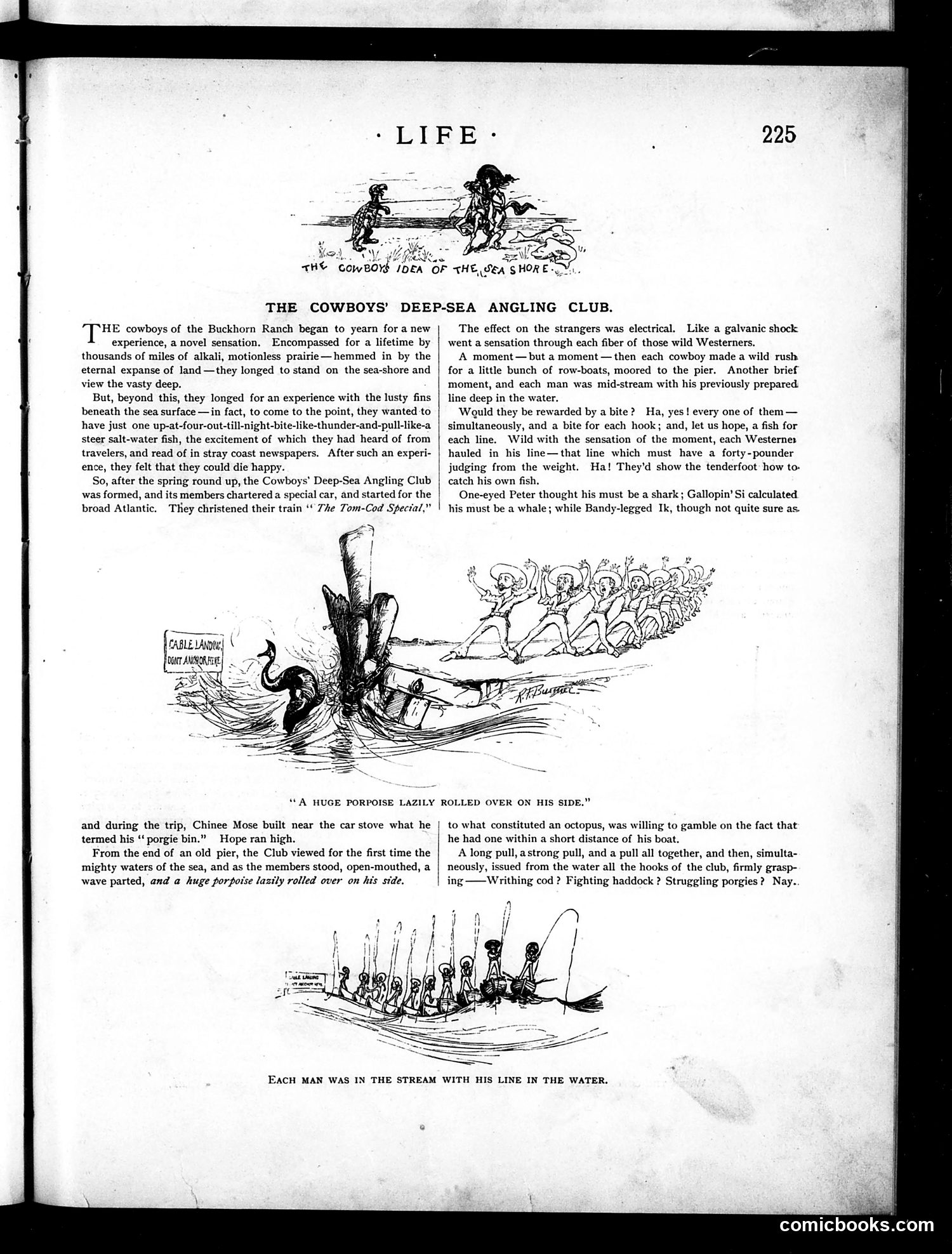
This is a humorous satirical piece about cowboys attempting deep-sea fishing. The text describes how ranch cowboys, bored with ranch life, formed a fishing club and traveled by train ("The Tom-Cat Special") to the Atlantic coast for an ocean fishing adventure. The humor centers on the incongruity of rough western cowboys encountering massive sea creatures—they joke about catching sharks, whales, and octopuses. One illustration shows a giant porpoise capsizing their boat, while another depicts the men in a fishing boat with their lines in the water. The satire gently mocks both the cowboys' naive enthusiasm and the contrast between their land-based skills and the ocean's actual dangers. It's lighthearted Americana humor typical of *Life* magazine's satirical approach to American regional character types.
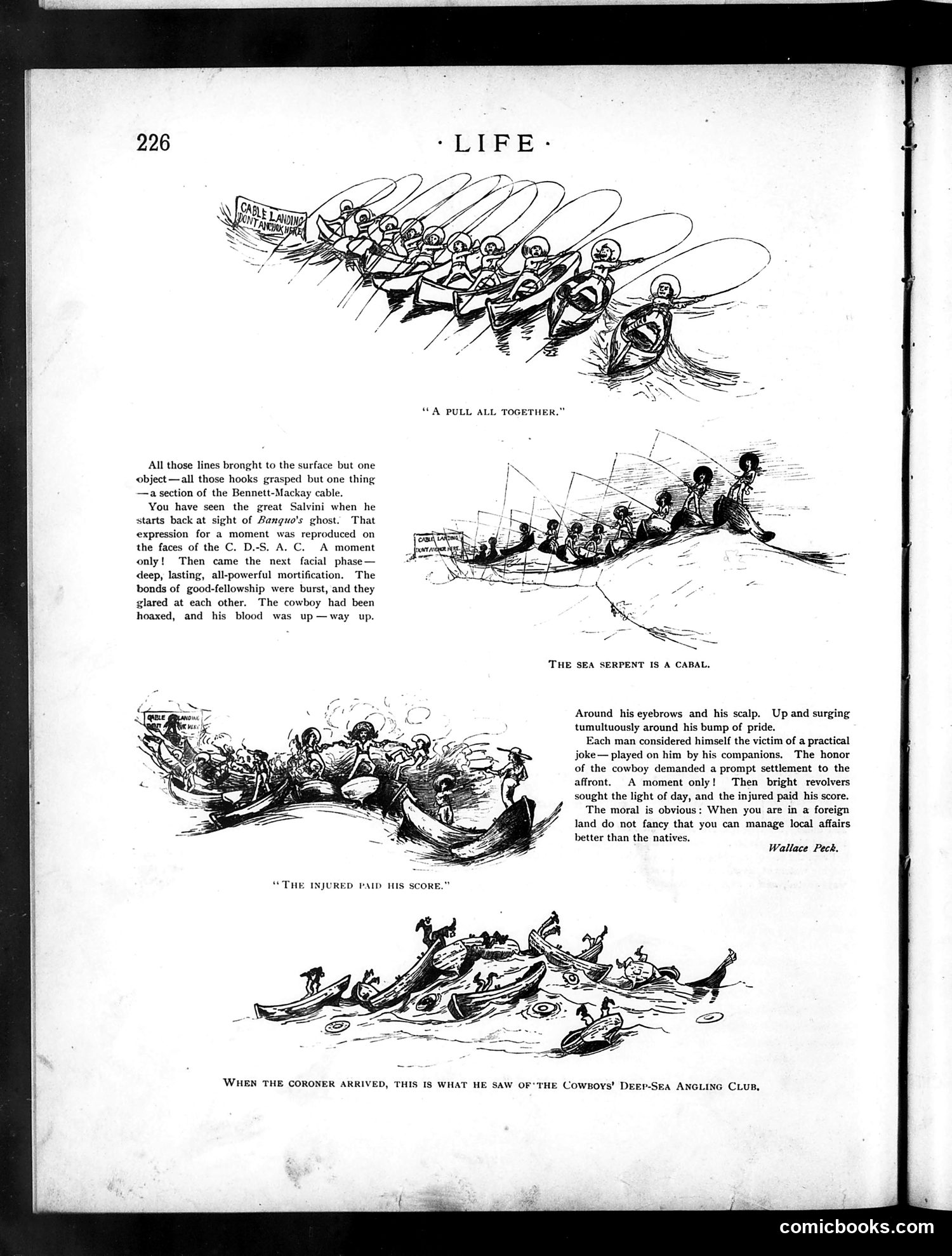
This page satirizes the Bennet-Mackay cable dispute through a nautical metaphor. The cartoons depict cowboys engaged in deep-sea fishing, with the text referencing "a section of the Bennet-Mackay cable" that was caught and brought to the surface. The satire appears to mock the practical consequences of this dispute: the first cartoon shows coordinated effort ("A full all together"), while subsequent images depict chaos and injury when the cable snaps. The final caption—"The Cowboys' Deep-Sea Angling Club"—treats this technical/legal dispute as absurdist comedy. The quote attributed to Wallace Peck suggests the cartoonist views foreign affairs management as inherently bungling, particularly when handled by inexperienced American administrators. The joke conflates Western roughness with diplomatic incompetence.
This page contains literary criticism and book reviews rather than political cartoons. The main sections include: **"An Echo of Bar Harbor"** - A poem (credited S.D.S. Jr.) satirizing gossip and rumor-mongering among the wealthy at the Bar Harbor resort community. It mocks how fabricated stories spread ("Such stories as these are invention") and the distortion of truth in high society. **"A Future Possibility"** - A brief comedic sketch imagining a Broadway street scene 100 years hence, with a gentleman asking a woman if she'll take a seat on a streetcar. **Book Reviews** - Including Frank Stockton's novelette and Celia Thaxter's poetry collection. The humor relies on contemporary social observation rather than partisan politics, targeting upper-class leisure society and literary pretension.
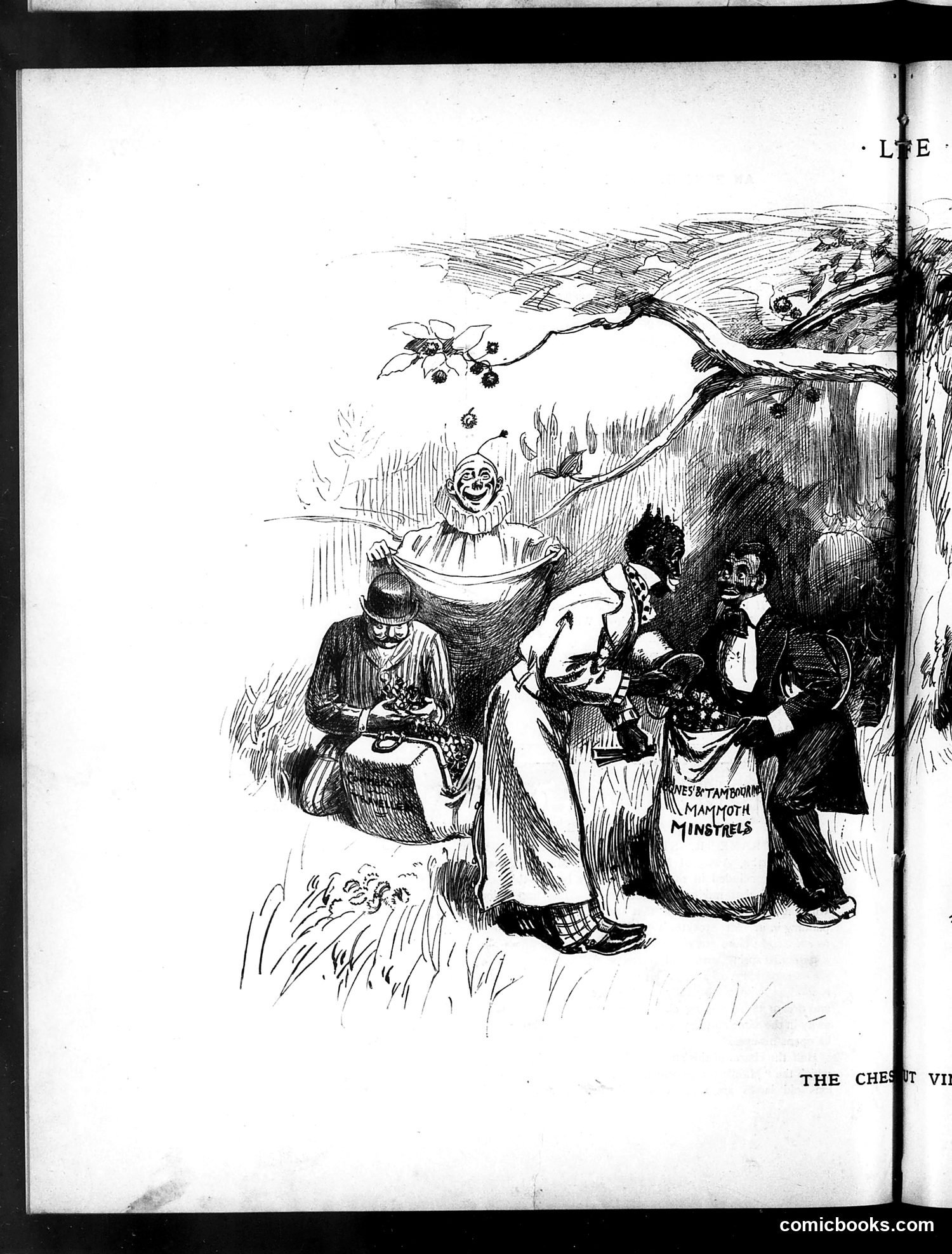
This Life magazine illustration depicts what appears to be a satirical scene about "Mammoth Mindrels" (visible text on a banner/sign). The drawing shows several figures in period dress gathered outdoors beneath a gnarled tree branch, with what appears to be a jester or entertainer suspended above them. The cartoon likely satirizes either a theatrical performance, entertainment trend, or public spectacle popular at the time. The exaggerated, caricatured faces and the surreal imagery of the suspended figure suggest mockery of contemporary entertainment or public figures. Without the full page context and complete title, the specific political or social target remains unclear, though the overall tone suggests satirical commentary on popular culture or public behavior.
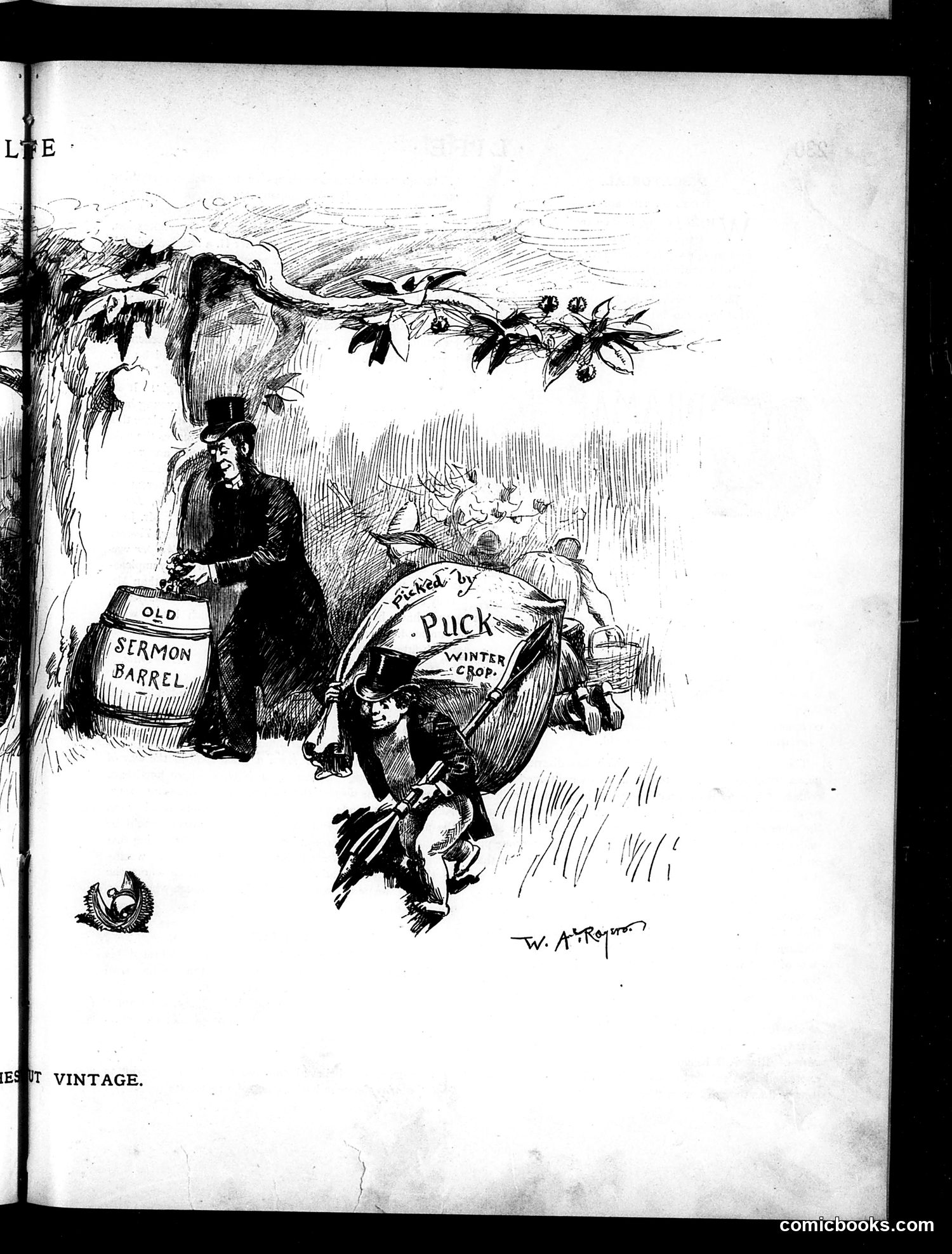
This W.A. Rogers cartoon satirizes the magazine *Puck* (a competing satirical publication). The image shows a man in a top hat carrying a barrel labeled "Old Sermon Barrel" encountering a figure representing *Puck* itself—depicted as a character carrying a large barrel labeled "Picked by Puck Winter Crop." The satire appears to mock *Puck*'s editorial practices, suggesting the magazine simply recycles worn-out material ("old sermon") rather than producing fresh content. The "winter crop" reference may allude to seasonal publishing cycles or the notion that *Puck* harvests stale ideas. Rogers, as *Life*'s cartoonist, uses this to position *Life* as superior—offering original satire rather than recycled material. The tree and rural setting reinforce the "harvest" metaphor for editorial sourcing.
This page contains theatrical reviews rather than political cartoons. The main content discusses Augustin Daly's production of "After Business Hours," a light comedy about a young couple and their financial speculations. The reviewer critiques the play as "dainty, sketchy" but entertaining, adapted from a German work called "Angina Zipperoff." He praises the cast (including Miss May Irwin) while noting that some elements—particularly long dialogues about feminine fashion—aren't entirely relevant to the plot. The page also includes brief theatrical notes about "Theodora" at Niblo's and a "Scraps" section with anecdotes about French kings and horse racing. It's a typical theater criticism page from this era of *Life* magazine.
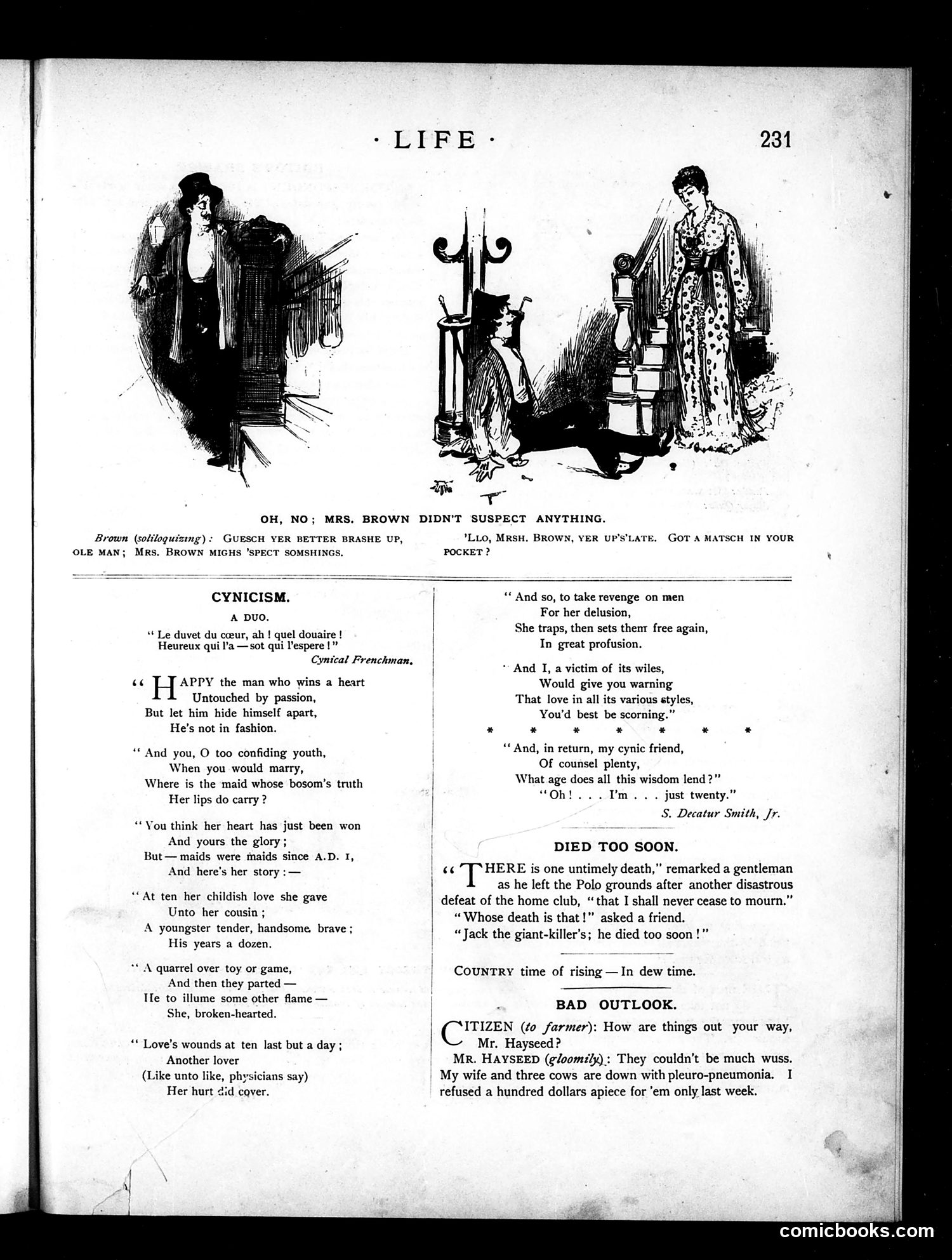
The page contains three satirical pieces: **Top cartoon**: "Mrs. Brown" depicts a man (Brown) preparing to hide evidence of infidelity from his wife, with exaggerated drunken speech ("guesch," "brashe"). The joke mocks men caught cheating attempting obvious deception. **"Cynicism: A Duo"**: A poem by S. Decatur Smith, Jr. presents a cynical dialogue between an older man and a twenty-year-old. The elder warns that women serially manipulate men for revenge after romantic disappointment. The humor lies in the irony: this supposed wisdom comes from someone barely adult, satirizing youthful overconfidence in pronouncing cynical "truths." **Bottom pieces**: "Died Too Soon" jokes that Jack the Giant-Killer (the folk tale hero) died prematurely—implying the home baseball club's poor performance needed such a miracle worker. "Bad Outlook" features a farmer lamenting livestock disease while regretting refusing $100 each for sick animals, highlighting rural hardship and poor judgment. All pieces target human folly: infidelity, romantic cynicism, and agricultural misfortune.
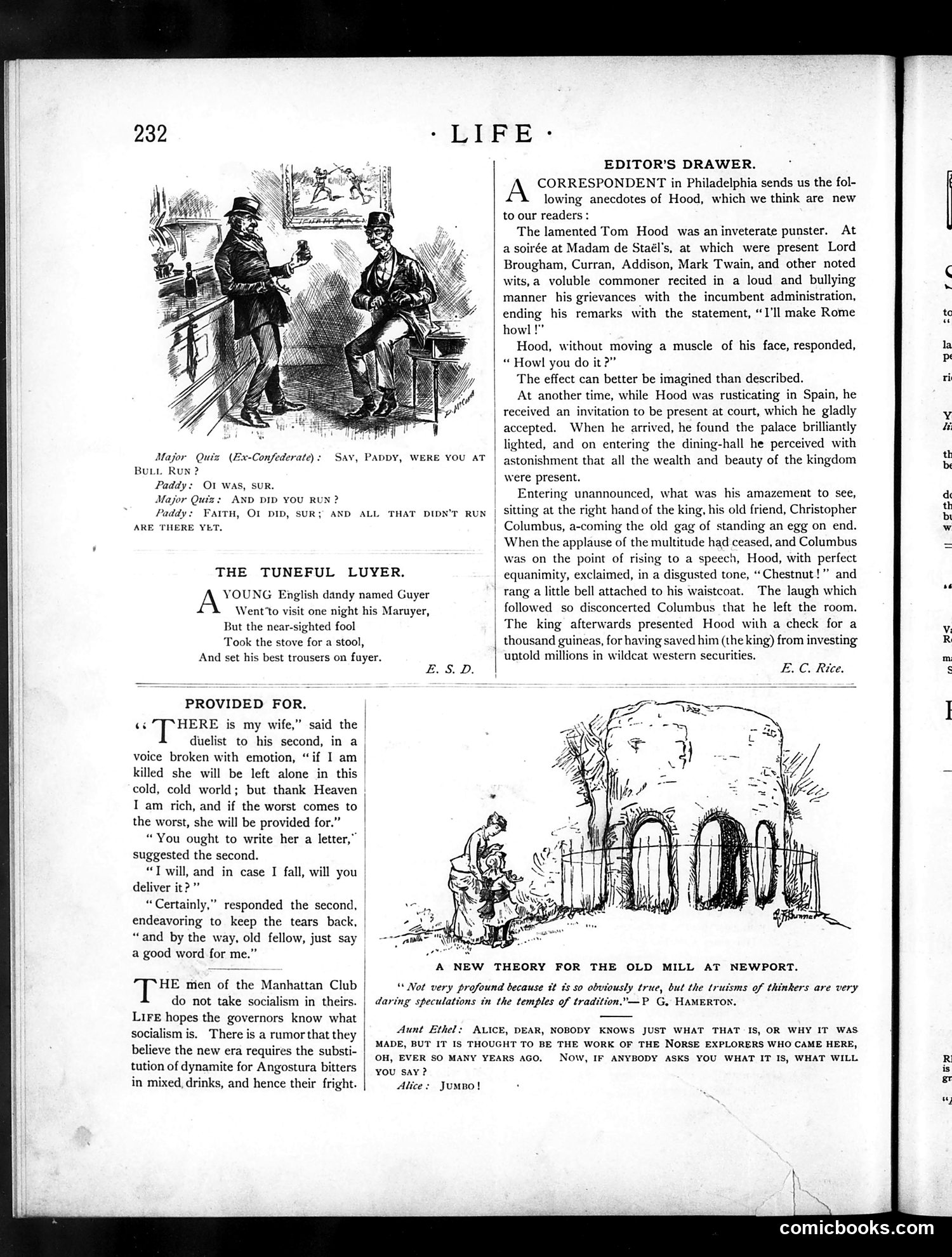
This page contains several satirical pieces typical of 19th-century American humor: **"Major Quiz" cartoon**: A post-Civil War joke mocking Irish immigrants ("Paddy") about their participation in the Battle of Bull Run. The humor relies on ethnic stereotyping and a play on words—Paddy claims he attended but "ran," and those who didn't run "are there yet" (implying they died). **"The Tuneful Luyer"**: A simple pun-based poem about an English dandy who mistakes a stove for a stool, burning his trousers—typical light verse filler. **"Provided For"**: A dark joke about a duelist assuring his second that his widow will be financially secure, then asking the second to court the widow himself. **Tom Hood anecdotes**: Biographical humor about the 19th-century wit, emphasizing his quick punning responses and social cleverness. **Newport Mill discussion**: References the mysterious Newport Tower, speculatively attributed to Norse explorers—reflecting contemporary archaeological debate. The page is typical *Life* content: ethnic humor, wordplay, social satire, and light anecdotes.
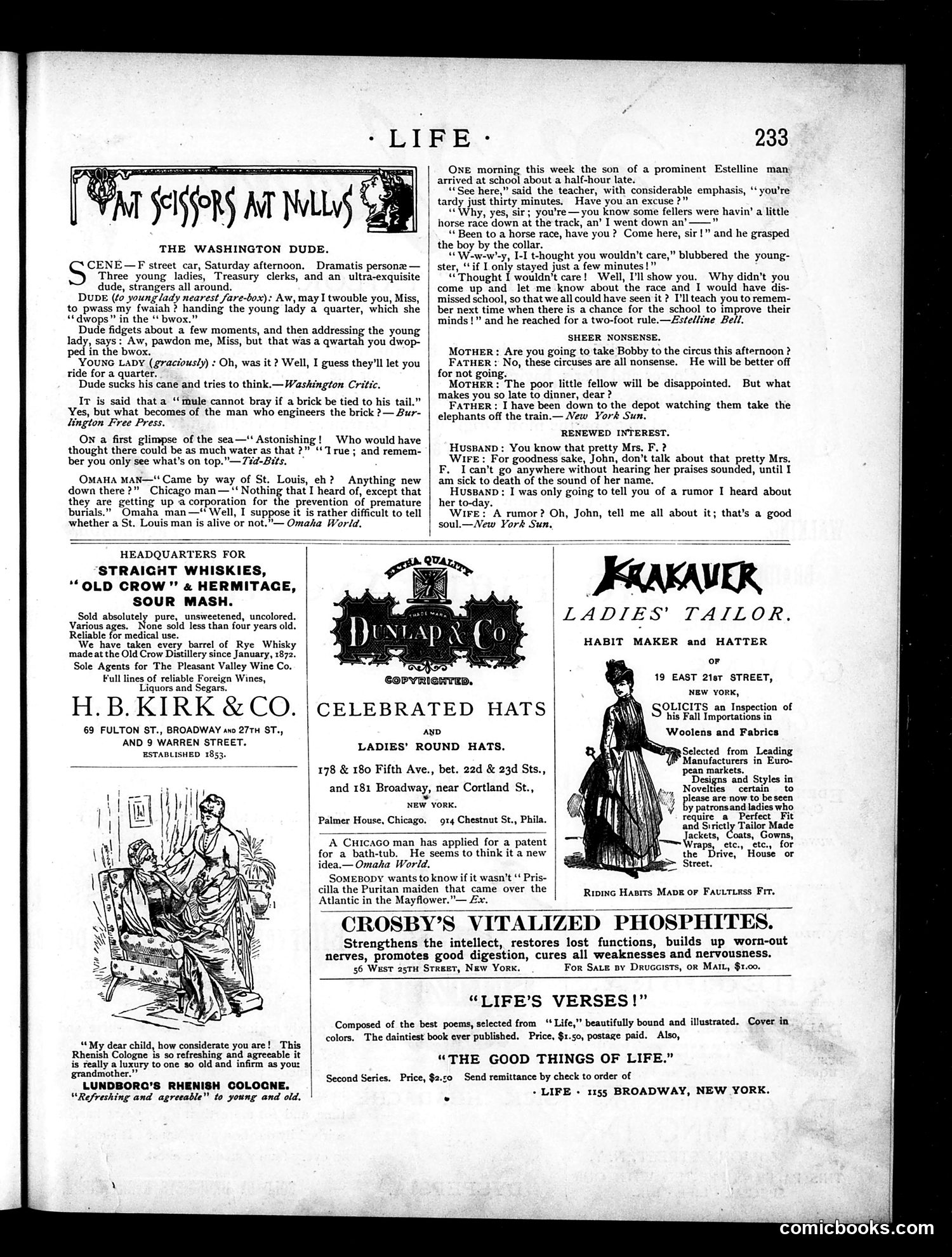
This page from *Life* magazine contains several brief satirical pieces mocking social pretension and hypocrisy: **"The Washington Dude"** depicts an affectedly dressed man ("dude") on a streetcar asking a woman to pass his fare—then awkwardly pointing out she accidentally dropped a quarter instead of a nickel. The humor targets his exaggerated speech patterns ("pwass," "fwaiah") and social incompetence masquerading as gentility. **Other brief jokes** mock: - Self-important Washington bureaucrats - A father who dismisses circuses as "nonsense" while eagerly watching elephants unloaded at the depot—exposing his own hypocrisy - A wife suddenly interested in gossip about a rival woman once rumors (rather than praise) become available The page is primarily advertisements for whiskey, hats, and tailoring services, interspersed with these short comedic pieces. The satire targets Victorian-era social pretension and the gap between stated principles and actual behavior.
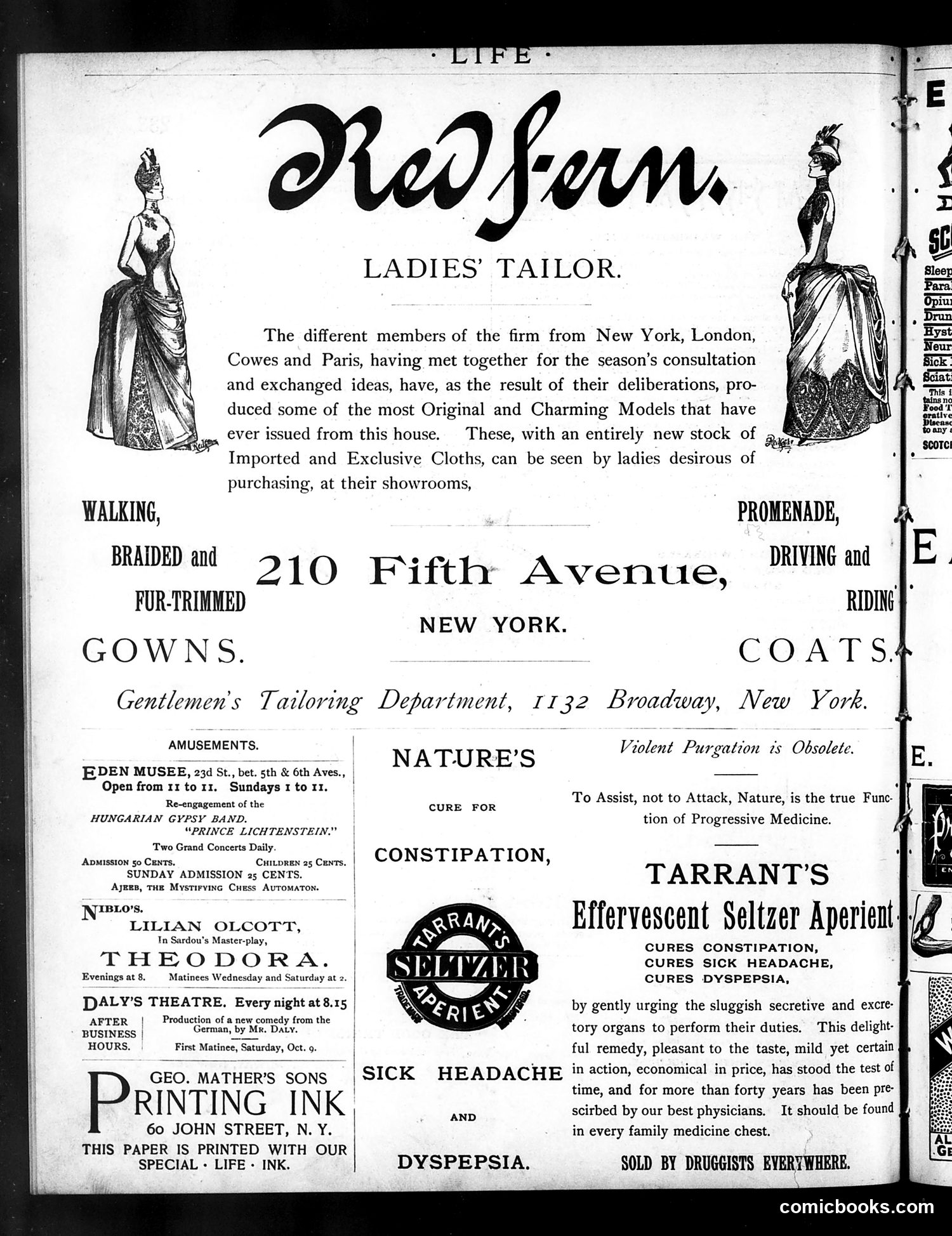
This page is primarily **advertising, not satire or political commentary**. The main content is a large advertisement for Red Fern, a ladies' tailor located at 210 Fifth Avenue, New York. The firm claims to have consulted with members from New York, London, Cowes, and Paris to produce "Original and Charming Models" of gowns and coats in imported fabrics. The page includes decorative illustrations of fashionable women in elaborate period dress and lists a gentlemen's tailoring department at a separate Broadway address. The remainder consists of standard period advertisements and theater listings (Eden Musee, Niblo's, Daly's Theatre) and a patent medicine ad for Tarrant's Effervescent Seltzer Aperient, which claims to cure constipation, sick headache, and dyspepsia—typical medical claims of the era. There is no discernible political satire present.
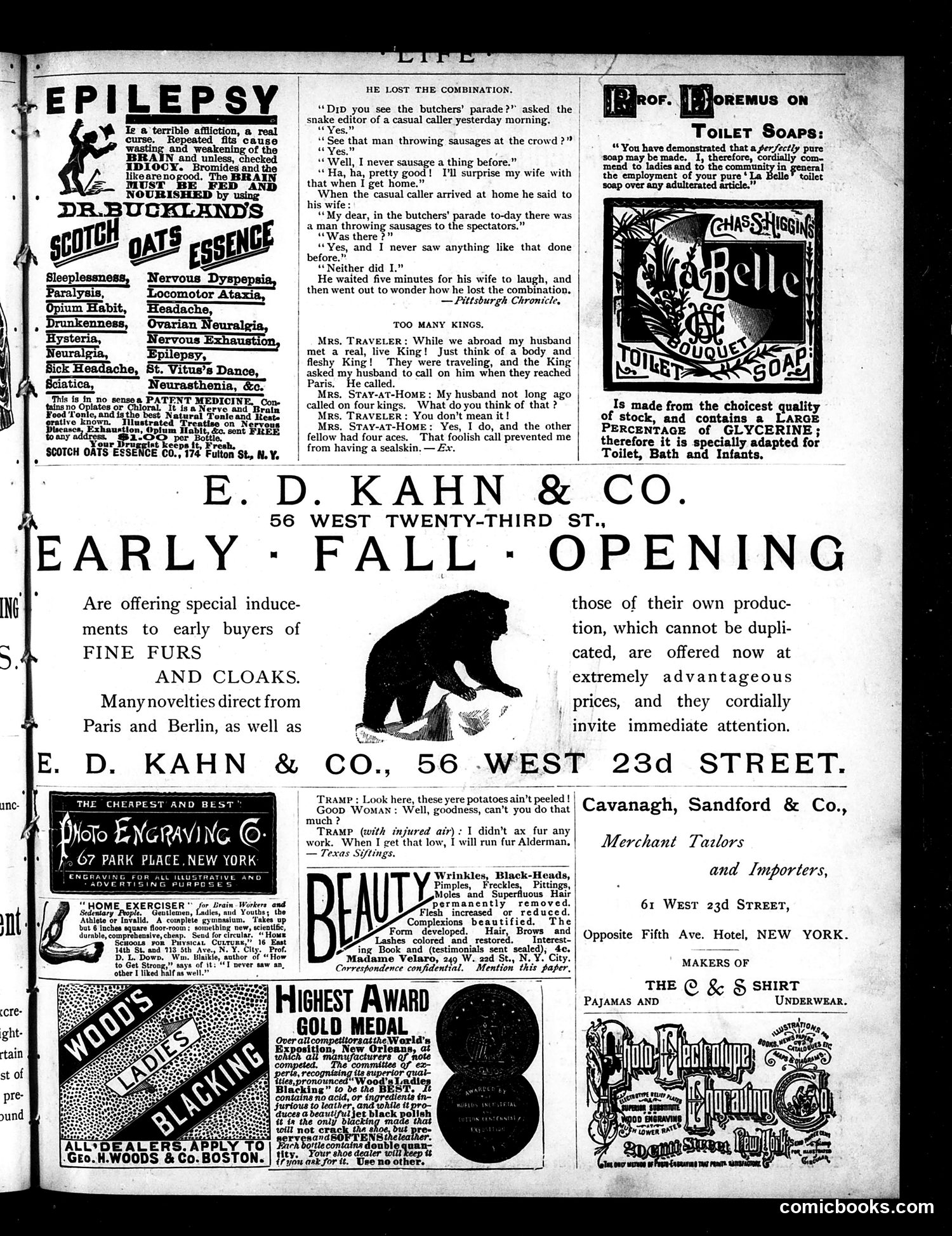
This page from *Life* magazine is primarily **advertising and humorous short jokes** rather than political cartoons. **The humor pieces** include: - "He Lost the Combination": A pun-based joke where a man tries to impress his wife with a sausage-throwing anecdote from a butchers' parade, but she doesn't laugh at his wordplay ("never sausage a thing"), leaving him wondering why his joke fell flat. - "Too Many Kings": A poker joke where a woman brags about her husband meeting a real king abroad, but the other woman reveals her husband "called on four kings"—a poker reference (four-of-a-kind), implying her husband gambled foolishly and lost money. **The advertisements** dominate the page, hawking patent medicines (Scotch Oats Essence for epilepsy and nervous conditions), furs and cloaks, beauty treatments, and other period products. There are **no significant political cartoons or social satire** on this page—it's a typical turn-of-the-century magazine mixing light domestic humor with commercial pitches.
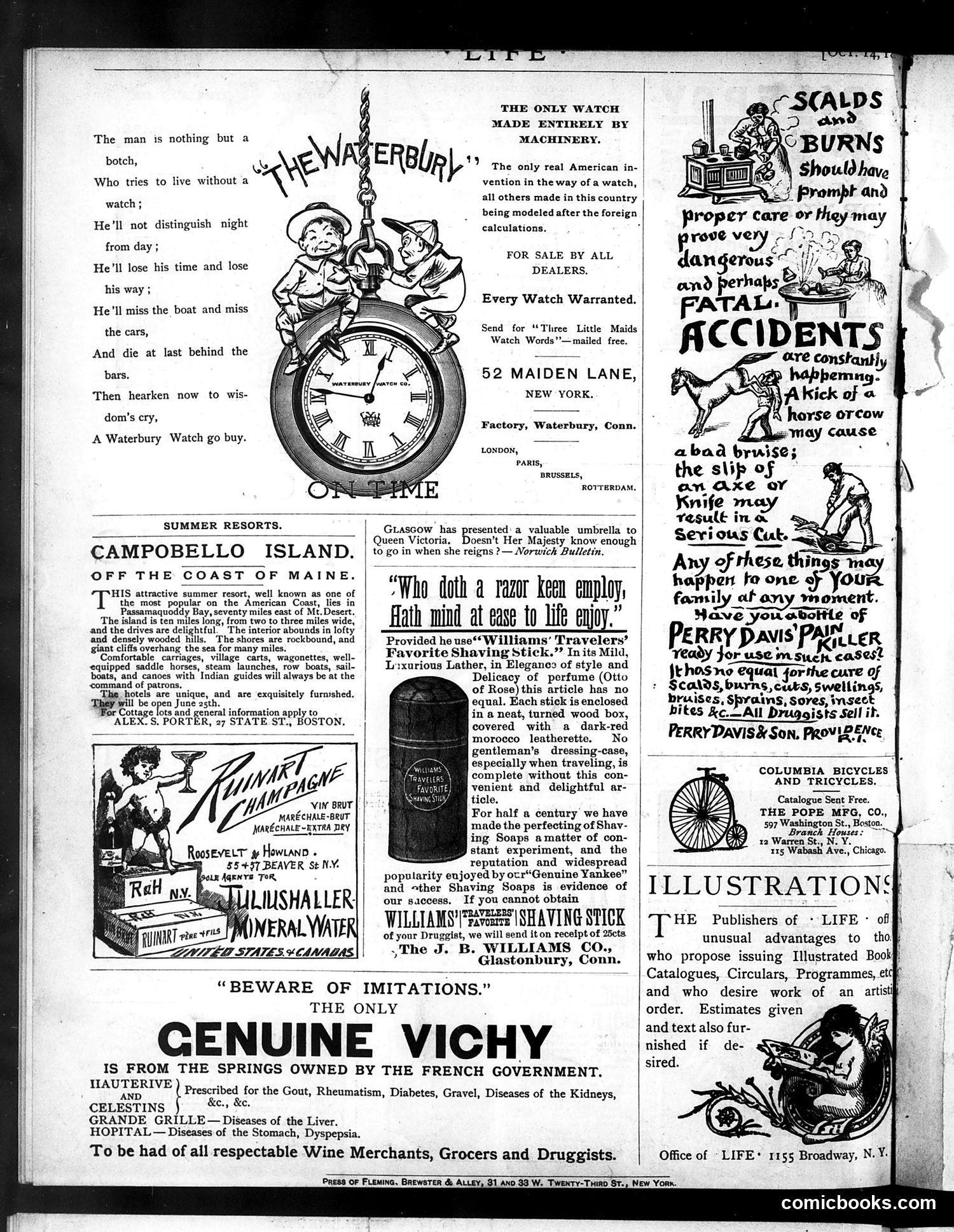
This page is primarily **advertisements** interspersed with brief satirical content typical of *Life* magazine's format. The main cartoon is a **Waterbury Watch advertisement** featuring verse mocking a man without a timepiece—he cannot distinguish day from night, misses transportation, and "die[s] at last behind the bars." The satire critiques American carelessness and dependence on punctuality in an industrial society. The watch is promoted as "the only real American invention" in watchmaking, appealing to nationalist pride. Other notable elements include: - A brief joke about **Queen Victoria** and an umbrella (Scottish gift), playing on her famous raininess - Multiple patent medicine ads (**Perry Davis Pain Killer**, **Vichy water**, shaving products) with dramatic health claims typical of the era - An advertisement for **Campobello Island** resort in Maine The page reflects late 19th-century American consumer culture and satirical wit targeting both individual irresponsibility and commercial snake-oil marketing.
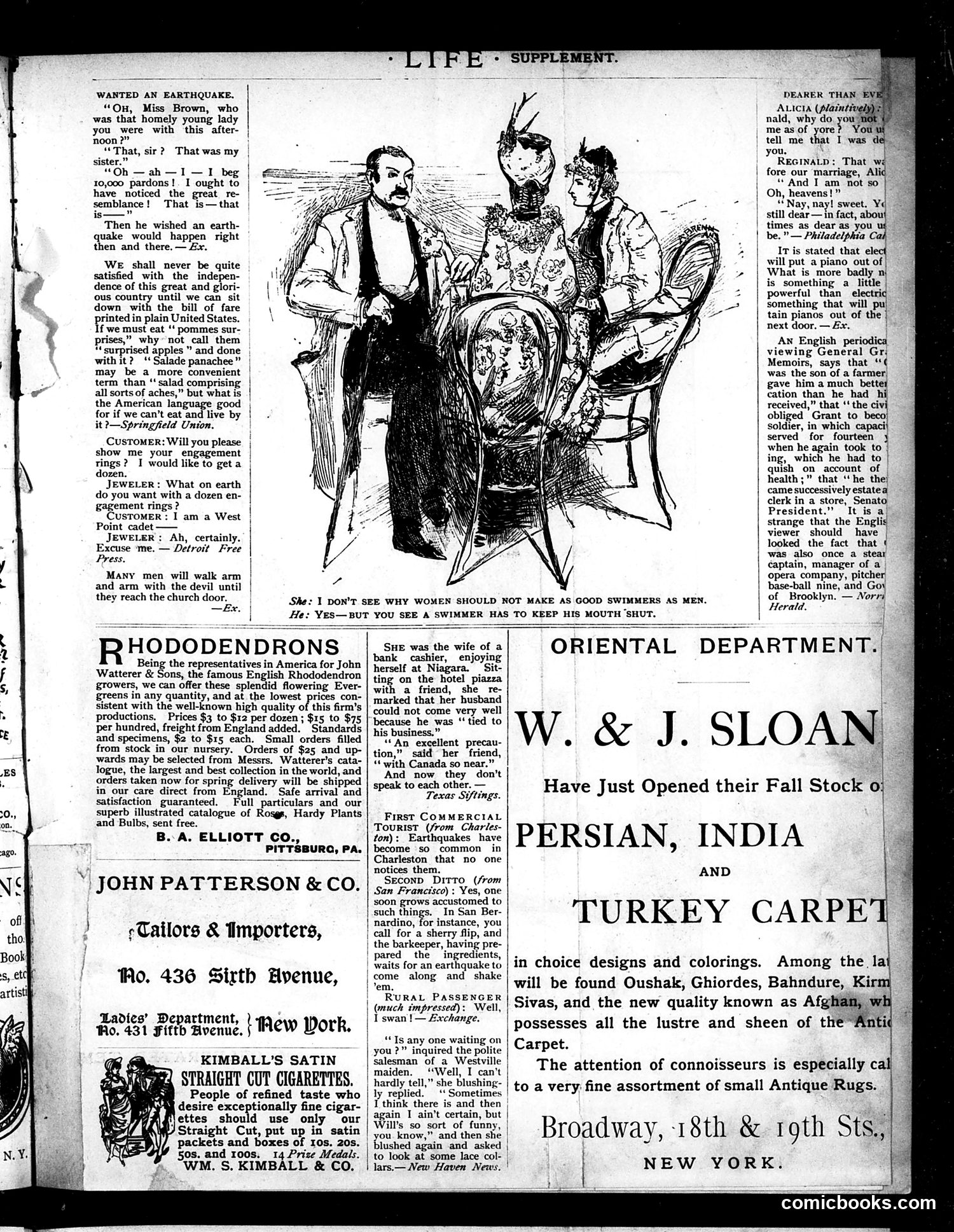
This page contains multiple brief satirical jokes typical of Life's humor format. **Main Cartoon:** Shows a man with an elaborately dressed woman, illustrating the joke about mistaking someone's appearance. The caption reads: "She: I don't see why women should not make as good swimmers as men. He: Yes—but you see a swimmer has to keep his mouth shut." This is a sexist gag implying women talk too much. **Surrounding Jokes:** Include commentary on: - A man who insulted a woman by saying she resembled his sister, then wishing for an earthquake - West Point cadets collecting multiple engagement rings - American resistance to French restaurant terms ("pommes surprises" vs. "surprised apples") - A reference to General Grant's many occupations The page is primarily **advertising** for rhododendrons, a tailor shop, cigarettes, and a carpet importer (W. & J. Sloan's "Oriental Department"). These ads occupy significant space alongside the humor content, typical of Life's revenue model. The satire reflects early 1900s attitudes: mockery of pretension, gender stereotypes, and Americanism.
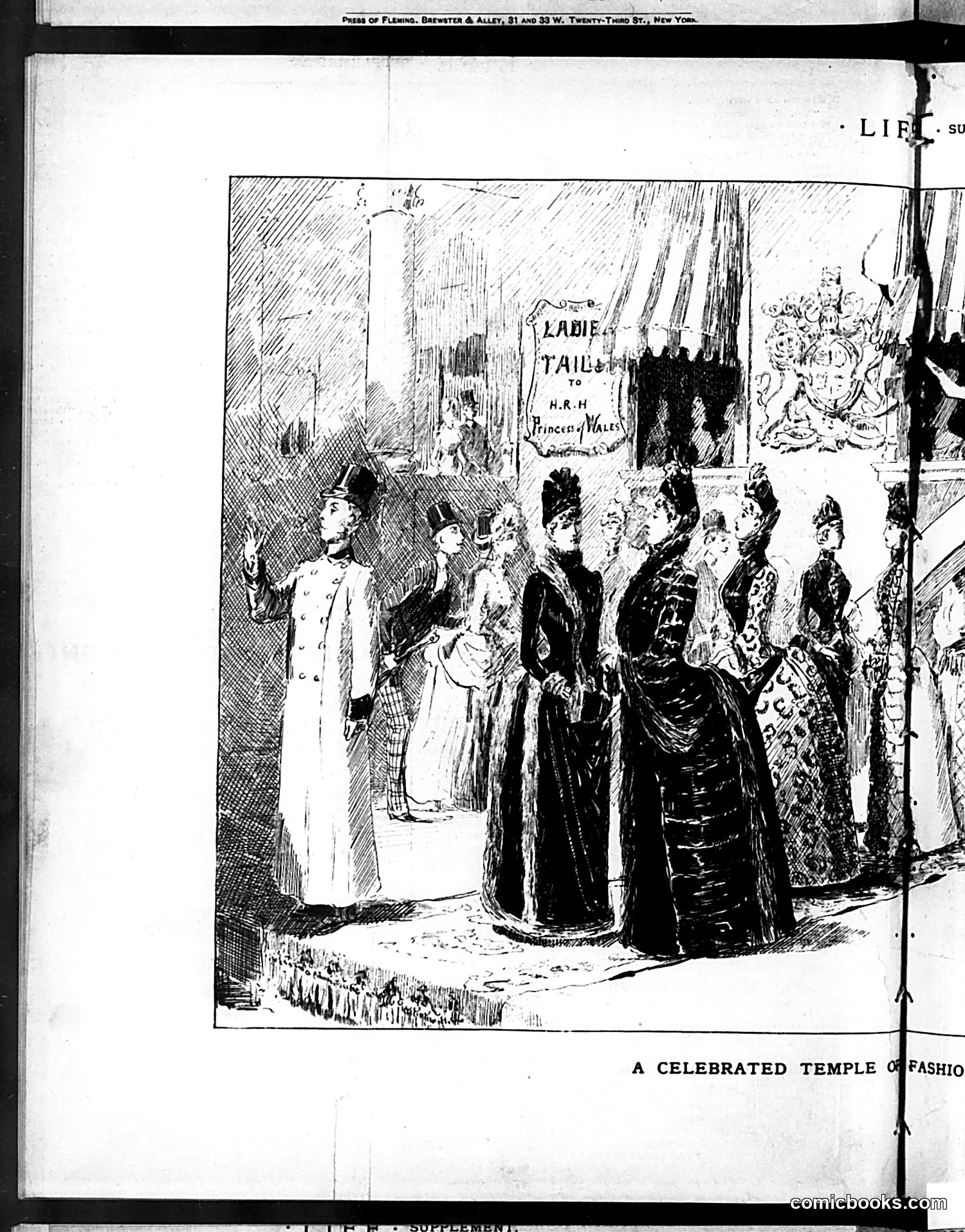
This appears to be a satirical cartoon from Life magazine titled "A Celebrated Temple of Fashion." The image depicts an elegant interior space with a banner reading "Ladies' Tails to H.R.H. Princess of Wales," suggesting a formal presentation or fashion event. The cartoon satirizes high society and aristocratic fashion culture. Multiple fashionably-dressed women in elaborate gowns and headdresses gather before what appears to be royalty or nobility. The "temple of fashion" framing mocks the reverent, almost religious devotion wealthy society women displayed toward fashion trends and royal approval. The specific reference to the Princess of Wales suggests this targets late Victorian or Edwardian-era fashion obsession, where following royal styles was paramount among the elite. The satire critiques the superficiality and exclusivity of high-society fashion culture.
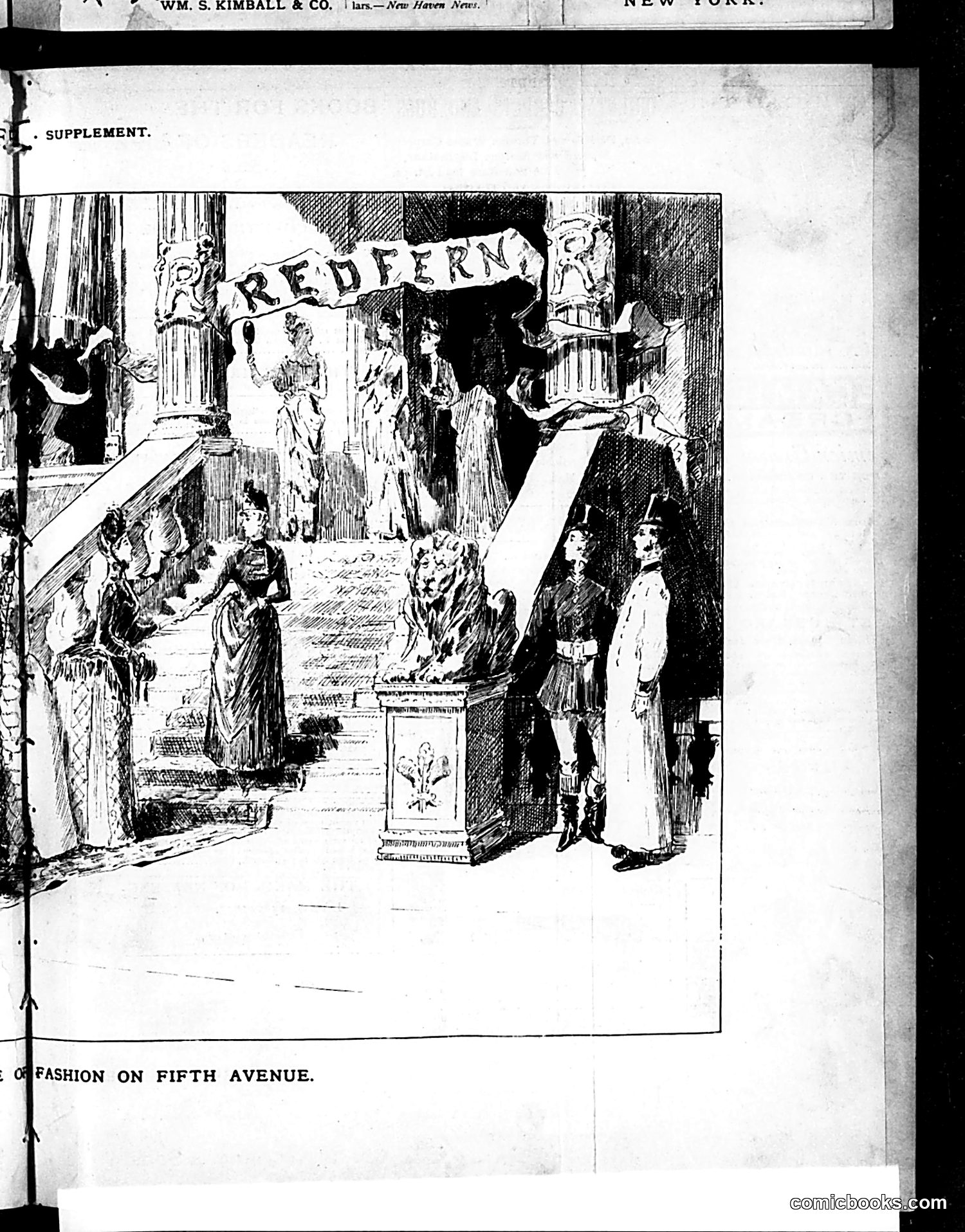
This illustration, titled "Fashion on Fifth Avenue," depicts a satirical scene set in what appears to be an elegant interior with classical columns. A banner reading "RED FERN" hangs prominently overhead. The scene shows well-dressed figures in period clothing gathered around a central pedestal or display, suggesting a fashion show or social gathering on Fifth Avenue (New York's prestigious shopping district). The satire likely mocks fashionable society and conspicuous consumption among the wealthy elite. The "Red Fern" banner's significance is unclear from the visible text alone. The formal poses and classical architectural setting parody the pretentiousness of high-society fashion displays. The illustration exemplifies *Life* magazine's typical social commentary on American upper-class vanity and materialism during the late 19th or early 20th century.
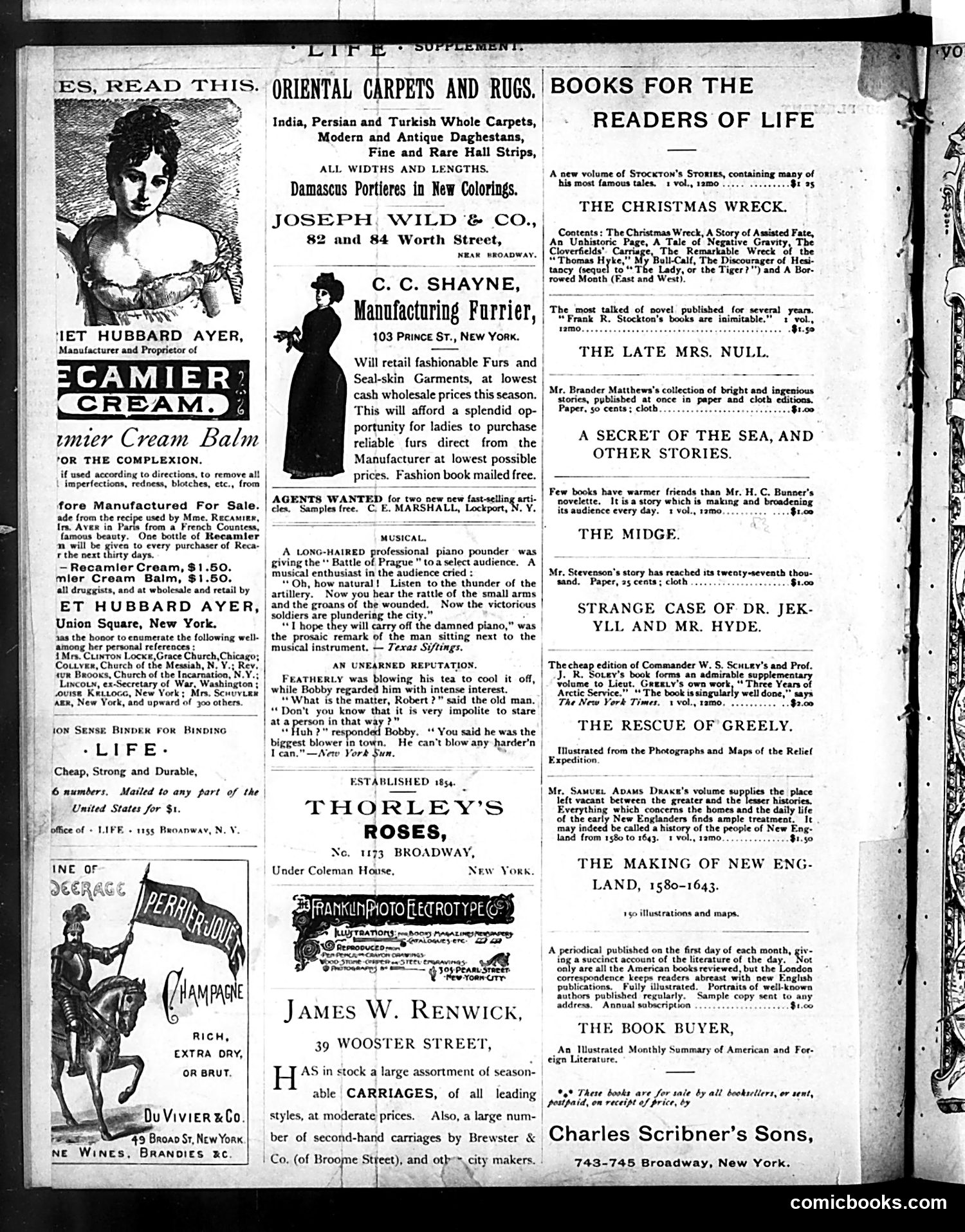
This page is primarily **advertising**, not editorial content or political cartoons. It's a supplement page from *Life* magazine featuring commercial advertisements for luxury goods and services typical of the late 19th century. The visible content includes ads for: - **Recamier Cream** (complexion product, marketed with references to a famous French beauty) - **Oriental carpets and rugs** - **Furs and seal-skin garments** - **Carriages** (horse-drawn vehicles) - **Wine and champagne** - **Books** (including Stockton's stories and historical works) There are **two brief humorous anecdotes** rather than political cartoons: 1. A joke about a piano player performing "Battle of Prague"—someone wishes the audience would steal the piano 2. A child's misunderstanding about a man being a "big blower" (exaggerator) These are light domestic humor pieces, not satire. The page demonstrates *Life*'s role as a venue for advertising luxury consumer goods to educated, affluent readers, alongside genteel entertainment.