
Life, 1886-10-14 · page 7 of 20
Life — October 14, 1886 — page 7: what you’re looking at
What you’re looking at
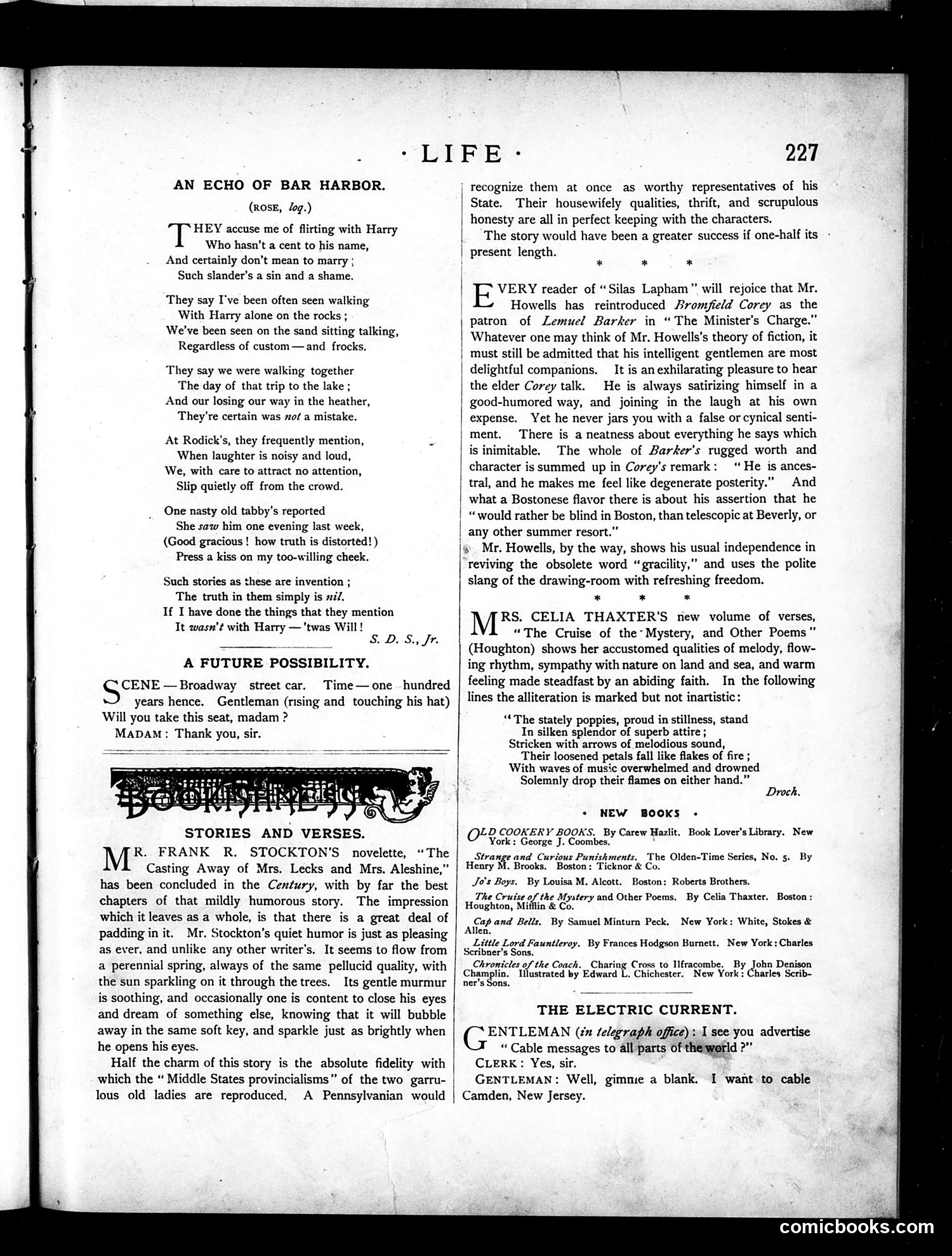
This page contains literary criticism and book reviews rather than political cartoons. The main sections include: **"An Echo of Bar Harbor"** - A poem (credited S.D.S. Jr.) satirizing gossip and rumor-mongering among the wealthy at the Bar Harbor resort community. It mocks how fabricated stories spread ("Such stories as these are invention") and the distortion of truth in high society. **"A Future Possibility"** - A brief comedic sketch imagining a Broadway street scene 100 years hence, with a gentleman asking a woman if she'll take a seat on a streetcar. **Book Reviews** - Including Frank Stockton's novelette and Celia Thaxter's poetry collection. The humor relies on contemporary social observation rather than partisan politics, targeting upper-class leisure society and literary pretension.
📄 Transcribed text from this page (OCR, searchable)
Machine-transcribed from the original scan — historical spelling and the odd misread are preserved.
. RIBS: AN ECHO OF BAR HARBOR. (RosE, 40g.) HEY accuse me of flirting with Harry Who hasn’t a cent to his name, And certainly don’t mean to marry ; Such slander’s a sin and a shame. They say I've been often seen walking With Harry alone on the rocks ; We've been seen on the sand sitting talking, Regardless of custom —and frocks. They say we were walking together The day of that trip to the lake ; And our losing our way in the heather, They're certain was xot a mistake. At Rodick’s, they frequently mention, When laughter is noisy and loud, We, with care to attract no attention, Slip quietly off from the crowd. One nasty old tabby's reported She saw him one evening last week, (Good gracious ! how truth is distorted!) Press a kiss on my too-willing cheek. Such stories as these are invention ; The truth in them simply is ni/. If I have done the things that they mention It wasn't with Harry —'twas Will! he S.D.S. Jr. A FUTURE POSSIBILITY. CENE — Broadway street car. Time—one hundred years hence. Gentleman (rising and touching his hat) Will you take this seat, madam ? Mapam: Thank you, sir. STORIES AND VERSES. R. FRANK R. STOCKTON’S novelette, “The Casting Away of Mrs. Lecks and Mrs. Aleshine,” has been concluded in the Century, with by far the best chapters of that mildly humorous story. The impression which it leaves as a whole, is that there is a great deal of padding in it. Mr. Stockton’s quiet humor is just as pleasing as ever, and unlike any other writer's, It seems to flow from a perennial spring, always of the same pellucid quality, with the sun sparkling on it through the trees. Its gentle murmur is soothing, and occasionally one is content to close his eyes and dream of something else, knowing that it will bubble away in the same soft key, and sparkle just as brightly when he opens his eyes. Half the charm of this story is the absolute fidelity with | which the “ Middle States provincialisms” of the two garru- | lous old ladies are reproduced. A Pennsylvanian would | present length. | ment. 227 recognize them at once as worthy representatives of his | State. Their housewifely qualities, thrift, and scrupulous honesty are all in perfect keeping with the characters. The story would have been a greater success if one-half its - * * VERY reader of “Silas Lapham” will rejoice that Mr. Howells has reintroduced Bromfield Corey as the patron of Lemuel Barker in “The Minister’s Charge.” Whatever one may think of Mr. Howells’s theory of fiction, it must still be admitted that his intelligent gentlemen are most delightful companions. It is an exhilarating pleasure to hear the elder Corey talk. He is always satirizing himself in a good-humored way, and joining in the laugh at his own expense. Yet he never jars you with a false or cynical senti- There is a neatness about everything he says which The whole of Barker's rugged worth and character is summed up in Corey's remark: “ He is ances- tral, and he makes me feel like degenerate posterity.” And what a Bostonese flavor there is about his assertion that he “would rather be blind in Boston, than telescopic at Beverly, or any other summer resort.” » Mr. Howells, by the way, shows his usual independence in reviving the obsolete word “gracility,” and uses the polite slang of the drawing-room with refreshing freedom. * is inimitable. * * RS. CELIA THAXTER’S new volume of verses, “The Cruise of the-Mystery, and Other Poems” (Houghton) shows her accustomed qualities of melody, flow- ing rhythm, sympathy with nature on land and sea, and warm feeling made steadfast by an abiding faith. In the following lines the alliteration is marked but not inartistic: “The stately poppies, proud in stillness, stand In silken splendor of superb attire ; Stricken with arrows of melodious sound, Their loosened petals fall like flakes of fire ; With waves of music overwhelmed and drowned Solemnly drop their flames on either hand.” Droch. + NEW BOOKS - Of2 COOKERY BOOKS. By Carew Hazlit. Book Lover's Library. New York: George J. Coombes. Strange and Curious Punishments. The Olden-Time Series, No. 5. By Henry M. Brooks. Boston: Ticknor & Co, Jo's Boys. By Louisa M. Alcott. Boston: Roberts Brothers. The Cruise of the Mystery and Other Poems. By Celia Thaxter. Boston : Houghton, Mifilin & Co, Gap and Bells, By Samuel Minturn Peck, Allen. Little Lord Fauntleroy. By Frances Hodgson Burnett. New York: Charles Scribner's Sons. Chronicles of the Coach, Charing Cross to Ilfracombe, By John Denison Champlin. Illustrated by Edward L, Chichester. New York: Charles Serib- ner's Sons. New York: White, Stokes & THE ELECTRIC CURRENT. ENTLEMAN (cn delegraph office): 1 see you advertise “Cable messages to all parts of the world ?”” CLERK: Yes, sir. GENTLEMAN: Well, gimme a blank. Camden, New Jersey. I want to cable comicbooks.com