
Life, 1886-10-14 · page 10 of 20
Life — October 14, 1886 — page 10: what you’re looking at
What you’re looking at
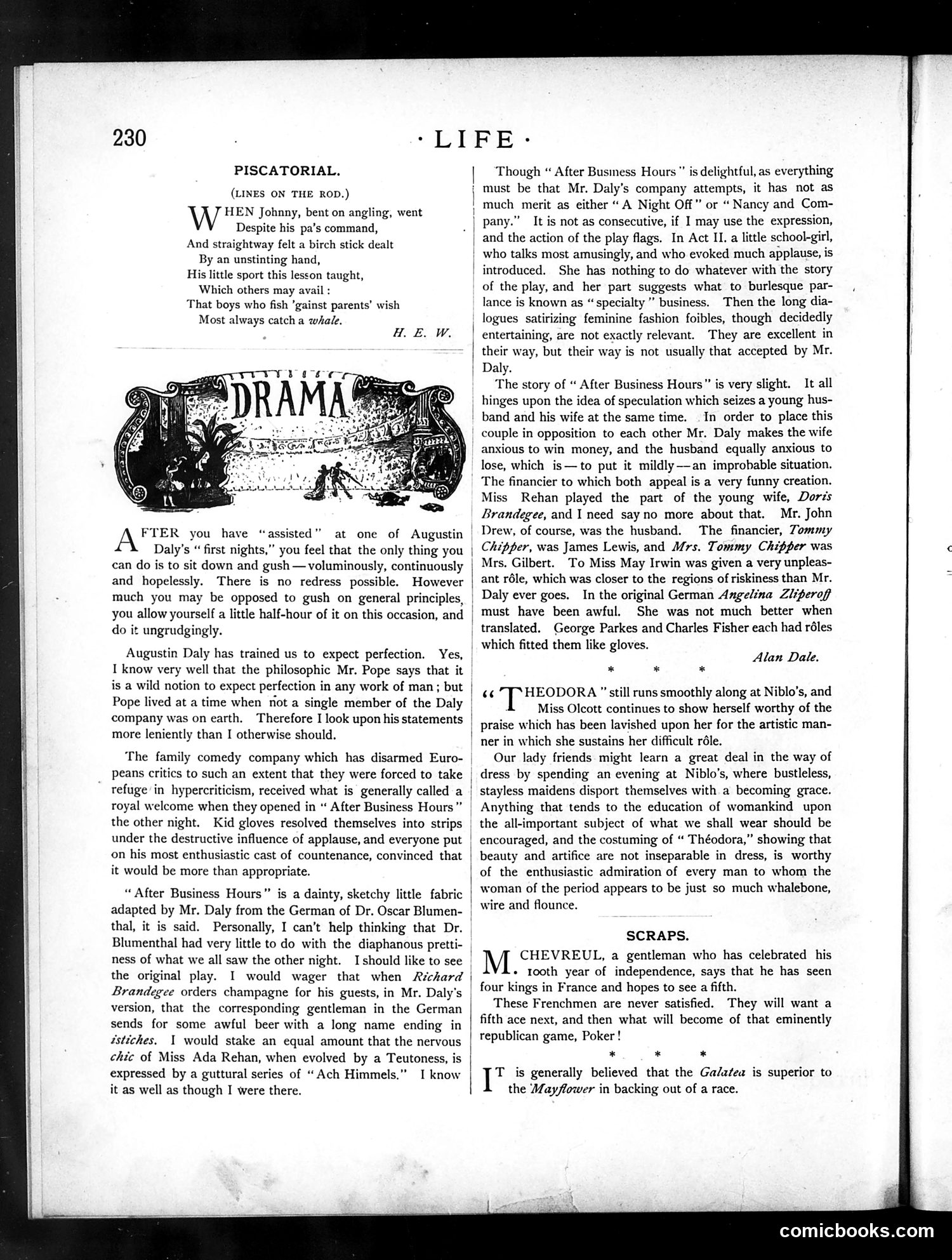
This page contains theatrical reviews rather than political cartoons. The main content discusses Augustin Daly's production of "After Business Hours," a light comedy about a young couple and their financial speculations. The reviewer critiques the play as "dainty, sketchy" but entertaining, adapted from a German work called "Angina Zipperoff." He praises the cast (including Miss May Irwin) while noting that some elements—particularly long dialogues about feminine fashion—aren't entirely relevant to the plot. The page also includes brief theatrical notes about "Theodora" at Niblo's and a "Scraps" section with anecdotes about French kings and horse racing. It's a typical theater criticism page from this era of *Life* magazine.
📄 Transcribed text from this page (OCR, searchable)
Machine-transcribed from the original scan — historical spelling and the odd misread are preserved.
-LIFE- PISCATORIAL. (LINES ON THE ROD.) HEN Johnny, bent on angling, went Despite his pa’s command, And straightway felt a birch stick dealt By an unstinting hand, His little sport this lesson taught, Which others may avail : That boys who fish ’gainst parents’ wish Most always catch a whale. ER you have “assisted” at one of Augustin Daly's “ first nights,” you feel that the only thing you | | pany.” Though “ After Business Hours ” is delightful, as everything ; must be that Mr. Daly’s company attempts, it has not as much merit as either “A Night Off” or “Nancy and Com- It is not as consecutive, if I may use the expression, and the action of the play flags. In Act II. a little school-girl, | who talks most amusingly, and who evoked much applause, is | Drew, of course, was the husband. can do is to sit down and gush —voluminously, continuously | and hopelessly. There is no redress possible. However much you may be opposed to gush on general principles, | you allow yourself a little half-hour of it on this occasion, and do it ungrudgingly. Augustin Daly has trained us to expect perfection. Yes, I know very well that the philosophic Mr. Pope says that it | must have been awful. is a wild notion to expect perfection in any work of man; but | Pope lived at a time when not a single member of the Daly company was on earth. Therefore I look upon his statements | more leniently than I otherwise should. The family comedy company which has disarmed Euro- peans critics to such an extent that they were forced to take refuge in hypercriticism, received what is generally called a | royal welcome when they opened in “ After Business Hours” the other night. Kid gloves resolved themselves into strips under the destructive influence of applause, and everyone put on his most enthusiastic cast of countenance, convinced that | it would be more than appropriate. “After Business Hours” is a dainty, sketchy little fabric adapted by Mr. Daly from the German of Dr. Oscar Blumen- thal, it is said. Personally, I can’t help thinking that Dr. introduced. She has nothing to do whatever with the story of the play, and her part suggests what to burlesque par- lance is known as “specialty” business. Then the long dia- logues satirizing feminine fashion foibles, though decidedly entertaining, are not exactly relevant. They are excellent in their way, but their way is not usually that accepted by Mr. Daly. The story of “ After Business Hours” is very slight. It all hinges upon the idea of speculation which seizes a young hus- band and his wife at the same time. In order to place this couple in opposition to each other Mr. Daly makes the wife anxious to win money, and the husband equally anxious to lose, which is—to put it mildly——an improbable situation. The financier to which both appeal is a very funny creation. Miss Rehan played the part of the young wife, Dords Brandegee, and 1 need say no more about that. Mr. John The financier, Tommy Chipper, was James Lewis, and Mrs. Tommy Chipper was Mrs. Gilbert. To Miss May Irwin was given a very unpleas- ant réle, which was closer to the regions of riskiness than Mr. Daly ever goes. In the original German Angelina Ziiperof? She was not much better when translated. George Parkes and Charles Fisher each had réles which fitted them like gloves. Alan Dale. * * * “cc HEODORA "still runs smoothly along at Niblo’s, and Miss Olcott continues to show herself worthy of the praise which has been lavished upon her for the artistic man- ner in which she sustains her difficult réle. Our lady friends might learn a great deal in the way of dress by spending an evening at Niblo’s, where bustleless, stayless maidens disport themselves with a becoming grace. Anything that tends to the education of womankind upon the all-important subject of what we shall wear should be encouraged, and the costuming of “ Théodora,” showing that beauty and artifice are not inseparable in dress, is worthy of the enthusiastic admiration of every man to whom the woman of the period appears to be just so much whalebone, | wire and flounce. Blumenthal had very little to do with the diaphanous pretti- , ness of what we all saw the other night. I should like to see the original play. I would wager that when Richard Brandegee orders champagne for his guests, in Mr. Daly's version, that the corresponding gentleman in the German sends for some awful beer with a long name ending in zstiches. 1 would stake an equal amount that the nervous chic of Miss Ada Rehan, when evolved by a Teutoness, is expressed by a guttural series of “Ach Himmels.” I know it as well as though I were there. SCRAPS. CHEVREUL, a gentleman who has celebrated his + tooth year of independence, says that he has seen four kings in France and hopes to see a fifth. These Frenchmen are never satisfied. They will want a fifth ace next, and then what will become of that eminently republican game, Poker! * * * T is generally believed that the Ga/atea is superior to the Mayflower in backing out of a race. comicbooks.com