
A complete issue · 16 pages · 1886
Life — June 17, 1886
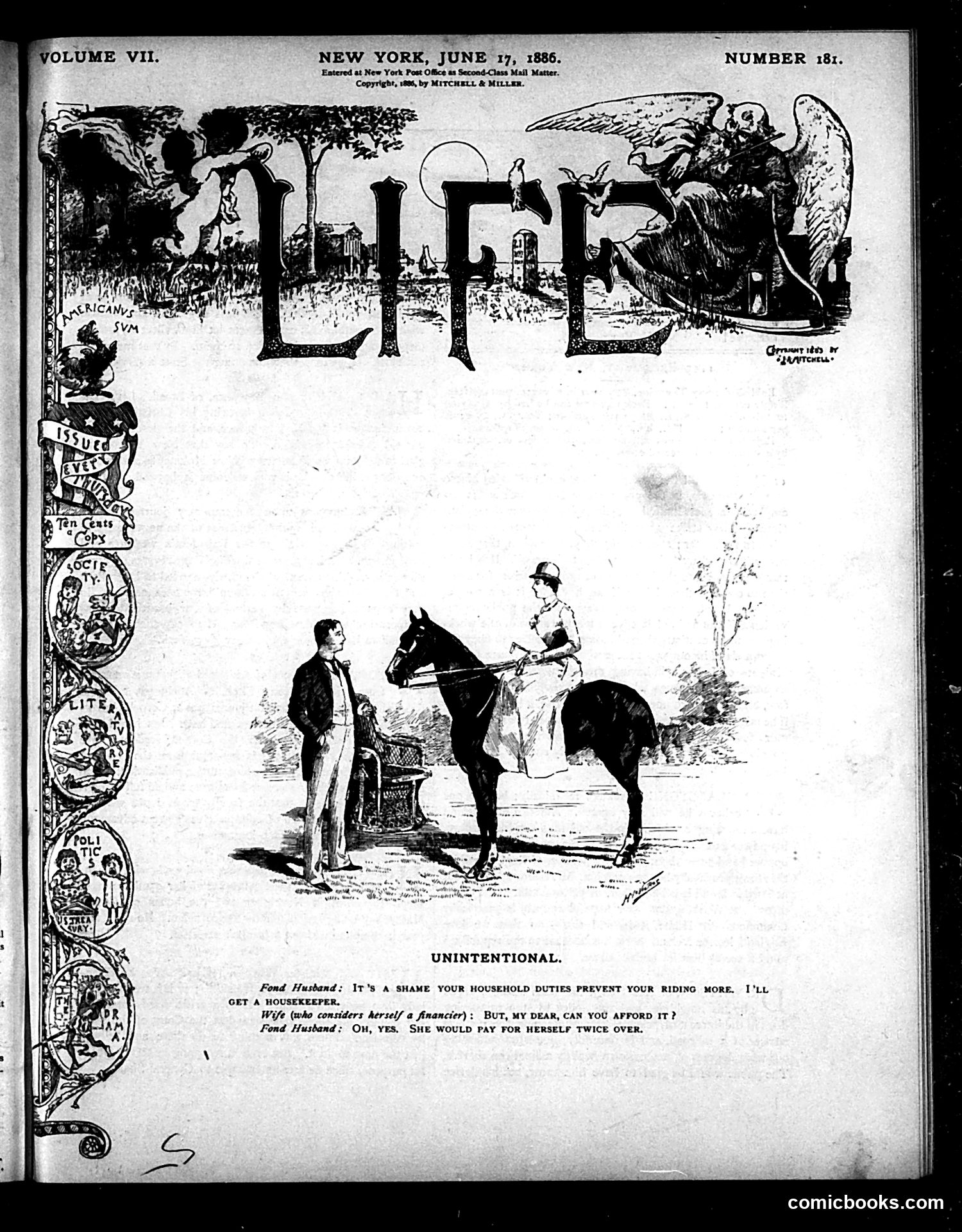
This cartoon satirizes upper-class marriage dynamics and household finances. A woman rides a horse while her husband stands beside her, objecting that "household duties prevent your riding more." When the wife replies that she'd "pay for herself twice over" if finances allowed, the husband reveals the joke's target: he cannot afford her riding hobby because she would "consider herself a financier"—implying that giving women financial independence or control over money leads to excessive spending and undermines male authority over household budgets. The cartoon's title "Unintentional" suggests the husband has accidentally revealed his true concern: that women shouldn't have financial autonomy. It's satirical commentary on Victorian gender roles and men's anxieties about women's economic independence.
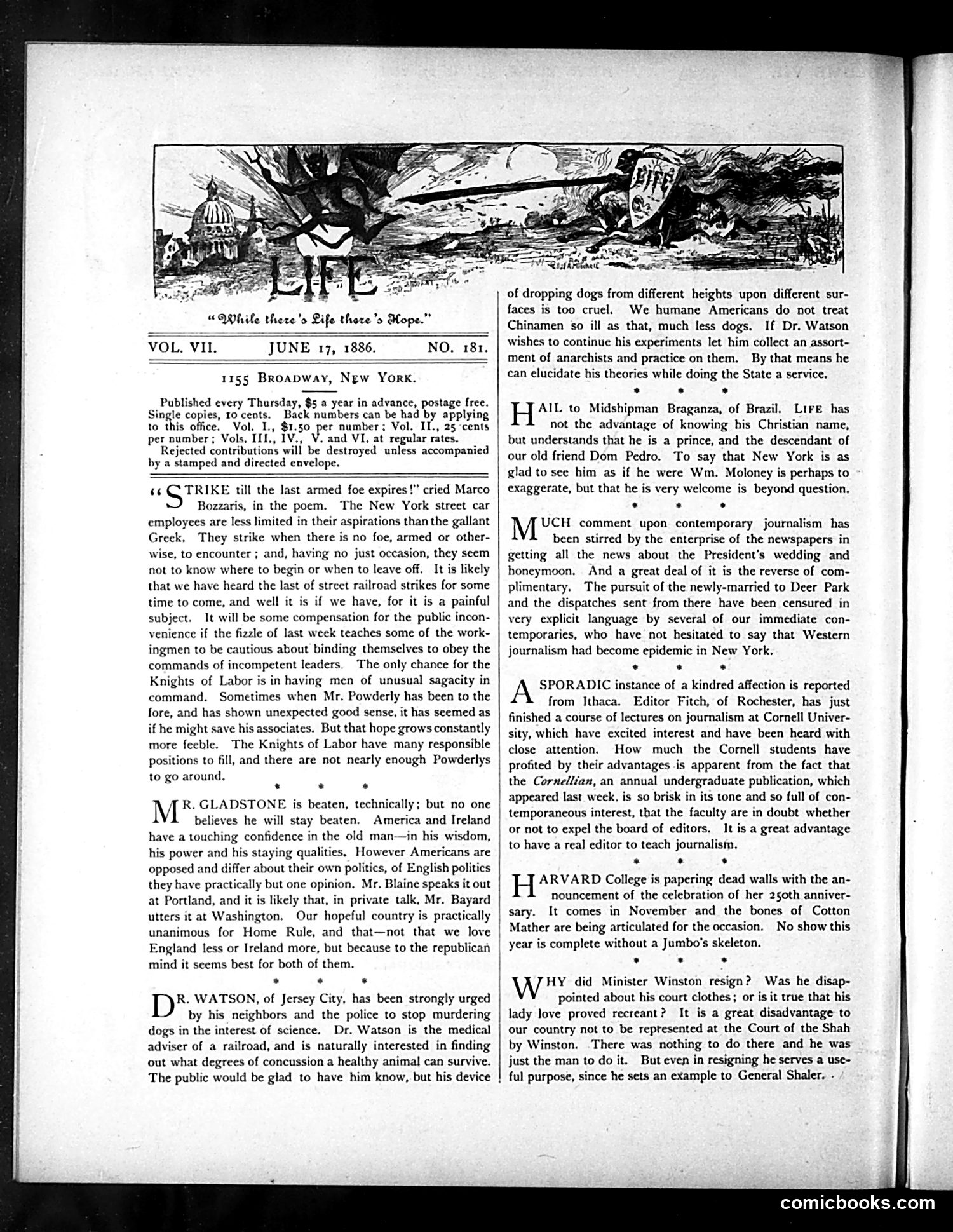
The masthead cartoon depicts a landscape with a large tree and classical buildings, illustrating the magazine's title "Life." The page consists entirely of editorial commentary with no advertisements. The articles discuss contemporary issues: 1. **Street car strikes** by railroad workers demanding better conditions 2. **Dr. Watson's dog experiments** in Jersey City—apparently involving dropping dogs from heights for scientific purposes, which the editor condemns as cruel 3. **Midshipman Braganza** visiting from Brazil 4. **Press coverage of the President's wedding** at Deer Park 5. **Academic journalism** at Cornell University 6. **Harvard's 250th anniversary** celebration 7. **Minister Winston's resignation** and representation at the Shah's court The tone is satirical commentary on contemporary American society, labor disputes, and institutional practices.
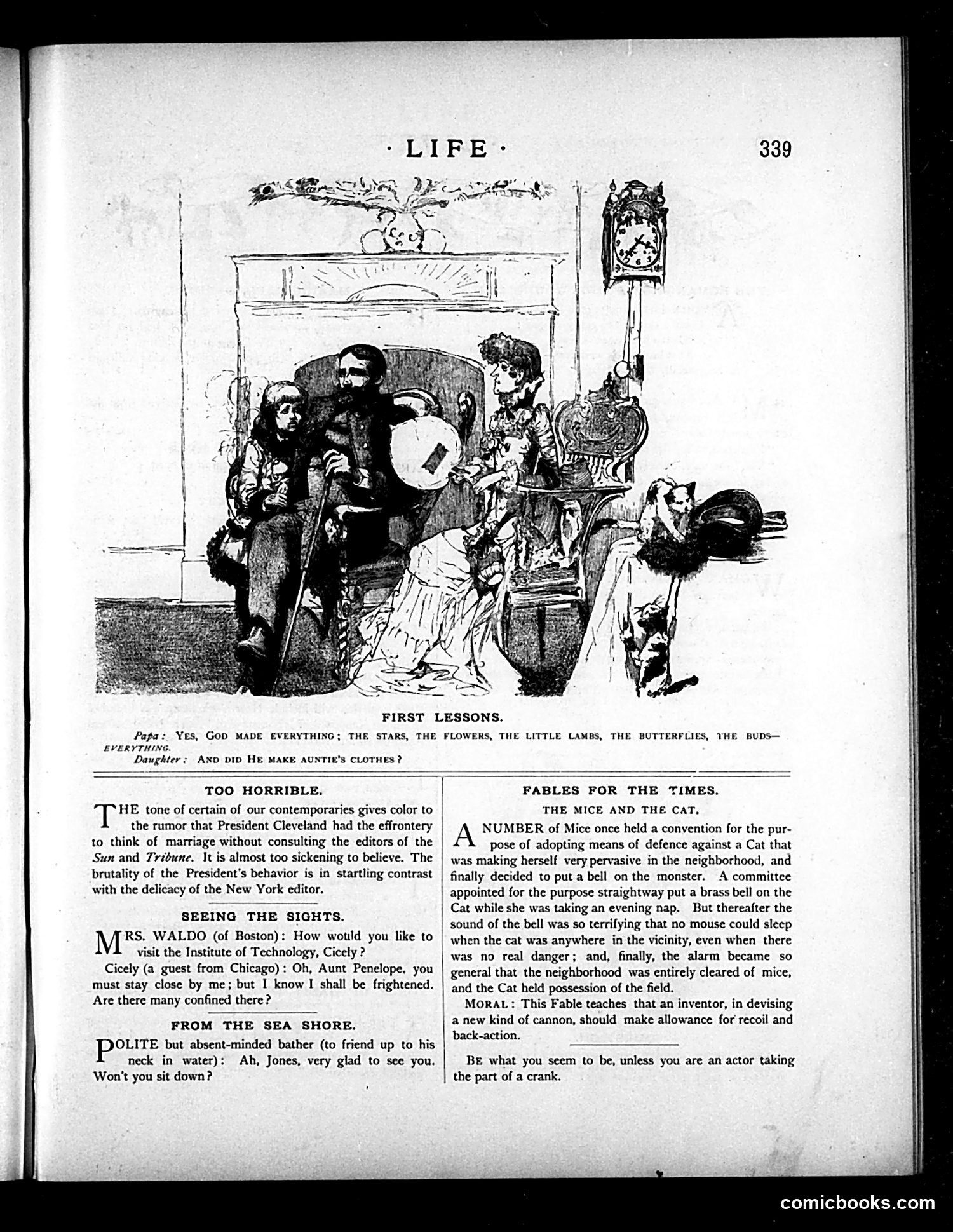
The main cartoon depicts a father teaching his daughter about creation ("God made everything; the stars, the flowers, the little lambs, the butterflies, the buds"), while she asks a pointed question: "And did He make auntie's clothes?"—a joke about fashion artifice versus nature. Below are three brief satirical pieces: **"Too Horrible"** critiques President Cleveland's marriage without consulting newspaper editors (the *Sun* and *Tribune*), mocking journalistic ego. **"Seeing the Sights"** jokes about a Boston woman's anxiety visiting MIT, playing on period stereotypes about technological intimidation. **"From the Sea Shore"** presents a barber's absent-minded social awkwardness. **"Fables for the Times"** offers a mock-fable about mice adopting defensive measures against a cat, with commentary on innovation and consequence.
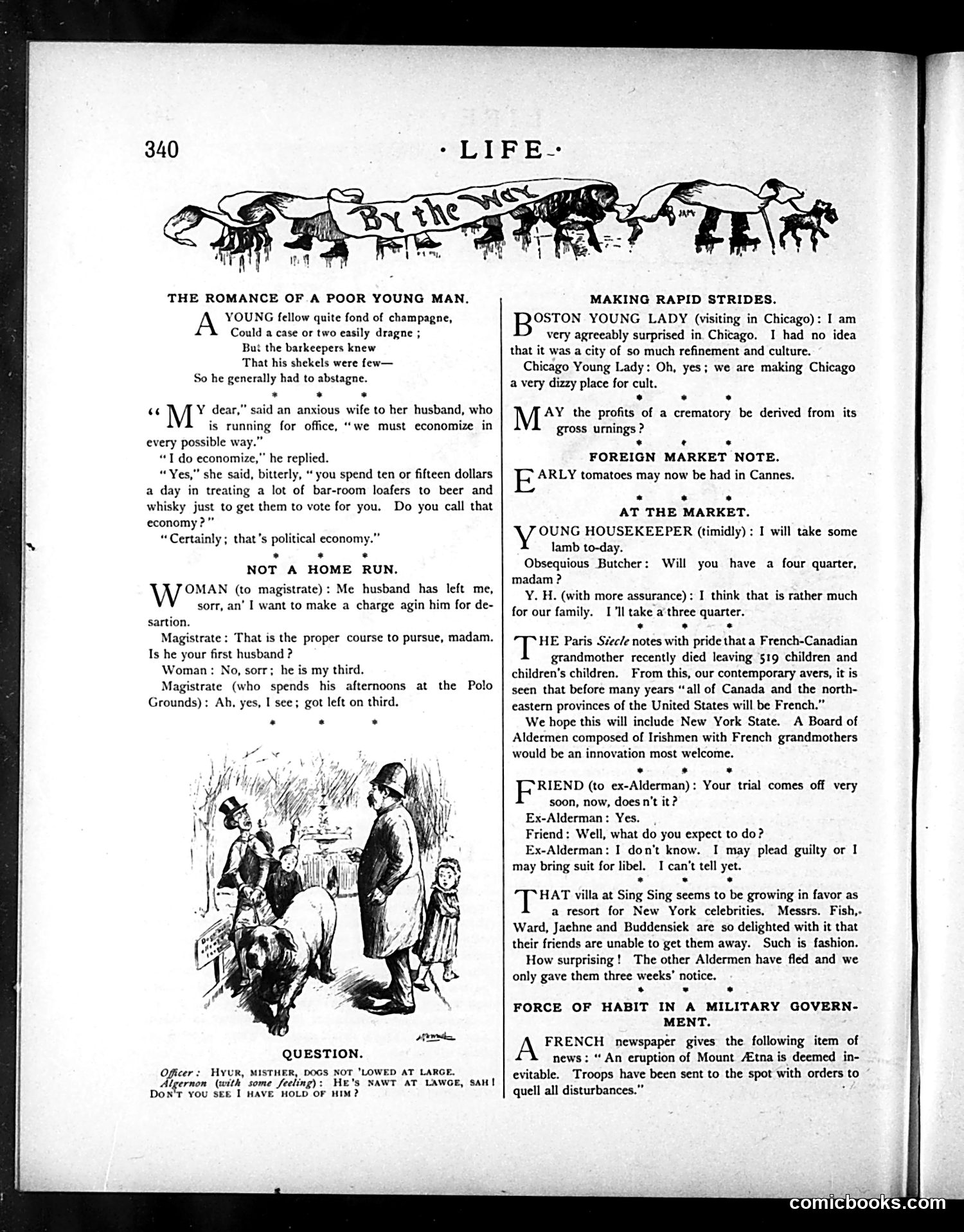
This page contains several brief satirical pieces typical of early 20th-century Life magazine humor: **"The Romance of a Poor Young Man"** mocks a husband's excuse for poverty—claiming champagne tastes despite having "few skeletons." His wife sarcastically calls his spending on "bar-room loafers" and alcohol for votes "political economy." **"Not a Home Run"** features a woman seeking to charge her third husband with desertion. The magistrate's dry response that she should pursue her "first husband" is the joke—implying she's a serial wife. **The illustration** (signed, appears to be by a cartoonist) depicts this magistrate scene, showing the woman before officials. **Right-side items** are brief gossip-style notes about Chicago refinement, tomatoes in Cannes, market prices, and military news—typical filler content mixing social commentary with trivia.
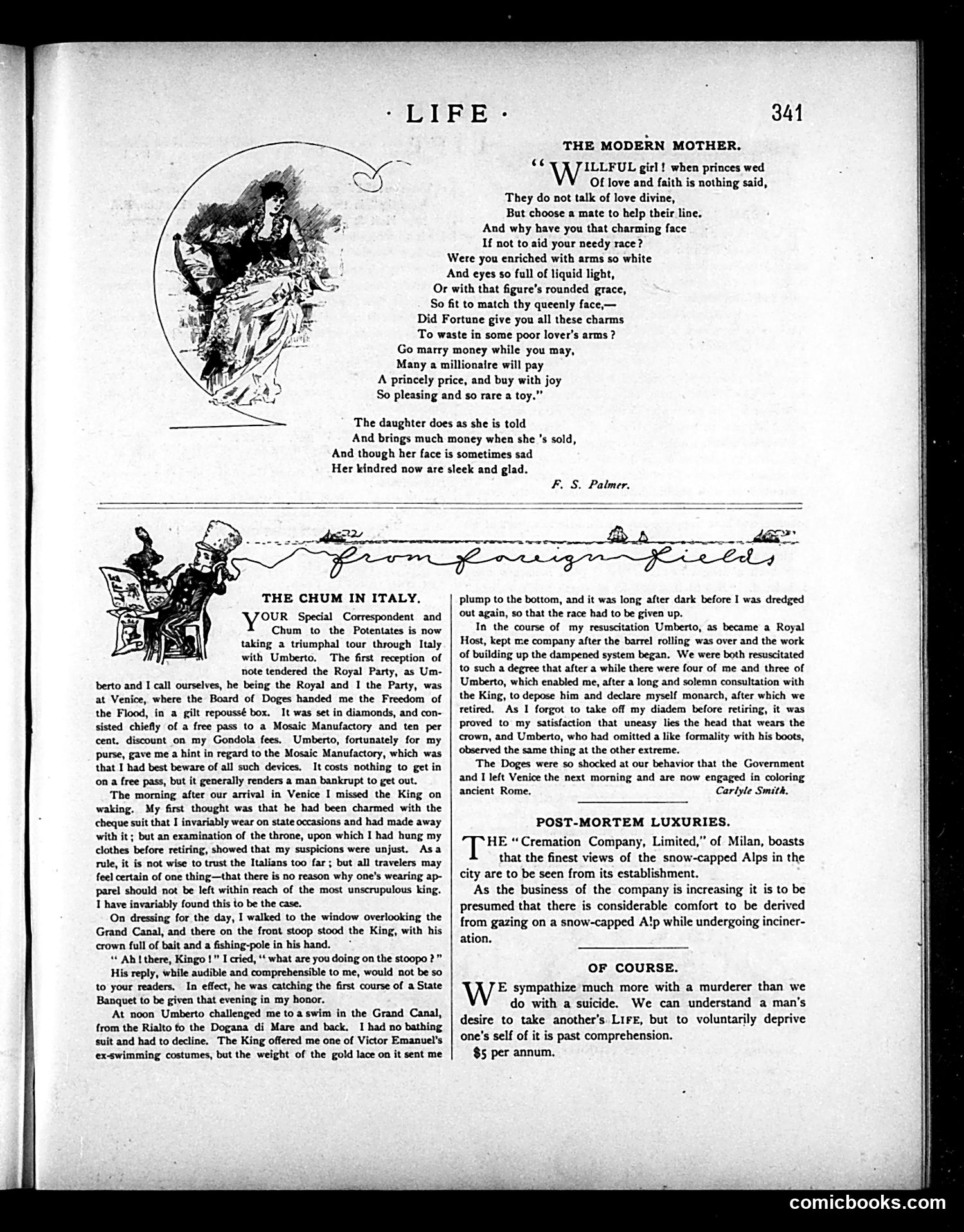
**"The Modern Mother" poem** (top): A satirical verse by F.S. Palmer mocking wealthy mothers who prioritize marrying their daughters to rich men over genuine love. The accompanying sketch shows an elegantly dressed woman, suggesting this critiques the mercenary marriage practices of the upper class. **"The Chum in Italy"** (middle): A travel account by someone identified as a correspondent, describing encounters with Italian nobility and King Umberto. The narrative includes anecdotes about swimming in Venice's Grand Canal and social interactions with royalty—likely satirizing American travelers' breathless admiration of European aristocracy. **"Post-Mortem Luxuries"** (bottom right): A brief satirical piece mocking a Milanese cremation company's marketing that romanticizes death by promoting views of snow-capped Alps during the process. The page reflects early 20th-century American satirical concerns: wealth-driven marriage, American tourism, and commercialized death.
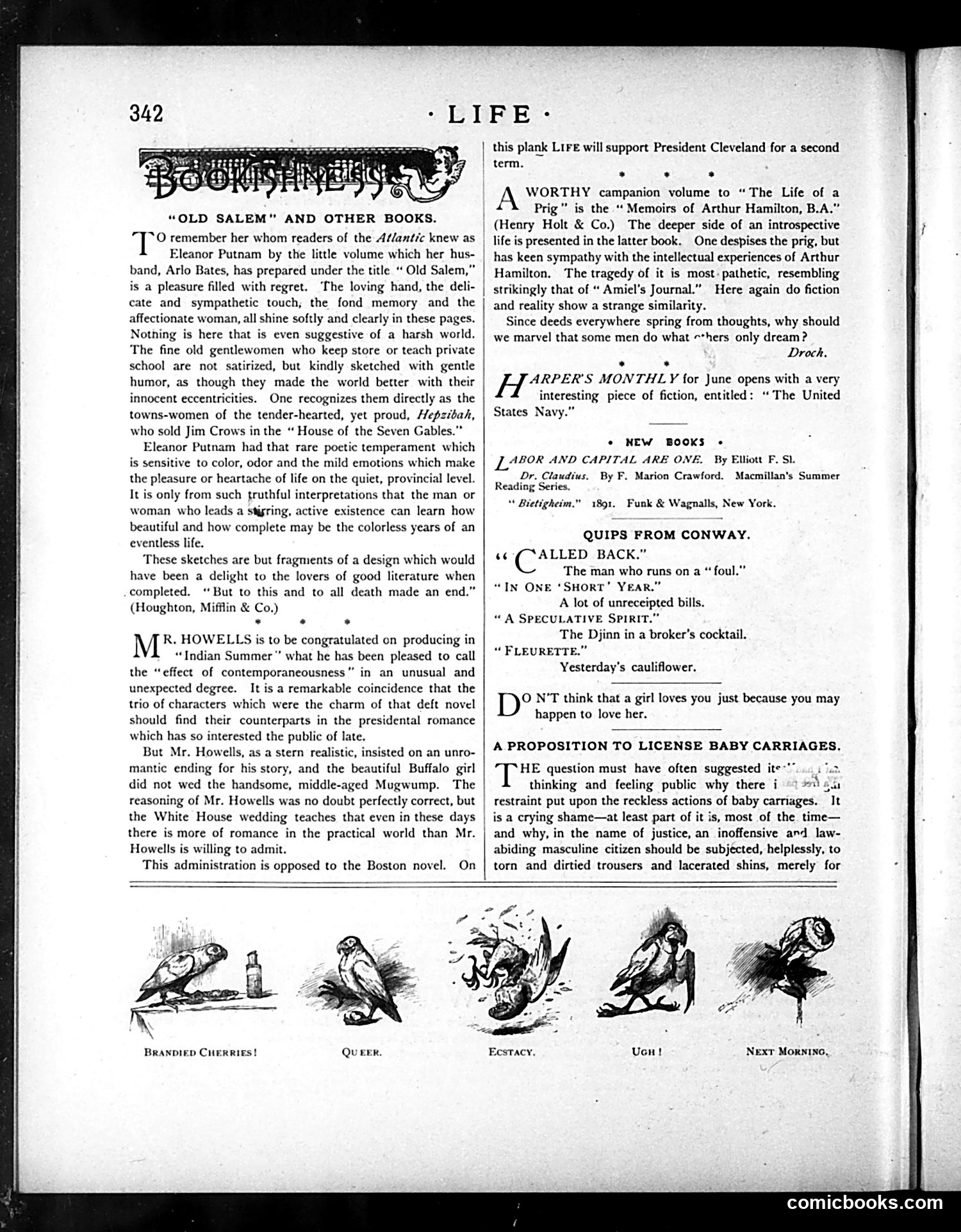
This page contains book reviews and literary commentary rather than political cartoons. The main content discusses Eleanor Putnam's volume "Old Salem" and praises her gentle, humorous sketches of New England town life. There's commentary on W.D. Howells's "Indian Summer" and its romantic ending, noting the administration's opposition to a Boston novel (unclear which). The bottom section features five small bird illustrations labeled "Brandied Cherries," "Queer," "Ecstasy," "Ugh," and "Next Morning"—likely satirizing human emotional states or social types through animal caricature, a common Victorian literary device. The page is primarily book criticism aimed at educated readers rather than political satire.
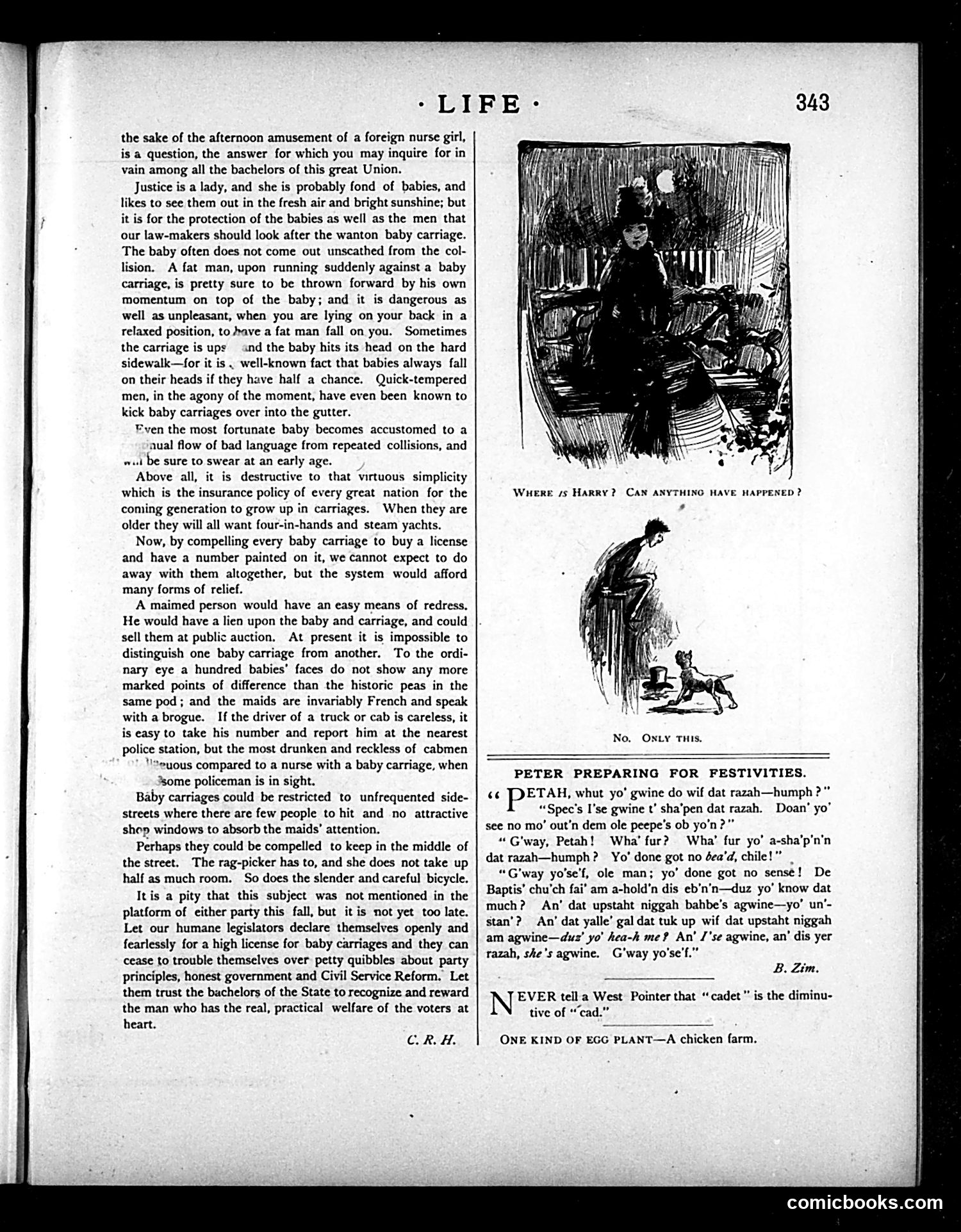
The page contains two distinct sections: **Upper section:** A serious editorial essay (signed C.R.H.) criticizing baby carriage regulations. The author argues against requiring licenses and numbers for carriages, claiming this won't solve real problems like collisions and accidents. The text advocates instead for holding owners legally liable for damages. **Lower section:** Two humorous items: 1. A sketch titled "WHERE IS HARRY? CAN ANYTHING HAVE HAPPENED?" depicting what appears to be a domestic scene—likely satirizing marital anxiety or missing spouses. 2. "PETER PREPARING FOR FESTIVITIES"—a dialect-heavy dialogue (signed B. Zim.) showing someone, presumably working-class, preparing for celebration in phonetically-rendered speech. The page mixes serious social commentary with light humor typical of Life's format.
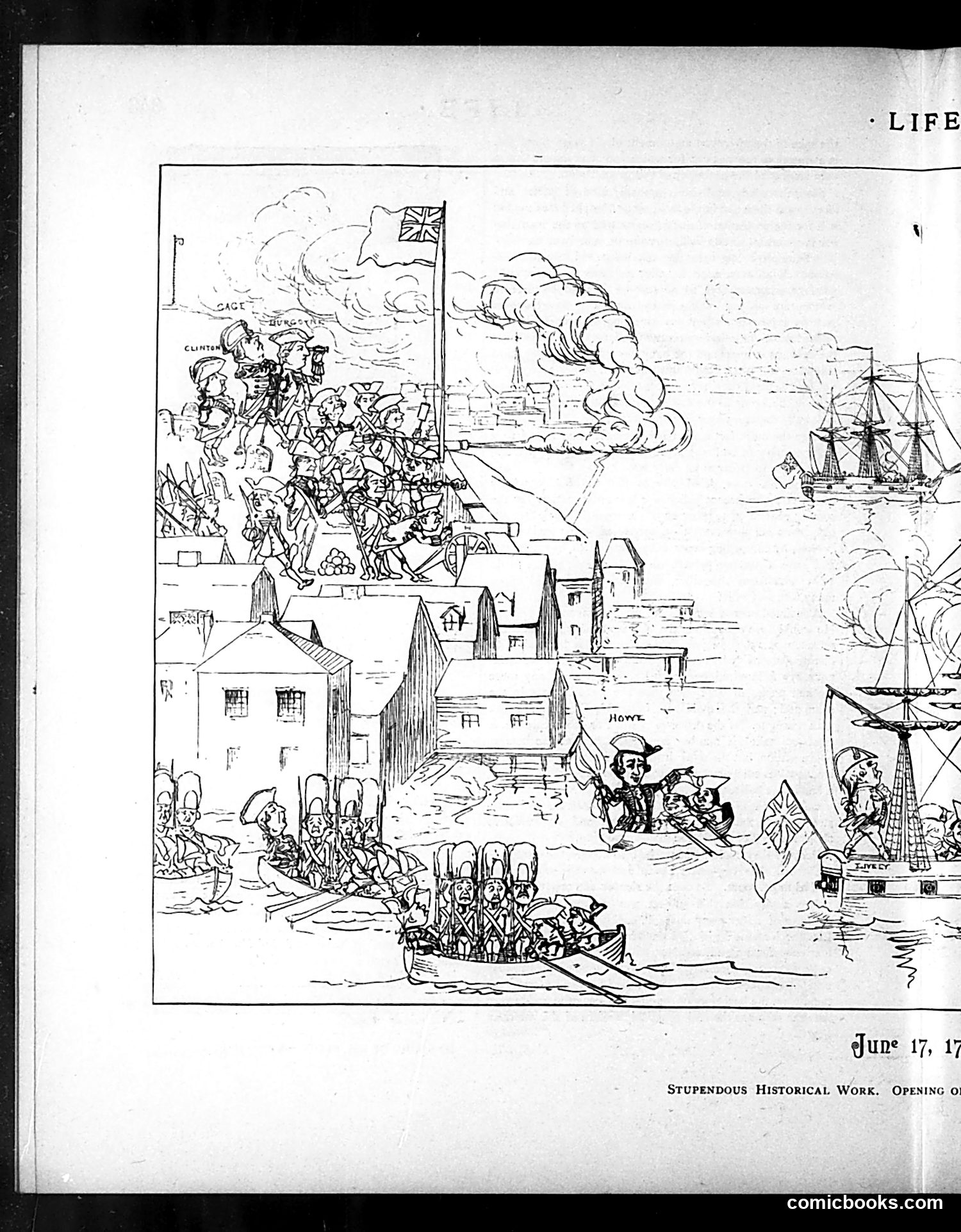
This appears to be a satirical cartoon from Life magazine dated June 17, 1917, titled "Stupendous Historical Work: Opening of..." (text cuts off). The cartoon depicts a chaotic invasion or military landing scene. A large fortified position flies a British flag while soldiers swarm from boats and climb fortifications. Buildings burn in the background. The composition suggests this is mocking a supposedly "historical" or grandiose military operation. Given the 1917 date during World War I, this likely satirizes either a British military campaign or an Allied operation. The label "Stupendous Historical Work" appears ironic—the messy, disorganized chaos depicted contradicts any notion of a grand, orderly historical achievement. The satire seems to mock inflated rhetoric about military operations versus their actual chaotic reality.
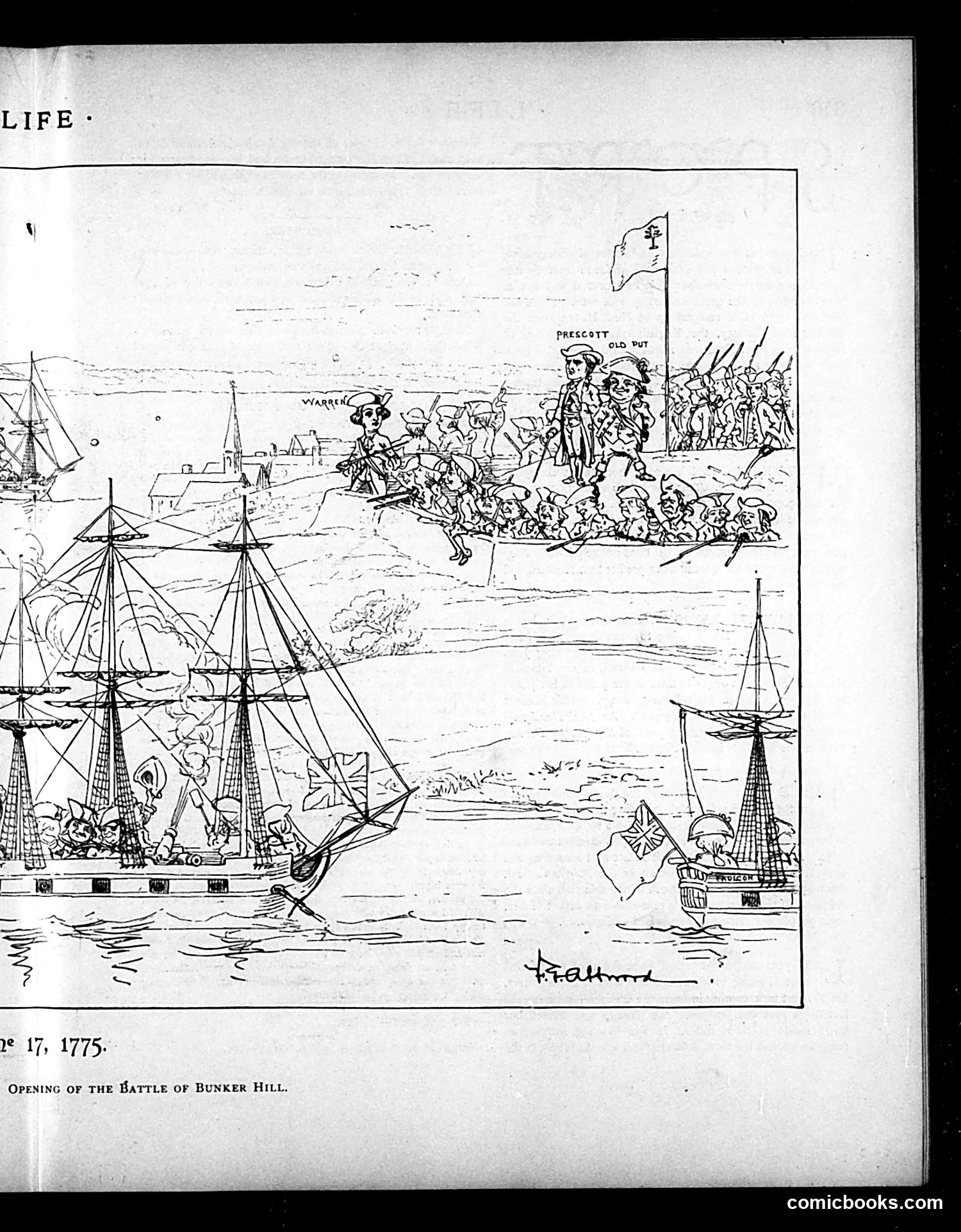
This illustration depicts the June 17, 1775 Battle of Bunker Hill, a major early engagement of the American Revolutionary War. The image shows British naval vessels (indicated by Union Jack flags) in the harbor and colonial troops on shore. The label "Prescott" likely references Colonel William Prescott, who commanded the American forces. The cannon-bearing troops and flag with what appears to be revolutionary insignia represent the colonial militia defending their position. The satire's point is unclear from the image alone, but Life magazine's satirical perspective on this famous battle—where outnumbered colonists inflicted heavy British casualties—would have reflected contemporary attitudes toward American independence and military prowess during the Revolutionary era.
This page contains three satirical pieces typical of Life's social commentary: **The Main Articles** discuss topical controversies: a Yale-Harvard rowing competition and coach dismissal; Edward Payson Weston's military walking match (characterized as charlatanical showmanship); and the yacht *Puritan*'s competitive prospects. **"A Surprise" Joke** mocks a country visitor who discovers that *Grenada* (a newspaper he'd stopped reading years ago) is now so profitable it built a grand office building. The satire targets both the visitor's naïveté and newspapers' rapid financial success. **"Women and Umbrellas"** begins a piece supporting women's suffrage and professional advancement—but the author then pivots to mock women carrying umbrellas in rain, calling it absurd and dangerous behavior. This reflects the era's contradictory attitudes: advocating women's rights while simultaneously critiquing their everyday choices. The illustration (visible but unclear) likely accompanies one of these pieces. The overall tone is typical of 1880s-era *Life*: satirizing current events, social pretensions, and gender politics with sharp wit.
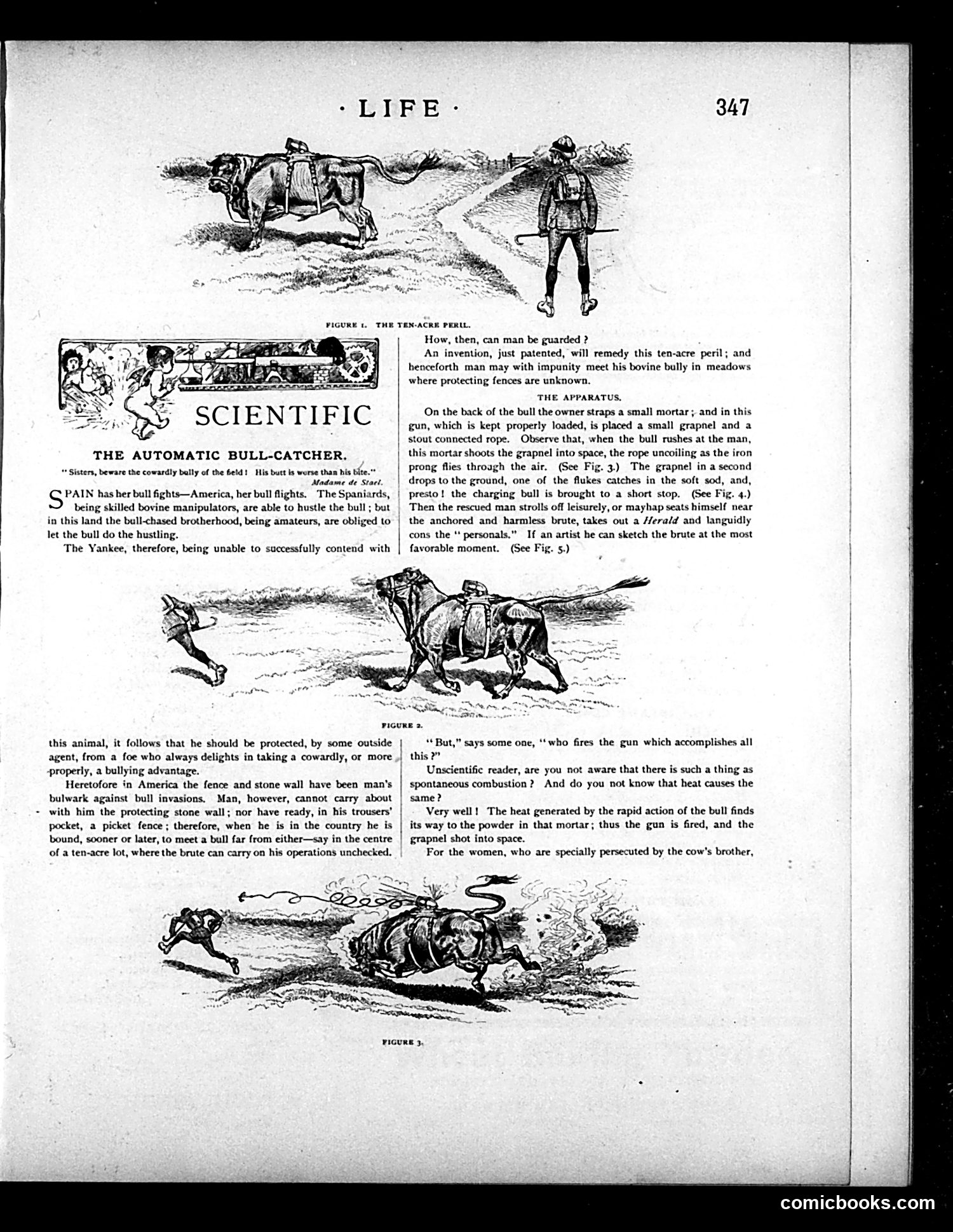
This is a humorous satirical piece contrasting American and Spanish approaches to bulls. Spain has celebrated bullfighting tradition with skilled matadors; America lacks such expertise, so bulls essentially "chase" inexperienced Americans rather than the reverse. The article proposes an absurd "scientific" solution: a small mortar mounted on the bull's back that fires a grapnel and rope when the charging bull generates heat through friction, automatically anchoring the animal and stopping its charge. The drawings illustrate this ridiculous contraption in action. The satire mocks American over-reliance on mechanical "invention" to solve practical problems that other cultures handle through skill and tradition. It also gently ridicules the American tendency to patent and commercialize solutions to everyday dangers—turning a simple rural hazard into a complicated gadget. The tone suggests American ingenuity, while clever, often produces unnecessarily complex answers to straightforward problems.
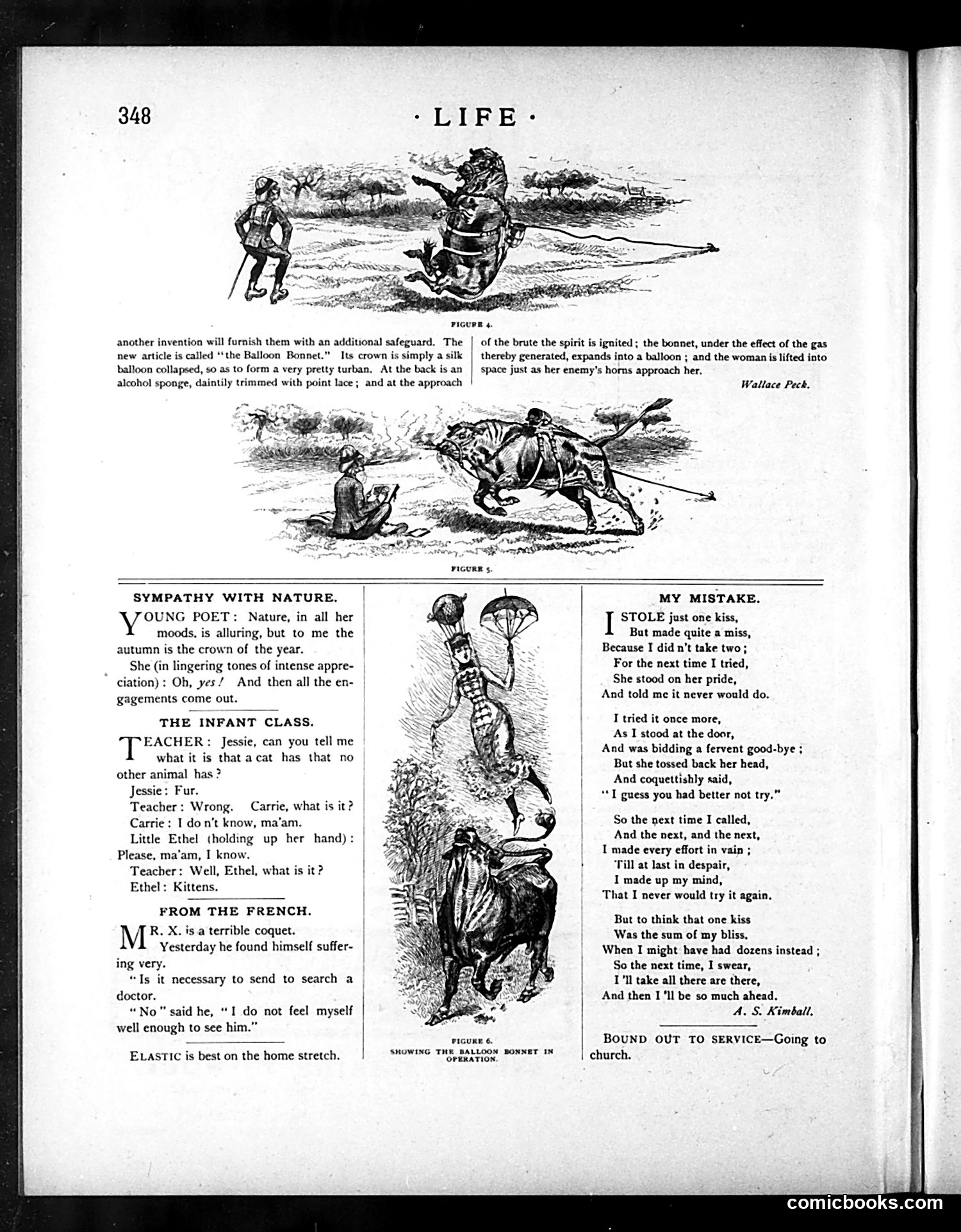
This page from *Life* contains several satirical pieces mocking contemporary social conventions: **"The Balloon Bonnet"** (Figures 4-6): A farcical invention by Wallace Peck satirizing women's defensive strategies against aggressive male suitors. The bonnet—a silk balloon with an alcohol sponge—inflates when ignited, lifting women away from men's advances. This mocks both the escalating "protection" devices marketed to women and the predatory behavior of men that necessitated them. **"Sympathy with Nature"**: A brief joke about a young poet romanticizing autumn, while his companion pragmatically notes that autumn means broken engagements—satirizing flowery sentimentality versus harsh reality. **"The Infant Class"**: A children's riddle joke where students struggle until a girl correctly answers that a cat has "kittens" (babies)—innocent humor about childhood logic. **"My Mistake"** (poem by A.S. Kimball): A man regrets not kissing a woman more aggressively on first opportunity, vowing future boldness. It satirizes male entitlement regarding women's affection. These pieces collectively satirize courtship dynamics, social pretension, and gender relations of the era.
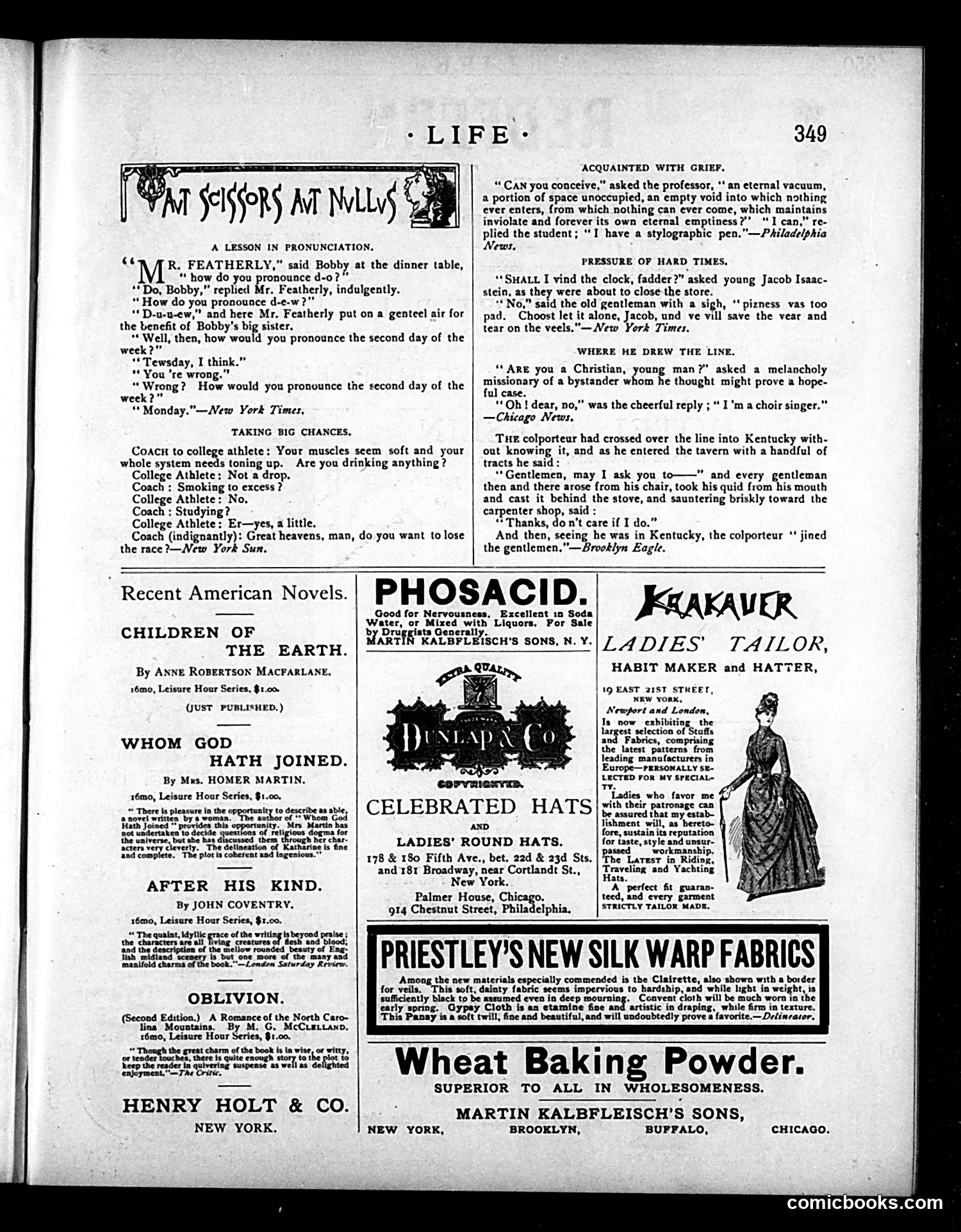
This page from *Life* magazine presents satirical humor pieces typical of the publication's era. The main cartoons are short, punchy jokes: **"A Lesson in Pronunciation"** mocks a student's faulty logic: Mr. Featherly teaches Bobby that "dew" is pronounced "d-u-u-ew," so the second day of the week must be "Monday" (following the sound pattern rather than spelling). **"Taking Big Chances"** satirizes college athletics priorities: a coach is horrified to learn his athlete studies, implying that academic work—not drinking or smoking—will make him lose races. The remaining pieces jest about student naïveté, Jewish immigrant dialect humor, and religious hypocrisy (a temperance missionary abandoning principles in Kentucky). The page is primarily filled with **period advertisements** for novels, medicines (Phosacid), ladies' fashion (hats, tailoring), and baking powder—typical commercial content subsidizing the magazine.
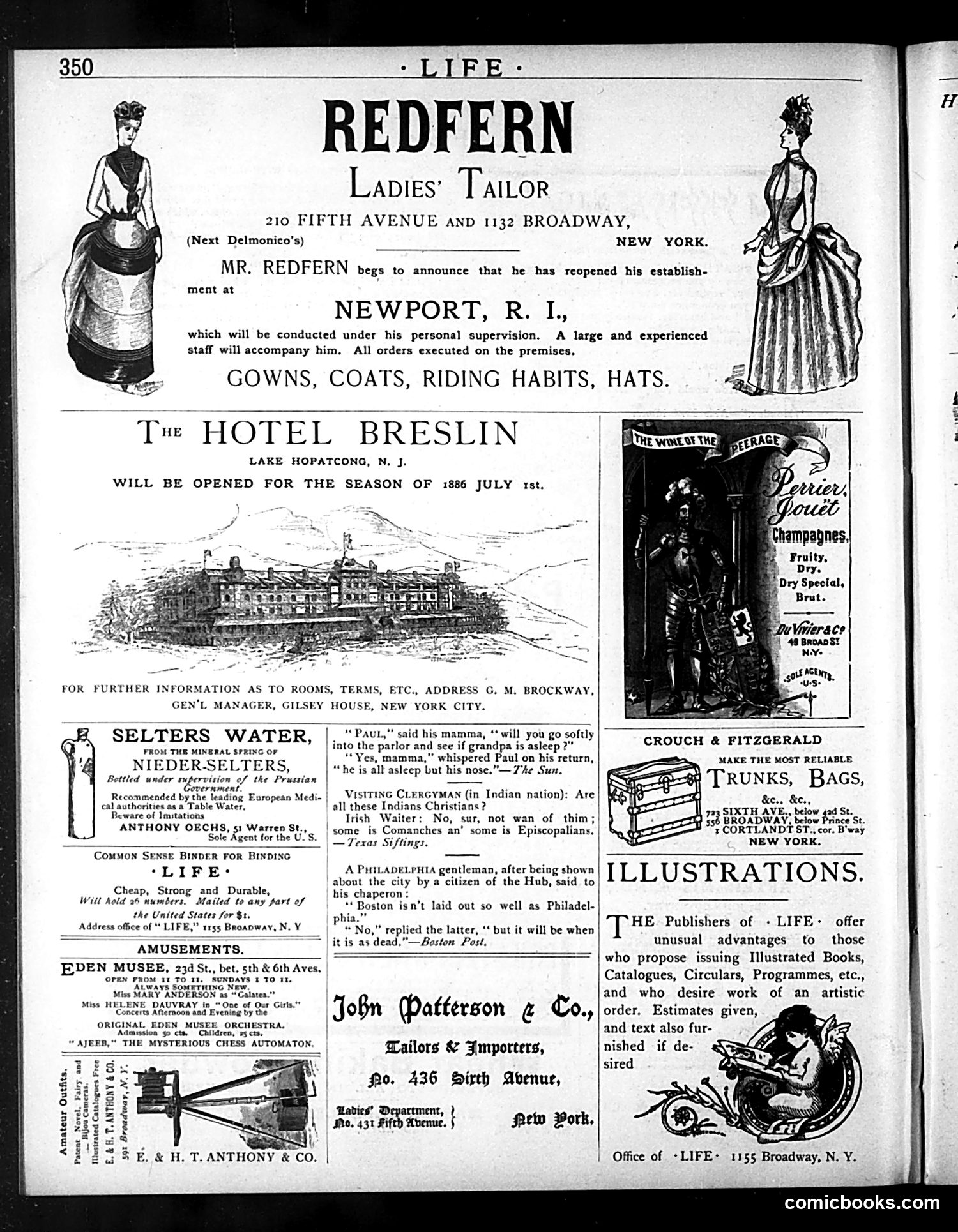
This is primarily an **advertising page** with minimal editorial content. The page features luxury goods and services targeting wealthy Americans of the Gilded Age: a high-end ladies' tailor (Redfern), an upscale hotel opening, imported German mineral water, and travel trunks. The few brief humorous items are standard joke-column fare with no political significance: - A child's innocent misunderstanding about his sleeping grandfather - A play on regional pride (Boston vs. Philadelphia) - A joke conflating Native American tribes with Protestant denominations (reflecting period stereotypes) These are gentle, domestic humor pieces typical of 1880s magazines—designed for family entertainment rather than satire or social commentary. The page's real content is **commercial**: advertising to an affluent readership about fashionable clothing, accommodations, and accessories. It reflects the magazine's role as a vehicle for high-end advertising alongside satirical content.
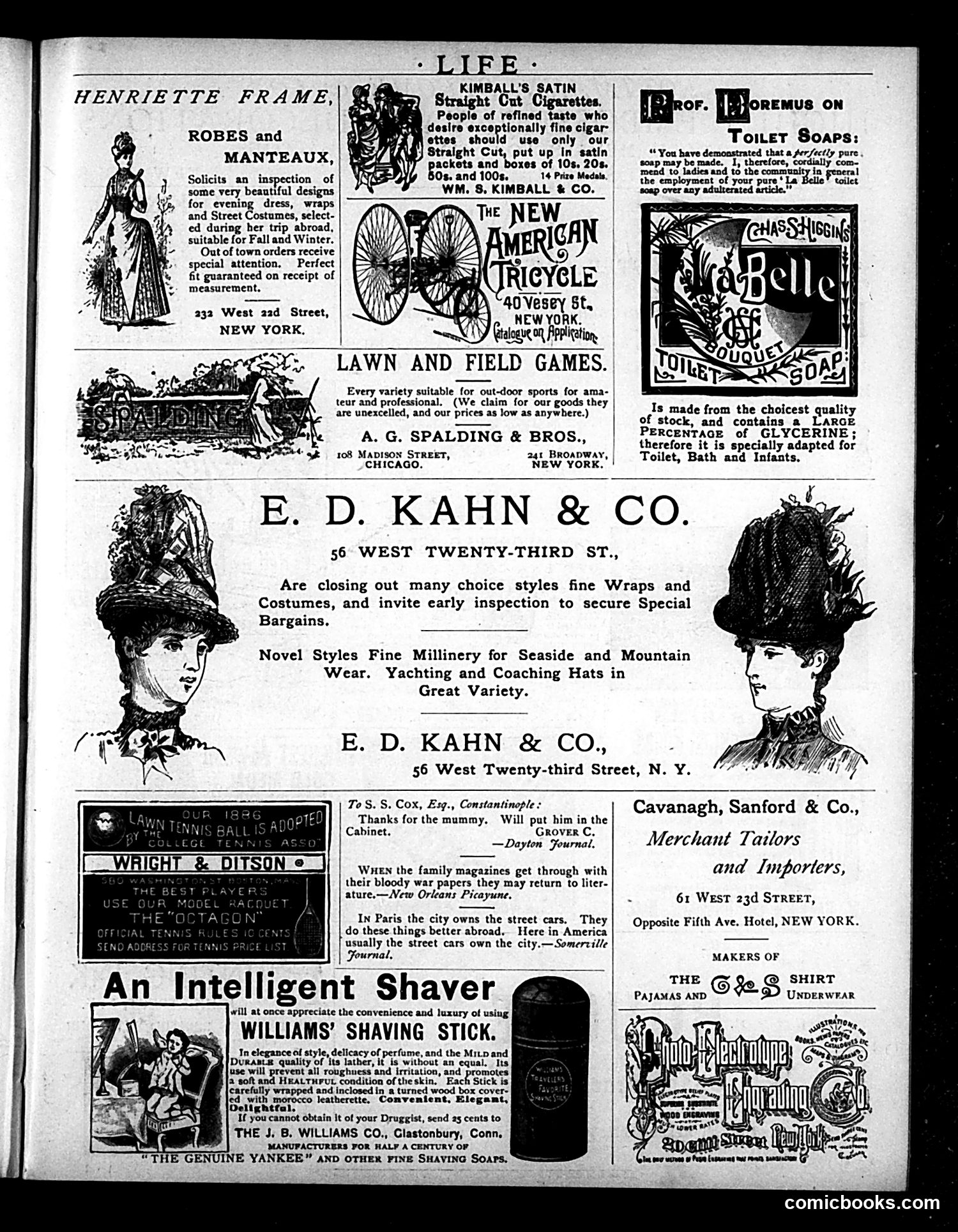
This page is primarily **advertising**, typical of late 19th-century American magazines. The layout contains no political cartoons or satirical content—instead, it showcases commercial advertisements for fashion, sporting goods, toiletries, and services. Notable ads include: - **Henriette Frame** (women's clothing) - **A.G. Spalding & Bros.** (sporting equipment) - **E.D. Kahn & Co.** (wraps, costumes, millinery) - **Williams' Shaving Stick** (grooming product) - **Cavanagh, Sanford & Co.** (tailoring) The page does include brief **humorous editorial snippets** (quotes attributed to various newspapers) making light social observations—such as a joke about Paris owning street cars versus American cities being "owned" by theirs. However, these are minor filler content, not satirical cartoons. The images are product illustrations and fashion drawings typical of period advertising, with no political references or caricatures requiring historical context.
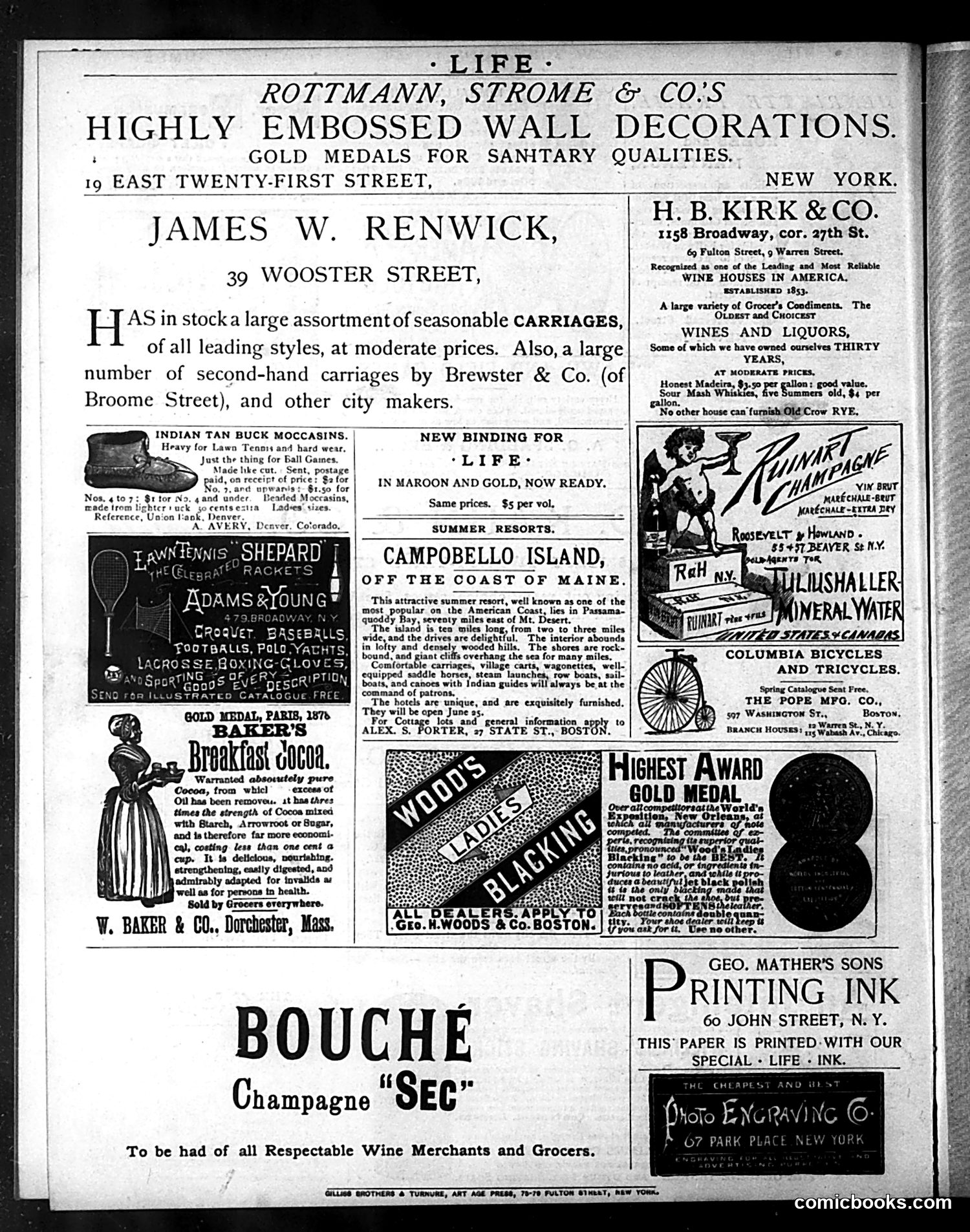
This is primarily an **advertising page** from Life magazine, not a satirical cartoon spread. The page contains approximately 12-15 advertisements for various 19th-century products and services. Notable ads include: - **Rottmann, Strome & Co.** (wall decorations) - **James W. Renwick** (carriages) - **Baker's Breakfast Cocoa** (with a Gold Medal claim) - **Campobello Island** (summer resort in Maine) - **Columbia Bicycles and Tricycles** - **Bouché Champagne** - **Printing Ink** by Geo. Mather's Sons The page reflects late 19th-century consumer culture, featuring luxury goods (wine, carriages), emerging technologies (bicycles), and leisure destinations. There is **no political satire or cartoon content** visible—this appears to be a standard revenue-generating advertisement page typical of the era. The typography and layout are characteristic of 1880s-1890s magazine design.