
Life, 1886-06-17 · page 2 of 16
Life — June 17, 1886 — page 2: what you’re looking at
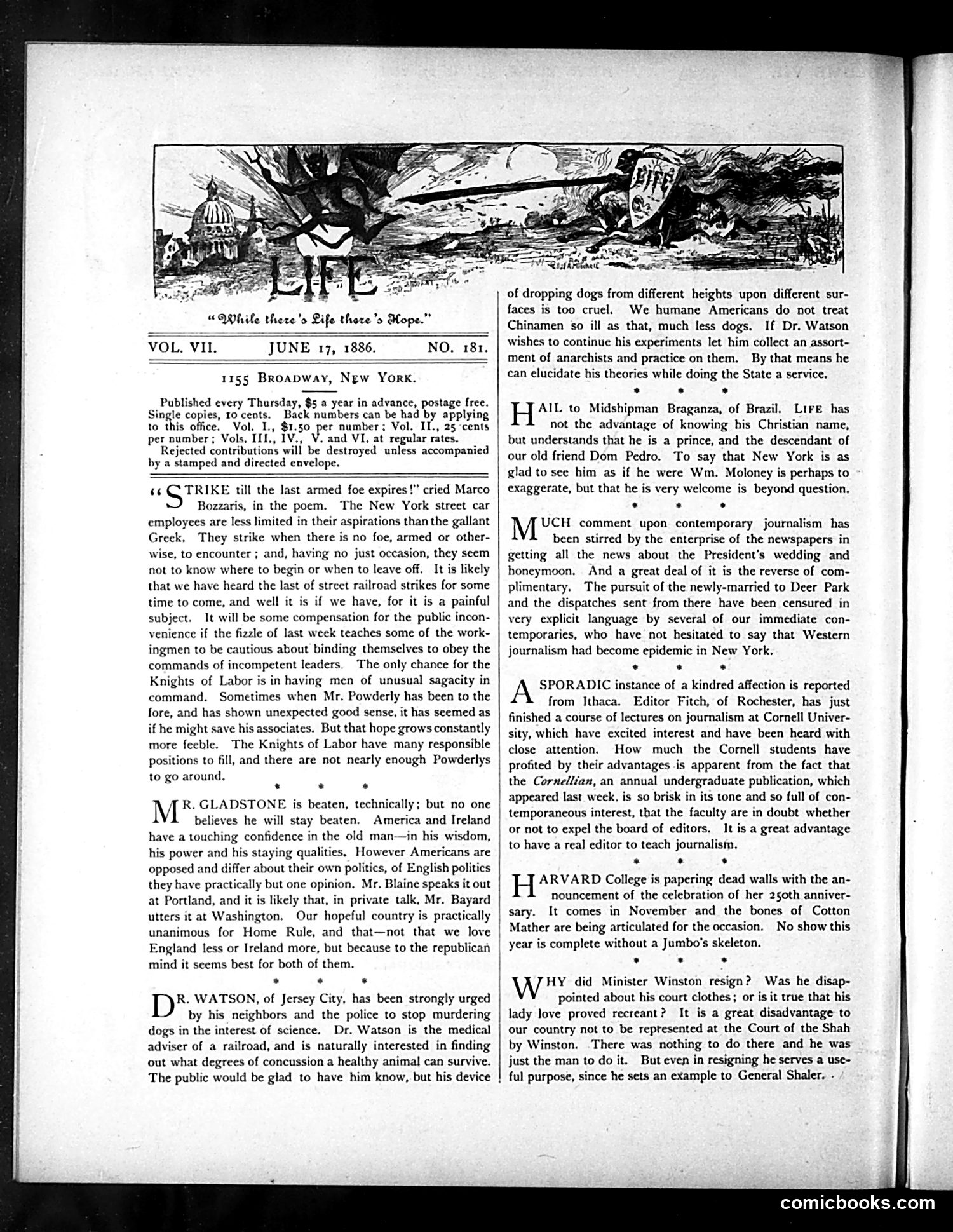
What you’re looking at
The masthead cartoon depicts a landscape with a large tree and classical buildings, illustrating the magazine's title "Life." The page consists entirely of editorial commentary with no advertisements. The articles discuss contemporary issues: 1. **Street car strikes** by railroad workers demanding better conditions 2. **Dr. Watson's dog experiments** in Jersey City—apparently involving dropping dogs from heights for scientific purposes, which the editor condemns as cruel 3. **Midshipman Braganza** visiting from Brazil 4. **Press coverage of the President's wedding** at Deer Park 5. **Academic journalism** at Cornell University 6. **Harvard's 250th anniversary** celebration 7. **Minister Winston's resignation** and representation at the Shah's court The tone is satirical commentary on contemporary American society, labor disputes, and institutional practices.
📄 Transcribed text from this page (OCR, searchable)
Machine-transcribed from the original scan — historical spelling and the odd misread are preserved.
“Dhile there's Life there's Hope.” VOL. VII. «JUNE 17, 1886. NO. 181. 1155 Broapway, New York. Published every Thursday, $5 a year in advance, postage free. Single copies, ro cents. Back numbers can be had by applying to this office. Vol. I., $1.50 per number ; Vol. II., 25 cents per number; Vols, III., IV., V. and VI, at regular rates. Rejected contributions will be destroyed unless accompanied | by a stamped and directed envelope. ¢¢ TRIKE till the last armed foe expires!" cried Marco Bozzaris, in the poem. The New York street car employees are less limited in their aspirations than the gallant Greek, They strike when there is no foe, armed or other- wise, to encounter ; and, having no just occasion, they seem not to know where to begin or when to leave off. It is likely | that we have heard the last of street railroad strikes for some time to come, and well it is if we have, for it is a painful | subject. It will be some compensation for the public incon- | venience if the fizzle of last week teaches some of the work- ingmen to be cautious about binding themselves to obey the commands of incompetent leaders. The only chance for the Knights of Labor is in having men of unusual sagacity in command. Sometimes when Mr. Powderly has been to the fore, and has shown unexpected good sense, it has seemed as if he might save his associates. But that hope grows constantly more feeble. The Knights of Labor have many responsible positions to fill, and there are not nearly enough Powderlys to go around. M R. GLADSTONE is beaten, technically; but no one | believes he will stay beaten. America and Ireland have a touching confidence in the old man—in his wisdom, his power and his staying qualities. However Americans are opposed and differ about their own politics, of English politics they have practically but one opinion. Mr. Blaine speaks it out at Portland, and it is likely that, in private talk, Mr. Bayard utters it at Washington. Our hopeful country is practically unanimous for Home Rule, and that—not that we love England less or Ireland more, but because to the republican mind it seems best for both of them. | . . . R. WATSON, of Jersey City, has been strongly urged by his neighbors and the police to stop murdering dogs in the interest of science. Dr. Watson is the medical adviser of a railroad, and is naturally interested in finding out what degrees of concussion a healthy animal can survive. The public would be glad to have him know, but his device | nia a) = eee Y i Sa eyes einai, me: of dropping dogs from different heights upon different sur- faces is too cruel. We humane Americans do not treat Chinamen so ill as that, much less dogs. If Dr. Watson wishes to continue his experiments let him collect an assort- ment of anarchists and practice on them. By that means he can elucidate his theories while doing the State a service. . . . AIL to Midshipman Braganza, of Brazil. Lire has not the advantage of knowing his Christian name, but understands that he is a prince, and the descendant of our old friend Dom Pedro. To say that New York is as glad to see him as if he were Wm. Moloney is perhaps to exaggerate, but that he is very welcome is beyond question. * . . UCH comment upon contemporary journalism has been stirred by the enterprise of the newspapers in getting all the news about the President's wedding and honeymoon, And a great deal of it is the reverse of com- plimentary. The pursuit of the newly-married to Deer Park and the dispatches sent from there have been censured in very explicit language by several of our immediate con- temporaries, who have not hesitated to say that Western journalism had become epidemic in New York. . . . SPORADIC instance of a kindred affection is reported from Ithaca. Editor Fitch, of Rochester, has just finished a course of lectures on journalism at Cornell Univer- sity, which have excited interest and have been heard with close attention. How much the Cornell students have profited by their advantages is apparent from the fact that the Cornelian, an annual undergraduate publication, which appeared last week, is so brisk in its tone and so full of con- temporaneous interest, that the faculty are in doubt whether or not to expel the board of editors. It is a great advantage to have a real editor to teach journalism. * . . ARVARD College is papering dead walls with the an- nouncement of the celebration of her 250th anniver- It comes in November and the bones of Cotton No show this sary. Mather are being articulated for the occasion. year is complete without a Jumbo’s skeleton. . . . Ww did Minister Winston resign? Was he disap- pointed about his court clothes; or is it true that his lady love proved recreant? It is a great disadvantage to our country not to be represented at the Court of the Shah by Winston. ‘There was nothing to do there and he was just the man to do it. But even in resigning he serves a use- ful purpose, since he sets an example to General Shaler. - comicbooks.com