
Life, 1886-06-17 · page 11 of 16
Life — June 17, 1886 — page 11: what you’re looking at
What you’re looking at
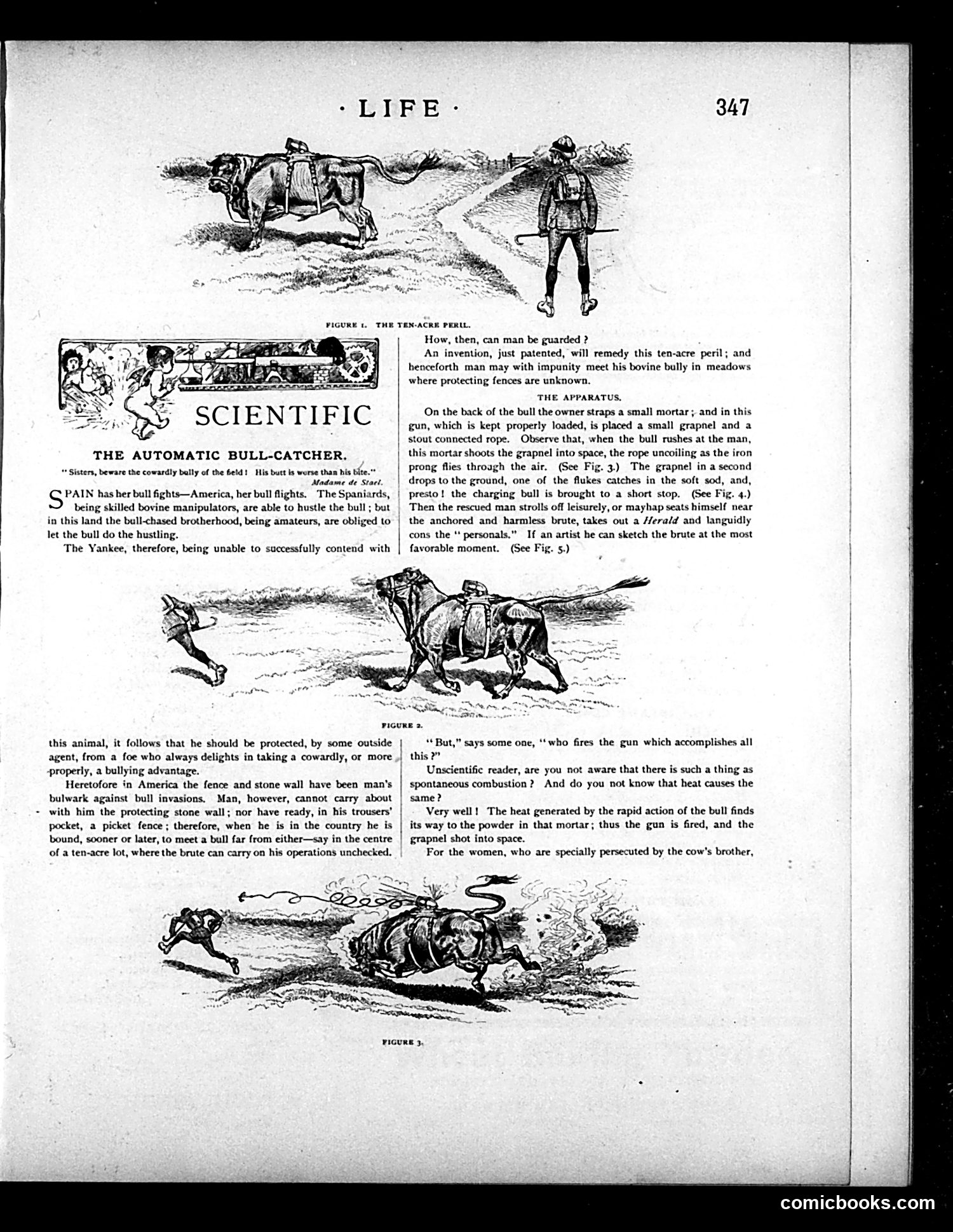
This is a humorous satirical piece contrasting American and Spanish approaches to bulls. Spain has celebrated bullfighting tradition with skilled matadors; America lacks such expertise, so bulls essentially "chase" inexperienced Americans rather than the reverse. The article proposes an absurd "scientific" solution: a small mortar mounted on the bull's back that fires a grapnel and rope when the charging bull generates heat through friction, automatically anchoring the animal and stopping its charge. The drawings illustrate this ridiculous contraption in action. The satire mocks American over-reliance on mechanical "invention" to solve practical problems that other cultures handle through skill and tradition. It also gently ridicules the American tendency to patent and commercialize solutions to everyday dangers—turning a simple rural hazard into a complicated gadget. The tone suggests American ingenuity, while clever, often produces unnecessarily complex answers to straightforward problems.
📄 Transcribed text from this page (OCR, searchable)
Machine-transcribed from the original scan — historical spelling and the odd misread are preserved.
FIGURE t. SCIENTIFIC THE AUTOMATIC BULL-CATCHER, isters, beware the cowardly bally of the Geld! His butt is worse than his bit Madame de Staet. S PAIN has her bull fights—America, her bull flights. The Spaniards, being skilled bovine manipulators, are able to hustle the bull ; but in this land the bull-chased brotherhood, being amateurs, are obliged to let the bull do the hustling. The Yankee, therefore, being unable to successfully contend with THE TEN-ACRE PERIL. How, then, can man be guarded ? An invention, just patented, will remedy this ten-acre peril; and henceforth man may with impunity meet his bovine bully in meadows where protecting fences are unknown. THE APPARATUS. On the back of the bull the owner straps a small mortar ; and in this gun, which is kept properly loaded, is placed a small grapnel and a stout connected rope. Observe that, when the bull rushes at the man, this mortar shoots the grapnel into space, the rope uncoiling as the iron prong flies through the air. (See Fig. 3.) The grapnel ina second drops to the ground, one of the flukes catches in the soft sod, and, presto! the charging bull is brought to a short stop. (See Fig. 4.) ‘Then the rescued man strolls off leisurely, or mayhap seats himself near the anchored and harmless brute, takes out a /era/d and languidly cons the “ personals.” If an artist he can sketch the brute at the most favorable moment. (See Fig. 5.) FicuRE 2. this animal, it follows that he should be protected, by some outside | agent, from a foe who always delights in taking a cowardly, or more ,| -properly, a bullying advantage. Heretofore in America the fence and stone wall have been man’s bulwark against bull invasions, Man, however, cannot carry about with him the protecting stone wall; nor have ready, in his trousers’ | pocket, a picket fence; therefore, when he is in the country he is | bound, sooner or later, to meet a bull far from either—say in the centre | of a ten-acre lot, where the brute can carry on his operations unchecked. “But,” says some one, ‘who fires the gun which accomplishes all this 2” Unscientific reader, are you not aware that there is such a thing as spontaneous combustion? And do you not know that heat causes the same? Very well! The heat generated by the rapid action of the bull finds its way to the powder in that mortar; thus the gun is fired, and the grapnel shot into space. For the women, who are specially persecuted by the cow's brother, vicuRE 3, comicbooks.com