
Life, 1886-06-17 · page 6 of 16
Life — June 17, 1886 — page 6: what you’re looking at
What you’re looking at
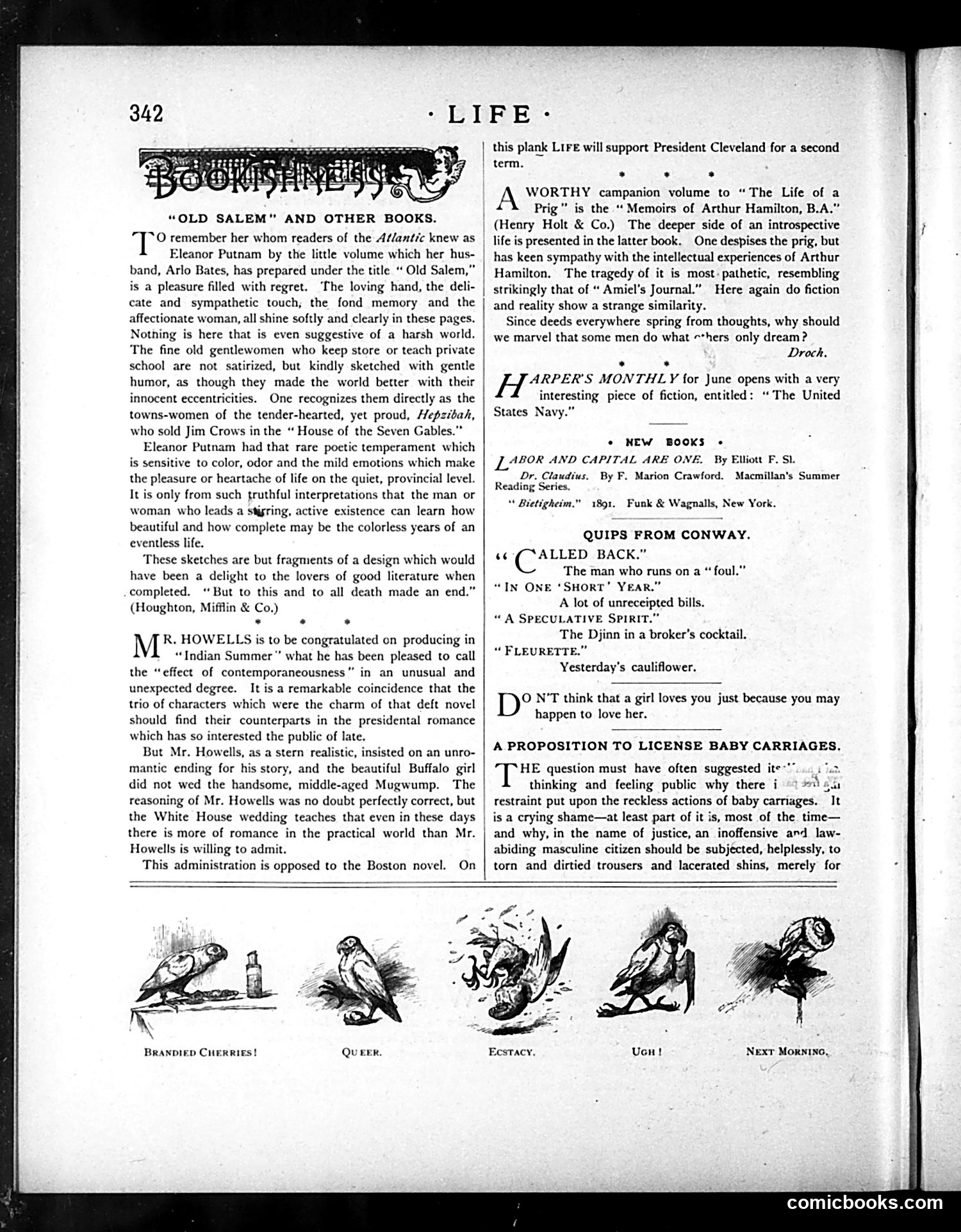
This page contains book reviews and literary commentary rather than political cartoons. The main content discusses Eleanor Putnam's volume "Old Salem" and praises her gentle, humorous sketches of New England town life. There's commentary on W.D. Howells's "Indian Summer" and its romantic ending, noting the administration's opposition to a Boston novel (unclear which). The bottom section features five small bird illustrations labeled "Brandied Cherries," "Queer," "Ecstasy," "Ugh," and "Next Morning"—likely satirizing human emotional states or social types through animal caricature, a common Victorian literary device. The page is primarily book criticism aimed at educated readers rather than political satire.
📄 Transcribed text from this page (OCR, searchable)
Machine-transcribed from the original scan — historical spelling and the odd misread are preserved.
* LIFE: “OLD SALEM" AND OTHER BOOKS. T°? temember her whom readers of the At/antic knew as Eleanor Putnam by the little volume which her hus- band, Arlo Bates, has prepared under the title “ Old Salem,” is a pleasure filled with regret. The loving hand, the deli- cate and sympathetic touch, the fond memory and the affectionate woman, all shine softly and clearly in these pag Nothing is here that is even suggestive of a harsh world. The fine old gentlewomen who keep store or teach private school are not satirized, but kindly sketched with gentle humor, as though they made the world better with their innocent eccentricities. towns-women of the tender-hearted, yet proud, Hepzibah, who sold Jim Crows in the “ House of the Seven Gables.” Eleanor Putnam had that rare poctic temperament which is sensitive to color, odor and the mild emotions which make the pleasure or heartache of life on the quiet, provincial level. It is only from such truthful interpretations that the man or woman who leads a stigring, active existence can learn how beautiful and how complete may be the colorless years of an eventless life. These sketches are but fragments of a design which would have been a delight to the lovers of good literature when completed. ‘But to this and to all death made an end.” (Houghton, Mifflin & Co.) . . . R. HOWELLS is to be congratulated on producing in “Indian Summer” what he has been pleased to call the “effect of contemporaneousness” in an unusual and unexpected degree. It is a remarkable coincidence that the trio of characters which were the charm of that deft novel should find their counterparts in the presidental romance which has so interested the public of late. But Mr. Howells, as a stern realistic, insisted on an unro- mantic ending for his story, and the beautiful Buffalo girl did not wed the handsome, middle-aged Mugwump. The reasoning of Mr. Howells was no doubt perfectly correct, but the White House wedding teaches that even in these days there is more of romance in the practical world than Mr. Howells is willing to ad: This administration is opposed to the Boston novel. On One recognizes them directly as the | this plank LiFe will support President Cleveland for a second | term. . . . WORTHY campanion volume to “The Life of a Prig” is the “ Memoirs of Arthur Hamilton, B.A.” (Henry Holt & Co.) The deeper side of an introspective life is presented in the latter book. One despises the prig, but has keen sympathy with the intellectual experiences of Arthur Hamilton. The tragedy of it is most pathetic, resembling strikingly that of “ Amiel’s Journal.” Here again do fiction and reality show a strange similarity. Since deeds everywhere spring from thoughts, why should we marvel that some men do what e*hers only dream? Droch. . . ARPER'S MONTHLY for June opens with a very interesting piece of fiction, entitled: “The United States Navy.” * NEW BOOKS «+ ABOR AND CAPITAL ARE ONE. By Elliott F. Sh. By F. Marion Crawford. Macmillan's Summer Dr. Claudius. Reading Series. “ Bietigheim.” 1891. Funk & Wagnalls, New York. QUIPS FROM CONWAY. “ ALLED BACK.” The man who runs on a “ foul.” “IN ONE ‘SHORT’ YEAR.” A lot of unreceipted bills. “ A SPECULATIVE SPIRIT.” The Djinn in a broker's cocktail. “ FLEURETTE.” Yesterday's cauliflower. O N’T think that a girl loves you just because you may happen to love her. A PROPOSITION TO LICENSE BABY CARRIAGES, HE question must have often suggested ite-'” thinking and feeling public why there i restraint put upon the reckless actions of baby carriages. It is a crying shame—at least part of it is, most of the time— and why, in the name of justice, an inoffensive and law- abiding masculine citizen should be subjected, helplessly, to torn and dirtied trousers and lacerated shins, merely for dol oy BRanpDieD CHERRIES! Ecstacy, Next MoRNING, comicbooks.com