
A complete issue · 16 pages · 1886
Life — May 6, 1886
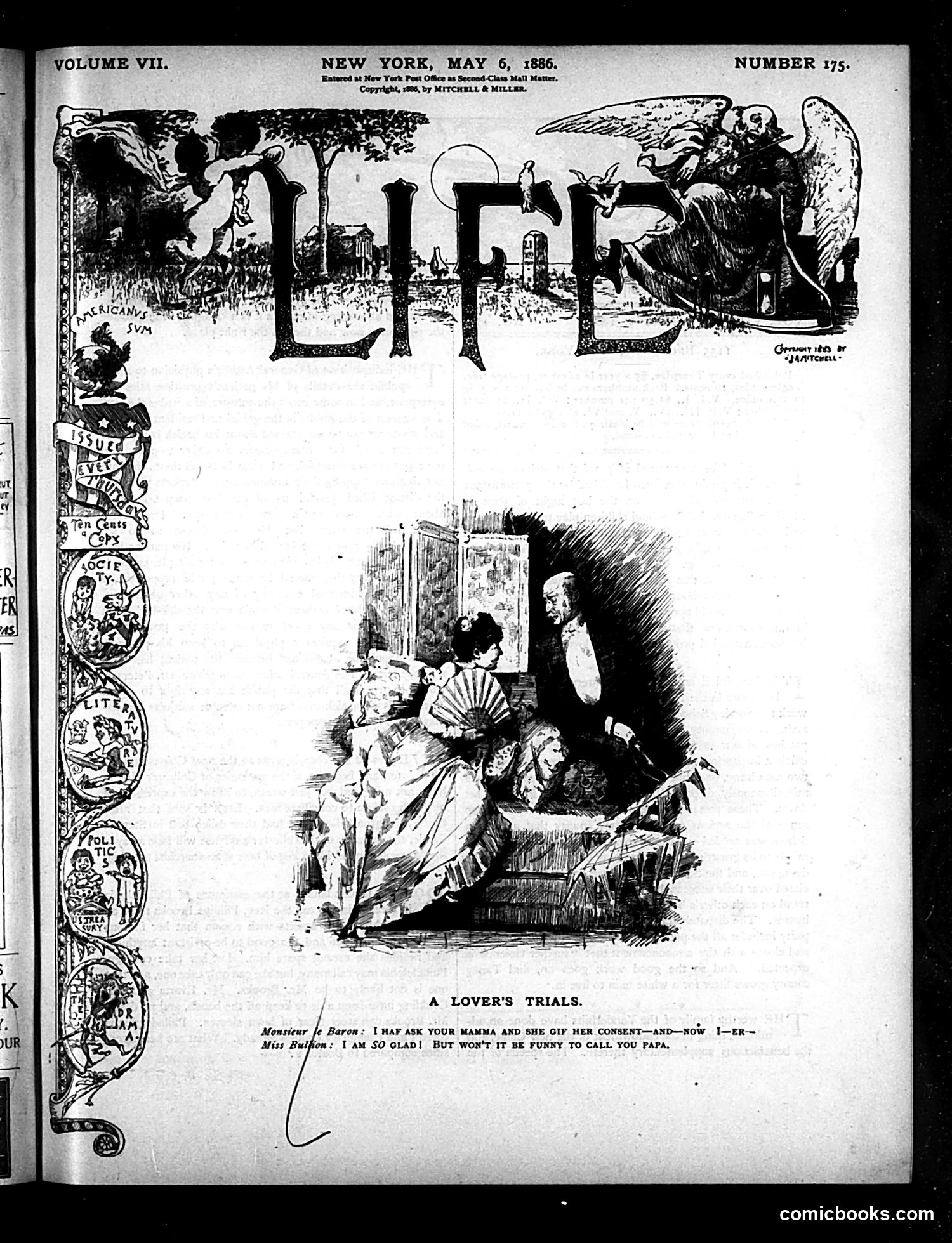
This satirical cartoon depicts a romantic scenario titled "A Lover's Trials." A well-dressed gentleman (identified as "Monsieur le Baron") seeks parental permission to marry, while a woman (Miss Budsoon) holds a fan. The joke relies on the social convention that a suitor must ask a woman's mother for consent before marriage. The humor turns on Miss Budsoon's response: she's "so glad" about the proposal but notes it would be "funny" to call him "Papa"—implying the Baron is already her father figure, suggesting either an inappropriate age gap or scandalous family relationship. This mocks Victorian courtship customs and the absurdities of formal marriage protocols among European nobility.
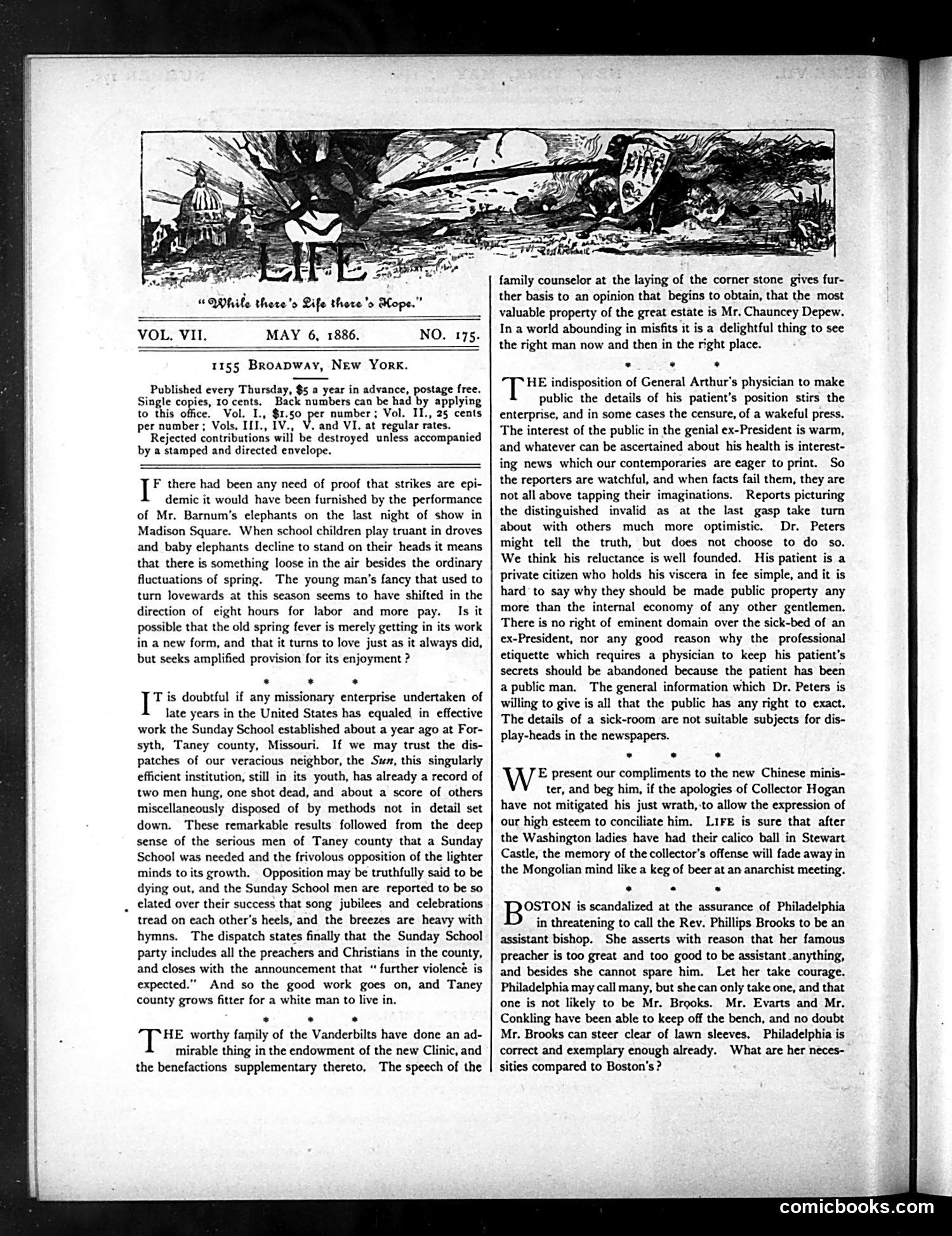
The cartoon at the top depicts a nighttime scene with a crescent moon and an elephant, likely referencing P.T. Barnum's famous elephant from his circus performances at Madison Square Garden. The accompanying text discusses whether spring fever is "getting its work in a new form," suggesting satirical commentary on seasonal behavioral changes. The page primarily contains editorial commentary rather than political cartoons. Topics addressed include: missionary work in the American West (specifically Taney County, Missouri's Sunday School), the Vanderbilt family's endowment of a medical clinic, and General Arthur's physician publicly discussing the ex-President's health condition—which the editors argue violates medical confidentiality and inappropriately treats a private citizen as public property.
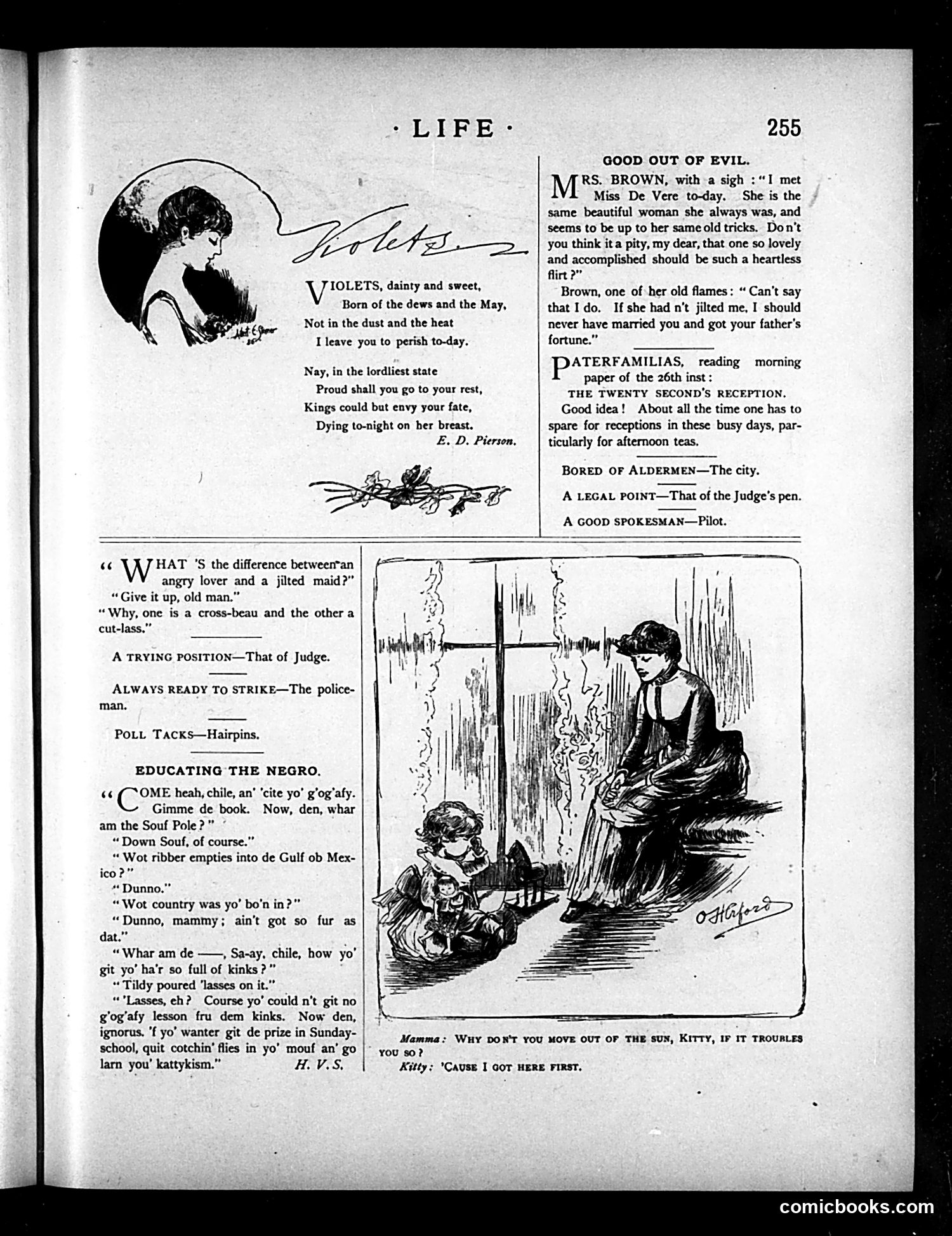
This page contains satirical jokes and a cartoon reflecting early-20th-century American attitudes. **The main cartoon** depicts a woman teaching a young child, with the caption implying the child questions why the mother doesn't move away if the sun troubles her—suggesting the child has absorbed racist ideas about displacement. **The text section titled "Educating the Negro"** presents a dialect-heavy conversation between what appears to be a teacher and student, using offensive stereotypes and phonetic spelling common to racist humor of the era. The crude "educational" exchange reflects the dehumanizing attitudes prevalent in this period's popular media. **Other brief jokes** mock legal judges, aldermen, pilots, and romantic situations with typical period humor. The overall content demonstrates how mainstream American publications casually normalized racist caricatures and dialect mockery as entertainment.
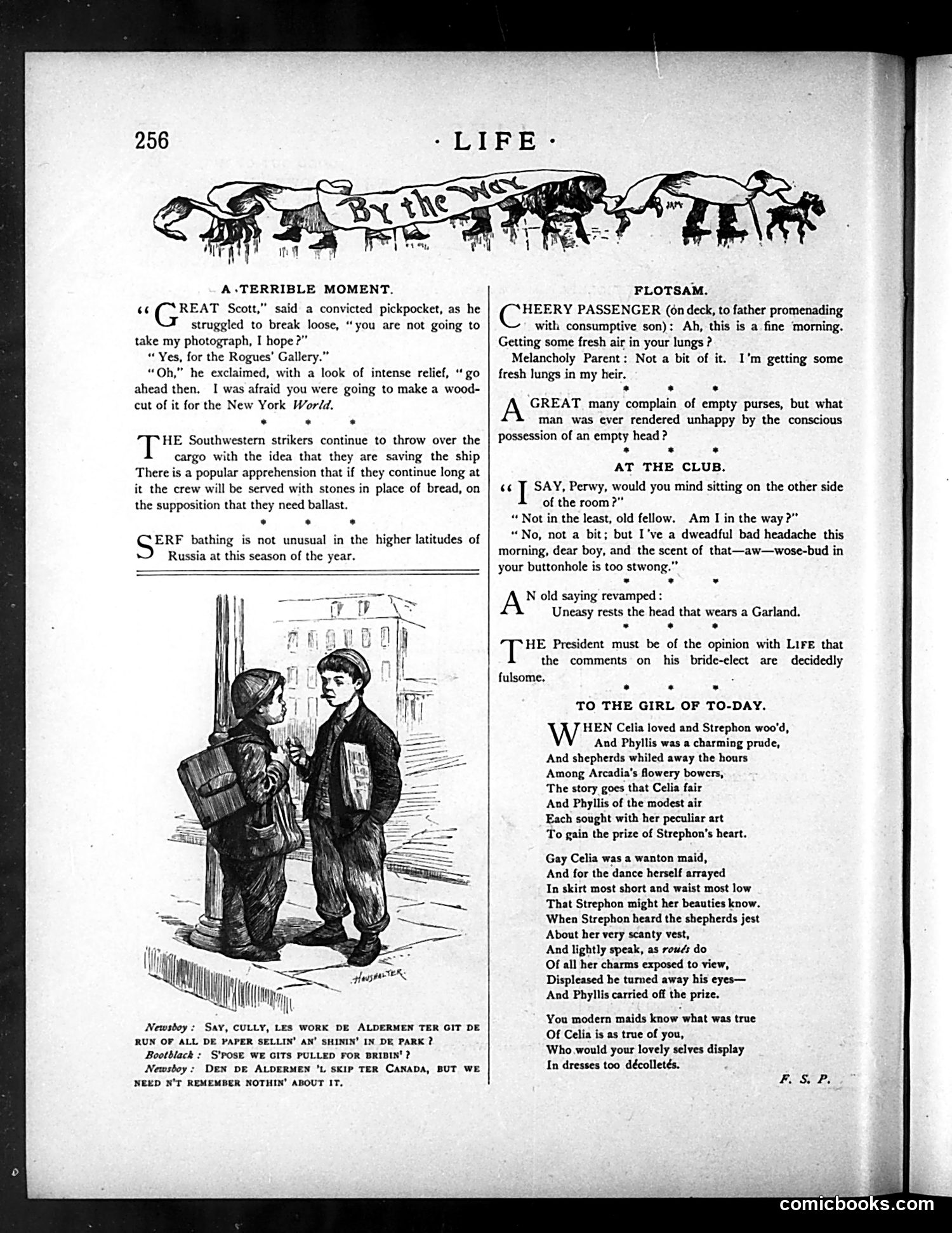
This page contains three satirical pieces rather than a unified cartoon: **"A Terrible Moment"** mocks a pickpocket concerned about being photographed at the Rogues' Gallery (police records), showing the criminal's inverted priorities. **"Flotsam"** includes brief jokes about empty purses and fresh air, typical of Life's short-form humor. **"At the Club"** presents workplace banter about headaches and strong scents. **"To the Girl of To-Day"** is a poem (signed F.S.P.) contrasting classical heroines like Celia and Phyllis—who competed modestly for male attention—with modern women who display themselves immodestly in short skirts. It's social criticism of 1920s-era changing female fashion and comportment, lamenting lost propriety. The accompanying illustration shows two men in conversation, likely supporting the club-related humor.
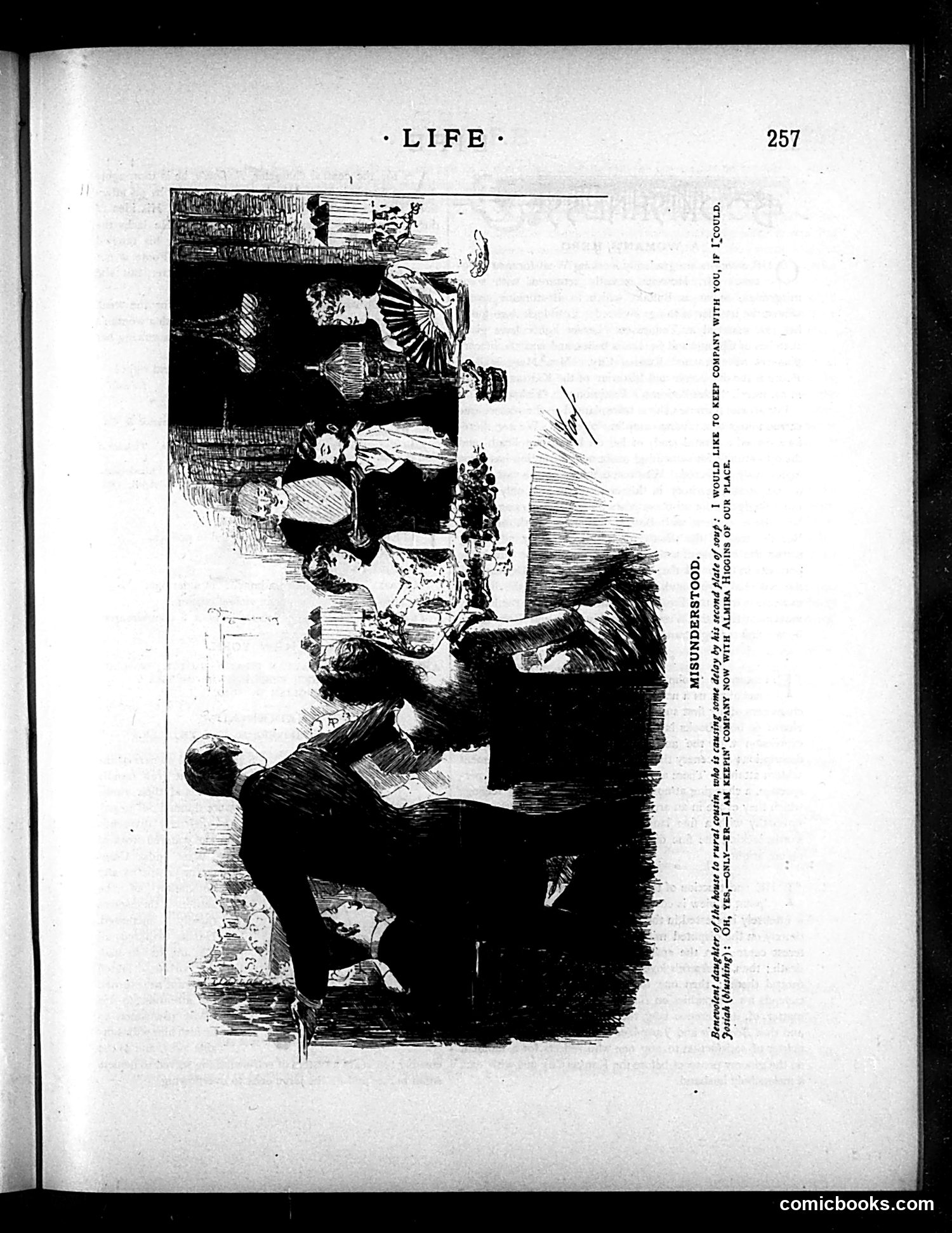
This appears to be a satirical illustration from Life magazine (page 257) titled "Mildred Disturbed." The image shows a woman in Victorian-era dress looking startled or dismayed while observing what appears to be fashionable women in elaborate, revealing clothing and theatrical poses in the background. The cartoon likely satirizes contemporary fashion trends or social behavior that would have shocked more conservative sensibilities. The contrast between the prudish, scandalized reaction of the central figure ("Mildred") and the uninhibited display of the fashionable women suggests social commentary on changing moral standards or the growing boldness of women's fashion and public behavior in early 20th-century America. The joke targets either fashion excess or generational culture clashes.
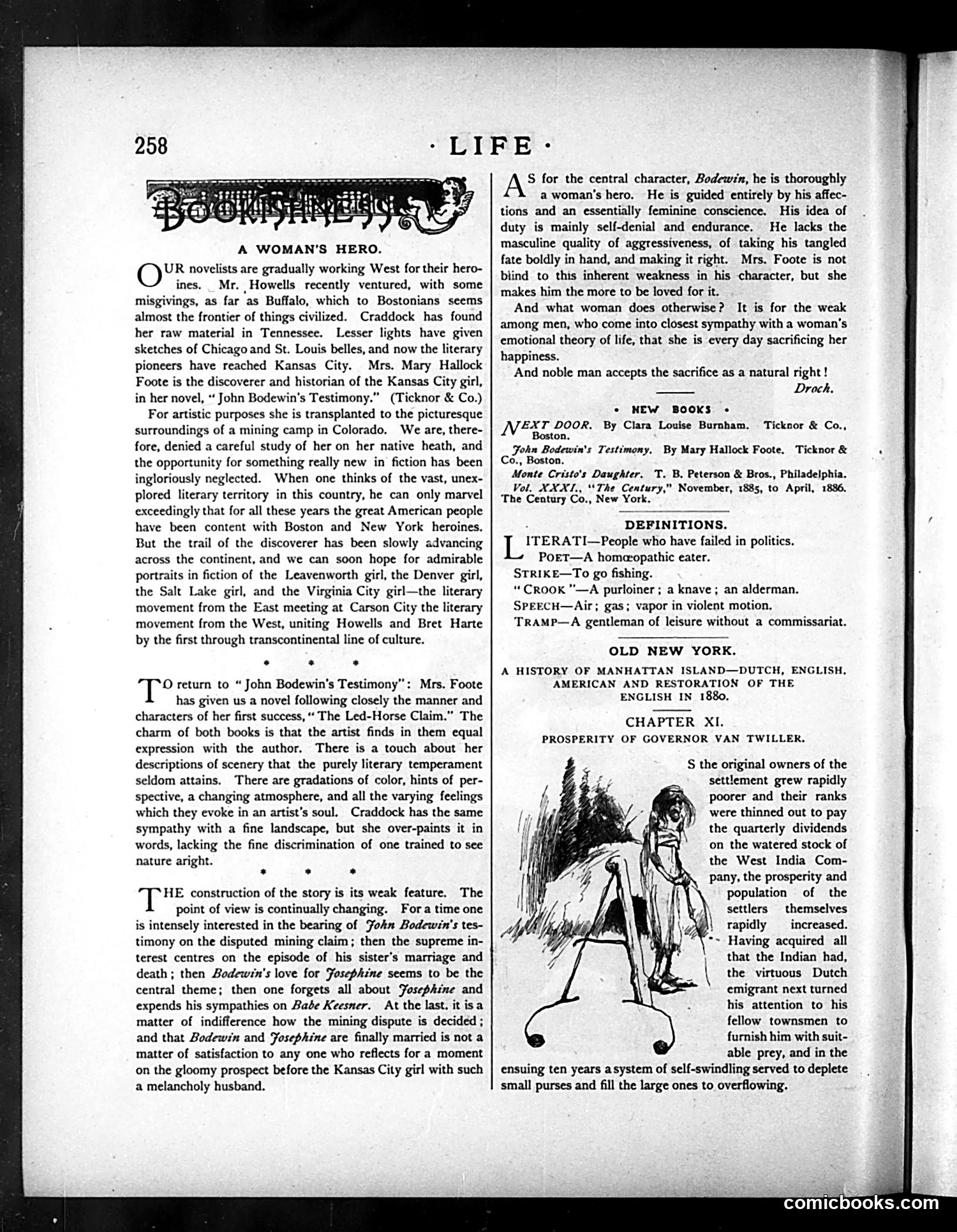
This page from *Life* magazine contains a literary review titled "A Woman's Hero," discussing Mrs. Mary Hallock Foote's novel "John Bodwin's Testimony." The reviewer praises Foote's depiction of frontier life in Colorado and her character Bodwin, described as "thoroughly a woman's hero" guided by feminine duty and self-denial rather than masculine aggression. The accompanying illustration shows a thin, poorly-dressed man in tattered clothing—likely depicting a character from the novel or representing the downtrodden frontier settler type Foote explored. The review criticizes the novel's weak plot construction while acknowledging Foote's artistic talents in character development and scenic description. No political satire appears on this page; it's primarily a serious literary critique from the late 19th century.
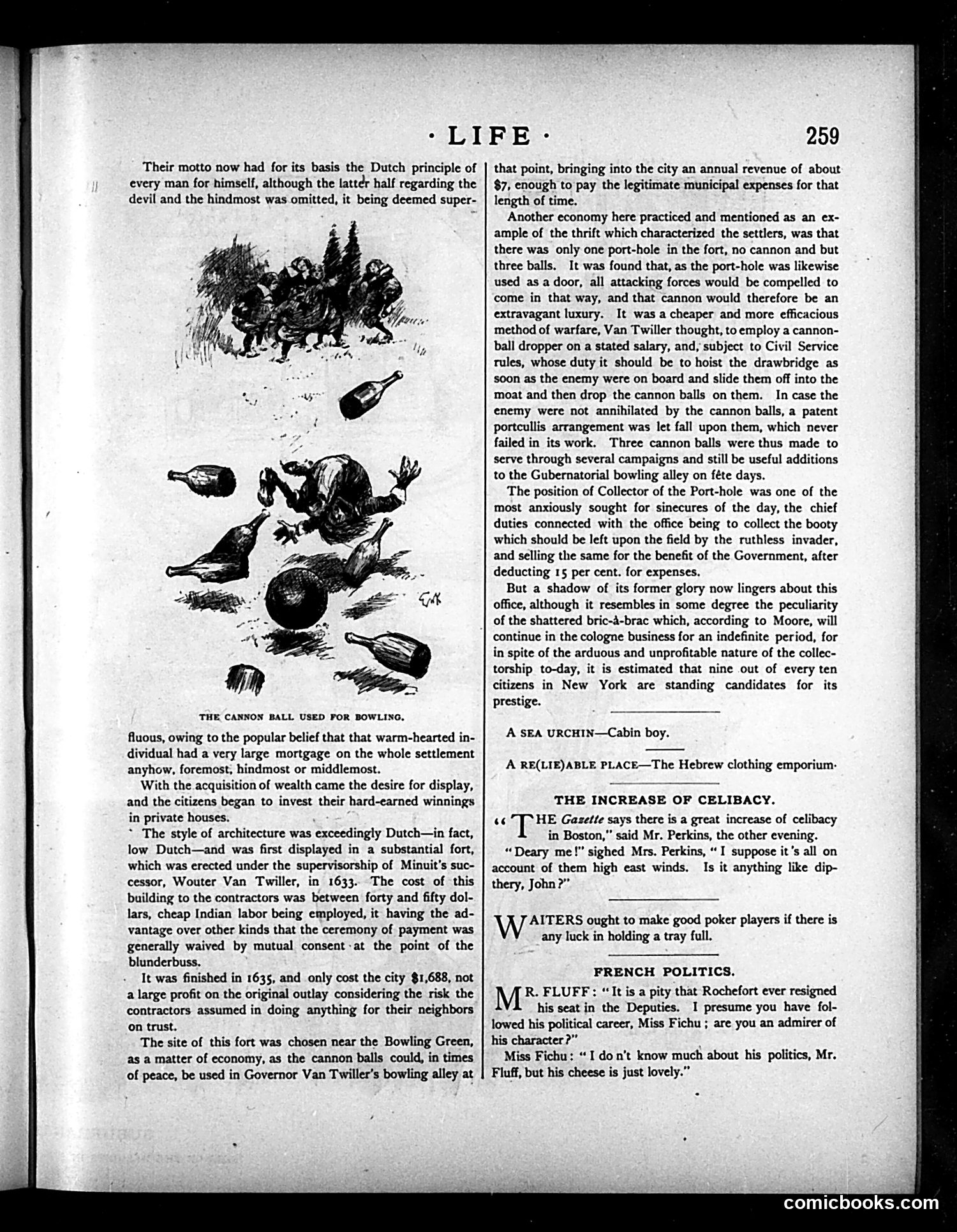
The page contains historical text about Dutch colonial New Amsterdam (early New York), describing Governor Van Twiller's fort and administrative practices. The illustration labeled "THE CANNON BALL USED FOR BOWLING" shows scattered objects—bottles, cannonballs, and debris—as a visual joke about the fort's dual-purpose efficiency: cannonballs served both military and recreational functions in the bowling alley. This satirizes Dutch pragmatism and thrift. Below are brief comedic anecdotes: "A Sea Urchin" (about cabin boys), "A Be(lie)able Place" (a pun on a Hebrew clothing store), and exchanges about celibacy in Boston and French politics. These items appear designed as light humor and historical interest rather than serious political satire—typical of Life's mixed-content approach to entertaining educated readers.
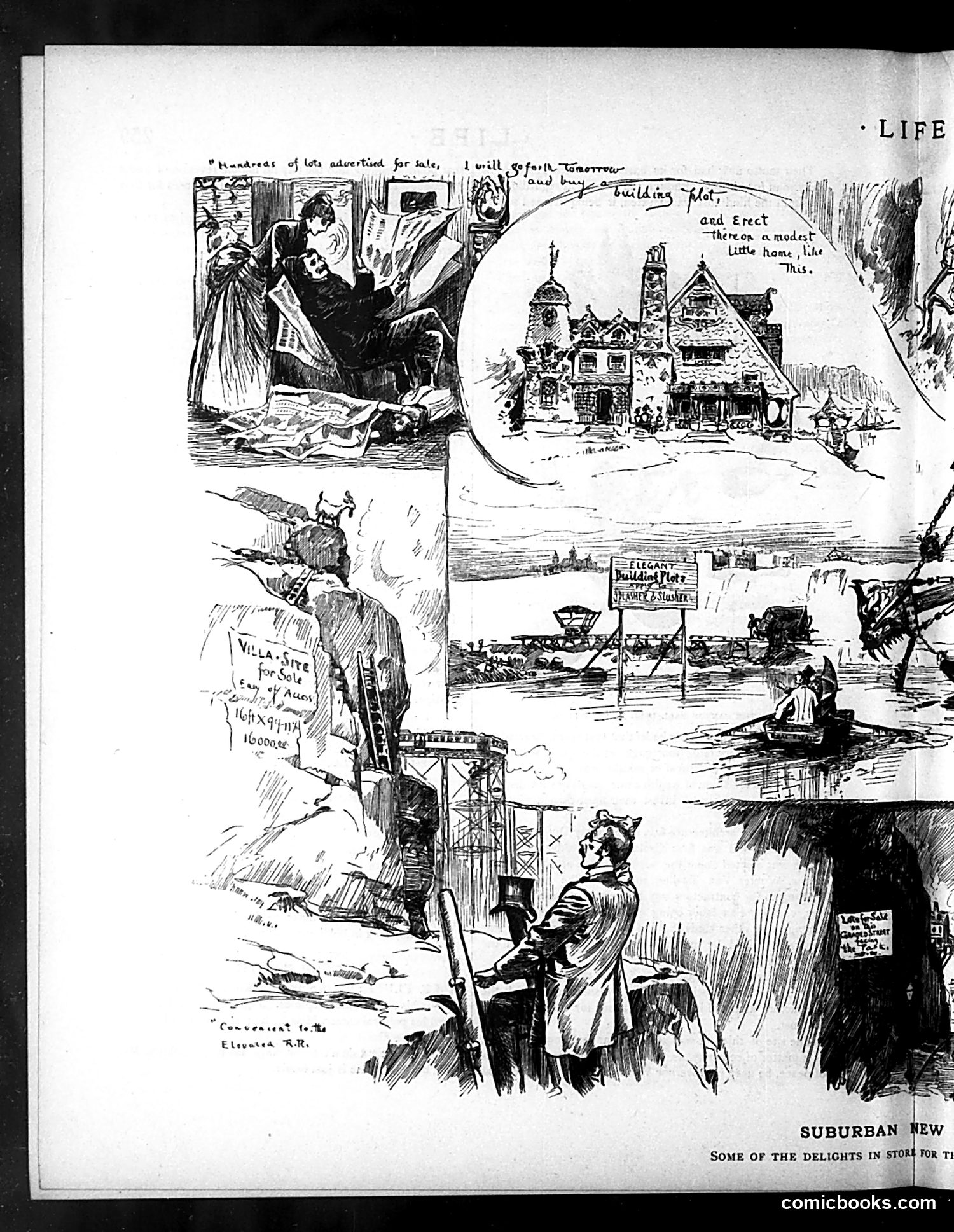
This page satirizes the real estate boom and suburban development craze of the early 20th century. The cartoon shows various property schemes targeting buyers: **Top left**: A real estate agent pitching lots "advertised for sale," with handwritten annotations suggesting dubious practices. **Center**: An elaborate villa or mansion labeled "for sale" with inflated pricing (appears to show "10,000" or similar). **Right panels**: "Elegant Building Plot" and waterfront property advertisements, including what appears to be swampland or undeveloped riverside land being marketed to unsuspecting buyers. **Bottom**: A figure examining a "Covenant to the Elevated R.R." — likely mocking how proximity to railroads was used as a selling point. The satire targets deceptive real estate marketing, overpriced properties, and schemes exploiting buyers' aspirations for suburban homes and investment opportunities.
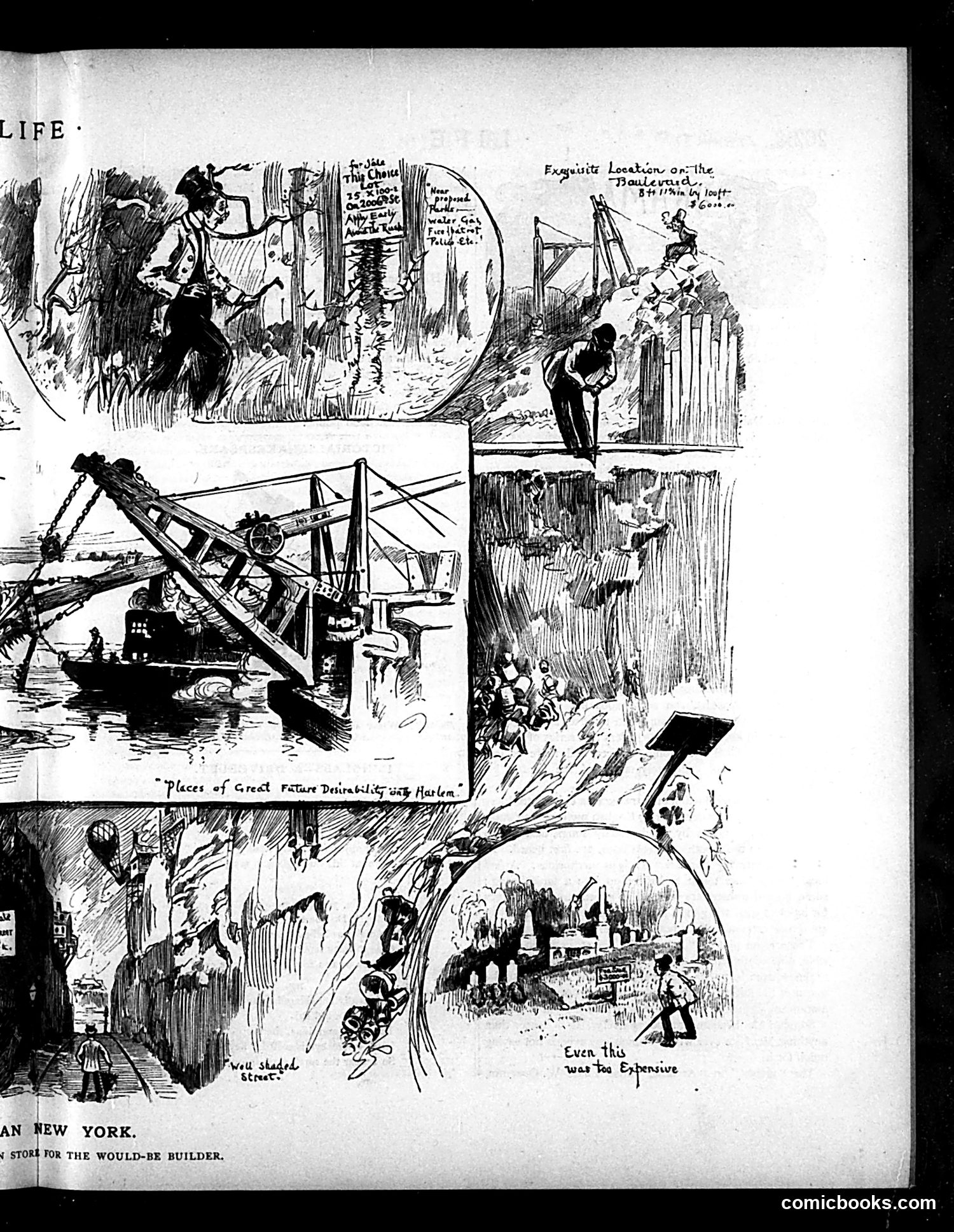
This appears to be a satirical comic strip about New York construction and real estate development. The panels show: 1. **Upper panels**: "Exquisite Location on the Boulevard" - depicting a building site with workers and what appears to be a wealthy businessman surveying property 2. **Middle panel**: "Places of Great Future Development near Harlem" - showing industrial construction equipment and a ship/barge, satirizing speculation about developing areas 3. **Lower panels**: "Well-shaded Street" and "Even this was too Expensive" - depicting increasingly cramped urban conditions and expensive properties The satire targets New York's real estate market, mocking how developers marketed marginal or inconvenient locations as prestigious investments, and how prices remained exorbitant regardless of actual desirability. The Harlem reference suggests commentary on neighborhood development patterns of the era.
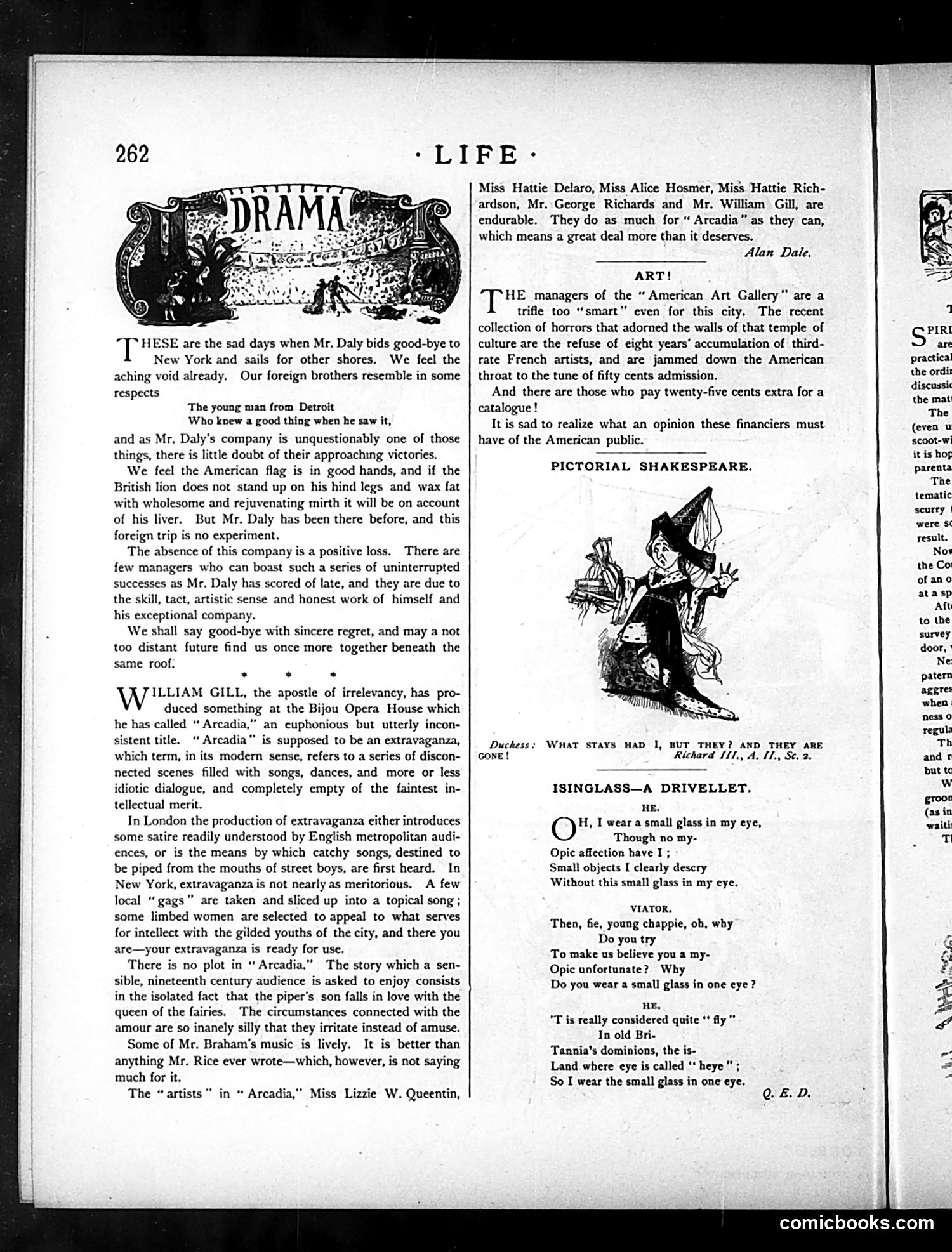
This page contains theater reviews and satirical commentary typical of Life magazine's cultural criticism. **DRAMA section**: The critic bids farewell to theatrical manager Mr. Daly, who is leaving New York on a foreign tour. The piece praises Daly's company as exceptionally successful and skilled, expressing genuine regret at their departure. It also reviews William Gill's production "Arcadia" at the Bijou Opera House—an extravaganza the critic dismisses as plotless, intellectually empty spectacle featuring disconnected songs and dances designed merely to showcase attractive actresses for "gilded youths." **ART section**: Mocks the managers of the "American Art Gallery" for charging admission (50 cents, with 25-cent catalogues) to display what the critic calls "refuse of eight years' accumulation of third-rate French artists." The satire targets both the gallery's pretentiousness and the American public's gullibility. **PICTORIAL SHAKESPEARE**: A visual joke quoting Richard III. **ISINGLASS—A DRIVELLET**: A humorous poem about wearing a monocle, mocking affectation.
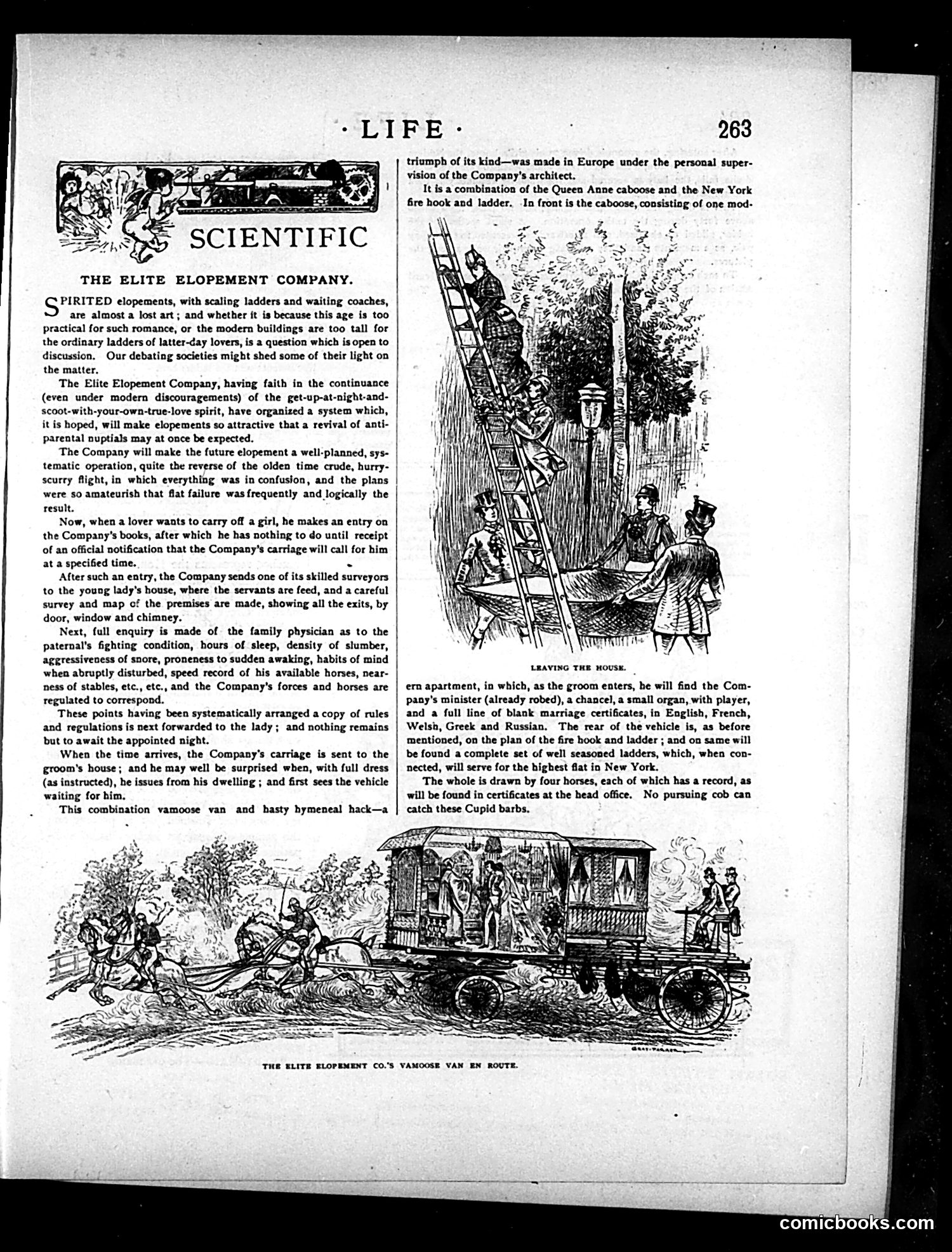
This is a satirical piece mocking both romantic elopement traditions and the era's obsession with systematizing everything through bureaucratic organization. The joke: A fictional company has industrialized the spontaneous, passionate act of eloping—turning it into a planned, surveyed operation with official procedures, licensed surveyors, and paperwork. The groom merely "makes an entry on the Company's books" and waits for notification. The vehicle itself embodies the satire: it's a hybrid carriage-fire-ladder-chapel on wheels, equipped with a minister, organ, marriage certificates (in multiple languages), and a complete ladder apparatus for scaling tall modern buildings—acknowledging that Victorian architecture has made traditional ladder elopements impractical. The illustrations show the comical mechanics in action: surveyors mapping exits, horses with documented speed records, the elaborate van en route. The underlying satire targets Gilded Age America's faith that any human experience—even romance—could be perfected through proper planning, professionalization, and corporate efficiency. It's gently mocking both the loss of genuine spontaneity and the era's faith in systematic solutions.
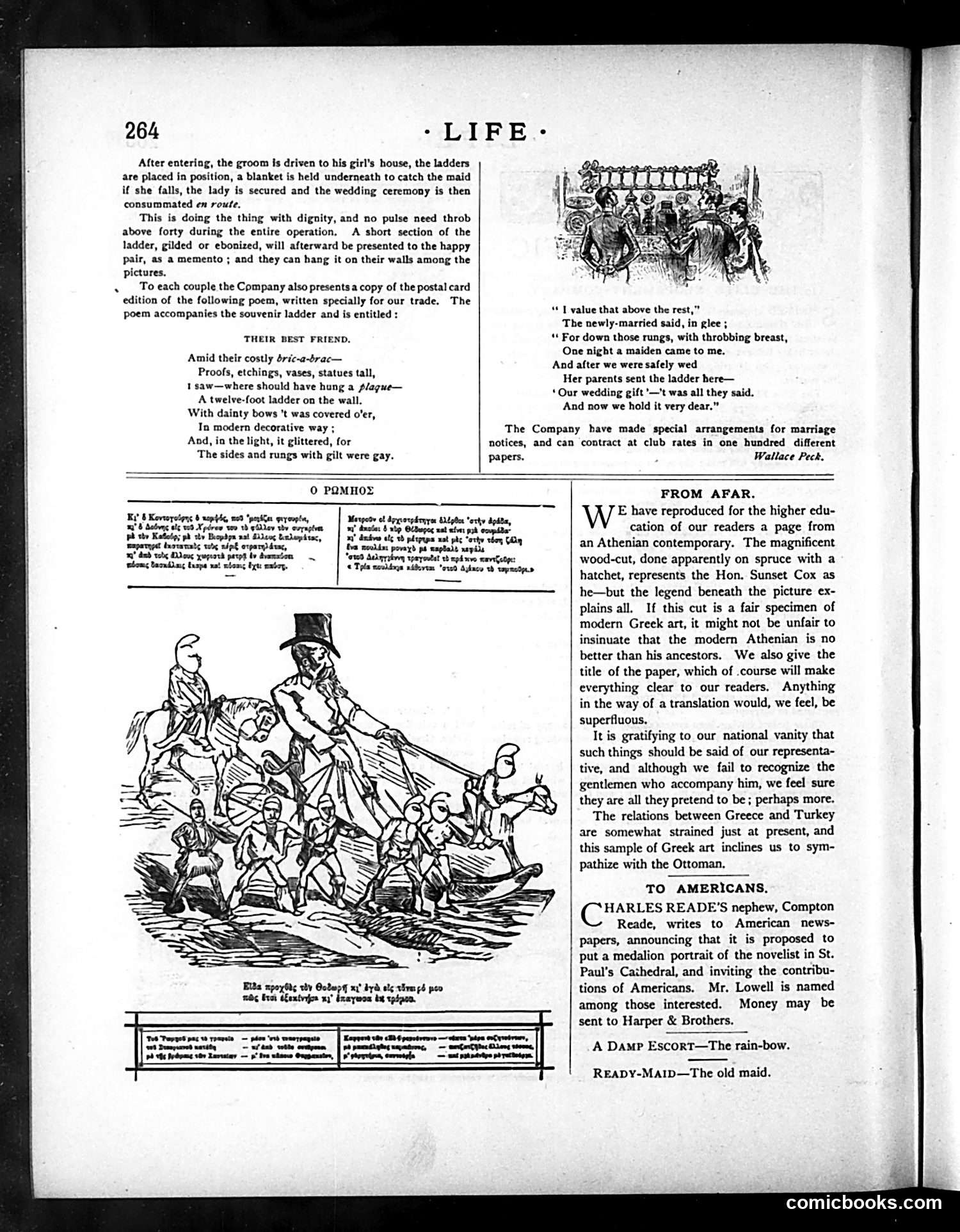
This page contains two main satirical pieces: **"Their Best Friend" (top):** A mock-serious advertisement for a wedding service that literally delivers brides via ladder. The humor mocks both the commercialization of marriage and Victorian propriety—the "Company" offers ladder-climbing as a dignified alternative to traditional courtship, complete with gilded souvenir ladders and commemorative poems. The satire targets how marriage had become a commodified transaction. **"From Afar" (bottom):** Life reproduces what it claims is a Greek newspaper woodcut depicting American diplomat Sunset Cox in an unflattering scene with Turkish figures. The joke relies on satirizing both modern Greek artistic standards (dismissing them as crude) and contemporary Greek-Turkish tensions. By "sympathizing with the Ottoman," Life mocks America's pretension while making light of real geopolitical conflict. The page exemplifies Life's brand of social satire through exaggerated, absurdist scenarios targeting marriage customs and international relations.
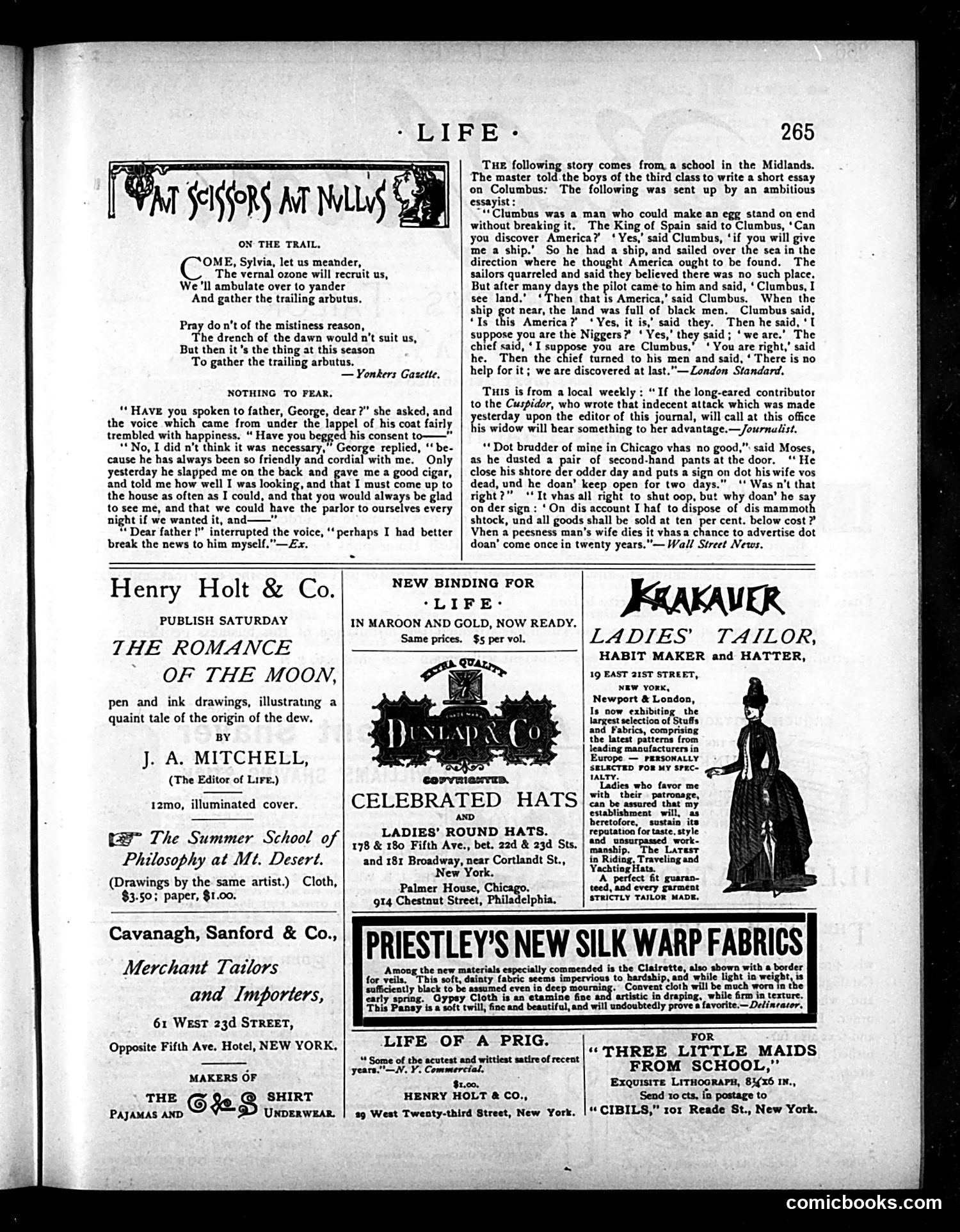
This page contains **primarily humorous short stories and advertisements** rather than political cartoons. The comic pieces mock various subjects through exaggerated dialect and absurdist scenarios: 1. **"Nothing to Fear"** satirizes courtship anxieties—a young man assumes his girlfriend's father approves of their relationship based on casual friendliness, missing social conventions. 2. **Columbus essay** mocks both student ignorance and racial attitudes of the era. The "essay" comically misattributes the egg-balancing trick to Columbus, then includes a crude encounter with Indigenous people using period-appropriate racist terminology. 3. **Various short quips** target pretentious writing, Yiddish-inflected speech (a common comedic stereotype of the period), and business practices. The page is dominated by **advertisements** for clothing, hats, and books, typical of Life's business model. The satire reflects turn-of-century American humor—often ethnic stereotyping and social commentary—aimed at middle-class readers.
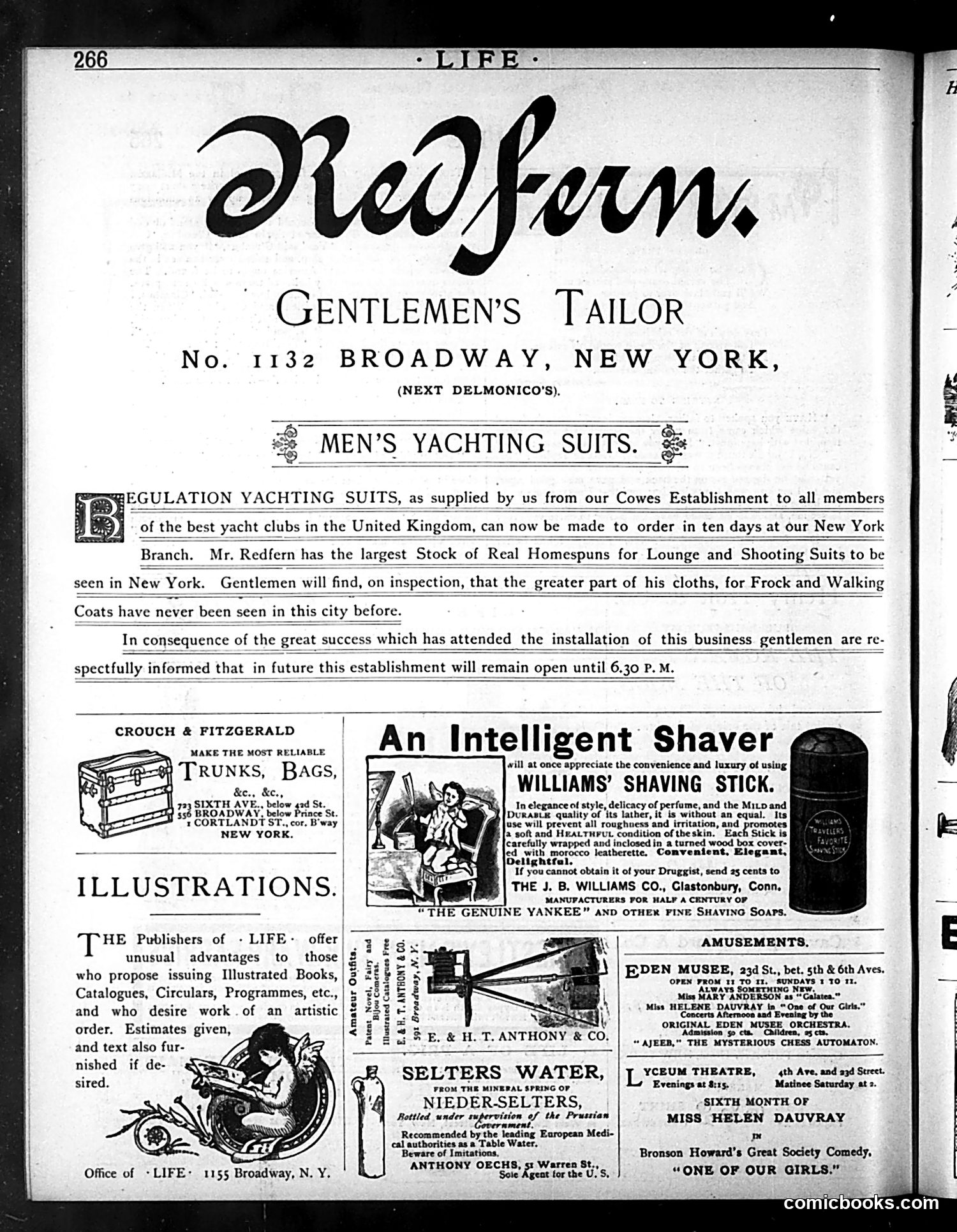
This is primarily an **advertising page**, not a satirical cartoon page. The content includes advertisements for: - **Red Fern**, a gentlemen's tailor on Broadway offering yachting suits imported from a Cowes (British) establishment - **Williams' Shaving Stick**, marketed as superior for luxury and skin health - **Crouch & Fitzgerald**, trunk and luggage makers - **Life magazine's illustration services** for publishers - Various **amusements**: Eden Musee (wax museum with chess automaton "Ajeeb"), Lyceum Theatre productions, and performances by actress Miss Helen Dauvray The only illustration with potential satirical content is "An Intelligent Shaver"—a small cartoon figure using the shaving stick—but it's essentially advertising copy, not political satire. **For modern readers**: This reflects late 19th-century consumer culture targeting wealthy gentlemen, emphasizing imported British goods, leisure activities (yachting), and emerging personal grooming products marketed as luxuries.
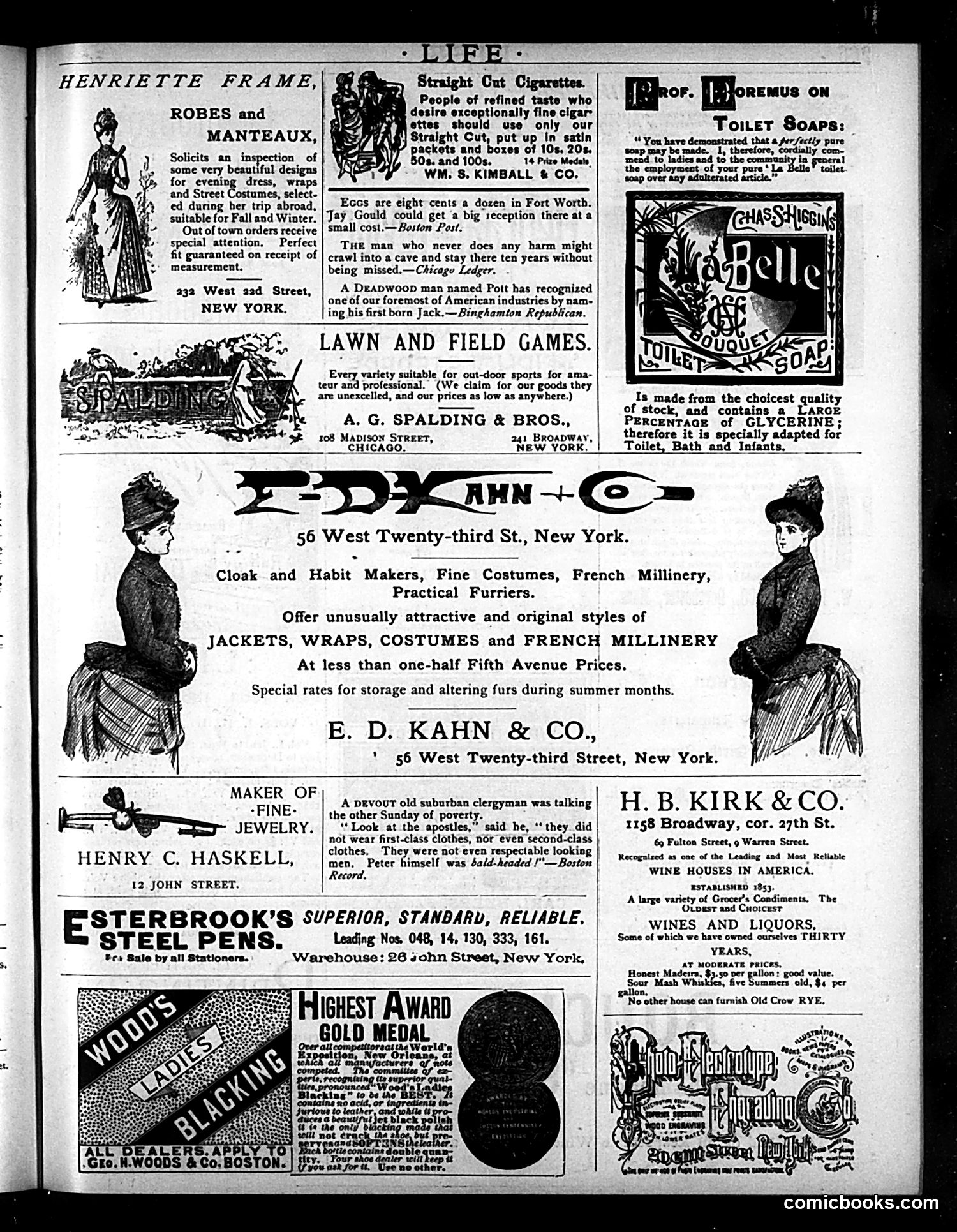
This is primarily a **commercial advertisement page** from *Life* magazine, dominated by New York City business ads for clothing, wine, pens, and luxury goods. The page includes several **brief humorous snippets** typical of *Life*'s satirical style: A joke about **Jay Gould** (the notorious robber baron) receiving a cheap reception in Fort Worth—mocking both Gould's reputation and the small town's economy. A clergyman's anecdote about the Apostles being poorly dressed, with the punchline that Saint Peter was "bald-headed"—gentle satire on religious hypocrisy or overly literal Biblical interpretation. A reference to a Deadwood man naming his son "Jack" after the town's mining industry—local color humor. These are **light, topical jokes** rather than political cartoons. The page reflects the magazine's role as a vehicle for both consumer advertising and genteel satirical commentary on contemporary figures and social pretension.
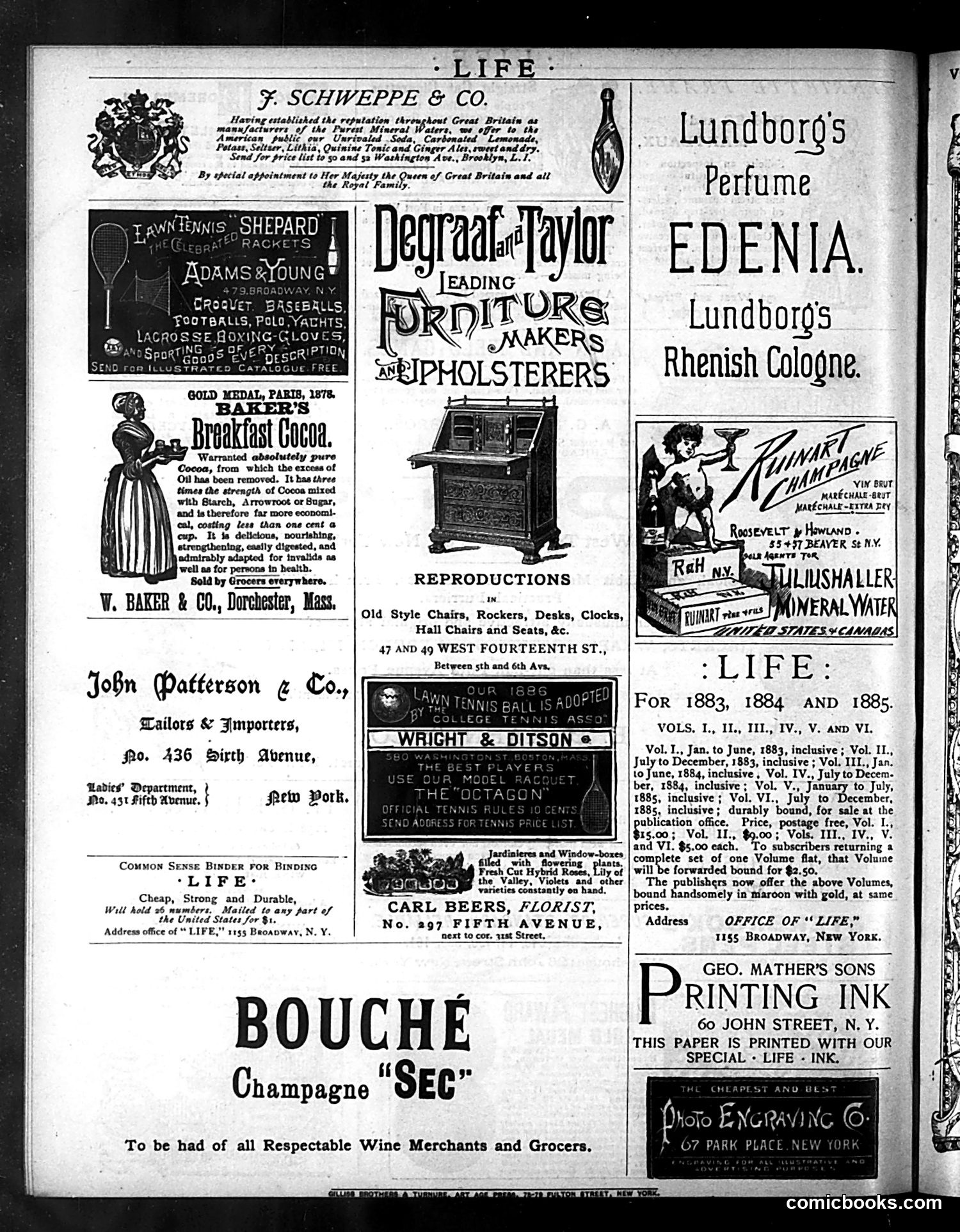
This is primarily an **advertising page** from Life magazine (circa 1883-1885), not a political cartoon. It contains no satire or social commentary. The page displays period advertisements for luxury goods and services typical of wealthy 1880s Americans: fine foods (Baker's Breakfast Cocoa, Schweppe's mineral waters), furniture reproductions, flowers, champagne, perfume, tailoring, and sporting equipment. Notable is the emphasis on **British prestige**—Schweppe's advertises royal appointment to the Queen, and products emphasize purity and quality for an affluent market. The page also promotes **Life magazine itself**, offering bound volumes and advertising its printing services with special inks. This represents Life's dual function as both satirical publication and commercial marketplace. There are no identifiable political figures or cartoon subjects to analyze here—it's a straightforward commercial document reflecting Gilded Age consumer culture and advertising conventions.