
Life, 1886-05-06 · page 10 of 16
Life — May 6, 1886 — page 10: what you’re looking at
What you’re looking at
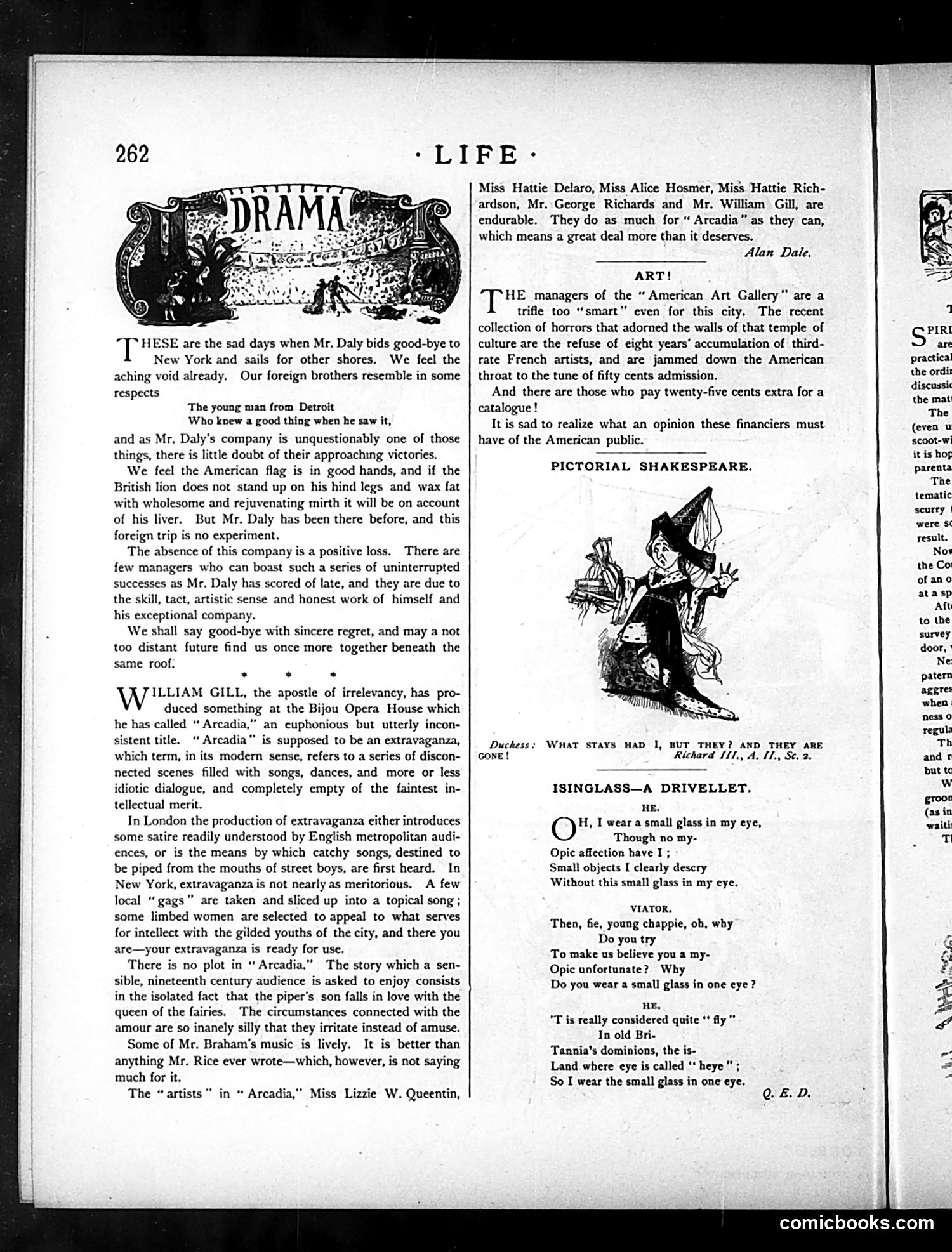
This page contains theater reviews and satirical commentary typical of Life magazine's cultural criticism. **DRAMA section**: The critic bids farewell to theatrical manager Mr. Daly, who is leaving New York on a foreign tour. The piece praises Daly's company as exceptionally successful and skilled, expressing genuine regret at their departure. It also reviews William Gill's production "Arcadia" at the Bijou Opera House—an extravaganza the critic dismisses as plotless, intellectually empty spectacle featuring disconnected songs and dances designed merely to showcase attractive actresses for "gilded youths." **ART section**: Mocks the managers of the "American Art Gallery" for charging admission (50 cents, with 25-cent catalogues) to display what the critic calls "refuse of eight years' accumulation of third-rate French artists." The satire targets both the gallery's pretentiousness and the American public's gullibility. **PICTORIAL SHAKESPEARE**: A visual joke quoting Richard III. **ISINGLASS—A DRIVELLET**: A humorous poem about wearing a monocle, mocking affectation.
📄 Transcribed text from this page (OCR, searchable)
Machine-transcribed from the original scan — historical spelling and the odd misread are preserved.
‘LIFE: HESE are the sad days when Mr. Daly bids good-bye to New York and sails for other shores. We feel the aching void already. Our foreign brothers resemble in some respects ‘The young man from Detroit Who knew a good thing when he saw it, and as Mr. Daly's company is unquestionably one of those things, there is little doubt of their approaching victories. We feel the American flag is in good hands, and if the British lion does not stand up on his hind legs and wax fat with wholesome and rejuvenating mirth it will be on account of his liver. But Mr. Daly has been there before, and this foreign trip is no experiment. The absence of this company is a positive loss. There are few managers who can boast such a series of uninterrupted successes as Mr. Daly has scored of late, and they are due to the skill, tact, artistic sense and honest work of himself and his exceptional company. We shall say good-bye with sincere regret, and may a not too distant future find us once more together beneath the same roof. . . * ILLIAM GILL, the apostle of irrelevancy, has pro- duced something at the Bijou Opera House which he has called “ Arcadia,” an euphonious but utterly incon- sistent title. “Arcadia” is supposed to be an extravaganza, which term, in its modern sense, refers to a series of discon- nected scenes filled with songs, dances, and more or less idiotic dialogue, and completely empty of the faintest in- tellectual merit. In London the production of extravaganza either introduces some satire readily understood by English metropolitan audi- ences, or is the means by which catchy songs, destined to be piped from the mouths of street boys, are first heard. In New York, extravaganza is not nearly as meritorious. A few local “ gags” are taken and sliced up into a topical song ; some limbed women are selected to appeal to what serves for intellect with the gilded youths of the city, and there you are—your extravaganza is ready for use. There is no plot in “Arcadia.” The story which a sen- sible, nineteenth century audience is asked to enjoy consists in the isolated fact that the piper’s son falls in love with the queen of the fairies. The circumstances connected with the amour are so inanely silly that they irritate instead of amuse. Some of Mr. Braham’s music is lively. It is better than anything Mr. Rice ever wrote—which, however, is not saying much for it. The “artists” in “ Arcadia,” Miss Lizzie W. Queentin, Miss Hattie Delaro, Miss Alice Hosmer, Miss Hattie Rich- ardson, Mr. George Richards and Mr. William Gill, are endurable. They do as much for “ Arcadia” as they can, which means a great deal more than it deserves. Alan Date. ART! HE managers of the “ American Art Gallery” are a trifle too “smart” even for this city. The recent collection of horrors that adorned the walls of that temple of culture are the refuse of eight years’ accumulation of third- rate French artists, and are jammed down the American throat to the tune of fifty cents admission. And there are those who pay twenty-five cents extra for a catalogue! It is sad to realize what an opinion these financiers must have of the American public. PICTORIAL SHAKESPEARE. Duchess; WHat stays HAD jy BUT THEY? AND THEY ARE cone! Richard II1,, A. IL, Sc. 2. ISINGLASS—A DRIVELLET. HE. H, I wear a small glass in my eye, Though no my- Opic affection have I ; Small objects I clearly descry Without this small glass in my eye. VIATOR. Then, fie, young chappie, oh, why Do you try To make us believe you a my- Opic unfortunate? Why Do you wear a small glass in one eye? HE. "T is really considered quite ** fly” In old Bri- Tannia’s dominions, the is- Land where eye is called ‘* heye” ; So I wear the small glass in one eye. See are practica the ordit discussic the mat The (even u scoot-w! it is hog parenta The tematic scurry | were 8 result. Nov the Co of ano at asp Aft to the survey wait Tv comicbooks.com