
Life, 1886-05-06 · page 2 of 16
Life — May 6, 1886 — page 2: what you’re looking at
What you’re looking at
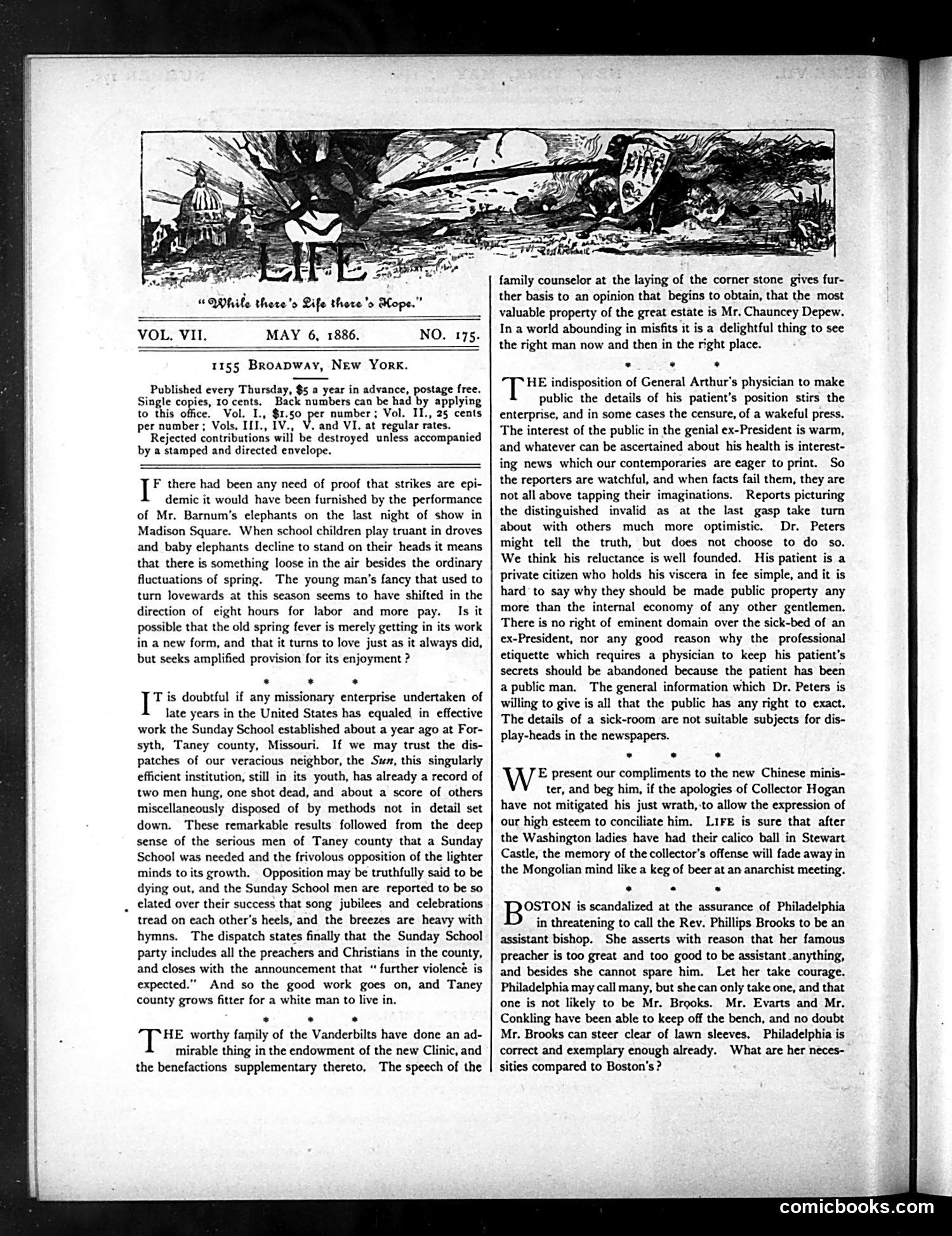
The cartoon at the top depicts a nighttime scene with a crescent moon and an elephant, likely referencing P.T. Barnum's famous elephant from his circus performances at Madison Square Garden. The accompanying text discusses whether spring fever is "getting its work in a new form," suggesting satirical commentary on seasonal behavioral changes. The page primarily contains editorial commentary rather than political cartoons. Topics addressed include: missionary work in the American West (specifically Taney County, Missouri's Sunday School), the Vanderbilt family's endowment of a medical clinic, and General Arthur's physician publicly discussing the ex-President's health condition—which the editors argue violates medical confidentiality and inappropriately treats a private citizen as public property.
📄 Transcribed text from this page (OCR, searchable)
Machine-transcribed from the original scan — historical spelling and the odd misread are preserved.
“While there's Life there's Hope.” VOL. VII. MAY 6, 1886. 1155 Broapway, New York. Published every Thursday, $5 a year in advance, postage free. Single copies, ro cents, Back numbers can be had by applying to this office. Vol. 50 per number; Vol. II., 25 cents per number; Vols, III., IV., V. and VI. at regular rates. Rejected contributions will be destroyed unless accompanied by a stamped and directed envelope. [Ir there had been any need of proof that strikes are epi- demic it would have been furnished by the performance of Mr. Barnum’s elephants on the last night of show in Madison Square. When school children play truant in droves and baby elephants decline to stand on their heads it means that there is something loose in the air besides the ordinary fluctuations of spring. The young man's fancy that used to turn lovewards at this season seems to have shifted in the direction of eight hours for labor and more pay. Is it possible that the old spring fever is merely getting in its work in a new form, and that it turns to love just as it always did, but seeks amplified provision for its enjoyment ? . . * T is doubtful if any missionary enterprise undertaken of late years in the United States has equaled in effective work the Sunday School established about a year ago at For- syth, Taney county, Missouri. If we may trust the dis- patches of our veracious neighbor, the Sux, this singularly efficient institution, still in its youth, has already a record of two men hung, one shot dead, and about a score of others miscellaneously disposed of by methods not in detail set down. These remarkable results followed from the deep sense of the serious men of Taney county that a Sunday School was needed and the frivolous opposition of the lighter minds to its growth. Opposition may be truthfully said to be dying out, and the Sunday School men are reported to be so elated over their success that song jubilees and celebrations tread on each other's heels, and the breezes are heavy with hymns. The dispatch states finally that the Sunday School party includes all the preachers and Christians in the county, and closes with the announcement that “further violence is expected.” And so the good work goes on, and Taney county grows fitter for a white man to live in. . . . HE worthy family of the Vanderbilts have done an ad- mirable thing in the endowment of the new Clinic, and the benefactions supplementary thereto, The speech of the family counselor at the laying of the corner stone gives fur- ther basis to an opinion that begins to obtain, that the most valuable property of the great estate is Mr. Chauncey Depew. In a world abounding in misfits it is a delightful thing to see the right man now and then in the right place. . . . if Be indisposition of General Arthur's physician to make public the details of his patient's position stirs the enterprise, and in some cases the censure, of a wakeful press. The interest of the public in the genial ex-President is warm, and whatever can be ascertained about his health is interest- ing news which our contemporaries are eager to print. So the reporters are watchful, and when facts fail them, they are not all above tapping their imaginations. Reports picturing the distinguished invalid as at the last gasp take turn about with others much more optimistic. Dr. Peters might tell the truth, but does not choose to do so. We think his reluctance is well founded. His patient is a private citizen who holds his viscera in fee simple, and it is hard to say why they should be made public property any more than the internal economy of any other gentlemen. There is no right of eminent domain over the sick-bed of an ex-President, nor any good reason why the professional etiquette which requires a physician to keep his patient's secrets should be abandoned because the patient has been a public man. The general information which Dr. Peters is willing to give is all that the public has any right to exact. The details of a sick-room are not suitable subjects for dis- play-heads in the newspapers. . . . E present our compliments to the new Chinese minis- ter, and beg him, if the apologies of Collector Hogan have not mitigated his just wrath,-to allow the expression of our high esteem to conciliate him. LIFE is sure that after the Washington ladies have had their calico ball in Stewart Castle, the memory of the collector’s offense will fade away in the Mongolian mind like a keg of beer at an anarchist meeting. . - . OSTON is scandalized at the assurance of Philadelphia in threatening to call the Rev. Phillips Brooks to be an assistant bishop. She asserts with reason that her famous preacher is too great and too good to be assistant anything, and besides she cannot spare him. Let her take courage. Philadelphia may call many, but she can only take one, and that one is not likely to be Mr. Brooks. Mr. Evarts and Mr. Conkling have been able to keep off the bench, and no doubt Mr. Brooks can steer clear of lawn sleeves. Philadelphia is correct and exemplary enough already. What are her neces- sities compared to Boston's ? comicbooks.com