
Life, 1886-05-06 · page 3 of 16
Life — May 6, 1886 — page 3: what you’re looking at
What you’re looking at
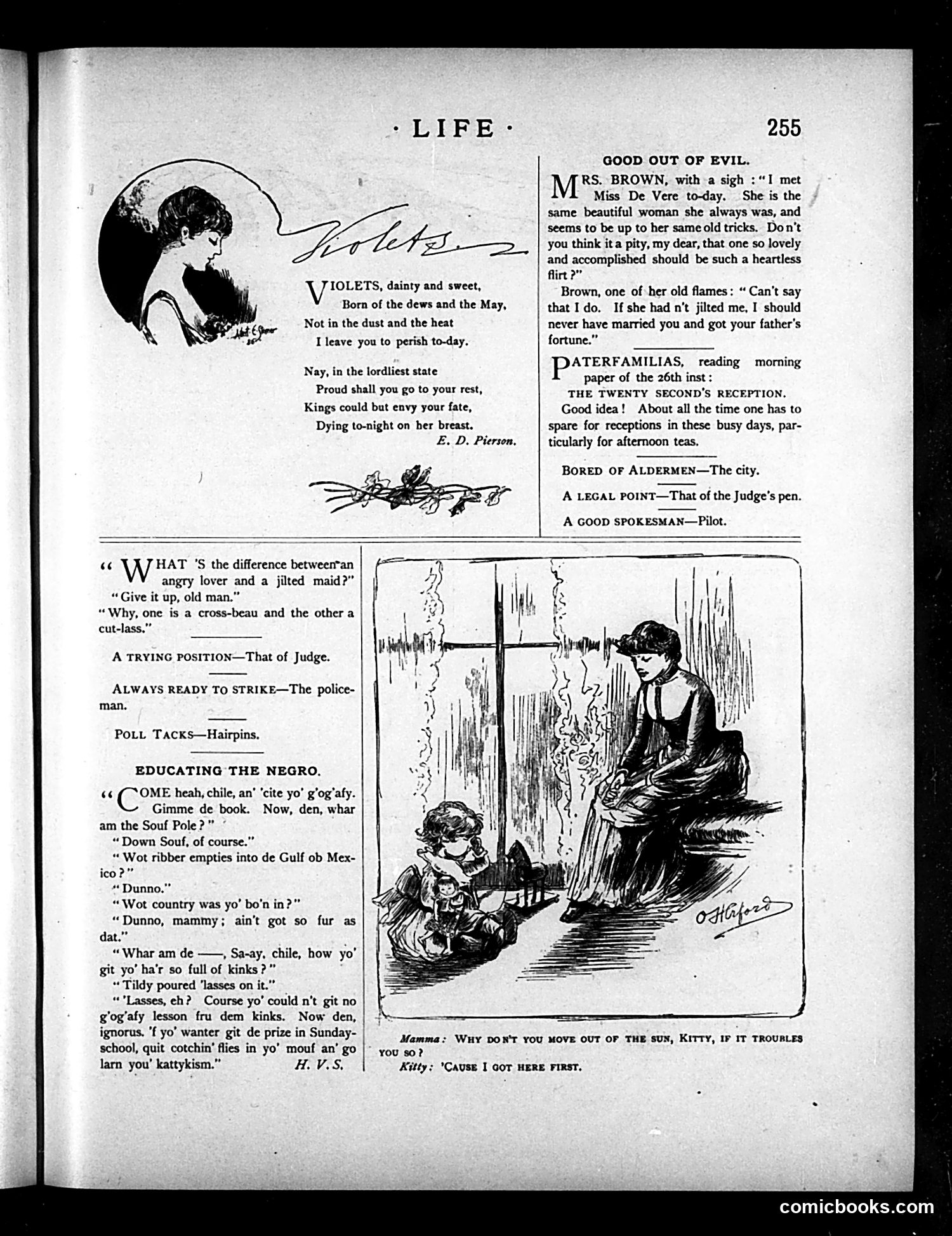
This page contains satirical jokes and a cartoon reflecting early-20th-century American attitudes. **The main cartoon** depicts a woman teaching a young child, with the caption implying the child questions why the mother doesn't move away if the sun troubles her—suggesting the child has absorbed racist ideas about displacement. **The text section titled "Educating the Negro"** presents a dialect-heavy conversation between what appears to be a teacher and student, using offensive stereotypes and phonetic spelling common to racist humor of the era. The crude "educational" exchange reflects the dehumanizing attitudes prevalent in this period's popular media. **Other brief jokes** mock legal judges, aldermen, pilots, and romantic situations with typical period humor. The overall content demonstrates how mainstream American publications casually normalized racist caricatures and dialect mockery as entertainment.
📄 Transcribed text from this page (OCR, searchable)
Machine-transcribed from the original scan — historical spelling and the odd misread are preserved.
255 GOOD OUT OF EVIL. RS. BROWN, with a sigh : “I met Miss De Vere to-day. She is the = same beautiful woman she always was, and seems to be up to her same old tricks. Don't ies fy os you think it a pity, my dear, that one so lovely and accomplished should be such a heartless flirt 2” JOLE Tey dainty endlewect: Brown, one of her old flames: “Can't say Born of the dews and the May, that Ido. If she had n't jilted me, I should Not in the dust and the heat never have married you and got your father’s I leave you to perish to-day, fortune.” ATERFAMILIAS, reading morning paper of the 26th inst : Proud shall you go to your rest, THE TWENTY SECOND'S RECEPTION. Kings could but envy your fate, Good idea! About all the time one has to Dying to-night on her breast. spare for receptions in these busy days, par- E. D. Pierson, ticularly for afternoon teas, Nay, in the lordliest state BORED OF ALDERMEN—The city. A LEGAL POINT—That of the Judge's pen. A GOOD SPOKESMAN—Pilot. “cc HAT 'S the difference between-an angry lover and a jilted maid?” “Give it up, old man.” | “Why, one is a cross-beau and the other a | cut-lass,” A TRYING POSITION—That of Judge. ALWAYS READY To STRIKE—The police- man. POLL TAcks—Hairpins, EDUCATING THE NEGRO. “ OME heah, chile, an’ ‘cite yo’ g’og’afy. Gimme de book. Now, den, whar am the Souf Pole?” “ Down Souf, of course.” “ Wot ribber empties into de Gulf ob Mex- ico?” “Dunno,” “Wot country was yo’ bo'n in?” “Dunno, mammy; ain’t got so fur as dat.” z “Whar am de ——,, Sa-ay, chile, how yo’ git yo’ ha’r so full of kinks?” “ Tildy poured ‘lasses on it.” “*Lasses, eh? Course yo’ could n't git no g’og’afy lesson fru dem kinks. Now den, ignorus. 'f yo’ wanter git de prize in Sunday- | Mamma: WHY DON'T YOU MOVE OUT OF THE SUN, KITTY, IF IT TROUALES school, quit cotchin’ flies in yo’ mouf an’ go |~ you so? larn you’ kattykism.” ALV.S, Kitty; 'Cause I Gor HERE FIRST, comicbooks.com