
Life, 1886-05-06 · page 6 of 16
Life — May 6, 1886 — page 6: what you’re looking at
What you’re looking at
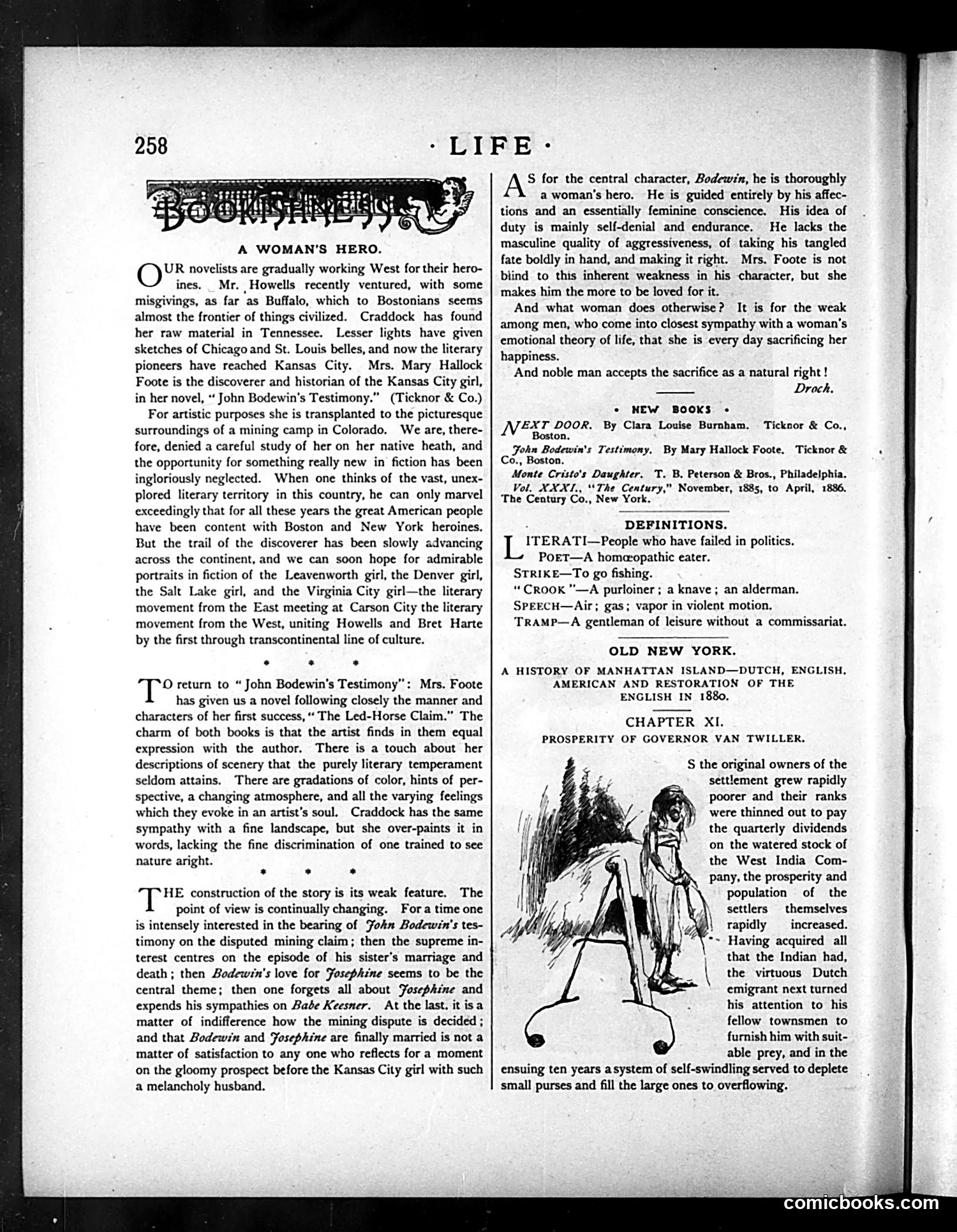
This page from *Life* magazine contains a literary review titled "A Woman's Hero," discussing Mrs. Mary Hallock Foote's novel "John Bodwin's Testimony." The reviewer praises Foote's depiction of frontier life in Colorado and her character Bodwin, described as "thoroughly a woman's hero" guided by feminine duty and self-denial rather than masculine aggression. The accompanying illustration shows a thin, poorly-dressed man in tattered clothing—likely depicting a character from the novel or representing the downtrodden frontier settler type Foote explored. The review criticizes the novel's weak plot construction while acknowledging Foote's artistic talents in character development and scenic description. No political satire appears on this page; it's primarily a serious literary critique from the late 19th century.
📄 Transcribed text from this page (OCR, searchable)
Machine-transcribed from the original scan — historical spelling and the odd misread are preserved.
- LIFE: A WOMAN'S HERO. UR novelists are gradually working West for their hero- ines. _ Mr. Howells recently ventured, with some misgivings, as far as Buffalo, which to Bostonians seems almost the frontier of things civilized. Craddock has found her raw material in Tennessee. Lesser lights have given sketches of Chicago and St. Louis belles, and now the literary pioneers have reached Kansas City. Mrs. Mary Hallock Foote is the discoverer and historian of the Kansas City girl, in her novel, “ John Bodewin's Testimony.” (Ticknor & Co.) For artistic purposes she is transplanted to the picturesque surroundings of a mining camp in Colorado. We are, there- fore, denied a careful study of her on her native heath, and the opportunity for something really new in fiction has been ingloriously neglected. When one thinks of the vast, unex- plored literary territory in this country, he can only marvel exceedingly that for all these years the great American people have been content with Boston and New York heroines. But the trail of the discoverer has been slowly advancing across the continent, and we can soon hope for admirable portraits in fiction of the Leavenworth girl, the Denver girl, the Salt Lake girl, and the Virginia City girl—the literary movement from the East meeting at Carson City the literary movement from the West, uniting Howells and Bret Harte by the first through transcontinental line of culture. . * * O return to “ John Bodewin’s Testimony”: Mrs. Foote has given us a novel following closely the manner and characters of her first success, “ The Led-Horse Claim.” The charm of both books is that the artist finds in them equal expression with the author. There is a touch about her descriptions of scenery that the purely literary temperament seldom attains. There are gradations of color, hints of per- spective, a changing atmosphere, and all the varying feelings which they evoke in an artist’s soul. Craddock has the same sympathy with a fine landscape, but she over-paints it in words, lacking the fine discrimination of one trained to see nature aright. . . HE construction of the story is its weak feature. The point of view is continually changing. Fora time one is intensely interested in the bearing of Fokn Bodewin's tes- timony on the disputed mining claim; then the supreme in- terest centres on the episode of his sister's marriage and death ; then Bodewin's love for Fosephine seems to be the central theme; then one forgets all about Josephine and expends his sympathies on Babe Keesner. At the last. it isa matter of indifference how the mining dispute is decided ; and that Bodewin and Fosephine are finally married is not a matter of satisfaction to any one who reflects for a moment on the gloomy prospect before the Kansas City girl with such a melancholy husband. S for the central character, Bodewzn, he is thoroughly a woman's hero. He is guided entirely by his affec- tions and an essentially feminine conscience. His idea of duty is mainly self-denial and endurance. He lacks the masculine quality of aggressiveness, of taking his tangled fate boldly in hand, and making it right. Mrs. Foote is not blind to this inherent weakness in his character, but she makes him the more to be loved for it. And what woman does otherwise? It is for the weak among men, who come into closest sympathy with a woman's emotional theory of life, that she is every day sacrificing her happiness. And noble man accepts the sacrifice as a natural right! Droch. * NEW BOOKS - NEXT DOOR. By Clara Louise Burnham. Ticknor & Co., Boston. John Bodewin's Testimony. By Mary Hallock Foote. Ticknor & Co., Boston. Monte Cristo's Daughter. T. B. Peterson & Bros., Philadelphia. Vol. XXXI., “The Century,” November, 1885, to April, 1886. The Century Co., New York. : DEFINITIONS. ITERATI—People who have failed in politics. PoeT—A homeopathic eater. STRIKE—To go fishing. “Crook "—A purloiner ; a knave ; an alderman. SPEECH—Air; gas; vapor in violent motion. TRAMP—A gentleman of leisure without a commissariat. OLD NEW YORK. A HISTORY OF MANHATTAN ISLAND—DUTCH, ENGLISH, AMERICAN AND RESTORATION OF THE ENGLISH IN 1880, CHAPTER XI. PROSPERITY OF GOVERNOR VAN TWILLER. S the original owners of the settlement grew rapidly poorer and their ranks were thinned out to pay the quarterly dividends on the watered stock of the West India Com- pany, the prosperity and population of the settlers themselves rapidly _ increased. Having acquired all that the Indian had, the virtuous Dutch emigrant next turned his attention to his fellow townsmen to furnish him with suit- able prey, and in the ensuing ten years a system of self-swindling served to deplete small purses and fill the large ones to overflowing. comicbooks.com