
Life, 1886-05-06 · page 7 of 16
Life — May 6, 1886 — page 7: what you’re looking at
What you’re looking at
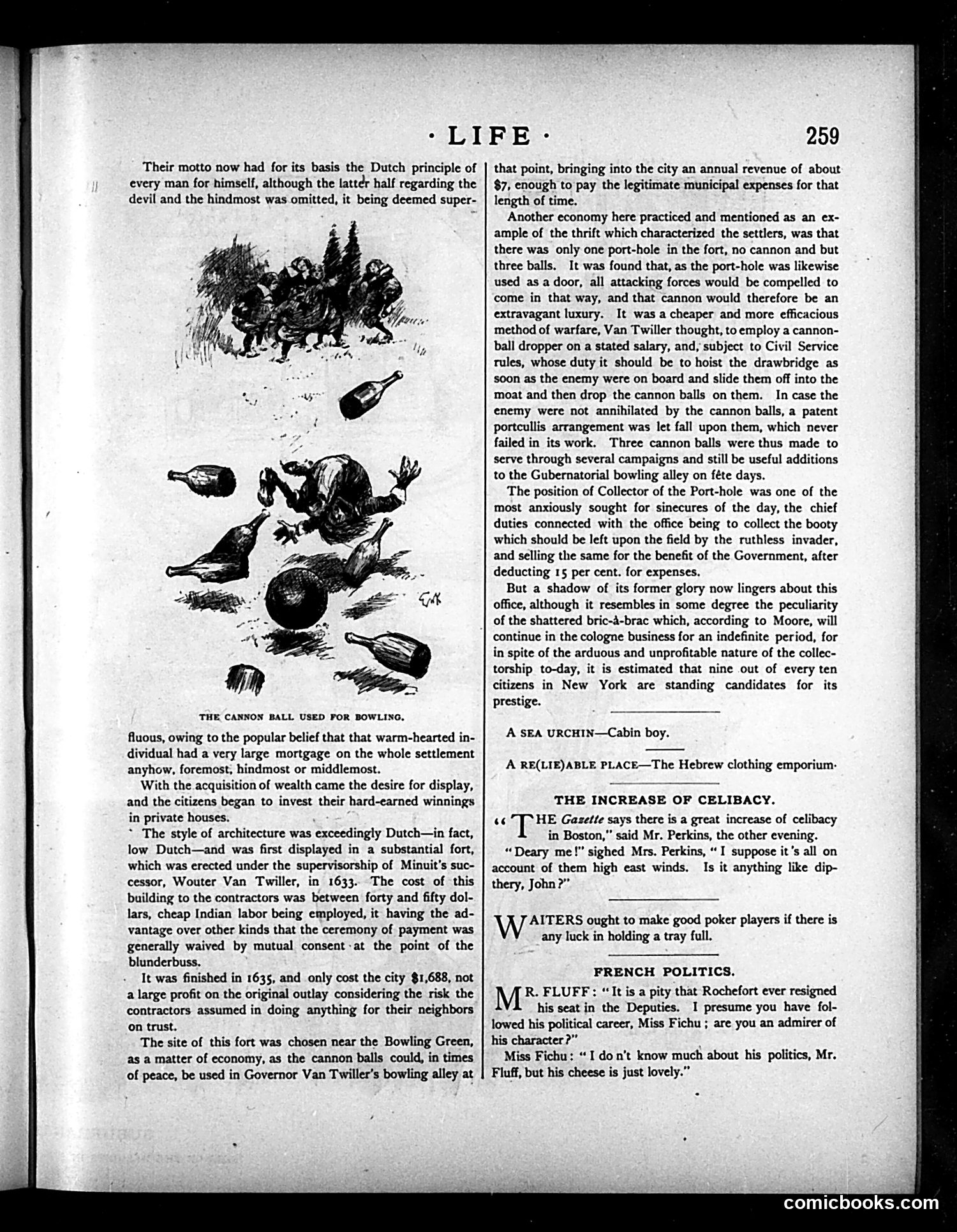
The page contains historical text about Dutch colonial New Amsterdam (early New York), describing Governor Van Twiller's fort and administrative practices. The illustration labeled "THE CANNON BALL USED FOR BOWLING" shows scattered objects—bottles, cannonballs, and debris—as a visual joke about the fort's dual-purpose efficiency: cannonballs served both military and recreational functions in the bowling alley. This satirizes Dutch pragmatism and thrift. Below are brief comedic anecdotes: "A Sea Urchin" (about cabin boys), "A Be(lie)able Place" (a pun on a Hebrew clothing store), and exchanges about celibacy in Boston and French politics. These items appear designed as light humor and historical interest rather than serious political satire—typical of Life's mixed-content approach to entertaining educated readers.
📄 Transcribed text from this page (OCR, searchable)
Machine-transcribed from the original scan — historical spelling and the odd misread are preserved.
- LIFE: Their motto now had for its basis the Dutch principle of every man for himself, although the latter half regarding the devil and the hindmost was omitted, it being deemed super- THE CANNON BALL USED FOR BOWLING, fluous, owing to the popular belief that that warm-hearted in- dividual had a very large mortgage on the whole settlement anyhow, foremost, hindmost or middlemost. With the acquisition of wealth came the desire for display, and the citizens began to invest their hard-earned winnings in private houses. ‘ ‘ * The style of architecture was exceedingly Dutch—in fact, low Dutch—and was first displayed in a substantial fort, which was erected under the supervisorship of Minuit’s suc- cessor, Wouter Van Twiller, in 1633. The cost of this building to the contractors was between forty and fifty dol- lars, cheap Indian labor being employed, it having the ad- vantage over other kinds that the ceremony of payment was generally waived by mutual consent-at the point of the blunderbuss. It was finished in 1635, and only cost the city $1,688, not a large profit on the original outlay considering the risk the contractors assumed in doing anything for their neighbors on trust. The site of this fort was chosen near the Bowling Green, as a matter of economy, as the cannon balls could, in times of peace, be used in Governor Van Twiller’s bowling alley at 259 that point, bringing into the city an annual revenue of about $7, enough to pay the legitimate municipal expenses for that length of time. Another economy here practiced and mentioned as an ex- ample of the thrift which characterized the settlers, was that there was only one port-hole in the fort, no cannon and but three balls. It was found that, as the port-hole was likewise used as a door, all attacking forces would be compelled to come in that way, and that cannon would therefore be an extravagant luxury. It was a cheaper and more efficacious method of warfare, Van Twiller thought, to employ a cannon- ball dropper on a stated salary, and, subject to Civil Service tules, whose duty it should be to hoist the drawbridge as soon as the enemy were on board and slide them off into the moat and then drop the cannon balls on them. In case the enemy were not annihilated by the cannon balls, a patent portcullis arrangement was let fall upon them, which never failed in its work. Three cannon balls were thus made to serve through several campaigns and still be useful additions to the Gubernatorial bowling alley on féte days. The position of Collector of the Port-hole was one of the most anxiously sought for sinecures of the day, the chief duties connected with the office being to collect the booty which should be left upon the field by the ruthless invader, and selling the same for the benefit of the Government, after deducting 15 per cent. for expenses, But a shadow of its former glory now lingers about this office, although it resembles in some degree the peculiarity of the shattered bric-A-brac which, according to Moore, will continue in the cologne business for an indefinite period, for in spite of the arduous and unprofitable nature of the collec- torship to-day, it is estimated that nine out of every ten citizens in New York are standing candidates for its prestige. A SEA URCHIN—Cabin boy. A RE(LIE)ABLE PLACE—The Hebrew clothing emporium- THE INCREASE OF CELIBACY. 66 HE Gasette says there is a great increase of celibacy in Boston,” said Mr. Perkins, the other evening. “Deary me!” sighed Mrs. Perkins, “I suppose it’s all on account of them high east winds. Is it anything like dip- thery, John?” AITERS ought to make good poker players if there is any luck in holding a tray full. FRENCH POLITICS. R. FLUFF: “It is a pity that Rochefort ever resigned his seat in the Deputies. I presume you have fol- lowed his political career, Miss Fichu ; are you an admirer of his character?” z Miss Fichu: “I don't know much about his politics, Mr. Fluff, but his cheese is just lovely.” comicbooks.com